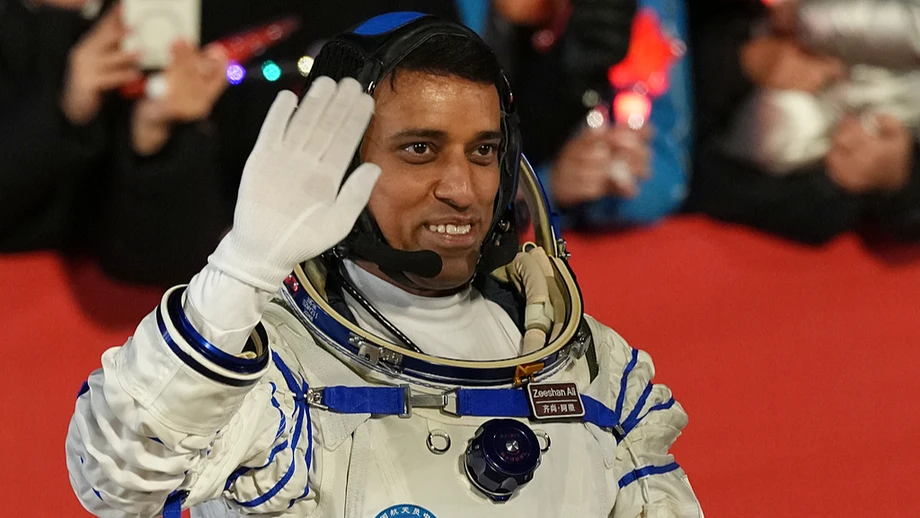
A Call From Orbit Turns a National Dream Into a Live Moment
Pakistan's prime minister and army chief did not have to wait for Muhammad Zeeshan Ali to come home to hear his first words from orbit. On Saturday, Prime Minister Shehbaz Sharif and Chief of Army Staff and Chief of Defence Forces Field Marshal Syed Asim Munir spoke by live video with Ali, who is aboard China's Tiangong space station on the Shenzhou-24 mission. The China Manned Space Agency said the call took place at the headquarters of Pakistan's Space and Upper Atmosphere Research Commission in Islamabad.
Contents
- A Call From Orbit Turns a National Dream Into a Live Moment
- What the Leaders Heard From Tiangong
- A Timeline From Agreement to Docking
- Who Is Muhammad Zeeshan Ali?
- What Ali Is Doing as a Payload Specialist
- The Four Pakistani Experiments Explained
- How Tiangong Fits Into a Bigger Space Race
- A Celebration in Islamabad, and on Video
- Why the Mission Carries Political Weight
- How India Is Reading the Flight
- What Happens Before Ali Comes Home
- Key Points
Ali told the leaders he was about 400 kilometres above Earth and travelling at 7.9 kilometres per second. That means the station circles the planet so quickly that its crew sees a sunrise or sunset about every 90 minutes. The exchange turned a technical space mission into a moment shared by families, students and officials across Pakistan.
Deputy Prime Minister Ishaq Dar, Information Minister Attaullah Tarar and the Chinese ambassador were also present at the space agency. The chairman of Pakistan's space agency said steady support from Pakistan's civilian and military leadership had made the achievement possible.
What the Leaders Heard From Tiangong
Prime Minister Shehbaz Sharif spoke from the space agency headquarters and told Ali that the day belonged to every Pakistani. He said the flight marked the beginning of Pakistan's human spaceflight programme and that the experience Ali brings home would open a new chapter in science and technology.
"Zeeshan (Ali), it is a great day for all of us sitting here and 240 million people of Pakistan," Sharif said in televised remarks, as Ali stood aboard the station with a Pakistani flag on his chest.
Sharif also said the mission showed Pakistan's belief that outer space should be used for peaceful purposes and for the welfare of humanity. He noted that the flight came in the year Pakistan and China mark 75 years of diplomatic relations, thanked Chinese President Xi Jinping and said Beijing's decision to make Pakistan its first foreign space partner would be remembered by Pakistanis.
Field Marshal Munir, one of Pakistan's most senior military leaders, congratulated Ali and said the armed forces were proud that one of their own had reached space. He linked the flight to the strategic partnership between Pakistan and China.
"We are really proud of you and proud of the armed forces that one of us has gone into space and achieved this great accomplishment," Munir said.
Ali, a pilot serving as a payload specialist, answered from the station that the work was going as planned. A payload specialist is a crew member whose main job is to operate experiments and research equipment, rather than command the spacecraft.
"Everything is going very well over here and according to the plan, and I'm doing my best to perform my duties and the scientific research work as per the expectations of the entire nation," Ali said.
Ali urged young Pakistanis to study science and technology. He said he expected a next generation of astronauts, engineers and scientists to travel farther and use exploration for the good of humanity.
A Timeline From Agreement to Docking
The flight was built over months of planning, training and diplomatic agreement. These are the dates that matter most.
- February 2025: Pakistan and China signed an agreement to select and train Pakistani astronauts for a mission to the Chinese space station.
- April 2026: Ali and fellow pilot Khurram Daud, also written Khurram Dawood, went to China for training after screening rounds. Daud became the backup.
- November 25, 2026: Shenzhou-24 lifted off from the Jiuquan Satellite Launch Center in northwestern China at 8:18 a.m. Beijing time (5:18 a.m. in Pakistan) on a Long March 2F Y24 rocket. Its crew was Chinese commander Tang Hongbo, flight engineer Wu Yi and Ali. A departure ceremony was held before launch.
- November 25, 2026: The spacecraft docked with Tiangong's forward port at 03:56 UTC, or 11:56 a.m. Beijing time and 8:56 a.m. in Pakistan, about three hours and 38 minutes after liftoff. The China Manned Space Agency called the launch a complete success and said the crew was in good condition.
- November 25 to 28: The Islamabad exhibition Kehkashan: Mission Control Center ran at the Pakistan-China Friendship Center.
- November 27: Video surfaced showing Ali taking part in research work aboard Tiangong with his Chinese colleagues.
- November 28: Ali spoke with Sharif and Munir, and the Shenzhou-23 and Shenzhou-24 crews held a handover in orbit.
The crew entered Tiangong after docking and was welcomed by the Shenzhou-23 crew. A group photo of the two crews was taken after the spacecraft reached the station, capturing the moment when a partnership planned over many months became a visible handover in orbit. Shenzhou-24 was the 41st flight mission of China's crewed space programme.
Who Is Muhammad Zeeshan Ali?
Ali is 40 years old, a former Pakistan Air Force pilot and the first Pakistani to reach orbit. He is also the first foreign astronaut to board Tiangong and the first international astronaut to enter China's space station. Those titles matter because orbit is different from a brief flight to the edge of space. A spacecraft in orbit keeps circling Earth; a suborbital flight rises high and then falls back within minutes. Pakistani adventurer Namira Salim paid for a Virgin Galactic flight in 2023 that lasted only a few minutes. Ali's mission reached orbit and is expected to last days.
Pakistan and China agreed in February 2025 to train Pakistani candidates. Ali and Khurram Daud were selected after three rounds of screening and assessment, then spent seven months at the Astronaut Centre of China in Beijing. Their preparation covered spacecraft systems, space station operations, scientific procedures, emergency response and training in the Chinese language.
Ali's training also included Chinese songs, poetry, calligraphy and table tennis, details that show how much of astronaut work is about teamwork and communication. Before launch, he recited a verse by national poet Allama Iqbal and said he was carrying the hopes of 240 million Pakistanis. A Chinese astronaut who worked with him for years praised his dedication and said the long collaboration helped them understand each other. Pakistan has said Daud trained as the backup and would be ready if needed.
What Ali Is Doing as a Payload Specialist
Ali's job aboard Shenzhou-24 is to work with the science carried by the mission. As a payload specialist, he helps install samples, set up equipment and run tests in a place where gravity is greatly reduced. This condition of near weightlessness is called microgravity, and it lets scientists see how materials and living things behave in ways that are hard to observe on Earth.
Video circulated on November 27 showed Ali working with Chinese colleagues on research and scientific activities inside Tiangong. The full Shenzhou-24 crew is scheduled to carry out more than 90 experiments and technology tests. Four of those projects come from Pakistani universities and were selected from more than 300 proposals sent to Pakistan's space agency.
SUPARCO officials said Ali's work includes experiments with biological materials and technologies for future space applications. The research is tied to practical needs such as food production, advanced materials and keeping people healthy away from Earth. SUPARCO put the stay at five to 10 days, while mission details have also described the visit as about one week or up to 10 days.
The Four Pakistani Experiments Explained
Pakistan's scientific contribution has a shortlist of four projects. Their names sound like science fiction, but each asks a practical question about how people could live and build safely in space.
- Hybrid Composite Shield: Researchers are studying composite materials made with graphene, a very light form of carbon, that could protect spacecraft from radiation, or particles with high energy that can damage materials and living cells.
- Self-Healing in Space: This project looks at carbon fibre composites that can repair tiny cracks, much as a road surface might seal small gaps before they grow.
- Quinoa Beyond Earth: The mission studies how microgravity and cosmic radiation affect quinoa seeds, including their survival, genetic traits and food value.
- Green Life Beyond Earth: Scientists are examining microalgae and cyanobacteria, tiny organisms that could one day help make oxygen, remove carbon dioxide and add food options for long journeys.
Taken together, the projects connect materials science with biology. That mix shows Pakistan's first astronaut as both a symbol in uniform and a worker in a flying laboratory. He is expected to install samples and help run the experiments selected under the Pakistan and China space research programme.
How Tiangong Fits Into a Bigger Space Race
Tiangong means Celestial Palace in Chinese. China completed the station in 2022, and it has been fully operational since late 2022. During crew changes, the station can host up to six astronauts at once. China has also selected research projects involving institutions from 17 countries in partnership with the United Nations.
Ali's stay is much shorter than the usual Chinese rotation, which lasts about six months. He is arriving as Shenzhou-23 commander Zhu Yangzhu remains behind for a stay lasting one year to study how the human body copes in space. By the time Zhu leaves, he will hold the record for the longest single stay in orbit by a Chinese astronaut.
The mission arrives as countries look toward the Moon. China's Chang'e-7 lunar mission was delayed after it failed to meet launch conditions because of bad weather linked to a tropical storm. China still aims to land people on the Moon by 2030 and to build a research base with Russia by 2035. The United States has a target of returning humans to the Moon in 2028. NASA is also planning for the International Space Station to retire around 2030, which makes Tiangong a more important place for international research.
A Celebration in Islamabad, and on Video
While Ali worked in orbit, Islamabad opened its doors to the public. The exhibition running for four days, Kehkashan: Mission Control Center, ran from November 25 to 28 at the Pakistan-China Friendship Center. Pakistan's Ministry of Information and Broadcasting organised it, with a temporary planetarium, virtual reality experiences, telescope observation and activities for visitors.
Zainab Arshad, a postgraduate physics student at the National University of Sciences and Technology, said she felt overwhelmed and proud when she learned about Ali's mission. She said the planetarium made her feel as though she had stepped into a dream she had long imagined.
"For us as Pakistanis, this is a historic moment. His dream has now become our dream," Arshad said.
Sidra Mumtaz, 21, an undergraduate at the International Islamic University Islamabad, said young Pakistanis felt pride when Ali spoke about carrying the country's name. She hoped more students would get the same chance. Mergim Tifeki, 26, an Austrian visitor, said he learned about the exhibition from a social media post and came with friends to see how another country was joining a Chinese mission.
Muhammad Waleed Khan, an official with Pakistan's Ministry of Information and Broadcasting, praised China's space technology and said Pakistan could learn from China's experience. He said the partnership had moved from traditional areas into science, technology and space exploration, giving students and researchers a new path to follow.
Why the Mission Carries Political Weight
For Pakistan, the call was also a statement about friendship with China. Sharif said in a post on X that the flight was the journey of 240 million Pakistanis and living proof of the bond between the two countries. He thanked SUPARCO, universities, scientists, the armed forces and Chinese President Xi Jinping. His message described Pakistan and China's partnership as rising beyond the Himalayas in its journey to outer space.
Planning Minister Ahsan Iqbal, who attended the departure ceremony in China, said the mission grew from years of cooperation under the China-Pakistan Economic Corridor. He said he had proposed sending a Pakistani astronaut in 2017 and 2018, called the launch a beginning rather than an end and said he hoped it could lead to further projects, possibly even a joint lunar mission.
"From highways to information superhighways, and now to skyways, Pakistan-China friendship and CPEC are rising even higher than the skies," Iqbal said.
President Asif Ali Zardari called the flight a landmark achievement and quoted national poet Allama Iqbal's line about there being more worlds beyond the stars. Information Minister Attaullah Tarar posted a photograph and wrote about worlds beyond the stars and the future of Pakistan-China friendship. Munir described Pakistan and China's friendship with familiar words, saying it was higher than the Himalayas, deeper than the oceans and sweeter than honey, and now as boundless as the universe.
How India Is Reading the Flight
The mission drew attention in India because it places Pakistan inside a Chinese human spaceflight project at a time of wider competition in space. Indian television commentary called the flight a major diplomatic signal and pointed out the contrast between Ali's visit of about one week and the roughly six months Chinese astronauts usually spend at the station.
Retired Brigadier Anshuman Narang, an expert on Chinese affairs, wrote that years of poetic descriptions of Pakistan and China's friendship had now moved from Earth into space. Journalist Rahul Shivshankar said in a social media post that the mission carried a deep strategic message for India. Pawan Khera, a Congress party spokesperson, said China usually keeps advanced technology close, described Pakistan's inclusion as a major departure from that approach and noted that Pakistan hosts an Asia-Pacific Space Cooperation Organization observation station alongside Iran and Peru.
A claim citing satellite tracking work by Digantara said a satellite network involving China and Pakistan keeps round the clock watch over Indian territory. That claim was part of a wider debate about technology with two uses, since navigation, communication and surveillance systems can serve both civilian and security needs. The discussion also came as scientists and employees at India's space agency sought written clarification about possible privatisation and the transfer of operations that build rockets.
Social media users compared the flight with India's 1984 spaceflight and with the Gaganyaan mission planned for 2027 and 2028. Some said Pakistan had not built its own human spaceflight programme; others said China's decision to share access to Tiangong was the main story.
What Happens Before Ali Comes Home
The Shenzhou-23 and Shenzhou-24 crews held a handover in orbit on Saturday, with the outgoing crew passing the space station keys to the incoming crew, according to the China Manned Space Agency. Under the mission plan, Ali will return to Earth aboard Shenzhou-23 with Zhang Zhiyuan, who will command the return mission, and Li Jiaying, also known as Lai Ka-ying in Cantonese.
The three had completed their scheduled tasks by the time of the call. Their return spacecraft is expected to land at the Dongfeng landing site in Inner Mongolia Autonomous Region. No landing date was given; the return was expected in the coming days. Officials said the returning crew would bring back a mysterious gift from the space station, and the landing site and support systems were making preparations.
Zhu Yangzhu will remain with Tang Hongbo and Wu Yi for the rest of the Shenzhou-24 mission. Ali's return will close a short but closely watched visit that gave Pakistan its first experience of crewed spaceflight. Pakistan's cooperation with China is expected to continue in other areas, including a rover built in Pakistan planned for a Chinese lunar mission around 2028.
Key Points
- Shehbaz Sharif and Field Marshal Syed Asim Munir spoke by live video with Ali at SUPARCO headquarters on Saturday.
- Ali is Pakistan's first astronaut, the first Pakistani to reach orbit and the first foreign astronaut to board Tiangong.
- Shenzhou-24 launched on November 25 from Jiuquan and docked with Tiangong about three hours and 38 minutes later.
- Ali is a payload specialist working on Pakistani experiments in materials science and biology.
- Four Pakistani projects were selected from more than 300 proposals.
- SUPARCO put the stay at five to 10 days, while other mission details described about one week or up to 10 days.
- Ali will return aboard Shenzhou-23, while Zhu Yangzhu remains for a stay lasting one year.
- The mission coincided with 75 years of diplomatic relations between Pakistan and China and drew strategic commentary in India.