The Price Put on Public Buying
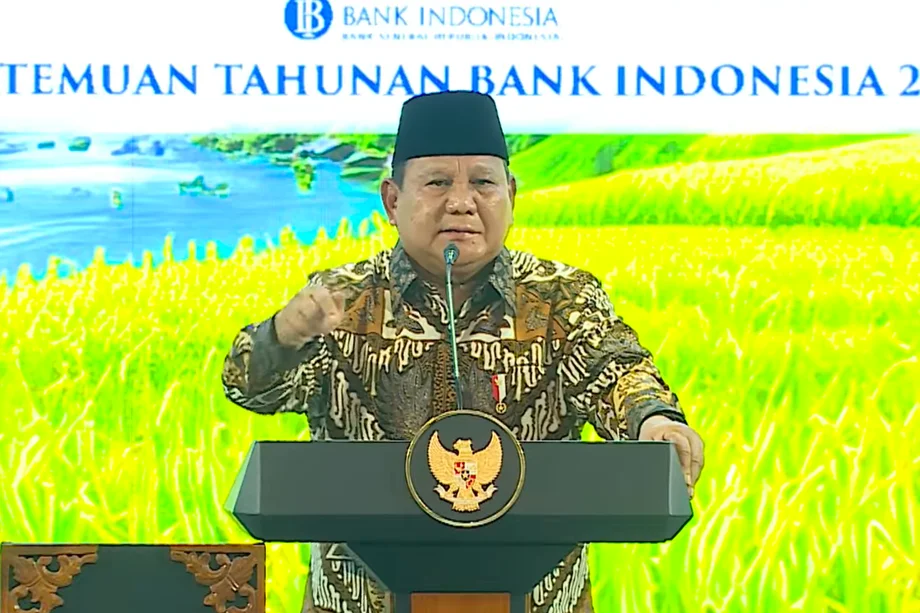
President Prabowo Subianto put a number on what he says Indonesia loses each year through waste and inflated prices in government purchasing: as much as US$21 billion. He spoke at the 2026 Bank Indonesia Annual Meeting at Grha Bhasvara Icchana in the Bank Indonesia headquarters complex in Jakarta on Friday night, November 27. The forum carried the theme Sinergi Menuju Indonesia yang Lebih Kuat dan Berdaya Tahan, or synergy toward a stronger and more resilient Indonesia.
Contents
- The Price Put on Public Buying
- What the President Wants Built
- Why One Drug Can Have 15 Prices
- How the US$21 Billion Figure Was Reached
- A Warning Delivered to Law Enforcement
- The Constitution Behind the Argument
- What Changes for Hospitals, Agencies and Taxpayers
- Bank Indonesia's Role in the Room
- How This Compares With the November 11 Speech
- What Remains Unclear
- Key Points
The president said purchases of goods and services take about 30 percent of the State Budget, known in Indonesia as the APBN. The APBN is the annual national budget. He put that spending at roughly US$70 billion a year. If 30 percent leaked away through inefficiency and price markups, he calculated, the state would lose about US$20 billion to US$21 billion annually.
A markup is an inflated price added to a purchase. In government buying, it can appear when an agency pays more than the market price for the same medicine, computer or piece of equipment, and the extra amount is shared or kept by people inside the process. Prabowo called such markups theft from the public and said his administration would treat them as corruption.
What the President Wants Built
Prabowo said the scale of spending requires a single institution able to set order over goods and services procurement. Procurement means the full process of buying what the government needs, from choosing suppliers to agreeing prices and signing contracts. At present, he said, no one institution determines how much agencies and regional governments spend on those purchases.
He turned to State Secretary Minister Prasetyo Hadi and asked how soon such a body could be formed. Prasetyo answered that he was ready, according to the exchange at the meeting. President Prabowo Subianto, speaking as head of state, made clear that he wanted the work to start quickly. He said:
Pak Menteri Sekretaris Negara, dalam waktu kapan ini kita bisa bentuk lembaga tersebut? Sudah siap?
The plan would shift buying away from a system in which ministries, agencies, provinces, regencies and cities make many separate decisions. A central body could compare prices, set common standards and use the government's buying power to seek better deals. Those are the practical goals implied by the president's call for order, rational spending and reasonable price standards.
Why One Drug Can Have 15 Prices
Regional hospitals were Prabowo's clearest example. Each hospital may buy its own medicines and medical equipment. When dozens of buyers negotiate alone, the same drug can end up with different prices across hospitals, even if the product and the needed quantity are similar.
President Prabowo Subianto, speaking as president, described that pattern and ordered it stopped. He said:
Rumah sakit daerah beli obat dan alat sendiri-sendiri, sehingga satu obat bisa ada 15 harga. Ini harus kita tertibkan. Ini harus kita rasionalisasikan dalam waktu yang sesingkat-singkatnya
For a patient, the difference may look like a hospital budget problem far from daily life. In practice, a higher price for a common drug uses money that could buy more doses, better equipment or other services. The same logic applies to buses, fire engines, computers and office supplies when every agency buys alone rather than against a shared price benchmark.
How the US$21 Billion Figure Was Reached
The calculation is simple. Prabowo starts with about 30 percent of the APBN for goods and services, which he equates to about US$70 billion. He then applies a 30 percent leakage rate: 30 percent of US$70 billion equals US$21 billion. In his speech, he also described the recoverable amount as about US$20 billion in cash if government spending is done properly.
The rupiah figures used around the event reflect different exchange rates. One version puts US$21 billion at Rp367 trillion. Another uses Rp18,300 per dollar and gives about Rp384 trillion. Another uses Rp18,390 per dollar, puts US$70 billion at Rp1,287 trillion and gives Rp386.10 trillion for US$21 billion. The goods and services pool was also described as about Rp1,200 trillion.
Those amounts are the president's estimates. The speech did not include a purchase by purchase breakdown showing how leakage was measured or when savings would arrive. The number matters because it sets the scale of the policy debate: even a part of that amount would be large compared with many annual programs.
A Warning Delivered to Law Enforcement
Prabowo directed part of the speech at the National Police chief, the attorney general and the chairman of the Corruption Eradication Commission, known as KPK, who were in attendance. He wanted them to hear price markups as a criminal issue, not a routine purchasing problem. At one point he asked whether the National Police chief and attorney general were present.
President Prabowo Subianto, speaking as head of state to those law enforcement leaders, called inflation in procurement corruption and theft from citizens. He said:
Bocor, markup. Markup adalah korupsi. Markup, mencuri dari rakyat
In English, his warning was that leakage and markups are corruption and steal from the people. He also said that some officials and influential figures were still thinking about ways to deceive the state.
The message links procurement reform to enforcement. If the new body sets price standards and identifies unusual purchases, investigators could use those records to look for inflated contracts. The president did not announce a specific case, raid or investigation at the meeting.
The Constitution Behind the Argument
Prabowo anchored his policy direction in Articles 33 and 34 of the 1945 Constitution. Those articles concern the management of the national economy and the use of resources for public welfare. In his framing, fixing procurement is not only an accounting exercise. It is a way to make state money serve the people more directly.
He told the audience that Indonesia should not see itself as short of money. President Prabowo Subianto, speaking as president, argued that the country has the funds if they are managed well. He said:
Kita bukan negara miskin, kita negara kaya, uang ada di depan kita
He added that proper procurement could produce what he described as an overnight windfall of about US$20 billion in cash. That phrase captures the political appeal of the plan: instead of raising taxes or borrowing more, the government would try to free money already inside the budget. He said recovered funds could help accelerate national development.
What Changes for Hospitals, Agencies and Taxpayers
A central purchasing system would change daily work in many offices. A regional hospital would no longer have to build its own price information from scratch for every drug or device. A procurement body could publish benchmark prices, combine orders and ask suppliers to compete on a more level field. A benchmark price is a reference cost based on market rates or earlier purchases.
For taxpayers, the hoped for change is straightforward. Money saved on overpriced goods could remain available for public services, infrastructure and other spending. Prabowo described the issue as both a challenge and an opportunity, because the same budget that currently leaks could become a source of savings.
The reform would also affect suppliers. Companies selling to ministries and local governments could face tighter price comparisons and more common rules. That can lower costs for the state, while also changing how companies win contracts and how quickly they are paid. Prabowo did not say how small and local suppliers would be treated under the planned institution.
Bank Indonesia's Role in the Room
The speech came at an annual meeting hosted by the central bank, a forum focused on economic stability and policy coordination. Bank Indonesia Governor Destry Damayanti said the central bank would keep working to protect national stability as external pressure stays high. She described a policy mix coordinated with the government, the Financial System Stability Committee, known as KSSK, and other parties.
A policy mix means using several tools together instead of relying on one lever. For Bank Indonesia, that can include interest rate decisions and coordination with fiscal policy, which covers government spending and taxation. Prabowo's procurement plan belongs on the fiscal side because it concerns how the state spends money.
The setting helps explain why the president used the forum to discuss the budget. Currency stability, inflation and public spending are linked. If the government can reduce waste without cutting services, it gains room to spend while keeping pressure on prices lower than it would be if it simply injected new money into the economy.
How This Compares With the November 11 Speech
Prabowo had raised the same subject 16 days earlier. At NasDem Tower in Jakarta on November 11, 2026, he said Indonesia could save about Rp480 trillion a year, nearly US$30 billion by his estimate, by changing government purchasing. He attributed that figure to Sarah Sadiqa, head of the National Public Procurement Agency, known as LKPP.
The two speeches used different rates. The November calculation applied 40 percent waste to about Rp1,200 trillion in annual purchases. The November 27 calculation applied 30 percent leakage to about US$70 billion. On the same Rp1,200 trillion base, 40 percent equals Rp480 trillion, while the newer speech put the loss at US$20 billion to US$21 billion.
The earlier speech also pointed to work already under way. LKPP had reported Rp14.10 trillion in savings from a defined group of consolidated purchases in 2025, and officials were preparing plans to turn the agency into a Government Procurement Agency with a broader role. Friday's speech went further by asking the State Secretary to prepare a new institution.
- November 11, 2026: Prabowo used a 40 percent waste assumption and a Rp480 trillion savings estimate.
- November 27, 2026: At the Bank Indonesia Annual Meeting, he used a 30 percent leakage rate and a US$20 billion to US$21 billion estimate.
- After the speech: State Secretary Minister Prasetyo Hadi was asked to prepare the new institution.
That sequence is visible in the earlier Rp480 trillion savings claim, which framed procurement as a management opportunity. The new speech adds a sharper corruption warning and a direct instruction to the State Secretary.
What Remains Unclear
The president did not announce a decree, draft law, timetable, budget or legal structure for the new institution. He did not say whether it would replace LKPP, sit inside the State Secretariat or operate as an independent agency. Prasetyo's readiness answer showed political agreement in principle, but the powers of the body were not set out at the meeting.
Several practical questions remain open. They include which purchases would be covered, whether regional governments must follow national prices and how exceptions would be handled. No date was given for the next formal step.
Law enforcement also heard a broad instruction rather than a named operation. Prabowo called for action against markups, but he did not identify companies, contracts or agencies under investigation. The next test will be whether a proposed institution turns the speech into rules that procurement officers can apply.
Key Points
- Prabowo estimated that Indonesia could lose US$20 billion to US$21 billion a year through procurement leakage and price markups.
- He said goods and services spending takes about 30 percent of the APBN, roughly US$70 billion a year.
- He asked State Secretary Minister Prasetyo Hadi to prepare a new institution to regulate government procurement, and Prasetyo said he was ready.
- Regional hospitals buying medicines separately gave the president's example of one drug having 15 prices.
- He called markups corruption and theft from the public, speaking directly to police, prosecutorial and KPK leaders.
- Rupiah figures cited around the speech ranged from Rp367 trillion to Rp386.10 trillion for the estimated loss, depending on the conversion used.
- The earlier Rp480 trillion savings claim used a 40 percent waste rate, while the new speech used 30 percent.
- No timetable, legal structure or detailed list of purchases was announced.