A Stone, a Pact and an Election
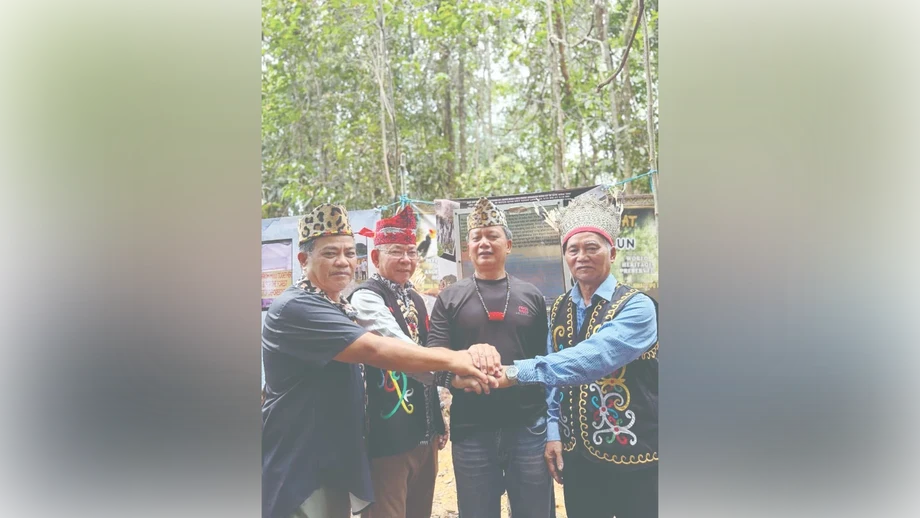
Leaders of three Indigenous groups in the Baram constituency of northern Sarawak have set a memorial stone into the ground at Baa Besanan, near the boundary of Mulu National Park, to record a unity pact against logging and plantation companies. The four who signed it are Berawan elder Willie Kajan, Sarawak Penan Keruan Association head Komeok Joe, Tering Association chief Jonathan Ngang and Mulu Penan elder Ukau Lupong.
Contents
- A Stone, a Pact and an Election
- Why the Pact Points at the Ruling Party
- Sabah's Forest Estate, by the Numbers
- A Small Reserve Where Customary Harvest Is Legal
- Across the Border, a Concession Inside a Biosphere Reserve
- 1,376 Hectares in Eight Months
- Villages That Say They Were Never Asked
- A Court Ruling, and the Paperwork That Follows
- Buyers Begin to Step Back
- Who the Dayak Are, and What Is at Stake
- Key Points
The site was chosen for its history. In the late 2000s, Penan, Berawan and Tering communities mounted a series of human blockades at Baa Besanan against a timber company based in Miri, and the blockades forced the firm to withdraw from forests near Mulu where it had been felling trees. The four leaders want the same result across the rest of Baram, where thousands of Penan, Tering and Berawan people live in settlements scattered through the jungle.
Their statement lands in the middle of a state election campaign. Nomination day for the 13th Sarawak election is set for November 28, with balloting on December 12 in 82 state constituencies. Sitting assembly members and candidates have begun touring their seats, and the four leaders have invited them to come to Baram and explain why logging and plantation concessions keep being extended there.
Willie Kajan framed the invitation as a direct challenge to anyone seeking office.
We want the politicians who are making their election rounds to come visit us and explain to our communities why they are continuing to extend concessions to logging and plantation firms in Baram. We want these politicians to support our unity pact.
The statement sets no deadline for an answer from Gabungan Parti Sarawak, the coalition that governs the state, and it names no company.
Why the Pact Points at the Ruling Party
Kajan said concessions issued by the state government are still opening forests to felling at a pace that alarms the people living in them. He works as a jungle tour guide and said his trips into the interior have taken him repeatedly through land where clearing is under way.
Many locations of forests are still being chopped down at a worrying rate by logging giants because the state government continues to extend the concession permits.
He also aimed at the state's messaging on the environment, arguing that conditions on the ground differ from the picture presented by politicians who describe Sarawak as a green economy. He tied the clearing to worsening climate effects in Sarawak and Borneo, and said the hardship falls hardest on communities whose food, water and incomes come from the forest.
These are contributing to the climate deterioration we are seeing in Sarawak nowadays. The state politicians go around claiming that they are championing a green economy.
Kajan described the forests of Baram as the ancestral territory of the Penan, among the earliest inhabitants of Sarawak, and said the pact is meant to hold the communities together as a single voice in their dealings with the state.
Sabah's Forest Estate, by the Numbers
Across the border in Malaysian Borneo, the state of Sabah keeps one of the region's most detailed public ledgers of what its forests are for. The Sabah Forestry Department's forest resources data records 3,574,468 hectares of gazetted forest reserve, about 48.6% of the state's total landmass, spread over 333 reserves sorted into seven functional classes. The same page notes that in 2021 no new forest reserve was gazetted, removed from the estate or moved to a different class.
Sabah's Totally Protected Areas cover roughly 1,942,397 hectares, or 26.4% of the state's land. Those areas bring together forest reserves gazetted for conservation under the Forest Enactment 1968 and forested land held under the Sabah Parks and Sabah Wildlife Department enactments. The forestry department manages about 26% of that protected estate.
Total forested area in Sabah is put at about 4,679,594 hectares. Of that, 3,848,597 hectares sit inside forest reserves and other forest land, and 830,997 hectares lie on state land and alienated land. The distinction matters for communities: a reserve carries rules written into law, while land outside it follows a different set of decisions.
A Small Reserve Where Customary Harvest Is Legal
Among Sabah's seven classes, one exists specifically for village use. The Class 3 Domestic Forest Reserve covers 4,634 hectares, and its products are meant for local consumption, with commercial use discouraged. Fruits, rattan, medicinal plants and damar may be taken from it with permission from the department. Damar is a resin tapped from forest trees and long used for varnish, incense and boat repair.
The remaining classes are larger and more tightly controlled. Class 1 Protection Forest Reserve, at 1,473,251 hectares, exists to shelter watersheds, soil and climate, and timber harvesting is not permitted there. Class 2 Commercial Forest Reserve, at 1,570,546 hectares, is allocated for harvesting to feed the timber trade, carried out under Sustainable Forest Management principles, meaning cutting is planned so the forest can regrow. Class 5 Mangrove Forest Reserve, at 234,383 hectares, supplies mangrove timber for fishing stakes, firewood and charcoal. Class 6 Virgin Forest Reserve, at 124,730 hectares, is kept for research and genetic conservation, and Class 7 Wildlife Forest Reserve, at 139,700 hectares, for wildlife protection and study.
The department's page also carries a second set of class figures, in which Class 1 stands at 1,421,717 hectares, Class 2 at 1,655,483 hectares, Class 5 at 234,680 hectares, Class 6 at 107,048 hectares and Class 7 at 139,503 hectares, while Class 3 stays at 4,634 hectares. Either way, the area set aside for village harvest is a small fraction of a forest estate that runs into millions of hectares.
Across the Border, a Concession Inside a Biosphere Reserve
In Indonesian Borneo, the pressure on forest communities takes a different shape. A palm oil company called PT Equator Sumber Rezeki (ESR), a subsidiary of the Jakarta-based First Borneo Group owned by tycoon Alexander Thaslim, holds a plantation concession of 15,000 hectares in Kapuas Hulu, a landlocked district deep in West Kalimantan near the Malaysian border. The concession overlaps part of the Labian-Leboyan watershed, a wildlife corridor that links Betung Kerihun and Danau Sentarum national parks, two of the last strongholds of the critically endangered Bornean orangutan.
The corridor and the parks form part of the Betung Kerihun-Danau Sentarum Biosphere Reserve, which UNESCO designated in 2018. Its forests hold hundreds of species of fish, birds and mammals, including hornbills and giant rafflesia flowers, and supply water, food and income to Dayak communities whose culture is bound to the land. The watershed covers 81,000 hectares and is home to an estimated 2,470 orangutans, according to figures compiled on the area.
On Indonesia's official land use maps the concession is not zoned as a forest area, which leaves it open to development as a plantation. Conservationists estimate that as much as 80% of the concession holds rainforest of high conservation value, and a study backed by the government in 2016 found orangutans in about a quarter of it.
1,376 Hectares in Eight Months
Satellite analysis of the concession shows how fast the clearing has moved. ESR cut 1,376 hectares of forest between January and August 2025, against 195 hectares in all of 2024, when its operations appear to have started. Around 3,000 hectares, roughly a fifth of the concession, have now been stripped of rainforest or other vegetation, which points to far more loss ahead.
- Late 2000s: Penan, Berawan and Tering communities blockade a timber company near Mulu, forcing it to retreat.
- 2012: Indonesia's Constitutional Court rules that customary forests belong to Indigenous communities, not the state.
- 2016: A study backed by the government finds orangutans in about a quarter of what is now ESR's concession.
- 2018: UNESCO designates the Betung Kerihun-Danau Sentarum Biosphere Reserve.
- 2024: ESR clears 195 hectares.
- January to August 2025: ESR clears 1,376 hectares.
- August 4 and September 25, 2025: Wilmar and Apical separately cut First Borneo fruit from their supply chains.
- November 28, 2026: Nomination day for the 13th Sarawak election.
- December 12, 2026: Sarawak ballots are cast in 82 constituencies.
Hilman Afif, a forest campaigner with the conservation group Auriga Nusantara, said the clearing so far is only a beginning.
What's happening in West Kalimantan indicates that palm oil deforestation will continue. ESR has only just begun clearing land, meaning the deforestation footprint is likely to expand far beyond what we're seeing today.
Villages That Say They Were Never Asked
Six villages sit inside or beside the concession. Two of them, Senunuk and Setulang, signed voluntary agreements allowing ESR to plant oil palm on parts of their territory. Banying, 62, an elder of a Dayak Iban community in Setulang, said the offer of 1 million rupiah (about $60) per hectare, or about $24 an acre, for usage rights lasting 30 years persuaded many neighbours, given how few jobs there are and how uncertain rice farming has become. He said the land handed over was smaller than what the company had asked for, and that a tract of 437 hectares is due to be cleared this year.
This year they plan to clear it with heavy equipment.
Banying said animals are already being pushed out of neighbouring Senunuk's territory and into Setulang, where they meet people more often.
Already we see bears often near houses. The small black bears eat fruits like rambutan and durian. Orangutans are also increasingly seen down the road.
Leaders of the other villages tell a different story. Robertus, head of the Ngaung Keruh hamlet in Labian village, said company officials first appeared in mid 2025 to ask permission to survey the forest, carrying papers showing that the village territory fell inside the operating zone of the plantation business permit, known in Indonesia as an IUP, issued by the district government.
The company brought institutional backing, and apparently they already had an Amdal, which said that Labian village territory was already demarcated and included in the company's land-use permit. Yet the company had never come to my hamlet. I was confused.
The Amdal is the environmental impact assessment a plantation developer must complete, and the HGU is the land use permit that follows. Bernadus Nandung, head of the Ukit-Ukit hamlet in Labian, said residents turned the officials away at once.
Before they even explained, the village leaders said any activity related to oil palm is not accepted here. We were afraid that if we signed anything, it would be misused.
Antonius Leo, 66, a temenggong, or customary leader, in Labian Ira'ang village, said nobody had ever told the community when its land was zoned for development.
It was never explained. That's why I'm angry.
Afif said the licensing steps that require a company to win landowner consent are often skipped in practice, leaving protected forest exposed to bulldozers.
We still see community conflicts, orangutan habitat destruction, and permits issued right next to national parks.
First Borneo, the Kapuas Hulu district government and Indonesia's Ministry of Forestry had not responded to requests for comment when the findings were published.
A Court Ruling, and the Paperwork That Follows
Labian villagers have spent years trying to secure government recognition of their territory. Indonesia's Constitutional Court ruled in 2012 that Indigenous peoples' customary forests are not state property and belong to the communities themselves. Recognition, though, depends on a process that runs through stacks of paperwork and lobbying at district and national level.
The gap between mapping and recognition is wide. Forestry Minister Raja Juli Antoni has put the area of customary forest formally recognised at about 332,500 hectares, against more than 23 million hectares mapped by the Ancestral Domain Registration Agency, known as BRWA, a body that records community land claims across the archipelago.
A similar documentation gap shapes the palm oil trade in Sarawak. About 58,000 Sarawak smallholders face exclusion from supply chains serving the European Union because they may struggle to document customary land rights, a risk raised by the Sarawak Dayak Oil Palm Planters Association and taken up by Works Minister Alexander Nanta Linggi, who has pressed for faster surveys and titles.
Buyers Begin to Step Back
Pressure has also come from the companies that buy the fruit. First Borneo's palm fruit was sold to mills belonging to the Sabeni Group, PT Samboja Inti Perkasa and PT Permata Subur Lestari. Wilmar and Apical, two of the largest processors in the trade, separately stopped sourcing from the group, with cut off dates of August 4 and September 25, 2025.
Afif argued that the location itself should have ruled out a plantation permit, because the government's own orangutan conservation strategy maps the Labian-Leboyan area as critical habitat, and because Indonesia has committed to making its forests a net carbon sink by 2030.
This calls into question the government's seriousness about orangutan protection.
Who the Dayak Are, and What Is at Stake
The Dayak are a grouping of more than 200 sub ethnic communities native to Borneo, living mainly in the Indonesian provinces of Kalimantan and in parts of Malaysia and Brunei. Many were traditionally animist and most are now Christian or Muslim, while keeping spiritual and cultural ties to the land. Longhouse dwellings, intricate tattoos and traditional dances remain markers of identity, and the communities have farmed, hunted and fished in the rainforest for generations.
The threats listed by Dayak organisations are consistent across the island: deforestation, mining, palm oil plantations and the loss of land. Because customary land rights are often not formally recognised by state authorities, disputes over ancestral territory end up in court or in certification systems. One such case saw the Roundtable on Sustainable Palm Oil order a company to stop clearing Indigenous territory in Muara Tae, in East Kalimantan.
Dayak groups have built alliances with non governmental organisations and with other Indigenous peoples to press land claims and oppose destructive projects, while younger Dayak have mixed traditional crafts, storytelling and rituals with digital media to reach new audiences. In Baram, the memorial stone at Baa Besanan puts that organising into a form the election campaign cannot easily ignore.
Key Points
- Penan, Berawan and Tering leaders signed a unity pact and placed a memorial stone at Baa Besanan near Mulu National Park.
- The signatories are Willie Kajan, Komeok Joe, Jonathan Ngang and Ukau Lupong.
- Sarawak votes on December 12, with nominations on November 28 across 82 constituencies.
- Sabah has 3,574,468 hectares of gazetted forest reserve, about 48.6% of its landmass, in 333 reserves under seven classes.
- Class 3 Domestic Forest Reserve covers just 4,634 hectares, where villagers may harvest fruit, rattan, medicinal plants and damar with permission.
- Sabah's Totally Protected Areas cover about 1,942,397 hectares, or 26.4% of the state.
- ESR, a First Borneo Group subsidiary owned by Alexander Thaslim, holds a 15,000 hectare concession in Kapuas Hulu, West Kalimantan.
- ESR cleared 1,376 hectares from January to August 2025, against 195 hectares in 2024, with about 3,000 hectares lost in total.
- Labian and Labian Ira'ang leaders say their land entered the permit area without their consent.
- About 332,500 hectares of customary forest is formally recognised, against more than 23 million hectares mapped by BRWA.