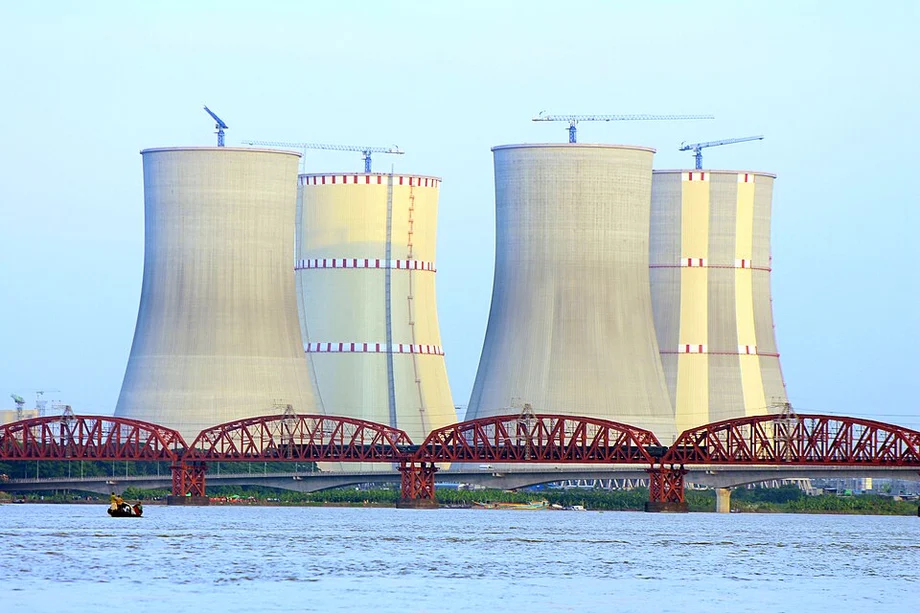
The last convoy closes a nine shipment fuel plan
At 5:48 am on Friday, 27 November 2026, three specialised lorries carrying uranium entered the Rooppur Nuclear Power Plant project area in Ishwardi, Pabna. Their arrival completed the scheduled import of nuclear fuel from Russia for Bangladesh's first nuclear power station, closing a delivery plan covering nine consignments and 211 fuel assemblies.
Contents
- The last convoy closes a nine shipment fuel plan
- What 211 assemblies mean for the two reactors
- The second grid test ran longer than planned
- Commercial supply still depends on tests and handover
- The dates behind the commissioning drive
- A US$12.65 billion project financed largely by Moscow
- Why 2,400 megawatts matters during an energy crunch
- The operating company faces a safety test of its own
- Rooppur within Asia's nuclear construction programme
- What to Know
The final consignment travelled under the supervision of the Bangladesh Army, with police and other law enforcement agencies protecting the convoy. Site official Ruhul Quddus Tutul said the vehicles were brought into the compound inside a tight security cordon. Rooppur stands beside the Padma River, about 160 kilometres northwest of Dhaka, and its two reactors are central to Bangladesh's plan for a new source of electricity.
The lorries had left Hazrat Shahjalal International Airport in Dhaka on Thursday night after the fuel arrived from Russia aboard specialised cargo aircraft. They travelled through the Jamuna Bridge, Banpara and Dashuria before reaching Ishwardi. Police guarded important highway junctions, while other security and intelligence personnel joined the escort. Heavy vehicles were temporarily prevented from using parts of the highway during the movement, reducing traffic around the convoy.
What 211 assemblies mean for the two reactors
Rosatom's delivery plan assigned 163 uranium assemblies to Unit 2, carried in seven cargo flights, and another 48 assemblies to Unit 1, carried in two flights for future refuelling. An October fuel delivery for Unit 2 illustrated the scale of the operation: that consignment weighed 41 tons and arrived in 12 containers before being taken to the plant on three trucks.
A fuel assembly is a structured bundle of rods containing nuclear fuel. Inside the reactor, controlled fission splits uranium atoms and releases heat. Rooppur's Russian designed VVER-1200 units use that heat to produce steam, which turns a turbine connected to an electricity generator. Each unit has a rated electrical capacity of 1,200 megawatts, giving the station a combined goal of 2,400 megawatts.
Unit 1 received its first uranium consignment on 29 September 2023, followed by four more deliveries that October and November. The additional 48 assemblies will support later refuelling, when part of the used fuel is replaced. Project officials expect roughly a quarter of the used fuel to be changed after about 18 months of operation. The December 2015 general contract covers the initial fuel loading and two reloads, with Russian deliveries included in the construction work through 2027. Project officials also describe Russia as supplying fuel for the first three years, after which Bangladesh will need to import replacement fuel at scheduled intervals.
The second grid test ran longer than planned
Unit 1 made its first grid connection at 3:16 pm on 17 November, in the presence of Science and Technology Minister Faqir Mahbub Anam. It supplied about 350 megawatts during the opening test and reached a maximum of 375 megawatts before its scheduled disconnection at 11:50 pm, more than eight and a half hours later. The initial 350 megawatts represented about 29% of the unit's 1,200 megawatt rating and nearly one seventh of the future station's 2,400 megawatt total.
A second round began at 10:20 am on 23 November. Project Director Dr Md Kabir Hossain said in a press release issued from Ishwardi that the plan was to supply between 300 and 350 megawatts for 10 to 24 hours. Engineers intended to examine the generation equipment and the unit's integrated operation with the national transmission system.
The test, conducted under the management of Nuclear Power Plant Company Bangladesh Limited (NPCBL), instead continued for nearly 30 hours, with Unit 1 feeding approximately 320 megawatts continuously into the grid. Supply stopped at 5:05 pm on Tuesday, 24 November. NPCBL valued electricity transmitted during the second round at about Tk7.06 crore, equivalent to Tk70.6 million. Project officials put electricity supplied across the first two rounds at roughly Tk9 crore, or Tk90 million.
Technical teams subsequently began analysing operating measurements, turbine and generator performance, and equipment efficiency recorded during the run. Their findings will determine the following operational steps. NPCBL Managing Director Dr Md Zahedul Hassan connected the achievement to the work of Bangladeshi personnel and their Russian partners:
Successfully connecting to the national grid for the second time and supplying 320 MW of electricity continuously for 30 hours is a matter of immense joy and pride for us. This reflects NPCBL's operational capability, the expertise of our engineers and operators, and our combined effort with Russian operational partners.
Hassan said NPCBL remained committed to safe, reliable and efficient operation, with nuclear safety, international standards and regulatory requirements guiding its work. He congratulated participants from the Ministry of Science and Technology, the Bangladesh Atomic Energy Commission, the Bangladesh Atomic Energy Regulatory Authority, Russian partner organisations and NPCBL.
Commercial supply still depends on tests and handover
Grid synchronisation requires the plant's generator to match the national network's electrical conditions, including voltage and frequency. Frequency describes the rhythm at which alternating current changes direction, so a generator joining the system must operate in step with it. Engineers also need to establish whether the turbine, generator, controls and transmission connections remain stable at different output levels.
Commercial generation is a later contractual stage. The Russian contractor is to supervise a trial operation lasting 10 months, after which Unit 1 can move gradually towards commercial supply at full capacity. The Bangladesh Atomic Energy Commission will then assume responsibility through a provisional takeover. A government gazette notification will subsequently formalise NPCBL's role as the operating organisation.
Minister Anam said the government hoped to raise Unit 1's output to between 1,100 and 1,200 megawatts by January. That generation target sits within the commissioning process, while the contractual handover follows the longer trial. No date was announced for the next grid test when the final fuel shipment arrived. Unit 2's construction and commissioning are continuing, but no commercial service date has been given for that unit.
The dates behind the commissioning drive
Rooppur's development stretches back to a 1961 plan in what was then East Pakistan. Rooppur village was selected in 1963, where 260 acres were acquired for a proposed 200 megawatt plant. Later studies examined capacities ranging from 125 to 600 megawatts. Bangladesh signed a memorandum with Rosatom in May 2009 and a framework agreement with Russia in May 2010, and parliament decided on 10 November 2010 to proceed with a nuclear power project.
- 25 December 2015: The Bangladesh Atomic Energy Commission and Rosatom signed the US$12.65 billion general contract for two VVER-1200 units.
- November 2017: Unit 1 construction began after its design and construction licence was issued on 4 November. The first concrete for Unit 2 followed on 14 July 2018.
- 29 September 2023: The first uranium consignment for Unit 1 arrived in Bangladesh, with further deliveries that October and November.
- Late 2025: An International Atomic Energy Agency safety review was successfully completed.
- 11 October 2026: Unit 1 achieved first criticality at 3:34 pm, beginning a controlled and self sustaining nuclear chain reaction. On 29 October, the Bangladesh Atomic Energy Regulatory Authority approved tests involving gradual increases in generating capacity.
- 17 November 2026: The unit synchronised with the national grid at 3:16 pm and completed its first trial supply.
- 23 and 24 November: The second trial supplied approximately 320 megawatts for nearly 30 hours.
- 27 November 2026: The ninth consignment completed the planned deliveries of 163 assemblies for Unit 2 and 48 additional assemblies for Unit 1.
First criticality and grid connection are separate commissioning milestones. Criticality establishes controlled nuclear heat production, initially at very low power. The subsequent Stage C commissioning work connects that nuclear process to the turbine, generator and grid through a sequence of approved tests.
A US$12.65 billion project financed largely by Moscow
The general contract uses an engineering, procurement and construction model. Rosatom's scope covers construction and installation, design documents, equipment and materials, commissioning, personnel training, initial nuclear fuel and two reloads. Its whole plant pricing structure means construction, commissioning and other tasks were not assigned separate public prices within that contract.
Russia is providing about US$11.38 billion of the US$12.65 billion contract value through an export credit, a share of almost 90%. The loan carries interest tied to the LIBOR benchmark, plus 1.75 percentage points, with a 4% cap. LIBOR is a reference interest rate historically used to price loans. Following a 26 February 2025 meeting between Chief Advisor Muhammad Yunus and Rosatom head Alexey Likhachev, the loan utilisation period was extended to the end of 2026.
The taka budget provides another measure of the project's changing cost. Its approved cost has risen by about Tk260 billion to Tk1.39 trillion, mainly because of movements in the dollar exchange rate. By June 2024, spending under the Revised Annual Development Programme for 2024 to 2025 had reached 73,746.06 crore taka, equivalent to approximately Tk737.46 billion.
Construction of Unit 1 began in November 2017 with an original operational target of December 2022. Technical work and safety inspections contributed to the delay. The broader project was originally scheduled for completion by December 2025, but its deadline has been extended twice and now runs to June 2028. For Bangladesh, the plant therefore brings both a new electricity source and a financial commitment to Moscow that will continue after generation begins.
Why 2,400 megawatts matters during an energy crunch
The first grid supply made Bangladesh the 33rd country to generate nuclear electricity. Rooppur is also the largest infrastructure investment in the country's history. Its two units are designed to diversify electricity production and reduce dependence on fossil fuels, while Rosatom subsidiary TVEL supplies the nuclear fuel and Russian specialists support the initial operating period.
The commissioning comes as the government of Tarique Rahman confronts rising energy prices linked to conflicts in the Middle East and reduced gas availability after a fire at one of Bangladesh's two regasification terminals. Such terminals turn liquefied natural gas back into gas that can be sent through pipelines. The fire has added to supply constraints and electricity cuts, increasing the value of a dependable domestic generating source.
Sama Bilbao y León, Director General of the World Nuclear Association, described the first electricity as the start of a much longer national asset:
Its first electricity marks the beginning of decades of reliable, clean power that can fuel economic growth, strengthen energy security and create prosperity opportunities for generations to come.
For consumers, the immediate contribution remains limited to test periods such as the 320 megawatt second run. The larger effect depends on Unit 1 completing its commissioning programme and Unit 2 finishing construction, testing and approval. At full capacity, their combined 2,400 megawatts would be eight times the approximately 300 megawatt level originally expected for early grid tests.
The operating company faces a safety test of its own
Writing on 25 November, Mohammad Shawkat Akbar, a former chairman of the Bangladesh Atomic Energy Commission, set out the institutional work required alongside the reactor tests. He said NPCBL carries responsibility for safety, security, safeguards and liabilities as the operating organisation, while the Bangladesh Atomic Energy Regulatory Authority must hold it directly accountable for compliance.
Akbar called for the site structure to follow the Novovoronezh-II reference plant in Russia and International Atomic Energy Agency guidance. A Station Director would handle administration, finance and external coordination. A Chief Superintendent would control plant operations and nuclear safety, including the authority to order an emergency reactor shutdown without pressure from administrative or commercial interests. Control room personnel, shift supervisors and specialist teams would staff each unit continuously.
The corporate structure in Dhaka also needs a Managing Director, Chief Nuclear Officer, independent directors and effective board committees. Akbar listed separate nuclear safety and nuclear security committees reporting directly to the board, stable funding for operations, radioactive waste and spent fuel management, nuclear liability coverage, transparent dealings with the regulator, reliable suppliers and a Power Purchase Agreement to support electricity sales to the grid.
His readiness framework extends beyond the plant fence. It includes a national body coordinating the nuclear energy programme, an independent regulator, expert technical support organisations and logistics for fuel, components and waste. He also called for probabilistic safety assessment, a method that examines combinations of equipment failures and human actions to estimate risks, together with monitoring of the site and reviews of vulnerability to climate change. Staff, he argued, need to report mistakes and near misses promptly so that safety concerns can be corrected before they grow.
Rooppur within Asia's nuclear construction programme
Approximately 55 reactors are under construction across Asia, most of them in China and India, according to the World Nuclear Association. Rosatom is building Turkey's four reactor Akkuyu plant, whose cost has exceeded US$20 billion and which is expected to supply about 10% of Turkish electricity demand when fully operational. Generation there is scheduled to begin in 2027. Uzbekistan started construction at Jizzakh in June 2026 with two small modular reactors and two larger units, while Kazakhstan has selected Rosatom for a plant in the Almaty region.
Vietnam's agreement with Russia on 23 March 2026 covers two VVER-1200 reactors at Ninh Thuan 1, reviving a programme suspended in 2016. Myanmar's military authorities signed an agreement with Moscow in March 2025 for a small plant using Russian modular reactors. Other countries are working with different suppliers: China National Nuclear Corporation is building Pakistan's Chashma 5 under a US$4.8 billion agreement signed in 2023, South Korea has four reactors under construction through its domestic industry, and Japan's two listed projects remain suspended following the Fukushima accident.
What to Know
- The ninth and final uranium consignment reached Rooppur at 5:48 am on 27 November 2026 in three specialised lorries.
- The completed plan delivered 211 assemblies: 163 for Unit 2 and 48 for future refuelling of Unit 1.
- Unit 1 first supplied the grid on 17 November, delivering about 350 megawatts and reaching a peak of 375 megawatts.
- The second trial ran for nearly 30 hours at approximately 320 megawatts and supplied electricity valued at Tk7.06 crore.
- Commercial generation requires further technical and safety checks, followed by a trial operation lasting 10 months and a formal handover.
- Each VVER-1200 unit is rated at 1,200 megawatts, giving Rooppur a planned combined capacity of 2,400 megawatts.
- The general contract is valued at US$12.65 billion, with about US$11.38 billion covered by Russian export credit.
- Unit 2's construction and commissioning continue, while analysis of the latest Unit 1 test will determine the next operating steps.