Five years in prison would remain possible for online rumours
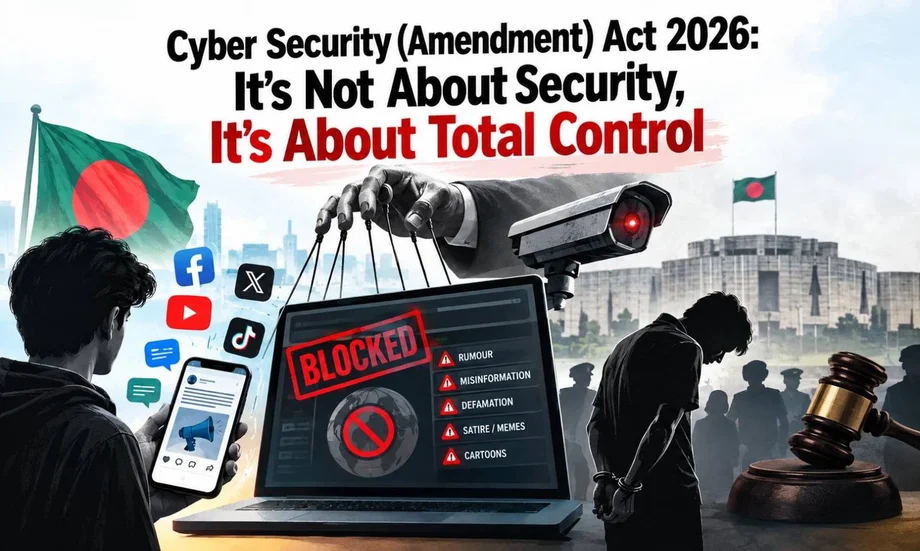
Bangladesh's proposed Cyber Security (Amendment) Act, 2026 would halve the maximum prison sentence for spreading rumours or disinformation, from 10 years to five, while keeping the offence cognisable and non-bailable. The ICT Division published the revised draft on November 10 and invited public comments by November 25.
Contents
- Five years in prison would remain possible for online rumours
- How Bangladesh reached another proposed rewrite
- What changes in the speech offences?
- Why bail and arrest rules matter
- Where criticism, defamation and memes meet
- Registered media gain safeguards that citizens lack
- Content blocking shifts away from mandatory court review
- Search powers and official immunity remain contested
- What the consultation must resolve
- Key Points
The maximum fine would fall from Tk 4 million to Tk 1 million. For defamation, the proposed maximum sentence would drop from five years to two, and the maximum fine from Tk 2 million to Tk 500,000. These are substantial reductions: the rumour offence's maximum prison term would fall by 50 percent and its maximum fine by 75 percent.
Journalists working through registered media would gain some protection, including tribunal approval before arrests over published news, opinions, images or cartoons. Ordinary citizens posting similar material would lack that specific safeguard.
The central dispute concerns what happens before a conviction as much as the punishment afterward. The revised draft retains powers to search, seize devices and make arrests without warrants under specified conditions. It would also replace mandatory judicial approval for content blocking with a review process handled by the National Cyber Security Agency.
Transparency International Bangladesh, lawyers and media representatives argue that smaller penalties leave the main danger intact: broadly defined speech offences can still expose people to arrest, prosecution and the removal of their work.
How Bangladesh reached another proposed rewrite
Bangladesh's cyber legislation has undergone repeated changes since the Digital Security Act took effect in 2018 amid widespread opposition. Critics accused that law of being used to suppress dissent during the Awami League government's tenure.
The latest amendment follows a new round of consultations after Parliament passed the Cyber Security Bill in April 2026. Officials say the revisions reflect views raised by stakeholders and media representatives.
- 2018: The Digital Security Act took effect amid opposition over its impact on expression.
- 2024: The Awami League government fell following a mass uprising.
- 2025: The interim administration issued the Cyber Security Ordinance after repealing the earlier legislation.
- April 30, 2026: Parliament passed the Cyber Security Bill, replacing the ordinance.
- July 2026: The government formed a committee to prepare amendments.
- September and October 2026: Government representatives held consultations with stakeholders and media representatives.
- November 10, 2026: The ICT Division published the revised draft, with comments invited by November 25.
The November text is a proposal open for consultation. Its changes to penalties, arrests and blocking powers would depend on the amendments becoming law.
What changes in the speech offences?
The ICT Division's published amendment text sets out Section 26A as an offence covering the publication or circulation of rumours and disinformation, with a maximum sentence of 10 years, a fine of Tk 4 million, or both. The November revision lowers those ceilings to five years and Tk 1 million.
The wording also changes. The earlier definition of a rumour covered unsupported or unverified information, news or claims that caused, or could cause, confusion, panic, agitation or social unrest. The revised definition focuses on false or distorted information deliberately created, published or circulated to cause public panic, agitation or social unrest.
That moves the definition toward deliberate falsehood rather than information that has simply not been verified. For someone posting during a fast moving event, the difference matters: an uncertain claim and an intentionally fabricated claim involve different conduct.
The draft does not specify how authorities would establish the required intention. Supreme Court lawyer Priya Ahsan Chowdhury considers the change a limited improvement, while warning that terms such as public panic and social instability remain subjective and could affect criticism, satire and reporting in the public interest.
The revised proposal also separates the treatment of speech offences. Defamation would be non-cognisable and bailable, with a maximum of two years in prison, Tk 500,000, or both. Belittling or bullying would carry up to three years, Tk 500,000, or both, and remain cognisable and non-bailable, as would rumours and disinformation.
Why bail and arrest rules matter
A cognisable offence generally allows police to begin an investigation and make an arrest without first obtaining a magistrate's order, subject to the applicable legal conditions. A non-cognisable offence generally requires judicial permission before police investigate.
Bailable offences give an accused person a right to bail when the legal requirements are met. For a non-bailable offence, release depends on the court's decision. These classifications shape whether someone may spend time in custody while a case proceeds.
The ICT Division's published text places cases under Section 26A, covering rumours and disinformation, before the Cyber Tribunal. It also assigns specified offences under Section 25(3), alongside hacking and other listed cyber offences, to that tribunal, while other offences go before a first class magistrate.
The official text generally limits who can file a case to an aggrieved person, someone authorised by that person in writing, or a member of law enforcement. A complainant seeking tribunal intervention after a police station refuses a complaint must submit an affidavit describing that unsuccessful attempt. The tribunal can then examine the complainant and order an investigation or reject the complaint.
Those procedures place conditions on how a case starts. The concern raised by critics is that retaining criminal liability, especially for offences without an automatic right to bail, leaves people exposed to detention and legal proceedings despite lower maximum sentences.
Where criticism, defamation and memes meet
The revised draft refers to Section 499 of the Penal Code, 1860 for the definition of defamation. Alongside that reference, its definition of belittling covers words, behaviour, publications, indications, gestures or activities that exceed constructive criticism and insult, mock or disdain someone in a way that harms personal dignity and self respect.
Ridicule involving a person's physical appearance, colour or bodily characteristics would fall within the proposed wording. So would making someone an object of mockery through memes or caricatures created by distorting images, videos or voices.
Fawzia Afroz, Bangladesh head of the technology research organisation TechGlobal Institute, questions why defamation should appear again in a cyber law when the Penal Code already covers it. She also questions who would set the limits of constructive criticism and whether political cartoons, memes and critical caricatures could become grounds for prosecution.
Priya Ahsan Chowdhury argues that imprisonment is a disproportionate response to reputational harm and that existing criminal defamation provisions have themselves been misused. Human Rights Support Society has called for civil remedies for defamation, which would allow a person to seek a remedy for damage to reputation without making imprisonment the response.
For cartoonists and social media users, the practical issue is the boundary between insulting conduct and legitimate satire. The proposed wording gives legal importance to that boundary while leaving authorities and courts to decide where individual publications fall.
Registered media gain safeguards that citizens lack
Proposed Section 46A would require tribunal approval before arresting anyone over news, opinions, pictures or cartoons published or broadcast by registered media. Section 29 would require at least 15 days of written notice and an opportunity to respond before proceedings against a registered outlet or its operating institution.
Kamal Ahmed, consulting editor of The Daily Star and former head of the Media Reform Commission, welcomes the government's decision to seek stakeholder views and reopen the draft for comment. He argues, however, that ordinary citizens should receive the same protection for expression as journalists and media organisations.
The protection's scope remains unclear for freelance journalists. The draft also lacks an equivalent requirement for prior court approval before searches of media offices or the seizure of journalists' digital equipment.
The Editors' Council's 12 recommendations extend beyond arrest protection. They seek court approval for searches, seizures, surveillance and access to devices; confidentiality for sources; safeguards for reporting in the public interest; and protection against punishing an entire outlet for an individual report. They also propose handling defamation complaints through the Press Council.
Section 29 would still allow a court, following conviction, to suspend or cancel an organisation's registration or licence, or prohibit its activities. Priya Ahsan Chowdhury argues that closing or disabling an organisation because of an individual's offence would be disproportionate, particularly where offences are broadly defined.
Content blocking shifts away from mandatory court review
Section 8 covers a wide range of grounds for blocking content, including threats to security or public order, incitement to religious hatred or violence, defamation, blackmail, sexual harassment and material involving child sexual exploitation.
The ICT Division's published text contains two specific checks. Section 8(3) requires public disclosure of information about blocked content. Section 8(4) requires tribunal approval within three days of removal, transfer or blocking, with restoration mandatory if approval is refused or not obtained in time.
The November revision would remove mandatory tribunal approval and the public disclosure requirement. Instead, authorities would have to inform the affected person or organisation of the reasons within three days. That person or organisation could apply to the National Cyber Security Agency for restoration, and the agency would have 15 days to decide after allowing the government or relevant party to be heard.
The change would move the routine review from a court to an agency. Someone whose content was blocked would have to seek restoration, rather than authorities automatically having to obtain judicial approval to keep it blocked.
Human Rights Support Society, in a statement signed by executive director Ejazul Islam, sought judicial approval and an effective appeals process. Rights advocates also want reasons disclosed when a blocking decision is made, rather than up to three days later.
Before publication, officials described plans to remove the ground of content being derogatory toward the state and narrow the wording identifying bodies able to request blocking. The published draft has nevertheless drawn concern over broad language relating to the country's dignity and public order. Precise grounds determine which posts authorities can order removed and which decisions an affected person can challenge.
Search powers and official immunity remain contested
Sections 33 to 35, dealing with investigation, searches, seizures and warrantless measures, remain unchanged despite stakeholder objections. Under Section 35, a police officer may act without a warrant when a cyberattack or unlawful entry into critical information infrastructure creates a risk that evidence will be destroyed.
The officer must record the reasons for acting. The powers include searching premises, seizing digital equipment and arresting a suspect. For journalists, taking a phone or computer can also interrupt work and expose communications with confidential sources, which helps explain the Editors' Council's demand for protection covering devices as well as arrests.
Sajjad Sharif, executive editor of Prothom Alo, said the government had responded to some concerns through advance notice and deadlines, but identified the unchanged investigative sections as a continuing problem.
"But the new draft should have also addressed sections 33, 34 and 35, which specifically deal with investigative powers, search, seizure and arrest without warrant," he said.
The draft also provides protection from civil or criminal proceedings for the Cyber Protection Council's chairperson, members and authorised officials over acts carried out in good faith. Section 52 of the official text contains that immunity provision.
Iftekharuzzaman, executive director of Transparency International Bangladesh, described the proposed protection as "blanket discriminatory immunity" and pointed to past allegations of abuse of official powers. Human Rights Support Society has sought compensation for unlawful arrests, wrongful blocking and abuse of power.
What the consultation must resolve
The November 25 comment deadline gives citizens and organisations an opportunity to challenge both the offences and the procedures used to enforce them. The main demands already raised include clearer definitions, bailable offences, civil remedies for defamation, judicial scrutiny of blocking and equal protection for expression.
Article 27 of Bangladesh's Constitution guarantees equality before the law, while Article 39 protects expression subject to specified reasonable restrictions. Critics connect those guarantees to the draft's different treatment of registered media and ordinary citizens.
The proposal would also reduce required Cyber Protection Council meetings from quarterly to twice a year, cutting the minimum from four meetings annually to two. Human Rights Support Society opposes that reduction alongside its calls for stronger accountability and remedies.
Iftekharuzzaman argues that cyber legislation should concentrate on protecting infrastructure, data integrity and online safety, including preventing hacking and digital fraud, rather than policing reputation and speech. The government's revisions reduce several punishments and add selected protections. The unresolved policy choice is how far a cyber law should reach into everyday criticism, satire and disputed information.
Key Points
- The ICT Division published the revised draft on November 10, with public comments invited by November 25.
- Rumours and disinformation would carry up to five years in prison and Tk 1 million in fines, down from 10 years and Tk 4 million.
- Rumours, disinformation and online belittling would remain cognisable and non-bailable offences.
- Registered media would gain notice and arrest safeguards that critics want extended to ordinary citizens.
- Mandatory tribunal approval for content blocking would give way to an agency review process with a decision due within 15 days.
- Specified warrantless search, seizure and arrest powers would remain, alongside proposed immunity for official acts carried out in good faith.