A Texas permit turns X-energy's Taiwan pitch into a practical test
On November 9, 2026, the US Nuclear Regulatory Commission (NRC) issued construction permit CPAR-3 to Long Mott Energy LLC, a wholly owned Dow subsidiary, for four X-energy Xe-100 reactors at Dow's Seadrift chemical complex in Calhoun County, Texas. The NRC project record gives that date, while one later chronology lists November 10. The four units would produce 800 megawatts of heat, equivalent to about 320 megawatts of electricity if all of it were used for generation. Their main job, however, would be making steam for Dow.
Contents
- A Texas permit turns X-energy's Taiwan pitch into a practical test
- How a billiard ball sized fuel pebble changes the design
- What the NRC safety review actually accepted
- Dow wants steam first, with surplus power for Texas
- The next gate is financing, followed by an operating license
- Fuel factories and supply contracts must arrive before the reactors
- What Taiwan would need beyond an invitation to suppliers
- The dates that will decide whether Long Mott becomes a working plant
- What to Know
The authorization was the NRC's first construction permit for a reactor cooled by helium and operating at high temperature since Fort St. Vrain received its permit in September 1968. It was also the first US advanced nuclear facility approved for construction at an industrial site. For X-energy, the decision gives technical weight to the message that Miriam D'Onofrio, its senior director for international markets, has brought to Taiwan: a smaller nuclear plant can be designed around industrial demand, limited land and a different approach to fuel safety.
For Taiwan, the Texas milestone does not provide a customer, a site or an operator. D'Onofrio said X-energy is interested in Taiwanese suppliers but is also waiting for local companies to create demand for a reactor at home. Dow is expected to consider a preliminary investment decision in 2027, with a separate final decision required before full construction. Initial energy delivery is targeted for the early 2030s, leaving several years in which engineering, financing and fuel production must come together.
How a billiard ball sized fuel pebble changes the design
Each Xe-100 produces 200 megawatts of heat and about 80 megawatts of electrical output when that heat drives a turbine. Instead of uranium rods, its core contains roughly 220,000 graphite spheres about the size of billiard balls. Every sphere holds thousands of tiny uranium particles wrapped in carbon and ceramic layers known as TRISO fuel. Recent design descriptions give about 18,000 particles in each pebble, while X-energy's Taiwan briefing gave about 19,000. The layers are intended to keep radioactive fission products contained at very high temperatures.
Graphite slows neutrons so that the fission chain reaction can continue, while helium carries heat out of the core. Helium does not react with the fuel or graphite and remains a gas, so no water boils inside the reactor. The helium leaves at more than 750 degrees Celsius and transfers its heat to a steam generator. X-energy says the system can provide steam at up to 565 degrees Celsius, hot enough for chemical manufacturing and refining as well as electricity production.
Refueling can continue while the reactor operates. Fresh pebbles enter at the top and older pebbles leave at the bottom, with each pebble making as many as six passes through the core over a little more than three years. A conventional plant commonly replaces about one third of its fixed fuel every 12 to 24 months and must shut down for work that can last from 10 days to about a month. X-energy is targeting a capacity factor above 95 percent, meaning the reactor would be available to produce energy for more than 95 percent of the time.
Spent pebbles can go into dry storage containers cooled by air. X-energy says the plant site would have room for all spent fuel generated during 60 years of operation. That plan addresses storage during the plant's operating life; it does not identify a final disposal destination. Reactors using gas cooling at high temperatures also have a longer history than the Xe-100 itself. The United States, Britain and Germany began research and demonstrations in the 1960s, and Japan and China have since gained operating experience with related designs.
What the NRC safety review actually accepted
The NRC completed an 852 page final safety evaluation on October 30, 2026, after its Advisory Committee on Reactor Safeguards supported issuing the permit on October 16. The review used the Licensing Modernization Project framework, which examines the likelihood and consequences of possible accidents for a particular design rather than applying assumptions developed only for conventional reactors cooled by water. X-energy has also secured NRC approval of 14 technical reports covering subjects such as fuel and graphite qualification, core behavior, heat movement, radiation releases, emergency planning and control room staffing. Later projects can use those approved methods within their stated limits, although every plant still needs its own licensing review.
Five basic safety functions anchor the Xe-100 review: retaining radioactive material, controlling the chain reaction, removing heat, controlling any entry of water or steam, and preserving the geometry of the pebble core. The evaluation calculated a nominal peak fuel temperature of 1,803 degrees Celsius, rising to 1,885 degrees when uncertainties were included. A separate NRC calculation using MELCOR, its accident analysis program, produced 1,788 degrees. The estimated radiation dose over 30 days at the exclusion area boundary was 14.4 rem, below the 25 rem licensing criterion. A rem is a unit used to estimate the biological effect of radiation exposure.
The emergency planning boundary accepted for Long Mott extends no more than 400 meters beyond the reactor building, compared with roughly 16 kilometers for a traditional large US plant cooled by water. An emergency planning zone defines where authorities prepare measures such as evacuation and sheltering. For crowded Taiwan, a smaller zone could widen the range of locations that merit study. The Texas boundary would not transfer automatically, because a Taiwanese proposal would require its own safety analysis, site review and emergency plan.
Dow wants steam first, with surplus power for Texas
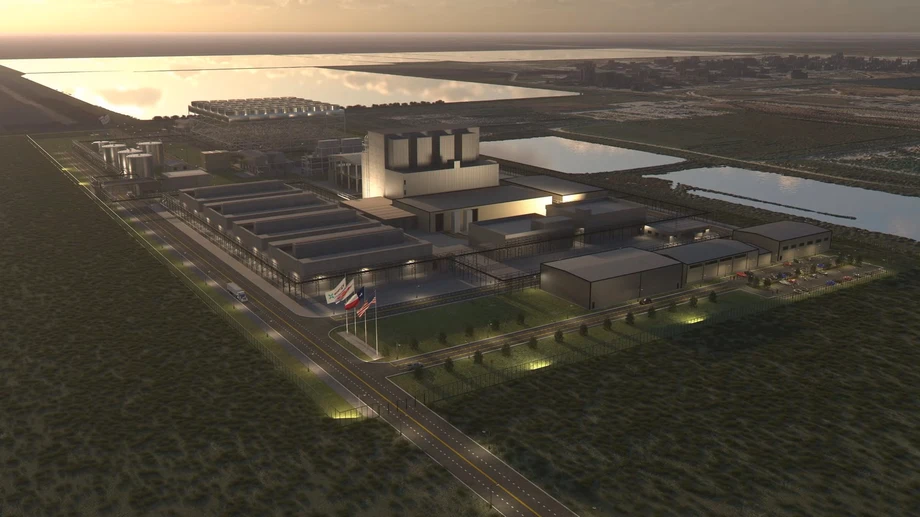
Long Mott Generating Station would occupy about 1,537 acres roughly 22 miles southeast of Victoria, at Dow's Seadrift Operations near Port Lavaca. Its four reactors would replace aging equipment that now supplies energy and steam to the chemical complex. Most of their output would serve Dow's industrial processes, while electricity not needed at Seadrift would go to the Texas grid. This arrangement explains why continuous refueling matters: a chemical plant that operates around the clock values dependable heat as much as a power utility values dependable generation.
Land use provides another useful comparison. The South Texas Project, a two reactor station with 2.6 gigawatts of capacity, occupies 12,220 acres, including a cooling reservoir of roughly 7,000 acres and an essential cooling pond of 46 acres. Long Mott is much smaller and has a different purpose, but its use of helium and passive heat removal allows a design without that kind of large reactor cooling reservoir. It still needs steam equipment, storage and other industrial infrastructure.
Long Mott was the NRC's third advanced reactor construction permit of 2026, following TerraPower's Kemmerer project in Wyoming on March 9 and the Tennessee Valley Authority's BWRX-300 project on September 28. NRC Chairman Ho Nieh connected the decision to the agency's effort to make licensing schedules more predictable.
We delivered on the 18-month schedule, proving we can do rigorous safety reviews on predictable timelines that move advanced nuclear technology from design to construction.
The next gate is financing, followed by an operating license
The construction permit legally allows Long Mott Energy to build, but it does not allow uranium fuel to be loaded or the reactors to operate. Those steps require a separate operating license, which Dow and X-energy are still preparing. Remaining work includes completing the design, qualifying fuel and materials, ordering components that take a long time to manufacture, and building the plant. X-energy chief executive Clay Sell has said the company intends to avoid beginning construction before the design is complete.
Dow has not yet committed the full construction budget. Edward Stones, Dow's business vice president for energy and climate, said the company would assess the project before making that commitment, naming three tests.
Competitiveness, execution readiness, and capital affordability.
A preliminary investment decision is expected in 2027, but no date has been given for the final decision. Project planning places construction completion between July 1 and December 31, 2033.
Federal support reduces part of the financial risk. The Department of Energy's Advanced Reactor Demonstration Program award is expected to grow to $2.15 billion, with $618 million already reimbursed, while Dow is expected to fund more than half of construction costs. X-energy reported using $123 million of cash in the third quarter and holding $1.56 billion with no debt, approximately enough for 13 quarters at the recent pace. Its illustrative lifetime estimate for a four reactor plant is $1.66 billion to $2.18 billion, including $1.095 billion to $1.25 billion for fuel. Those figures are planning estimates rather than a final construction budget.
Time will also shape the financing. The last three US nuclear plants took an average of 15.3 years from concept to operation, according to an analysis by the Solar Energy Industries Association. Comparable estimates were 1.4 years for solar, 1.7 years for batteries and onshore wind, 2.6 years for gas combustion turbines and four years for combined cycle gas plants. X-energy's early 2030s target implies roughly seven to 10 years for Long Mott, still slower than those alternatives but faster than recent nuclear projects.
Fuel factories and supply contracts must arrive before the reactors
The Xe-100 uses HALEU, a form of low enriched uranium with a higher concentration than fuel used by most existing reactors, with the X-energy design enriched to 20 percent. US production capacity remains limited. X-energy signed long term agreements with two American uranium enrichment companies in August 2026 and used advance payments to help them expand. This creates a direct connection between Taiwan's possible interest and a supply chain that is still being built in the United States.
X-energy's TX-1 fuel plant in Tennessee is designed to press about 700,000 pebbles a year, containing five metric tons of uranium, enough for as many as 11 Xe-100 reactors. The NRC approved its special nuclear material license in February 2026, the agency's first Category II fuel fabrication license of its kind, although a final inspection is still required before operation. TX-1 is expected to begin producing fuel in 2027 for Long Mott. A second plant, TX-2, is in design with four times TX-1's capacity, or 20 metric tons of uranium a year. Combined construction spending for the two facilities is expected to reach about $768 million over five years.
Equipment agreements are also accumulating. South Korea's Doosan Enerbility has reservations covering 16 sets of reactor components, while Japan's Toyo Tanso is involved in graphite supply. On November 22, X-energy awarded Fluor a second nuclear island engineering contract, this one for Energy Northwest's Cascade project near Richland, Washington. Applying lessons from Long Mott to Cascade is intended to standardize equipment and engineering before larger deployment.
Amazon joined Cascade after agreeing to finance an initial group of four reactors, and the wider project has been described as targeting 12 modules and 960 megawatts. It forms part of an Amazon and X-energy agreement covering as much as five gigawatts, with operation expected in the mid-2030s. X-energy also has an agreement with Centrica for as many as 12 reactors at Hartlepool within a broader six gigawatt ambition in Britain. Its April 24, 2026 stock listing raised more than $1 billion, providing capital while commercial reactor revenue remains years away.
What Taiwan would need beyond an invitation to suppliers
D'Onofrio identified three requirements for an Xe-100 project in Taiwan: a customer with energy demand, a suitable site, and a company willing to develop and operate the plant. Government agencies and local residents would also need to participate. She welcomed Taiwanese manufacturers into the global supply chain but argued that component exports alone would not establish a domestic reactor market.
Without demand, there will be no supply.
Taiwan's semiconductor factories could provide demand for steady electricity, while petrochemical plants could use both electricity and high temperature steam, giving them a profile closer to Dow's Seadrift complex. D'Onofrio said some technology and industrial customers are willing to consider prices above the cheapest available electricity when a supply offers dependable output and low carbon emissions over many years. Amazon's early investment illustrates that approach, but no Taiwanese company has announced a comparable commitment.
X-energy hosted a Taiwanese nuclear industry delegation earlier in 2026 and expressed interest in local participation in equipment manufacturing. No Taiwan customer, reactor site, operator, license application or construction date has been announced. A serious proposal would therefore need to move through several separate decisions: an industrial buyer would have to value the heat or electricity, an operator would have to accept responsibility for the plant, and Taiwanese regulators and affected communities would have to examine the site, emergency zone, fuel imports and spent fuel storage.
The dates that will decide whether Long Mott becomes a working plant
The Texas project reached its permit through years of engineering and regulatory work, while several decisive steps remain ahead.
- 2018: X-energy began discussions with the NRC before submitting an application.
- March 2023: X-energy and Dow signed a joint development agreement, moving the first demonstration from its earlier Washington concept to the Texas Gulf Coast.
- May 2023: The companies selected Dow's Seadrift site.
- March 31, 2025: Long Mott Energy submitted its construction permit application, which the NRC accepted for review on May 12.
- May 2026: The NRC completed its environmental assessment and issued a finding of no significant impact.
- September to November 2026: The NRC held its mandatory hearing, received the advisory committee's support, finished its safety evaluation and issued the construction permit.
- 2027: Dow is expected to consider a preliminary investment decision, and TX-1 is expected to begin fuel production.
- Early 2030s: The companies are targeting initial energy delivery, with project planning giving a construction completion window in the second half of 2033.
What to Know
- The NRC has authorized four Xe-100 reactors at Dow's Texas chemical complex, with 800 megawatts of heat and an electrical equivalent of about 320 megawatts.
- The plant would mainly supply industrial steam, with surplus electricity sent to the Texas grid.
- Its graphite fuel pebbles, helium cooling and continuous refueling distinguish it from conventional reactors using fixed uranium rods.
- Long Mott's accepted emergency planning boundary is 400 meters, but any Taiwanese project would require a separate review.
- The permit does not authorize operation, and Dow still faces investment decisions beginning in 2027.
- X-energy is building US fuel capacity and supply agreements, but HALEU availability and manufacturing remain essential constraints.
- Taiwan still needs a customer, a suitable site and an operator, alongside government and community participation.