Dresden stays on schedule for production
TSMC said on November 27, 2026, that its German semiconductor project was progressing on schedule and smoothly, keeping the Dresden fab on course to begin production by the end of 2027. The plant belongs to European Semiconductor Manufacturing Company, or ESMC, a venture formed by TSMC with Bosch, Infineon and NXP. It will make chips for European automotive and industrial customers.
Contents
- Dresden stays on schedule for production
- What the 10 billion euro project will produce
- The construction milestones still to come
- Why the partners chose these chip technologies
- A 2027 relocation wave is already taking shape
- Dresden prepares for a larger Taiwanese community
- Hiring and training extend in both directions
- Energy and water commitments for the new fab
- How ESMC fits into TSMC's wider expansion
- Key Points
The next year will bring a substantial movement of people as well as machinery. Between 500 and 800 Taiwanese professionals are expected to go to Saxony to work in 2027, with some relocating their families. Their assignments will coincide with preparations to install the first manufacturing equipment during the second half of that year. ESMC has not given a more precise date for commercial production than the end of 2027.
Dresden has already seen the factory's main structure take shape. Workers completed the principal structural work in September 2026, and ESMC president Christian Koitzsch said the project was advancing within budget. About 2,000 construction workers from 106 countries were working around the clock at the site when its topping out ceremony took place. That construction workforce is separate from the roughly 2,000 direct professional jobs ESMC expects to create when the fab reaches full operation.
What the 10 billion euro project will produce
The four partners set out their plan in a joint venture announcement on August 8, 2023. TSMC holds 70% of ESMC and operates the fab, while Bosch, Infineon and NXP each own 10%. Total investment is expected to exceed 10 billion euros, financed through equity, borrowing and support from the European Union and the German government. The announcement did not specify an exact amount of public funding. At that stage, the final investment decision still depended on confirmation of the support level; construction subsequently began in August 2024.
Planned capacity is 40,000 wafers per month, with each silicon wafer measuring 300 millimeters, or about 12 inches. A wafer carries many individual chips that are separated and packaged later. Output at the planned monthly rate would equal 480,000 wafers over a full year, matching the annual production figure used in ESMC's recruitment information.
The factory will use TSMC's 28/22 nanometer planar CMOS processes and its 16/12 nanometer FinFET processes. These labels identify generations of manufacturing technology rather than the dimensions of a finished chip. CMOS is a widely used way of building low power electronic circuits. In a planar process, the transistor's main structure lies along the surface of the silicon. A FinFET instead uses a raised channel with greater control from its gate, helping chip designers manage electrical current and power consumption more effectively.
ESMC describes its FinFET service as the first offering of its kind by a contract chip manufacturer in Europe. The intended markets include vehicles, factory equipment, telecommunications and the Internet of Things, meaning machines, sensors and other objects connected through networks. This gives Dresden a specific role: supplying chips needed for electrification, automation and connected equipment, rather than trying to reproduce every advanced process TSMC operates elsewhere.
The construction milestones still to come
Christian Koitzsch spoke at the topping out ceremony on September 14, 2026, held 25 months after groundbreaking. Known in Germany as a Richtfest, the ceremony marks the placement of the final structural element at a building's highest point and recognizes the construction crews, architects and engineers. Koitzsch expressed confidence that construction would finish on time.
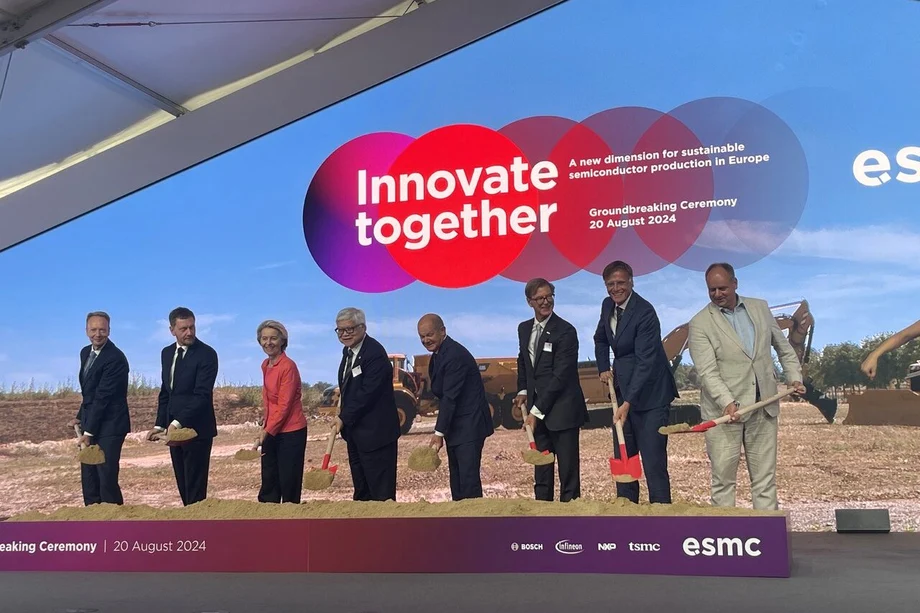
The ceremony combined customs from both countries involved in the project. September 14 was selected as an auspicious date in Taiwanese culture, while the ritual followed German practice. A carpenter gave a speech and broke a glass for a toast, although the glass contained water because alcohol is prohibited on the construction site. Koitzsch also recalled that guests at the 2024 groundbreaking had been asked to fill their shovels with soil, a gesture associated with good luck and prosperity in Taiwan.
- August 8, 2023: TSMC, Bosch, Infineon and NXP announced ESMC, with production targeted for the end of 2027.
- August 2024: Ground was broken at the Dresden site.
- September 14, 2026: The topping out ceremony marked 25 months of construction, and the main structural work was completed that month.
- November 27, 2026: TSMC said progress remained on schedule and was proceeding smoothly.
- Second half of 2027: ESMC plans to install its first manufacturing process equipment.
- End of 2027: The fab is expected to begin production.
Installing tools is only one part of the remaining work. ESMC must also finish the cleanroom interior, install the automated system that moves materials through the factory and complete essential infrastructure, including electricity and water supplies. A cleanroom tightly controls dust and other airborne particles because contamination far smaller than a visible speck can damage microscopic circuits.
Why the partners chose these chip technologies
The investment was planned under the European Chips Act and addresses a practical concern shared by the three European shareholders: obtaining dependable supplies of chips close to major customers. Bosch said cooperation with TSMC would strengthen the semiconductor network near its own Dresden plant. Infineon identified the city as the location of its largest front end manufacturing site, where wafers are processed, and said it would use the new capacity for demand from automotive and connected device customers. NXP linked the project to innovation and supply chain resilience as vehicles and industrial equipment use more electronics.
CC Wei, identified in the 2023 announcement as TSMC's chief executive, explained why the company considered Europe suitable for the venture.
Europe is a highly promising place for semiconductor innovation, particularly in the automotive and industrial fields, and we look forward to bringing those innovations to life on our advanced silicon technology with the talent in Europe.
Jochen Hanebeck, chief executive of Infineon Technologies, described the partnership's importance for regional manufacturing.
Our joint investment is an important milestone to bolster the European semiconductor ecosystem.
Hanebeck also connected the capacity to technologies intended to support decarbonization and digitalization. Kurt Sievers, president and chief executive of NXP, thanked the European Union, Germany and the Free State of Saxony for backing the project and pointed to rising demand created by vehicle electrification and industrial digitalization.
Saxony State Premier Michael Kretschmer said at the topping out ceremony that the progress showed TSMC, Dresden's city government and Saxony's state government had kept their commitments. He said the trust developed during construction could support further cooperation. Kretschmer also expressed hope that additional suppliers would settle in Dresden following the European Commission's recent proposal for a Chips Act 2.0, although the source material provides no detailed terms or approval date for that proposal.
A 2027 relocation wave is already taking shape
The estimate of 500 to 800 Taiwanese professionals covers people expected to work across Saxony in 2027. A separate local estimate referred to about 600 TSMC engineers expected in Dresden that year, accompanied by family members and personnel from suppliers. Some arrivals will be temporary assignments, while others are expected to involve longer relocations with children, housing and schooling to arrange.
Dresden Mayor Dirk Hilbert offered a broader population estimate, saying that 15,000 to 20,000 workers could move to the area by 2030. His projection extends beyond ESMC's own employees to the wider employment and supplier base expected around semiconductor investment. It helps explain why the city is preparing for demand for residential, industrial and commercial land, rather than treating the fab as an isolated construction project.
The workforce figures also mark different stages. Thousands of people are currently needed to construct the buildings, hundreds of Taiwanese specialists are expected during preparation for production, and ESMC plans approximately 2,000 direct professional positions at full operation. Recruitment and relocation therefore have to proceed while the physical plant is still being completed.
Dresden prepares for a larger Taiwanese community
Su Yi-ting, who leads Dresden's Taiwanese business association, said nearly 80 Taiwanese families had been added to the city over the past two years as ESMC built its plant and suppliers developed their plans. She said the growing community was increasing demand for housing, restaurants, consumer businesses and everyday services.
Many engineers and employees sent abroad by their companies move with their entire families, according to Su. Their concerns consequently extend beyond the workplace to children's education, language, housing, leisure and whether they can establish a lasting sense of belonging in Dresden. The expected arrivals in 2027 will place those practical issues alongside cleanroom construction and equipment installation on the project's immediate agenda.
Germany's representative office in Taipei has responded to the administrative workload by recruiting three employees who can work in Chinese, English and German. The temporary positions, working full time from February through November 2027, will support visa services by accepting applications, conducting preliminary reviews and answering public inquiries. That period covers much of the run-up to the planned production start.
A German relocation services company has also opened its first overseas office in Taipei. It assists Taiwanese technology employees with residence permits, rental housing and school arrangements for their children. Chief executive Janett Krätzschmar-König said moving abroad often raises numerous questions and that receiving advice face to face in a familiar language before departure can help establish trust.
Dresden has held events introducing Taiwanese culture to local residents and welcoming Taiwanese workers. Hilbert said the city also hopes to host a Taiwanese night market. Alongside those social efforts, officials are preparing a more coordinated approach to economic development so that land, investment services and housing planning can absorb growth when the fab begins operating.
Hiring and training extend in both directions
ESMC was still seeking hundreds of technical specialists in October 2026. The vacancies include equipment technicians, automation specialists, maintenance staff and personnel for quality, reliability, information technology, logistics and safety. Facilities teams will operate water, gas, chemical, mechanical and electrical systems that must function continuously and meet strict safety and environmental requirements.
Production technicians will commission machinery, maintain it and identify abnormalities before they disrupt output. Supporting departments will manage incoming materials and central processes. These roles show why a semiconductor fab needs far more than chip designers: its output depends on people who can keep complex equipment and supplies operating with very little variation.
New technical recruits will receive training at TSMC's headquarters in Taiwan before starting work in Dresden. Depending on the position, that preparation will last between three and twelve months, with ESMC organizing and financing it. The arrangement sends European recruits to Taiwan for knowledge transfer while Taiwanese professionals travel to Germany to prepare the plant.
English is ESMC's official team language, although the company does not require perfect business English. It says shared technical understanding and collegial communication are central to daily work. The language policy is intended to bring employees from different countries into the same operating teams as the fab moves from construction into production.
Energy and water commitments for the new fab
ESMC says the Dresden fab will run entirely on renewable energy when operations begin and will recycle more than 70% of its water. Water management matters in chipmaking because manufacturing uses highly controlled supplies for processing and cleaning, while large volumes must also be handled safely after use.
The site plans include a rainwater management system intended to prevent heavy storms from sending runoff into a neighboring community. Landscaping plans call for more than 10,000 plants and a green facade extending 200 meters. These are commitments for the factory's opening and design, alongside the production and employment targets.
How ESMC fits into TSMC's wider expansion
TSMC says nearly 20 wafer fabs are proceeding under its global plans. Over the next few years, it expects to build a combined 13 advanced wafer fabrication and advanced packaging plants in Taiwan, plus another five or six wafer fabs overseas. Advanced packaging turns processed silicon into usable components and connects chips with other elements needed in finished products.
Dresden's announced purpose remains local manufacturing for automotive and industrial demand, while much of TSMC's most advanced process and packaging expansion is planned for Taiwan. Construction also continues at the company's American sites. ESMC therefore represents one part of a broader effort to place different kinds of capacity closer to customers and supply chains.
The wider investment cycle has produced 2027 spending forecasts ranging as high as $90 billion from UBS and $85 billion from Goldman Sachs, compared with TSMC's announced 2026 capital spending range of $60 billion to $64 billion. TSMC has not announced its actual companywide capital budget for 2027. Those forecasts are separate from the more than 10 billion euros assigned to the Dresden venture.
For Dresden, the nearest tests remain concrete and dated: complete the cleanroom and utilities, install the first process tools in the second half of 2027, bring staff and families into the region and prepare the production organization. The end of 2027 remains the stated target for turning that work into chip output.
Key Points
- TSMC said on November 27, 2026, that ESMC's Dresden project remained on schedule for production by the end of 2027.
- TSMC owns 70% of ESMC; Bosch, Infineon and NXP each hold 10%, and TSMC operates the fab.
- Investment exceeds 10 billion euros, with planned capacity of 40,000 wafers per month, equivalent to 480,000 annually.
- The first manufacturing tools are scheduled for installation in the second half of 2027 after cleanroom and infrastructure work.
- Between 500 and 800 Taiwanese professionals are expected to work in Saxony in 2027, with some bringing their families.
- Nearly 80 Taiwanese families have been added to Dresden over two years, while visa and relocation services are expanding.
- ESMC expects about 2,000 direct professional jobs at full operation and is training recruits in Taiwan for three to twelve months.
- The fab is designed to use renewable energy entirely and recycle more than 70% of its water when operations start.