A steep national decline hides sharp local differences
South Korea will use the economic and social histories of about 120,000 people who died by suicide to reshape prevention policy, while offering roughly 50 local governments grants of 50 million to 150 million won for strong results. Kim Young-soo, first vice minister at the Office for Government Policy Coordination, announced the approach on November 27, 2026, at the Government Complex Seoul. The records cover 2016 through 2024, and the funding is intended to make local governments central to prevention rather than leaving the task mainly to national agencies.
Contents
- A steep national decline hides sharp local differences
- What nine years of records reveal
- Why Ulsan, Daejeon and Jeju need different responses
- How the grants and evaluations will work
- Public scorecards and a demanding 2030 target
- The policy push, date by date
- A wider national response beyond local grants
- Jeju focuses on income shocks and adults in their 40s and 50s
- Why officials urge caution, and what happens next
- What to Know
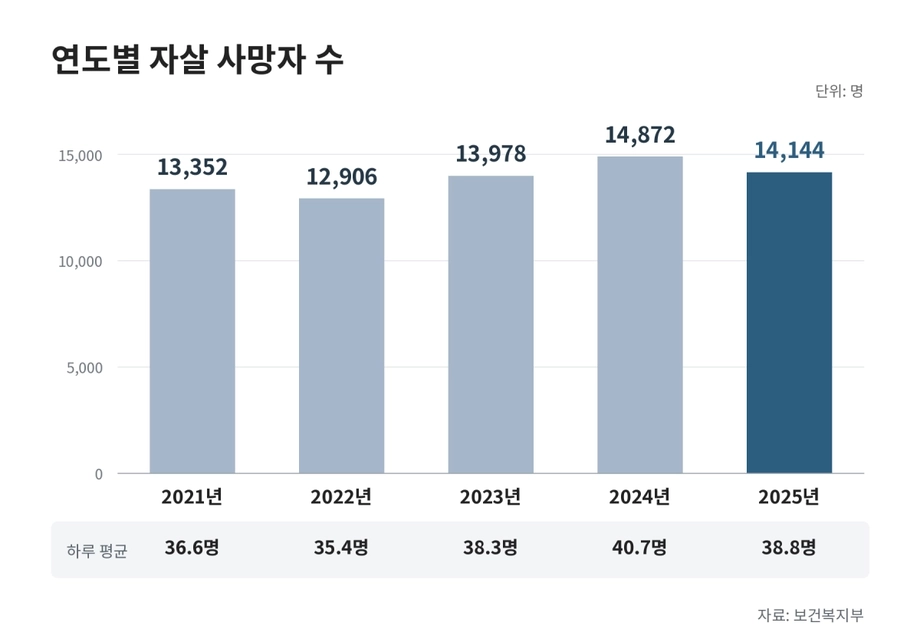
Provisional figures released by Kim's office show 1,014 suicide deaths in September, 197 fewer than a year earlier, a fall of 16.3 percent. The total for January through September was 9,591, down 1,270, or 11.7 percent. Every month from October 2025 through September 2026 had fewer deaths than the corresponding month a year earlier. Provisional figures can be revised as records are finalized.
Men accounted for 701 of the September deaths, or 69 percent, and women for 313, or 31 percent. The number of male deaths fell 18.4 percent from September 2025, while female deaths fell 11.1 percent. Earlier figures also show that the improvement began before the latest briefing: 7,432 deaths were recorded from January through July, compared with 8,475 during the same months of 2025, a decrease of 12.3 percent.
Fifteen of the 16 provincial level areas tracked recorded fewer cumulative deaths through September. Jeju had the largest percentage decrease at 24.6 percent, followed by Daejeon at 21.4 percent, Ulsan at 20.9 percent and Daegu at 16.4 percent. Gyeonggi Province, Seoul, South Jeolla Province and Gwangju recorded relatively large reductions in the number of deaths. Sejong was the exception, with an increase of 27.3 percent.
The improvement has unfolded as President Lee Jae Myung's administration has introduced prevention measures under its stated goal of saving lives. South Korea nevertheless continues to have the highest suicide rate among members of the Organization for Economic Cooperation and Development. It has held that position since 2003, except in 2017, when it ranked second following Lithuania's accession. The suicide rate means the number of suicide deaths per 100,000 people in a year.
What nine years of records reveal
For the first time, the government linked cause of death statistics from the Ministry of Data and Statistics with administrative records covering population, households, local activity and the statistical register. This allowed officials to examine employment, income, household composition and housing circumstances before death, rather than relying only on basic information about the death itself. The analysis covered approximately 120,000 people over nine years.
Kim Young-soo, the Office for Government Policy Coordination's first vice minister, said a shared national objective did not require an identical response everywhere.
The goal of protecting people's lives is the same across the country, but the specific methods for achieving that goal can differ from region to region.
The linked records also allow officials to study several pressures together. A person may have experienced falling income, insecure employment, isolation or unsuitable housing before death. Looking at those circumstances alongside age and household structure gives local authorities more detail about where existing services may be missing people.
Why Ulsan, Daejeon and Jeju need different responses
Ulsan had a relatively high share of deaths among middle and older age groups. Officials said the city could examine prevention activities that reflect their living and working conditions. Daejeon had a relatively high share of deaths among households consisting of one person. Its proposed response centers on preventing social isolation and building stronger connections between people living alone and their communities.
Jeju had a relatively high share of people who had experienced a sharp fall in income before death. The national government said places with that profile should identify households in crisis earlier and connect welfare, employment and financial assistance. Financial support in this context includes debt advice and other practical help, rather than counseling alone.
Local governments are being asked to examine their own risk factors and policy gaps and reflect suitable measures in their 2027 implementation plans. Officials have already held a briefing for metropolitan and basic local governments and plan to share further data. Dedicated local teams and prevention managers are expected to coordinate health, welfare, economic and employment departments with police, fire services and medical institutions.
Kim said future monthly releases will include regional death counts, cumulative percentage changes and changes in the number of deaths compared with the same period a year earlier. The intended service chain runs from early identification of a resident in crisis through counseling, treatment, welfare referrals and subsequent care.
How the grants and evaluations will work
The 2026 assessment covers the country's 227 basic local governments, with Sejong City and Jeju's Seogwipo administrative city expressly included in the arrangements. Officials will examine the operation of dedicated prevention organizations and officers, reductions in suicide deaths and examples of strong policy. Around 50 governments will then receive special grants ranging from 50 million won to 150 million won each, with the amount varying according to the assessment. These grants are budget transfers from the national government, not payments to individuals.
Park Yong-woo, director general for suicide prevention at the Life Protection Promotion Headquarters, which coordinates work across government, said recipients will be advised to spend the money on suicide prevention. His statement describes a recommendation for its use, rather than announcing a new legal condition.
Local governments where deaths are rising or improvement is comparatively weak are to receive examinations of local risks and policy conditions, followed by support measures drawn up with them. Possible disadvantages for governments with insufficient prevention efforts remain under review. Lee Sang-won, head of the headquarters' Social Support Bureau, said discussions with the Ministry of the Interior and Safety include how prevention efforts could affect local evaluation indicators and the allocation of grants.
The government also plans awards for contributions to protecting life. The prime minister is due to chair an award ceremony and discussion in December 2026, although no exact day has been announced. The selection date for the grant recipients was also not given.
Public scorecards and a demanding 2030 target
The Sixth Basic Plan for Suicide Prevention, announced on October 12 at a policy committee meeting chaired by Prime Minister Han Sung-sook, sets the wider framework. It aims to reduce the national suicide rate from 29.1 deaths per 100,000 people in 2024 to 18.9 or lower by 2030. That would be 10.2 fewer deaths per 100,000 people, a reduction of about 35 percent in the rate. Separate national figures put the 2025 rate at 27.8, still the highest in the OECD comparison.
After a grace period of one year, the Ministry of Health and Welfare intends to publish annual evaluations of suicide rates and prevention efforts for basic municipalities on its website. Residents will be able to compare performance from the strongest areas to the weakest. Until now, the results were communicated to the relevant local government rather than fully disclosed to residents.
Lee Hyung-hoon, the ministry's second vice minister, said local prevention activity had often been insufficient and varied considerably between areas. He said central government action alone had limits. A ministry official also acknowledged concerns that public comparisons could damage a locality's image or prompt worries about housing prices, but said saving lives had to come first.
The comparisons require careful construction. Deaths are counted according to the person's registered home address, not the place where the death occurred. The ministry uses adjustments for age and population when comparing regions. A death or two can sharply move the rate in a small municipality, while areas with many older residents or emotional labor workers may face greater underlying risks. Emotional labor refers to work that requires employees to manage their feelings while dealing with customers, often under considerable strain.
Park Jae-woo, head of the ministry's suicide prevention policy division, said the published assessment will therefore include improvement from the previous year and prevention work such as counseling and case management, alongside the suicide rate. Case management means continuing, coordinated support arranged around an individual's needs. A precise date for the first public scorecard has not been provided beyond the grace period of one year.
The policy push, date by date
October and November brought several connected national and Jeju measures, followed by further deadlines through 2027.
- October 12, 2026: Prime Minister Han Sung-sook chaired the meeting that announced the Sixth Basic Plan for Suicide Prevention.
- October 2026: Jeju Province created its four person Life Protection Team.
- November 18: Jeju completed a council bringing together 25 provincial departments, specialist institutions and private organizations.
- November 26: Jeju set out its plan to connect financial, employment and welfare assistance.
- November 27: Kim presented the national regional analysis, provisional death figures and local grant arrangements.
- December 2026: A prime ministerial award ceremony and discussion are planned, and Jeju intends to finish its plan for 2027 to 2030 by the end of the year.
During 2027, local governments are expected to carry out their revised implementation plans. National increases in prevention center staffing and the phased opening of a new response office are also scheduled for that year.
A wider national response beyond local grants
The Sixth Plan expands the classification of suicide motives from seven categories to 27 and permits several reasons to be recorded. This is designed to capture combinations such as economic difficulty, mental health problems and caregiving burdens, which can be lost when officials must select only one reason. Health insurance and social security benefit data will also be combined to develop a model for predicting regional risk before deaths occur.
Responsibility for particular groups is being assigned to named ministries. The Education Ministry will handle adolescents, the Financial Services Commission will address people vulnerable to debt, and the Ministry of Employment and Labor will handle emotional labor workers. Each ministry must prepare an annual implementation plan, while the Office for Government Policy Coordination checks progress every month.
Average staffing at suicide prevention centers is scheduled to rise from 5.0 people per center in 2026 to 7.1 in 2027, an increase of 42 percent. People who attempt suicide but are not admitted to hospital are to be offered up to 24 hours of temporary protection, counseling and connections to necessary services. A National Suicide Response Office under the Ministry of Health and Welfare, with police and fire personnel working together, will begin phased operations in 2027.
Jeju focuses on income shocks and adults in their 40s and 50s
Jeju recorded 243 suicide deaths in 2024 and 231 in 2025, according to cause of death statistics from the Ministry of Data and Statistics. Its rate fell from 32.4 to 30.3 deaths per 100,000 people, but remained the highest among South Korea's provinces and major cities. The island's 24.6 percent decline through September 2026 therefore comes after a period in which it still faced an especially severe regional problem.
Among the 243 deaths in 2024, 112 involved people in their 40s or 50s, about 46 percent, and 185 involved men, or 76 percent. Nationally, people aged 65 or older form the largest group, followed by those aged 19 to 34. Jeju's assessment also identifies economic problems as the leading local cause, while mental health problems figure more prominently in the national pattern.
Jeju Province established its Life Protection Team in October with one leader and three staff members. Its Suicide Prevention Measures Council, completed on November 18, connects 25 government departments, specialist bodies and private organizations. The province intends to finish a comprehensive plan covering 2027 to 2030 by the end of 2026 and begin carrying out projects in earnest the following year.
The team plans to work with the Credit Counseling and Recovery Service and Employment Welfare Plus Centers to identify people at high risk and connect them with debt assistance, employment services, emergency welfare and help finding work. Agencies are also expected to maintain counseling and subsequent care after a crisis is identified. Before settling its final measures, Jeju plans policy exchanges with Japan's Akita Prefecture, along with expert seminars and working meetings. Akita has experience with prevention efforts involving local communities and private organizations.
Jeju aims to reduce annual suicide deaths to 170 or fewer by 2030, a 30 percent reduction from the 243 recorded in 2024 and at least 73 fewer deaths. Governor Wi Seong-gon said the province would cooperate across departments and with private groups.
There can be no exceptions and no lower priorities when it comes to protecting the lives of residents. We will strengthen cooperation across the provincial government and with the private sector, pursue suicide prevention policies thoroughly and devote all our resources to establishing a culture that values life throughout Jeju society.
Why officials urge caution, and what happens next
Sejong recorded 15 more suicide deaths through September than during the same period of 2025, producing its 27.3 percent increase. Six people died there in September, compared with three a year earlier. Park Yong-woo said Sejong's smaller population means a modest numerical change can create a large percentage movement. Officials are examining growth in the population aged 70 or older, an increase in deaths among people in their 70s and a possible base effect. A base effect occurs when an unusually low previous total makes a later increase look larger. The detailed cause remains under analysis.
Kim Young-soo said regional trends must be assessed alongside demographic and economic conditions rather than through a short run of figures.
Regional suicide trends are affected by various factors, including population size and structure and economic and social conditions, so it is difficult to judge policy performance from statistics covering a short period alone.
Age patterns also require further work. Officials recorded 318 deaths among people aged 19 or younger from January through September and identified some increases involving adolescents and people in their 70s. The government plans to strengthen cooperation among education offices, schools, public health centers and prevention centers, while conducting more detailed analysis by region and age.
Residents should see the practical effects through earlier identification of financial or social crises, clearer referrals between counseling and welfare services, and more local information published each month. Areas with weak improvement are promised consulting and locally designed assistance as well as scrutiny. Kim called the national decline a welcome change but said the government remained conscious of the many lives still being lost.
In South Korea, professional counseling is available at any hour by calling 109, and the Madlan online counseling service is at www.129.go.kr/etc/madlan. Other services listed for people in distress include 1577-0199, the Hope Hotline at 129, LifeLine Korea at 1588-9191 and the Youth Hotline at 1388. English language counseling can be arranged through the Seoul Global Center at 02-2075-4180. International helplines are listed at www.befrienders.org.
What to Know
- Provisional figures show 1,014 suicide deaths in September 2026, down 16.3 percent from a year earlier.
- The January to September total was 9,591, down 1,270 deaths, or 11.7 percent.
- A government analysis linked administrative records for about 120,000 people who died from 2016 through 2024.
- Ulsan, Daejeon and Jeju showed different patterns involving age, people living alone and sharp income losses.
- Around 50 local governments are to receive grants of 50 million to 150 million won based on prevention work and results.
- Annual public local evaluations are planned after a grace period of one year, with a national rate target of 18.9 per 100,000 by 2030.
- Sejong was the only tracked region with an increase through September, and officials are still analyzing the reasons.
- Jeju plans to connect debt, employment and welfare support and reduce annual deaths to 170 or fewer by 2030.