A footballer at 86 shows what the programme wants to protect
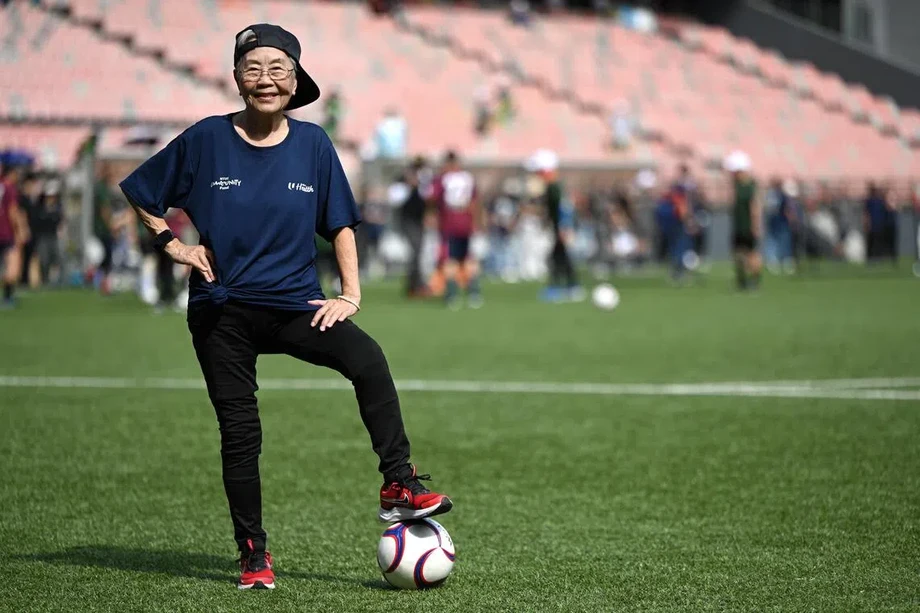
Teo Gek Kee spent Nov 27 on the bleachers at Tampines Hub, cheering other players after her team missed the finals of NTUC Health's annual Active Ageing Centre Walking Football Championships 2026. At 86, the retired souvenir shop owner plays for the western Singapore Walking Football team and says she exercises three times a day.
Contents
- A footballer at 86 shows what the programme wants to protect
- Why a simple fall carries such weight
- What happens during an AI fall screening
- Training seniors to become screeners
- From a Boon Lay pilot to a network of 27 centres
- What support follows a screening result
- The other risk: eating poorly while living alone
- Reaching people whom activities can miss
- Activity, confidence and a reason to stay connected
- What to Know
Teo said stronger players on the other teams had kept her side out of the finals, but that result had not diminished her enthusiasm for the event.
"Unfortunately, the men in the other teams were stronger, so we are not in the finals, but it will not stop me from coming here to cheer others on," she said.
Her own routine begins with taiji in the morning and includes brisk walking. She no longer swims, but she has continued playing walking football since joining a group at Jalan Besar about four years ago. Teo represents a small group of people in their 80s who remain highly active and have no difficulties with walking or balance.
NTUC Health now wants seniors with an interest in learning to help others approach that kind of physical confidence. It is training an initial group of 25 seniors to use CaptureProof Balance Scan, a screening tool that applies artificial intelligence to measurements of walking and movement. The volunteers will learn to administer screening under the Senior-to-Senior (S2S) programme, bringing an assessment of fall risk into neighbourhood Active Ageing Centres rather than relying solely on visits to clinics or hospitals.
Why a simple fall carries such weight
Singapore had about 145,000 citizens aged 80 and above in June 2025, compared with 91,000 in June 2015. That is an increase of 54,000 people, or roughly 60%, in a decade. This age group accounted for 4% of citizens in 2025, up from 2.7% in 2015, and about six in 10 of its members were women.
The National University Health System (NUHS) estimates that about one in three adults aged 65 and above in Singapore experiences at least one fall each year. Among people over 80, the proportion rises to one in two. In its guidance concerning older adults, NUHS also says falls account for 40% of deaths related to injury.
A fall can therefore mean much more than a bruise. It can lead to injury, reduced movement and a loss of confidence that makes a person less willing to leave home. Screening is intended to identify people who could benefit from exercises, physiotherapy or rehabilitation before reduced strength and balance produce a more serious loss of independence.
The broader demographic shift is also continuing. By June 2025, citizens aged 65 and above accounted for 20.7% of the citizen population, compared with 13.1% in 2015. As the number of older residents grows, services that can be delivered close to home become relevant to a larger share of the population.
What happens during an AI fall screening
The CaptureProof assessment asks a senior to complete two ordinary actions: stand up from a seated position and walk in a straight line. Cameras record the person's movements, posture and balance, while the system also measures walking speed and the time needed to complete the tasks.
Artificial intelligence then analyses those recordings and classifies the person's risk of falling as high, moderate or low. Gait, one of the measurements used, simply means the pattern of a person's walking. One example from the screening criteria concerns repeated standing: taking more than 12 seconds to complete five rounds of rising from a chair indicates a higher risk of falling.
The software was developed by digital health company CaptureProof. NTUC Health is working with the company and NUHS, whose clinicians helped develop the support that can follow a screening result. The purpose of the technology is to organise visual and timing information into an accessible assessment, not to make the volunteer screener responsible for medical treatment.
The pilot began at NTUC Health's Boon Lay Active Ageing Centre in July 2025, with particular attention given to frail seniors. Sixty-three people had been screened by the September announcement of the partnerships, and NTUC Health was aiming to reach 200 by the end of 2025. The launch figures did not state how many participants fell into each risk category or provide a final total for that target.
Training seniors to become screeners
Sharon Thien, 63, is among those taking on this unfamiliar responsibility. The retired school vice-principal spent 30 years in education and initially felt uncertain about learning to administer CaptureProof. Her concerns eased after she understood the process and had an opportunity to practise.
Thien said the experience had given her both a useful skill and a way to help other seniors understand their health.
"Once I learnt how the screening works and had the chance to practise it, I realised that it was something useful. I am learning something new while helping other seniors understand their own health better," she said.
She has also applied what she learnt to her own posture, making adjustments intended to reduce her risk of falling. Her teaching background made the peer education element appealing, and she said a simple screening could be meaningful if it encouraged someone to take steps to remain strong and active.
The first 25 trainees form only one part of S2S. Over three years, as many as 200 seniors will take structured roles supporting their peers across NTUC Health's network of 27 centres. Dr Lily Yeo, head of Active Ageing Centres at NTUC Health, said the programme enables seniors to draw on their experiences while acquiring skills and accepting responsibilities within their communities.
From a Boon Lay pilot to a network of 27 centres
According to NTUC Health's milestones, CaptureProof Fall Screening became available in Singapore for the first time at its Active Ageing Centres in 2025. The organisation's official chronology links its launch to the opening of its 25th centre at Bukit Panjang and to a second partnership examining nutrition among seniors who live alone.
The Bukit Panjang centre occupies the second floor of Bukit Panjang Hawker Centre and Market, making it the first Active Ageing Centre in Singapore to share a building with a hawker centre. It began operating in April 2025. By its official opening that September, about 900 seniors had joined its activities, and 44% of them lived outside Bukit Panjang.
- April 2025: The Bukit Panjang centre started operations.
- July 2025: The CaptureProof pilot began at Boon Lay, focusing on frail seniors.
- Sept 19, 2025: Health Minister Ong Ye Kung officially opened the Bukit Panjang centre, where the screening and nutrition partnerships were presented.
- Oct 23, 2025: The initiatives were announced together as part of a wider effort to bring neighbourhood screening and nutrition research closer to seniors.
- First quarter of 2026: This became the revised target for expanding the network to 27 centres, with new locations planned in Bishan and Gek Poh.
Liang Eng Hwa, the Member of Parliament for Bukit Panjang SMC, said the shared location benefited from the natural flow of people visiting the hawker centre and market. Seniors could join centre activities after eating. Ong urged centre operators to work closely with grassroots organisations and nearby hospitals, using residents' networks and community health posts to engage more people.
The S2S expansion now covers the network of 27 centres. At the earlier launch, NTUC Health also raised the possibility of trained staff taking the screening equipment into seniors' homes to make assessment easier, but no date was given for introducing that option.
What support follows a screening result
A screening result can lead to preventive programmes centred on strength and balance, or to physiotherapy and rehabilitation. Physiotherapy uses guided movement and other physical treatments to improve mobility and function. The interventions developed with NUHS clinicians also include strengthening core muscles and addressing malnourishment or muscle loss.
Core muscles support the trunk and help stabilise the body during standing and walking. Exercises directed at these muscles therefore form a practical part of fall prevention. Nutrition also enters the assessment pathway because inadequate nourishment and lost muscle can affect physical strength.
Mdm Yeoh, 73, was screened at Boon Lay. She described why having the assessment at a neighbourhood centre mattered to her.
"Having the assessment at the AAC is much more convenient; I don't need to queue at the hospital and wait for a long time," she said.
For volunteers such as Thien, the role ends with helping a peer complete and understand the screening. Decisions about suitable exercises, treatment or rehabilitation can then draw on the result and the support pathways developed with clinicians.
The other risk: eating poorly while living alone
The second partnership announced at Bukit Panjang addresses a difficulty that a camera cannot assess. Known officially as the GERI Diet Quality Project, it brings NTUC Health together with the Geriatric Education and Research Institute (GERI) to examine the nutritional challenges faced by seniors living alone.
Researchers have been interviewing 30 people aged 60 and above who live by themselves, with participants identified by NTUC Health and its community partners. Preliminary findings showed difficulties preparing proper meals and a tendency among some participants to choose canned food rather than fresh ingredients.
Dr Lily Yeo explained that cooking for one person can feel troublesome, while supermarket package sizes may be too large and dental or other oral health problems can make eating difficult.
"Many consider it too troublesome to cook for one, find supermarket portions too large, or encounter practical difficulties such as oral health issues," she said.
Those circumstances can encourage reliance on processed foods. The research is intended to inform an intervention that reflects the daily constraints participants actually face, rather than assuming that a communal meal programme will reach everyone.
Dr Zoe Lim, the project's principal investigator at GERI, said older adults would participate in shaping that response.
"We are looking to bring in older adults into the research process as valued stakeholders so we can develop an intervention that fits their real-world circumstances and preferences," she said.
The study was still at the interview and preliminary findings stage in the launch account. It did not provide a date for a finished intervention.
Reaching people whom activities can miss
NTUC Health chief executive Chan Su Yee has identified five groups that remain especially difficult to engage: men, seniors from minority communities, frail people, socially isolated individuals and seniors caring for elderly parents, grandchildren or other relatives.
Its responses include activities designed for men, befrienders who visit seniors at home and cooperation with partners at places of worship. Chan said these efforts formed part of the organisation's mission as it expanded services in line with the Age Well Neighbourhoods initiative.
"Supporting them is just as much a part of our AACs' mission, which is to ensure every senior can access resources that enable them to live well at every stage of their life," she said.
S2S also builds on an earlier youth initiative. More than 80 students participated when the Youth-to-Senior (Y2S) programme launched in 2025. Y2S brought students into contact with older residents, while S2S gives seniors themselves defined responsibilities. Yeo described the combined approach as a collaboration across generations intended to keep the senior community healthier, stronger and more connected.
Activity, confidence and a reason to stay connected
Walking football retains the team element of football while requiring participants to walk rather than run. For Teo, regular activity strengthens her legs and core muscles, improves balance and coordination, and builds stamina. Those benefits also appear when she hikes up Mount Faber with her grandson, who is in his 20s.
Teo said she usually keeps up with him and sometimes goes faster, laughing as she recalled their outings.
"I am also able to build stamina. Whenever I go hiking up Mount Faber with my grandson, who is in his 20s, I am usually able to catch up with him. Sometimes I even outpace him," she said.
The new screening programme addresses a different stage of the same effort to remain active. Seniors learn a practical skill, neighbours gain access to an assessment in a familiar setting, and those identified as needing help can be directed towards strength, balance or rehabilitation support. Its stated measures of progress include the first 25 screeners, expansion across 27 centres and up to 200 structured peer support roles over three years.
What to Know
- NTUC Health is training an initial group of 25 seniors to administer CaptureProof Balance Scan through its Senior-to-Senior programme.
- The assessment records a person rising from a chair and walking in a straight line, then uses AI to classify fall risk as high, moderate or low.
- Taking more than 12 seconds to stand up five times is one indicator of higher risk.
- The Boon Lay pilot began in July 2025 and had screened 63 frail seniors by the September partnership announcement.
- Up to 200 seniors will take structured peer support roles across 27 Active Ageing Centres over three years.
- NUHS estimates that one in three Singapore residents aged 65 and above falls each year, rising to one in two among people over 80.
- A parallel GERI project is interviewing 30 seniors who live alone to understand poor nutrition and develop support suited to their circumstances.
- Teo Gek Kee, 86, continues to play walking football, practise taiji, walk briskly and hike with her grandson.