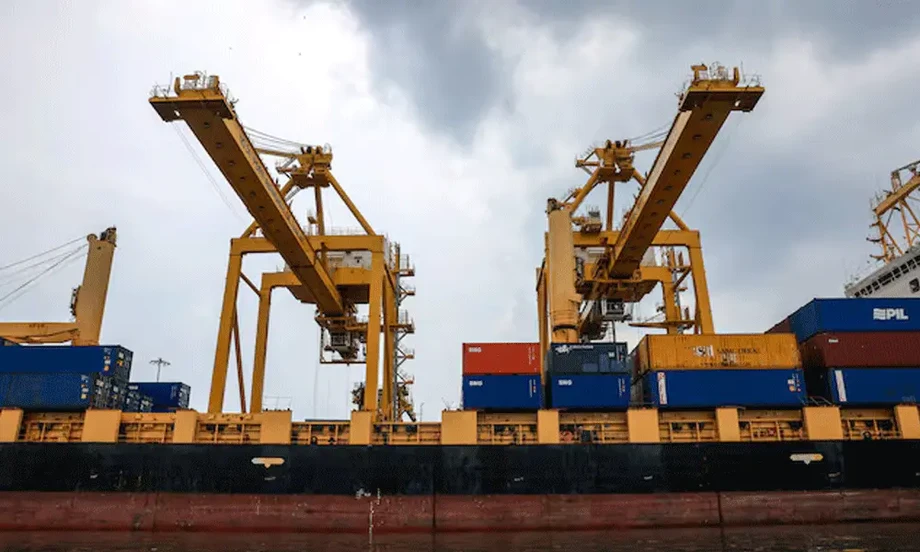
October brings the fastest export growth in five years
Bangkok's Commerce Ministry said on November 27, 2026 that customs cleared exports rose 27.5% in October from a year earlier to $36,859.2 million, or 1,217,046 million baht. That was the fastest annual increase in five years and the 28th straight month of export growth. The pace accelerated from 24.0% in September, when exports reached $38.438 billion and September's record imports pushed the monthly trade deficit to $5.857 billion.
Contents
- October brings the fastest export growth in five years
- Electronics explain most of the export jump
- Where Thailand's exports went
- Imports rose faster than exports
- The wider economy shows an uneven recovery
- Forecasts rise, but 2027 is expected to slow
- A proposed US tariff hangs over the outlook
- AI chips raise questions but show limited immediate impact
- October fits a larger investment story
- The dates that matter
- Key Points
The October reading beat a poll forecast of 26.2%. Imports climbed 53.2% to $49,202.8 million, or 1,645,072 million baht, far above a poll forecast of 32.1%, while another market survey had expected 35.2%. The monthly trade deficit reached $12,343.7 million, or 428,026 million baht, against a forecast shortfall of $5.89 billion. A trade deficit means the value of goods bought from abroad was higher than the value of goods sold overseas.
Nantapong Chiralerspong, director general of the Trade Policy and Strategy Office, said exports for January to October totaled $341,447.8 million, up 20.4% from a year earlier. He said the office expected full year export growth above 19%, supported by electronics, higher oil related shipments and demand before year end festivals. The strong October number came with a $5.04 billion trade surplus with the United States, but the import bill rose even faster than sales by exporters.
The reading was the strongest since June 2021. Excluding oil, gold and military goods, October exports grew 24.5%, and the same measure rose 20.3% in the first 10 months. Those figures show that growth remained broad across goods outside those categories.
Electronics explain most of the export jump
Electronics were the engine. A Kasikorn Research Center analysis said electronics exports rose 67.3% in October and contributed 15.7 percentage points to overall export growth. A contribution in this context is the share of the headline increase that came from one product group. The same analysis said electronics shipments to the United States rose 61.5% and to China rose 75.2%, as demand for artificial intelligence and data center equipment stayed strong.
The Commerce Ministry's product breakdown shows how sharp the technology shift was. Video and audio equipment, devices and parts surged 1,050.9% from a year earlier. Telephones, equipment and parts rose 120.6%, while computer equipment and components increased 56.8%. Industrial products as a group grew 28.0%, and October was the first month in 15 months in which industrial, agricultural and agro industrial exports all expanded together.
Agriculture also contributed. Agricultural exports rose 6.9% and agro industrial products rose 1.4%, giving the two groups combined growth of 4.1% for a third month. The same analysis noted that agro industrial exports had returned to growth after seven months. Sugar rose 31.5%, rubber 30.3%, pet food 10.6%, seasonings 10.5%, processed chicken 8.0% and fresh, chilled, frozen and dried fruit 7.2%. Refined oil exports accelerated as prices rose and regional buyers drew down stocks. Automobiles, equipment and parts fell 17.6%, subtracting about 1.7 percentage points, as flooding from late September to mid October stopped some car plants because parts and labor were short.
Where Thailand's exports went
The United States remained Thailand's largest single market. Shipments there rose 42.9% in October from a year earlier, while shipments to China rose 21.3%, according to the ministry. Thailand booked a $5.04 billion trade surplus with the United States in October, but a $11.89 billion deficit with China, up 78.25% from a year earlier. Receiver and transmitter equipment and installation related devices were the product groups contributing most to the surplus with the United States and the deficit with China.
Other major buyers also increased orders. Exports to the European Union rose 41.3%, to the ASEAN 5 group rose 40.4%, to the CLMV group of Cambodia, Laos, Myanmar and Vietnam rose 18.0%, and to Japan rose 8.8%. Main markets together grew 32.4%. Secondary markets grew 16.8%, including Russia and Commonwealth of Independent States markets at 22.9%, Latin America at 19.6%, South Asia at 16.3%, the United Kingdom at 12.4% and Africa at 2.7%.
Two markets moved the other way. Exports to the Middle East fell 9.3%, which the ministry linked to the closure of the Strait of Hormuz, a shipping route used for oil and Gulf trade. Exports to Australia fell 0.7% because of lower car shipments and parts. For January to October, exports to the United States reached $48.5 billion, up 34.5%, while total exports stood at $341.45 billion, up 20.4%. The cumulative deficit with China was $86.35 billion, up 60.17%.
Imports rose faster than exports
October imports rose 53.2%, up from 50.4% in September, to a record $49.20 billion. Capital equipment imports reached $16.8 billion, and imports of crude oil and refined fuel increased 77% to $6.78 billion. Officials said higher fuel prices and strong purchases of machinery and production inputs explained much of the increase. Capital goods are machines and equipment used to make other goods, so they can raise the import bill now while supporting output later.
Pann Ananapibut, director of the Macroeconomic Policy Bureau and deputy spokesman of the Fiscal Policy Office, said the volume of capital goods imports rose 104.6% in October from a year earlier, although it fell 2.9% from September. The Trade Policy and Strategy Office put January to October imports at $397,485.3 million, up 39.6%, with a cumulative customs basis trade deficit of $56,037.5 million. An alternative customs tally put the same import growth at 36.6%, using a nearly identical dollar total.
Nantapong said the deficit was driven by imports that feed production. He explained his view to reporters after the trade figures were released:
The trade deficit is not a concern because imports have grown on shipments of raw material, capital goods, and semi-finished goods,
The monthly shortfall was larger than September's deficit of $5.857 billion and much wider than the forecast of $5.89 billion. For October, imports exceeded exports by $12.34 billion. That gap matters for businesses because Thailand is paying more for fuel, machines and components, even as those purchases help factories fulfill overseas orders.
The wider economy shows an uneven recovery
Pann said the economy in October had support from exports and domestic tourism, while foreign visitor numbers remained weak. Thailand received 2.27 million foreign visitors in October, down 12.0% from a year earlier but up 4.5% from September. Domestic visitors numbered 23.3 million, up 0.4% annually and 0.6% from the previous month.
Household signals were mixed. New passenger car registrations rose 19.5% from a year earlier and motorcycle registrations rose 3.3%, yet commercial vehicle registrations fell 10.4% and cement sales fell 5.8%. Real farm income increased 12.8%. The consumer confidence index dropped to 50.9 from 52.1 in September, with flooding and high living costs weighing on sentiment.
Inflation and stability figures gave officials room to argue that the external shock was manageable. Headline inflation was 3.90% in October and core inflation, which excludes volatile food and energy prices, was 1.58%. Public debt stood at 68.6% of gross domestic product at the end of September, within the government's fiscal discipline framework. International reserves, the foreign assets held to cushion payment shocks, were $272.8 billion at the end of October.
Forecasts rise, but 2027 is expected to slow
The Trade Policy and Strategy Office raised its 2026 export forecast to more than 19%, up from a baseline of 15% to 16% set last month. The new range is 17% to 21%, with 19% as the midpoint. At the center of that range, full year exports would be about $404.88 billion, or roughly 13 trillion baht, an all time high for Thailand.
Nantapong said growth of 20% or 21% was possible if the electronics cycle accelerated further in November and December. KResearch kept its own 2026 export growth forecast at 20.5% and said artificial intelligence and data center related goods would remain important into 2027. The analysts also expected exports to slow next year because 2026 had set a high base, meaning the comparison is against unusually strong shipments.
The ministry's preliminary 2027 forecast was around 3.5% growth. Officials cited global trade volumes, continued investment in artificial intelligence, progress on a reciprocal trade agreement with the United States and new free trade agreements as supports. Nantapong said the electronics cycle had accelerated in the second and third quarters of 2026. If that trend continued, he said growth could still moderate because the starting point would be much higher.
A proposed US tariff hangs over the outlook
On November 25, the United States announced a preliminary Section 301 tariff of 18% on Thailand after an investigation into structural excess capacity. Section 301 is a United States trade tool used to respond to practices seen as unfair. A tariff is a tax on imported goods, usually paid by the importer, and it can change where buyers place orders. The proposed rate matched rates applied to Malaysia, Indonesia and Cambodia. The final rate is due after a public hearing in January 2027 and a decision in March 2027.
KResearch said an 18% final rate would be close to rates applied to major ASEAN competitors and would not greatly change Thailand's competitive position. The research center also said exporters could ship goods earlier before a tariff starts, a practice known as front loading. It urged monitoring of Section 232, another United States trade provision that can lead to national security based measures if its scope widens to more products.
Dhanakorn Kasetsuwan, chairman of the Thai National Shippers' Council, said exporters were likely to keep orders in the short term. He said United States importers could delay some purchases or ask suppliers to share the tariff burden. Over a longer period, some orders could move to countries with more favorable tariff treatment, and companies could reconsider Thailand as a production base.
The Commerce Ministry has also been trying to widen market access. Officials cited progress in the 10th round of Thailand and European Union free trade talks and the first round of Thailand and Canada talks. A free trade agreement reduces barriers such as tariffs and rules that make it harder to sell goods across borders.
AI chips raise questions but show limited immediate impact
Nantapong was asked about a reported halt in shipments of Nvidia servers. Graphics processing units, or GPUs, are chips that handle many calculations at once and are central to building and training artificial intelligence systems. He said Thailand's GPU imports were relatively small and that detailed figures were not yet clear. He said delayed delivery of some servers could affect data center and artificial intelligence investment if shipments were postponed, while private industrial estate operators remained confident.
The Commerce Ministry said last week that fresh United States restrictions on advanced chip exports affected about 0.7% of Thailand's chip imports, with no broad impact seen so far. The restrictions were aimed at preventing China and other strategic rivals from gaining advanced computing power through third countries. Nantapong said United States companies were not under a framework prohibiting exports of GPUs or advanced computing technology for artificial intelligence into Thailand.
KResearch said electronics exports had not yet faced United States import taxes, but tighter rules for artificial intelligence and data centers could affect investment and demand. The research center still expected global demand for AI related goods to grow. For now, the official data show a technology driven export boom alongside a small but closely watched exposure to chip shipment rules.
October fits a larger investment story
The trade numbers fit the third quarter GDP picture. Thailand's economy grew 2.9% in the third quarter of 2026, supported by an 11.8% rise in total investment and an 18.3% increase in merchandise exports. Private investment rose 16.2%, including a 20.5% increase in machinery and equipment spending. GDP measures the value of goods and services produced in an economy.
Global conditions also helped. The composite purchasing managers index was 53.2 in October, while the manufacturing measure was 52.6, down from 53.0 in September, and the services measure was 53.2, down from 54.5. The manufacturing measure had expanded for 15 straight months. A purchasing managers index above 50 usually indicates expansion. The Commerce Ministry said stronger activity among trading partners supported demand for Thai intermediate goods and raw materials, which are products used in later stages of production.
Risks remained visible. Conflict in the Middle East added uncertainty to shipping through the Strait of Hormuz and to energy costs. Financial markets were volatile, with foreign investors net sellers of 11,922.16 million baht in Thai equities from the start of November through November 25. They were net buyers of 11,388.27 million baht in Thai bonds year to date. Those flows show how global investors were balancing Thailand's export strength against trade policy and geopolitical risk.
The dates that matter
- September 2026: Exports rose 24.0% to $38.438 billion, imports reached $44.296 billion and the trade deficit was $5.857 billion, according to the earlier trade data.
- October 2026: Exports rose 27.5% to $36.859 billion, imports hit $49.203 billion and the monthly deficit reached $12.344 billion.
- November 25, 2026: The United States announced a preliminary 18% Section 301 tariff after its excess capacity investigation.
- November 27, 2026: The Commerce Ministry released the October trade figures in Bangkok.
- January 2027: A public hearing on the proposed tariff is due.
- March 2027: A decision on the final tariff is due.
Key Points
- Thailand's October exports rose 27.5% to $36.859 billion, the fastest annual growth in five years and the 28th straight month of expansion.
- Electronics led the surge, rising 67.3% and contributing 15.7 percentage points to export growth.
- Imports rose 53.2% to $49.203 billion, producing a $12.344 billion monthly trade deficit.
- The United States, China, the European Union and ASEAN markets all posted strong export growth.
- The Commerce Ministry forecast full year export growth above 19%, while KResearch forecast 20.5%.
- A proposed 18% United States tariff and possible Nvidia server delays remain the main external concerns.
- The tariff process moves to a public hearing in January 2027 and a final decision in March 2027.