Rome approval sets a $121.1 million food plan
The executive board of the UN World Food Programme approved a country strategic plan for Tajikistan covering 2027 to 2030, with planned spending of $121.1 million. WFP documents say the decision was made on 18 November at the second regular session of the Executive Board in Rome. The Committee on Food Security under the Government of Tajikistan dated the session 16 November.
Contents
- Rome approval sets a $121.1 million food plan
- What the plan will pay for
- School meals reach half a million children
- How the new budget compares
- Who paid for the current programme
- A parallel push on food quality and exports
- Where national priorities meet international aid
- What changes for families and schools
- What is still unknown
- Key Points
The plan starts on 1 January 2027 and runs until the end of 2030. A country strategic plan is WFP's roadmap for a single country: it sets out what the agency will do with food assistance, nutrition work and logistics over several years. The $121.1 million is the total budget for WFP activities in Tajikistan. It is not a direct payment into the republic's state budget.
The approved document was presented by Lutfullo Abdurazikzoda, deputy chair of the Committee on Food Security. He outlined the plan's main points and said it fits the National Strategy for Development of the Republic of Tajikistan to 2030 and existing state programmes. That alignment matters because a large international plan can only work well when its projects match the country's own priorities and can be delivered through national systems.
What the plan will pay for
Four areas sit at the centre of the 2027 to 2030 plan: helping people withstand emergencies, preventing hunger, strengthening Tajikistan's national school feeding system and improving social protection. In simple terms, resilience means that a village or a family can absorb a shock, such as a disaster or a sharp loss of income, without falling into hunger.
Social protection means public or partner support that helps people cope when life is difficult. It can include help for families with little income, nutrition support for children, or measures that reduce the risk that a poor harvest turns into a long period of hunger. The new plan places this work beside school meals and rural infrastructure, showing that WFP sees hunger as a problem shaped by health, income, water and roads, not only by the amount of food available.
WFP already supports work that fits those priorities in Tajikistan. The agency has helped restore irrigation systems, improve water supply, protect soil fertility and build roads, bridges and other infrastructure. These projects are designed to lower disaster risks and make rural economies steadier.
Climate change makes that work more urgent in a country where many people depend on farming. When rain is irregular or a disaster damages land and roads, crops suffer, family income falls and food becomes harder to reach. WFP's approach is to combine immediate food support with practical projects that help communities keep producing and trading food.
School meals reach half a million children
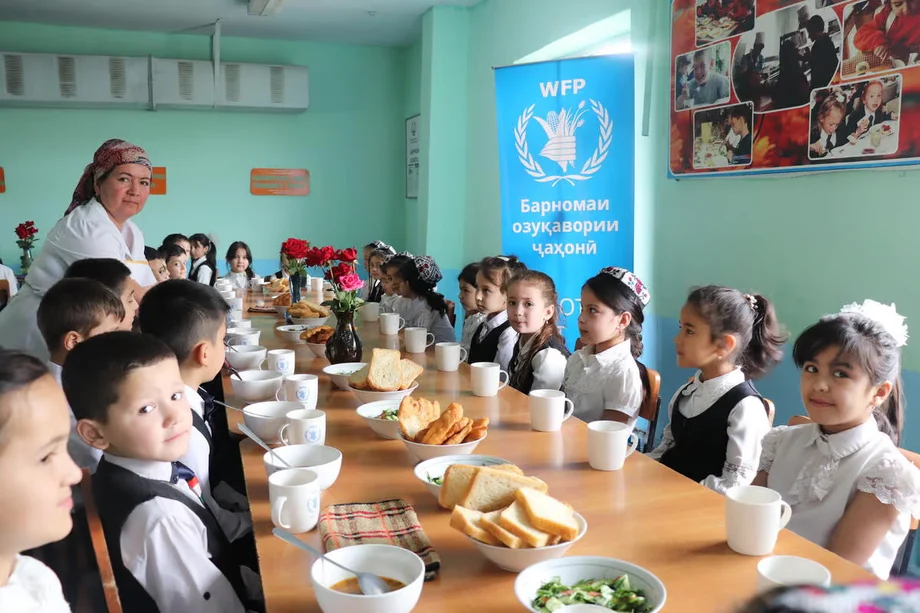
School feeding is one of WFP's largest activities in Tajikistan. The programme has run with the government since 1999. The WFP office in Tajikistan says more than 500,000 schoolchildren receive meals every day in 2,000 educational institutions across 53 cities and districts.
A hot meal at school can change a child's day in several ways. It improves nutrition and health, and it helps pupils learn better because they are less hungry in class. The plan for 2027 to 2030 keeps this programme as a priority and links it to a stronger national system, meaning the aim is to help the country run and improve school meals itself, beyond handing out food.
The programme can also use local food. A WFP photograph by Giulio d'Adamo from Chashma village shows children eating meals prepared from products grown on the school grounds. Such a model links school meals with local agriculture, although the plan does not say how many schools use this approach.
WFP also supports medical facilities in the fight against undernutrition among young children. The focus includes preventing vitamin and mineral deficiencies, which can hold back growth and learning even when a child eats enough calories.
How the new budget compares
The new $121.1 million budget is larger than the funding requirement of the current country programme. WFP's financial report for Tajikistan, as of 16 November 2026, puts the current 2023-2026 programme's financing need at $95.3 million. Measured against that figure, the 2027 to 2030 plan is almost $25.8 million higher, an increase of 27.1%.
The Committee on Food Security used a different comparison and said the new strategy exceeds the previous programme period of 2022-2026 by more than $28 million. The two comparisons label the earlier period differently, but both point in the same direction: WFP is planning a much larger package than the one now ending.
By mid November, the current programme was 96.7% funded. WFP had mobilized about $92.2 million, leaving a gap of $3.1 million. Those figures show a programme close to full funding, while the next one starts with a bigger headline budget and an unfinished question about who will cover it.
The increase matters in practical terms. An additional $25.8 million over four years can support more activities in school meals, nutrition, disaster resilience and social protection. The exact effect will depend on how the money is allocated among these areas and how quickly projects begin after the 1 January 2027 start date.
Who paid for the current programme
The two largest donors are governments. Russia provided $49.1 million and the United States provided $17 million. Together, they account for about 69.4% of the programme's total financing requirement.
- Russia: $49.1 million
- United States: $17 million
- Republic of Korea: $7 million
- Switzerland: $2.4 million
- Saudi Arabia: $439.2 thousand
- Eurasian Development Bank: $300 thousand
The smaller contributions still form part of the same funding pool. The Republic of Korea's $7 million is more than twice the $3.1392 million from Switzerland, Saudi Arabia and the Eurasian Development Bank combined. The donor list applies to the current programme, not to the approved 2027 to 2030 strategy.
A parallel push on food quality and exports
One day after the board session, on 19 November in Rome, Lutfullo Abdurazikzoda met Mohammad Mansuri, director of the Investment Centre of the Food and Agriculture Organization of the United Nations. Their talks covered investment projects outside WFP's own budget, but connected to the same goal: safer food, stronger controls and better access to markets.
The officials discussed modernizing regional diagnostic laboratories and border checkpoints. They also discussed stronger sanitary and phytosanitary supervision in line with international standards, digital food security systems and product traceability. Sanitary and phytosanitary supervision means the checks and rules that protect people, animals and plants from unsafe food, disease and pests. Traceability means being able to follow a product back through the supply chain, so officials know where it came from and how it was handled.
The two sides also looked at investment in Tajikistan's agricultural export potential. They expressed readiness to develop joint investment projects and to strengthen cooperation on food security and the development of the agricultural sector. For farmers, the practical goal would be better quality control and stronger chances of selling products beyond local markets.
Where national priorities meet international aid
The WFP plan and the FAO investment talks share a common idea: outside help is most useful when it fits national plans and institutions. Lutfullo Abdurazikzoda said the new strategy matches Tajikistan's National Strategy for Development to 2030 and current state programmes.
The Committee on Food Security said practical results will depend on matching international support with national priorities and using resources well. In everyday terms, that means money and expertise need to reach working systems, such as schools, health facilities, laboratories and local authorities, rather than sit in a separate aid structure.
This approach can also help keep services running after a programme ends. If school meals, nutrition support and food safety checks are linked to national institutions, they are easier to continue. The 2027 to 2030 plan gives WFP and Tajikistan a longer horizon to build that connection.
What changes for families and schools
For families, the most direct part of the plan is the continuation of school meals for a huge share of the school population. More than 500,000 children already receive daily meals. Keeping this as a priority through 2030 means the programme is expected to remain a routine part of school life in 53 cities and districts.
For rural communities, the focus on resilience means continued work on water, soil, irrigation and transport. These are not abstract aid items. Better irrigation can help farms produce food in difficult weather; better water supply can improve daily life; roads and bridges can help farmers reach markets and help families reach services during emergencies.
For young children, WFP's support to medical facilities targets undernutrition and vitamin and mineral deficiencies. These problems can be hard to see from the outside, but they affect growth, learning and health. The plan puts nutrition work next to schooling and social protection, which recognises that a child learns best when the household is stable.
What is still unknown
How much of the new strategy is already funded remains unstated, and the distribution of the $121.1 million among donors has not been set. No date was given for those decisions. That leaves two practical questions for the period before 1 January 2027: which donors will contribute, and which activities will receive money first.
The current programme still has a $3.1 million financing gap. The next programme has a larger budget, but the approved figures do not show how much will be spent each year or divided between school feeding, rural infrastructure, nutrition and social protection.
The next fixed dates in the plan are its start on 1 January 2027 and its end at the close of 2030. Between now and then, the effect of the strategy will depend on funding decisions, coordination with national programmes and delivery through schools, health facilities and rural infrastructure projects.
Key Points
- WFP approved a Tajikistan country plan for 2027 to 2030 with $121.1 million in planned spending.
- The plan focuses on emergency resilience, hunger prevention, school meals and social protection.
- School feeding currently reaches more than 500,000 pupils in 2,000 institutions across 53 cities and districts.
- The current 2023-2026 programme has $92.2 million mobilized and a $3.1 million gap.
- Russia and the United States account for about 69.4% of the current programme's financing requirement.
- Funding already secured for the new plan and its donor shares have not been established.