A bombshell claim without a public algorithm
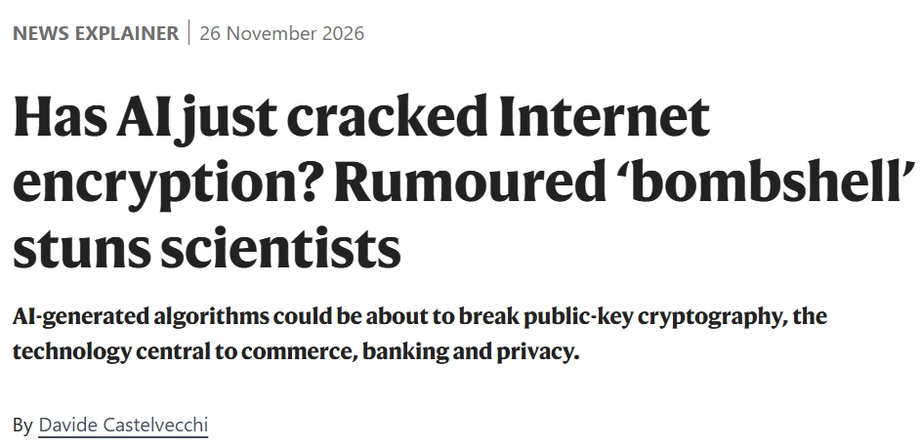
Late on November 24, 2026, Scott Aaronson answered a reader in the comments of his blog, Shtetl-Optimized. The University of Texas at Austin computer scientist said he had heard many rumors that OpenAI, Anthropic or both might be able to factor large numbers in polynomial time on ordinary computers. Such a discovery could undermine RSA, which helps protect websites, financial systems, digital certificates and software signatures. By November 27, neither company had confirmed the claim, and no public algorithm, proof or demonstration showed that modern RSA encryption had been defeated.
Contents
- A bombshell claim without a public algorithm
- Why polynomial time factoring would matter
- The sequence behind the scare
- What two September records actually showed
- Google's papers strengthened theory, not an attack
- A rush of mathematical claims raised the temperature
- Bitcoin wallets face a different mathematical question
- The post-quantum replacements also need an escape route
- Standards and practical deadlines already exist
- What would settle the claim, and what happens now
- What to Know
The speculation had several starting points. On November 21, the X account @Xenoimpulse described hints passed along by an unnamed friend, without identifying a research team or method. Aaronson's subsequent comment carried far more weight because he directs the Quantum Information Center at UT Austin, previously spent two years working on AI safety at OpenAI, and has a reputation for challenging exaggerated computing claims. A viral post by AI commentator Andrew Curran drew more than 2.2 million views by Friday, while some versions of the story omitted Aaronson's caveats.
In a post published on November 25, whose title repeated HOLY SHIT four times, Aaronson separated his confidence about undisclosed research from knowledge of any particular result. He introduced his statement this way:
Because people have been hounding me about it: yes, I'm virtually certain, from multiple reliable sources, that the AI labs are now sitting on one or more bombshells in that area.
Aaronson added that he was much less confident about the specific nature of those bombshells because he had neither seen the details nor heard directly from someone at a laboratory. He later attached a clarification to his earlier comment:
A rumor is a rumor is a rumor, and the parts that I'm 'virtually certain' about fall well short of Factoring in P.
Charles Guillemet, chief technology officer at the digital asset security company Ledger, said affordable factoring in polynomial time would simply break RSA. He also said he did not think factoring belonged to that complexity class. Guillemet warned that a clean process for responsible disclosure would be difficult if a frontier laboratory really had made such a discovery, since premature publication could enable mass exploitation.
The public record remains much narrower than the viral claim. A review of OpenAI's public preprint collection found no paper about factoring large numbers among more than 750 entries, and Anthropic had issued no statement confirming the rumor. Aaronson's words describe information he believes reliable sources possess, not a cryptographic result he has inspected.
Why polynomial time factoring would matter
RSA takes its name from Rivest, Shamir and Adleman, who introduced the algorithm in 1977. Its arithmetic can be illustrated with 77, which equals 7 × 11. Multiplication quickly produces 77, while recovering the two primes from a carefully chosen product hundreds of digits long is vastly harder. An RSA system uses a public key to encrypt information or verify a signature, and a private key to decrypt information or create that signature.
Computer scientists measure factoring algorithms against the number of bits needed to write the input. An algorithm running in polynomial time has a cost bounded by a fixed power of that length, such as n² or n⁵. Even then, a huge exponent or constant could make it impractical. The fastest established classical method for large general numbers, the general number field sieve, has a subexponential cost estimate that grows faster than any fixed power of the input length.
An affordable method at deployed sizes would let an attacker derive an RSA private key from its public modulus. The consequences could include forged website identities, fraudulent software update signatures and false authorization for transactions. A reference key of 2,048 bits is enormously beyond the public challenge numbers discussed below. Practical damage would depend on the hardware, money and time required for each key.
Quantum computing already supplies a theoretical route. Peter Shor's 1994 algorithm can factor numbers in polynomial time on a sufficiently capable quantum computer. The new rumor concerns classical hardware, which is why it has altered the perceived timetable. It would also leave P versus NP unresolved: that question asks whether every yes or no problem with efficiently checkable evidence can also be solved efficiently. Factoring's decision version belongs to NP, but is not known to be among the hardest problems in that class. The Riemann hypothesis, which concerns the distribution of primes, supplies no known general method for quickly finding the factors of a particular integer.
The sequence behind the scare
Several genuine research events became compressed into a single story about broken internet encryption. Keeping their dates separate shows where engineering records, theoretical papers and unsupported claims entered the discussion.
- September 3: Eric Lu of Cognition published the factorization of RSA-260, using GPU software developed with help from the Devin coding agent.
- September 19: Anthropic engineer Stephen A. Weis published the factors of RSA-896 after a GPU computation coordinated with help from Claude.
- November 5: Google DeepMind released Fan Factories, a working paper about sharing some calculations when factoring batches of numbers of equal size. The method had not been implemented.
- November 20 and 22: Cryptographer Anthony Leverrier raised the possibility of an attack involving Ring-LWE, then suggested that such an attack might require a quantum computer.
- November 21: @Xenoimpulse repeated an unnamed person's hints about fast factoring, without supplying evidence.
- November 23: Anthropic and OpenAI separately posted claimed proofs that VP ≠ VNP, a problem related to algebraic complexity.
- November 24 and 25: Aaronson posted his rumor comment and then his bombshells statement, while Google released a separate collection of mathematical papers.
- November 27: No publicly verified classical algorithm for general factoring in polynomial time had appeared, and no practical attack on RSA keys of 2,048 bits had been demonstrated.
What two September records actually showed
Before September 2026, the public record for a general factorization was RSA-250, a number of 829 bits factored in February 2020 with about 2,700 CPU years of computation. Lu's RSA-260 result involved 862 bits and 260 decimal digits. Cognition estimated that it consumed about 4,900 GPU days, equivalent to roughly 13.5 GPU years, and cost around $400,000. Devin helped adapt the CADO-NFS implementation of the number field sieve to NVIDIA GPUs, with the company reporting a cost about one tenth of the previous public CPU approach.
Weis moved the record to 896 bits sixteen days later. RSA-896 has 270 decimal digits and two secret prime factors of approximately 448 bits each. It once carried a $75,000 prize in the RSA Factoring Challenge, which RSA Security retired in 2007. Weis published both primes, allowing anyone to verify the result by multiplying them. His run peaked at 2,048 GPUs and used about 30 GPU years over roughly ten days, drawing on idle computing capacity rather than a dedicated allocation.
The two computations moved the public frontier from 829 to 896 bits in sixteen days, after six years without a larger published general result. Their shared advance was engineering: AI coding systems helped one researcher at a time adapt difficult CPU software for large GPU fleets. Both efforts still used the established number field sieve. Weis said his project produced no new algorithmic improvement and no new threat to deployed keys. His background adds an unusual footnote: he earned his MIT doctorate in 2006 under Ronald Rivest, one of the inventors of RSA.
The distance to modern keys remains immense. No public team has factored RSA-1024. Lu estimated that doing so with the demonstrated approach might require about 1,050 GPU years and roughly $30 million, or about $32 million at market GPU prices. He also estimated that RSA-2048 remains roughly a billion times harder than RSA-1024 under current methods.
That cost estimate still matters for outdated equipment. NIST Special Publication 800-131A assigns RSA keys of 1,024 bits only 80 bits of security strength, below its minimum of 112 bits for applying cryptographic protection, and deprecated that use in 2013. Older VPNs, embedded devices and certificates using keys of 512, 768 or 1,024 bits therefore present a more immediate migration concern than the suggestion that RSA-2048 has already fallen.
Google's papers strengthened theory, not an attack
Google Research released six papers written with AI on November 25, two of them addressing integer factorization. They came from its Cogentic mathematical discovery system, built on Gemini 4 models. One preprint, called Unconditional Integer Factorization in Time L_N[1/3, O(1)], proposes a randomized algorithm with a rigorous subexponential bound. Other manuscripts address deterministic factoring and discrete logarithms in finite fields.
The proposed randomized method carries a running time constant of 105, compared with approximately 1.923 for the established general number field sieve. That makes it considerably less practical for attacking conventional RSA keys, even though its mathematical guarantee may interest researchers. The documents are preprints awaiting independent peer review, and Google has promised formal verification materials. Aaronson described major theoretical results with nothing of immediate practical relevance to cryptography. Guillemet similarly said the work was not a faster attack algorithm and broke no deployed system.
Other experiments define the current boundary even more plainly. A Google DeepMind preprint reported one successful factorization among 15,523 semiprimes of 68 bits reserved for testing, and that success required conventional mathematical processing afterward. The authors found exponential growth in computing cost as bit length increased at fixed accuracy. DeepMind's November 5 batch method remains unimplemented and depends on standard number field sieve assumptions.
Separate theoretical work also falls short of polynomial time. In October, Isaac Rudich and Louis-Martin Rousseau posted a preprint claiming a subexponential bound for deterministic factoring and credited Claude with ideas and formal proof work. Joseph Shunia subsequently claimed a more explicit subexponential bound. Even if independent checking upholds those papers, their stated growth bounds remain weaker than the rumor requires. DeepMind's recent reductions in the cost of selected quantum algorithms for physical simulation likewise did not amount to a new version of Shor's algorithm for attacking RSA.
A rush of mathematical claims raised the temperature
The rumor followed an extraordinary sequence of announcements. In October, OpenAI and Anthropic released rival claims refuting the Exponential Time Hypothesis, with arguments checked using the Lean proof assistant. On November 23, both laboratories posted claimed proofs that VP ≠ VNP, Leslie Valiant's algebraic analogue of P versus NP from 1979. Anthropic included Lean code, while its notes said no human mathematician had checked the proof and stated, This does not settle P vs NP.
Ryan Williams of MIT, Russell Impagliazzo and Ramamohan Paturi formed the independent team examining those claims. Williams called the developments really surprising and said OpenAI was reasonably confident that its result implied no encryption break. Their assigned task is reviewing the proofs, not investigating secret laboratory cryptography.
OpenAI also posted a 111-page paper claiming that the exponent of matrix multiplication is exactly 9/4, addressing a question associated with Volker Strassen's work in the late 1960s. Another release claimed matching upper and lower bounds for linear gates needed to compute the Fourier Transform. Anthropic mathematician Levent Alpöge separately said that he and Claude had proved the Riemann hypothesis, with the argument certified by Lean. These are consequential claims still undergoing mathematical scrutiny, rather than evidence of a universal key to encryption.
Aaronson, reflecting on the pace of the announcements, offered a personal forecast rather than a completed theorem:
I now feel in my bones, for the first time ever, that a proof of P ≠ NP is not far.
His reaction helps explain why the cryptography rumor found an audience. Laboratories had demonstrated that they could hold a claimed mathematical result before publishing it, leaving outsiders to wonder what other work remained undisclosed.
Bitcoin wallets face a different mathematical question
Bitcoin does not use RSA to authorize spending. It relies on ECDSA and Schnorr signatures over the secp256k1 elliptic curve, with Taproot introducing Schnorr signatures in 2021. A method for factoring integers would not by itself solve the elliptic curve discrete logarithm problem behind those signatures. Bitcoin mining presents a third mathematical system: its proof of work uses SHA-256, so the factoring rumor does not directly alter mining.
Exposure would change if elliptic curve signatures were broken. Glassnode said about 7.12 million BTC sat at addresses whose public keys were already visible in the blockchain, a record high in its November 26 tally. Public keys in that condition would be the relevant targets if attackers could derive corresponding private keys. Aaronson told readers primarily worried about their wallets to look elsewhere for rumors about ECDSA, declining to validate that separate claim.
A sufficiently capable quantum computer running Shor's algorithm could threaten both RSA and elliptic curve keys. Ethereum Foundation researcher Justin Drake had already urged the cryptocurrency industry in October to prepare a calm bunker mode plan, including moving funds to addresses whose public keys had never appeared in the blockchain. Vitalik Buterin also warned that mathematical progress driven by AI could weaken some post-quantum proposals within two years. Those preparations address possible future attacks, not a demonstrated theft capability from the RSA rumor.
The post-quantum replacements also need an escape route
The third branch of the rumor concerns Ring-LWE, a lattice problem related to the mathematics behind several post-quantum systems. Lattices can be pictured as regular patterns of points extending through hundreds of dimensions. Ring-LWE hides secrets within equations whose answers have been distorted by small errors. Leverrier's November 20 warning and his subsequent quantum computing qualification did not establish that the standardized systems could be defeated.
NIST's ML-KEM standard establishes shared keys, while ML-DSA creates digital signatures; both rely on lattice mathematics. SLH-DSA instead uses hash functions, which are closer to digital fingerprints, but produces larger signatures. Published attacks against selected versions of Ring-LWE have not defeated these standards. The episode nevertheless shows the danger of permanently building every device around one mathematical assumption.
Ofir Joseph of the University of Haifa, Irit Hadar of the same university and Miriam Shtilman of Tal Ventures argue that cryptographic agility should become a purchasing requirement. A utility, hospital or telecom operator should be able to change signature and key establishment methods across installed equipment without sending technicians to every site or interrupting essential service. A supplier that can demonstrate such a switch turns a newly discovered weakness into a managed maintenance project rather than an equipment replacement crisis.
Recorded communications create a separate deadline. An operator can change next year's signature method, but cannot restore secrecy to traffic that an adversary has already stored if its key protection later fails. Correctly combining conventional and post-quantum key establishment can preserve confidentiality when either method remains secure and the rest of the system is sound. Quantum key distribution over fiber may suit some connections between data centers, but it cannot replace digital signatures. The US National Security Agency advises against its use in national security systems unless practical limitations are overcome.
Standards and practical deadlines already exist
NIST began publicly requesting post-quantum standardization proposals in 2016 and finalized its first three standards in August 2024: FIPS 203, FIPS 204 and FIPS 205. Work on additional standards, including FIPS 206, continues. Organizations therefore have concrete algorithms to test now rather than waiting for a rumored laboratory disclosure.
In RSA Security's guidance, updated July 1, 2026, the company explains that RSA encryption is a public standard specified in FIPS 186-5, not a product owned by RSA Security. The guidance cites NIST's position that RSA keys of 2,048 bits should remain sufficient through at least 2030. Modern browsers also support RSA keys of 4,096 bits, although longer keys do not provide a permanent answer to a fundamentally faster algorithm.
An earlier quantum scare illustrates the scale problem. A May 2024 paper by Shanghai University researchers described a hybrid quantum and classical method that factored integers of up to 50 bits. That experiment was far removed from attacking RSA keys of 2,048 bits. Estimates for breaking one such RSA key with a quantum computer call for a large machine capable of correcting errors and containing millions of physical qubits, well beyond current practical cryptographic capability.
Migration work should begin with an inventory of certificates, applications, cloud services, industrial equipment and systems operated by suppliers. Organizations can then identify data that must remain secret for many years, test the NIST standards, maintain key rotation and require vendors to explain how algorithms can be replaced. The same guidance identifies credential theft, weak multifactor coverage, social engineering and unmanaged access as active dangers. The Change Healthcare, Scattered Spider and Colonial Pipeline incidents show why encryption planning should accompany identity controls rather than displace them.
What would settle the claim, and what happens now
A credible claim of fast general factoring would need an explicit algorithm, clearly stated assumptions, and proofs of correctness and running time that independent specialists can examine. Reproducible runs on public inputs would answer the separate practical question, with hardware, elapsed time, energy use and financial cost disclosed. If researchers credit an AI model, they would also need to identify which ideas, proofs or code came from the model and which steps people verified.
No disclosure timetable has been announced by OpenAI or Anthropic, and no date has been given for a public verdict on the rumor itself. Aaronson has urged serious consideration of the possibility that AI models could discover breaks in one or more widely deployed cryptographic codes within the next year or two. He did not name a specific deployed system that had already been compromised.
For security teams, the useful response is measurable preparation: find obsolete RSA keys, prioritize sensitive records with long secrecy requirements, test post-quantum implementations, preserve the ability to change algorithms and close identity weaknesses being exploited today. Those actions remain valuable whether the next development is a mathematical paper, a laboratory denial or another year without either.
What to Know
- As of November 27, 2026, no publicly verified classical algorithm could factor general integers in polynomial time, and OpenAI and Anthropic had confirmed no RSA break.
- Scott Aaronson said he was virtually certain that AI laboratories held cryptography bombshells, while stressing that his confidence fell well short of Factoring in P.
- September records for RSA-260 and RSA-896 used the established number field sieve; Devin and Claude mainly accelerated GPU engineering and coordination.
- RSA-1024 remains unfactored in public, while RSA-2048 is estimated to be roughly a billion times harder under the current approach.
- Google's November papers offered theoretical bounds but no practical attack on modern RSA keys.
- Bitcoin uses elliptic curve signatures rather than RSA, and its SHA-256 mining process is separate from both.
- Ring-LWE rumors also remain unverified, reinforcing the case for systems that can replace cryptographic algorithms safely.
- NIST finalized FIPS 203, 204 and 205 in 2024, giving organizations concrete post-quantum standards to test during migration.