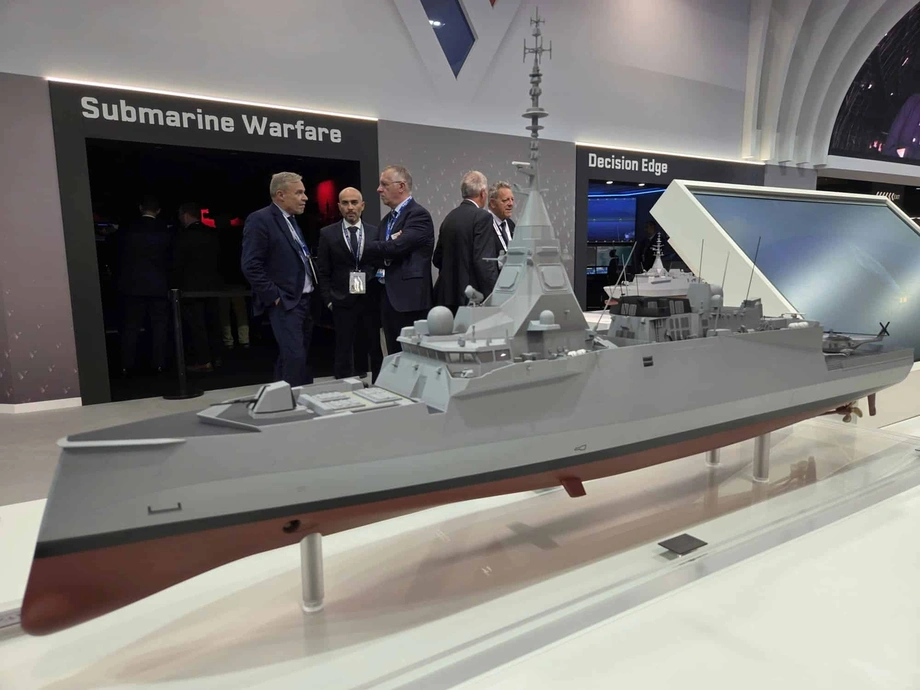
A new weapons package for an export frigate
Lockheed Martin has shown how it would arm the International Class Frigate, a surface combatant displacing 4,000 tons, with a compact forward launcher bank and 12 launch positions for Joint Air-to-Ground Missiles. The concept appeared on the company's interactive screen at Euronaval 2026, and details of the display were published on November 26. Gibbs & Cox designed the ship from its Taiwan Light Frigate work for escort, submarine hunting and combat against other surface vessels.
Contents
- A new weapons package for an export frigate
- Two launcher choices and 12 JAGM positions
- Why defense against drones shapes the concept
- Taiwan construction and a flexible export design
- A corvette measuring 88 meters for smaller shipyards
- Nine potential buyers and no signed orders
- Why the Philippine financing package matters
- Subic Bay, Basco Airport and the Luzon Strait
- Drones, digital systems and the wider diplomatic package
- Five dates behind the story
- What to Know
The proposal is aimed at navies that need a ship for general missions while planning for drones, other unmanned vehicles and relatively inexpensive munitions. Lockheed Martin has marketed the design to the Philippines, Croatia, Egypt, Romania, Bahrain, Greece, Sweden, Kuwait and the United States. Those pitches range from countries considering small combatants to the U.S. Navy, which is reassessing its own frigate plans.
Displacement is the weight of water a ship pushes aside and provides a standard measure of its size. At 4,000 tons, the International Class is smaller than the major destroyer programs that Lockheed Martin also displayed at Euronaval. No country has announced a formal purchase of the frigate or the exact weapons arrangement shown at the exhibition.
Two launcher choices and 12 JAGM positions
The forward launcher bank offers two distinct choices. One is eight Mark 41 vertical launch cells in the strike length version. Vertical launch cells are tubes built into a ship, allowing missiles to be fired without turning a launcher toward the target. The strike length version is longer than shorter configurations and can accommodate larger weapons. The alternative is nine Extensible Launching System cells, divided into three modules containing three cells each.
The Extensible Launching System, or ExLS, is intended for smaller missiles and countermeasures. Lockheed Martin listed the RIM-116 Rolling Airframe Missile and Nulka active missile decoys among the equipment it can accommodate. The Rolling Airframe Missile provides defense against threats approaching the ship, while Nulka is designed to lure an incoming missile away from its intended target.
Three JAGM Quad Launchers sit farther aft, above the helicopter hangar. Each launcher has four positions, giving the ship 12 in total. Lockheed Martin presents them for combat against surface targets at short range and for defense against unmanned aircraft. Although the full JAGM name refers to an air launched weapon for attacking ground targets, the company is adapting its use for naval missions.
Placeholders for missile canisters also appeared amidships, meaning in the middle section of the ship. Those canisters would hold missiles for attacking other vessels. The design also showed a defensive missile system intended to destroy threats very close to the frigate. The exhibition did not identify the specific weapons that would occupy those positions.
Why defense against drones shapes the concept
Lockheed Martin's systems for Japan's Aegis System-Equipped Vessels and Canada's River-class destroyers were also on display at Euronaval. Those programs use more advanced combat systems. By contrast, the equipment selected for the Gibbs & Cox concept concentrates on threats at medium range and on the everyday missions assigned to frigates, including escorting other ships, hunting submarines and fighting surface vessels.
The JAGM launchers connect the concept to a wider search for less expensive ways to defeat drones. Lockheed Martin previously proposed installing the same type of quad launcher on Arleigh Burke-class guided missile destroyers as a response to drone threats in the Red Sea. Large warships carry sophisticated defensive missiles, but commanders facing repeated drone attacks also need options that conserve their most expensive weapons.
The U.S. Navy has separately adjusted the Littoral Combat Ship's Surface-to-Surface Missile Module so that it can target unmanned aerial systems. That module fires Longbow Hellfire missiles and is slated for future JAGM integration. Littoral Combat Ships were designed for operations near coasts. The Red Sea proposal and the changes to that module explain why a weapon originally associated with aircraft and ground targets is now being presented for naval defense against drones and surface threats.
Taiwan construction and a flexible export design
Two light frigates based on the Gibbs & Cox design are in production in Taiwan. They are being built in different configurations, one concentrated on air defense and the other on warfare against submarines. The export design therefore has a direct connection to an active shipbuilding program rather than existing solely as an exhibition model.
A frigate scale model displayed at Indo Pacific 2025 carried Naval Strike Missile launchers, Mark 41 vertical launch cells and the AN/SLQ-32 electronic warfare suite. Electronic warfare equipment is used to detect and respond to hostile electronic emissions, including those associated with radar and missile threats. The Euronaval display showed a different arrangement, including the option of ExLS instead of Mark 41 and the addition of JAGM launchers.
An Australian variant displayed at Indo Pacific 2023 had a CEA radar suite. Gibbs & Cox offered that version for SEA3000, the Royal Australian Navy's requirement for smaller surface combatants known as its Tier 2 program, but the bid was unsuccessful. The changing weapons, sensors and national configurations demonstrate how the underlying design can be adjusted for a customer's mission and budget. Gibbs & Cox also designed the frigate so that it could be produced by a wider range of shipyards around the world, rather than relying exclusively on the largest naval shipbuilding specialists.
A corvette measuring 88 meters for smaller shipyards
The International Class Corvette unveiled at Indo Pacific 2025 applies the same approach to a smaller vessel. It measures about 88 meters, or 288.7 feet, and incorporates much of the frigate's equipment in a reduced package. Gibbs & Cox developed it after navies expressed interest in something smaller than the frigate. Its size allows construction at more shipyards in Australia and elsewhere, with lower construction costs offset by the loss of some frigate capabilities.
The corvette has a sizable utility deck that can carry several cargo containers measuring 20 feet and accommodate containerized mission packages. It also has a flight deck capable of landing helicopters, two bays for Rigid Hull Inflatable Boats and a power plant using diesel engines alone. Both the corvette and frigate have a design life of 40 years.
Levi Catton, managing director for Leidos Gibbs & Cox Australia, described the durability intended for the design family when he presented the corvette:
Absolutely a U.S design heritage, U.S Navy toughness standards, absolutely built for long, tough service.
Gibbs & Cox is open to both Foreign Military Sales and direct commercial sales. Under Foreign Military Sales, the U.S. government acts as an intermediary for a foreign customer's purchase. A direct commercial sale is negotiated with the company instead, giving potential customers two different acquisition routes.
Nine potential buyers and no signed orders
Croatia and the United States provide the clearest active procurement openings among the nine countries on Lockheed Martin's exhibition list. Zagreb is pursuing a multipurpose corvette acquisition. The U.S. Navy retains frigate and FF(X) small surface combatant requirements after cutting back its Constellation-class construction program. Neither requirement has produced an announced selection of the International Class design.
The other listed countries have pursued frigates or similar small surface combatants in recent years, while the Philippines has received a specific proposal supported by the partnership between Lockheed Martin and Gibbs & Cox. A marketing presentation allows a company to offer different sensors, launchers and construction arrangements before a navy settles its requirements. No contract values, hull quantities, construction sites or delivery dates were announced for any of the nine potential customers.
Why the Philippine financing package matters
The Philippines now has a separate defense financing package that could support a broad range of purchases, although it has not selected the frigate. During President Donald Trump's visit to the Philippines for the Association of Southeast Asian Nations summit, agreements were announced alongside Philippine President Ferdinand Marcos Jr. A White House fact sheet released on November 18, 2026, proposed a $2 billion defense loan for equipment and services from U.S. suppliers, together with $400 million in Foreign Military Financing.
The $2 billion is a proposed loan rather than a straightforward equipment grant, and its repayment terms were not given. The wider package was described as supporting more than 7,000 American jobs. The White House release described the $400 million allocation and its intended role in the South China Sea:
The United States will utilize $400 million in [foreign military financing] for the Philippine military to expand its operational reach and deterrence capabilities in the South China Sea, including long-range fires, command and control, critical infrastructure and multi-domain drones, supporting 1,500 American jobs.
The employment figure of 1,500 jobs applies specifically to that allocation, while the larger jobs estimate covers the broader package. The listed priorities include weapons capable of striking at long range, command and control systems, critical infrastructure and drones operating across different environments.
Lockheed Martin's proposals to Manila also include M142 High Mobility Rocket Systems and F-16V Viper fighter jets. The company has partnered with Gibbs & Cox to arm the International Class Frigate for the Philippine Navy. Manila has separately expressed interest in Lockheed Martin's Mid-Range Capability, which uses Mark 41 launch technology on land. The U.S. Army has deployed that system in the Philippines since April 2024. Neither financing announcement named the frigate as an acquisition, and no date was given for a Philippine ship decision.
Subic Bay, Basco Airport and the Luzon Strait
Subic Bay is receiving a $40 million fuel storage facility under the same group of announcements. The former U.S. Navy base has become an increasingly active logistics location. Since 2022, almost every branch of the U.S. military has staged forces or supplies there. The Army and Marine Corps contracted storage for vehicles and supplies, while the Coast Guard staged cutters during the summer of 2026 at a pier across from the Philippine Navy's primary base.
Basco Airport in the Batanes Islands is also due for modernization to increase operational access. The airport lies in the Luzon Strait within 100 miles of Taiwan. Since 2025, the U.S. Marine Corps has used it to insert maritime sensing teams and Navy-Marine Expeditionary Ship Interdiction Systems, units equipped with missiles for attacking ships. During an exercise in 2024, one maritime domain awareness team was positioned on an island only 88 miles from Taiwan.
The Luzon Strait lies between the Philippines and Taiwan and connects the South China Sea with the western Pacific. It forms part of the first island chain, the arc of islands close to the Asian mainland. Airfield access, fuel storage, sensors and missile units give the allies more ways to monitor and operate around that passage. Those infrastructure measures are separate from the frigate proposal, but they illustrate the defense relationship in which Lockheed Martin is pursuing the Philippine sale.
Drones, digital systems and the wider diplomatic package
Attack drones are expected to be transferred to the Philippines in 2027, according to U.S. defense officials. American assistance for Manila's Asymmetric Capabilities Program involves Maritime Tactical Systems, Inc. and Ocean Aero. The program is building a mesh network of unmanned systems, meaning a collection of connected platforms that can share sensor and command information rather than operating in isolation.
Digital work includes a $37 million contract with a U.S. company for technology enabled mission support and improved interoperability. The Philippine Department of National Defense separately committed to work with U.S. technology providers on a $63 million upgrade of defense cloud infrastructure, the computing systems used to store and share military data.
The two governments are also exploring an intergovernmental agreement on civilian nuclear technology. If completed, it would be the first U.S. civil nuclear agreement with an Indo-Pacific partner. The commercial announcements included Philippine Airlines' plan to buy as many as 20 Boeing 787 aircraft with GE Aerospace engines. Trump announced more than $17 billion in commercial deals and strategic investments during the ASEAN summit.
Chester B. Cabalza, founder and president of International Development and Security Cooperation, said the U.S. defense commitment to the Philippines remained unmatched by Manila's other security partners in the region. He described Washington's objective in these terms:
Washington wants to strengthen Manila to build a network of allies that are capable of defending their own sovereignty and willing to contribute to regional security.
Five dates behind the story
The Australian sales campaign, Taiwan's construction work and the Philippine defense announcements developed over several years:
- Indo Pacific 2023: Gibbs & Cox showed an Australian frigate variant with CEA radar for the SEA3000 competition, which it ultimately did not win.
- April 2024: The U.S. Army began its deployment of the Mid-Range Capability in the Philippines. A maritime awareness team operated 88 miles from Taiwan during an exercise later that year.
- 2025: Gibbs & Cox unveiled the corvette measuring 88 meters at Indo Pacific 2025. Basco Airport has supported U.S. Marine Corps sensor and missile unit insertions since that year.
- November 18, 2026: The White House fact sheet set out the proposed $2 billion Philippine defense loan, the $400 million financing allocation and infrastructure measures.
- November 26, 2026: Details of the Euronaval display showed the International Class Frigate's launcher options, JAGM positions and list of nine countries where it has been marketed.
What to Know
- Lockheed Martin's Euronaval 2026 concept arms the International Class Frigate, which displaces 4,000 tons and derives from the Gibbs & Cox Taiwan Light Frigate design.
- Customers can choose eight Mark 41 cells or nine ExLS cells, alongside three quad launchers providing 12 JAGM positions.
- The design has been marketed to nine countries, including the Philippines, Croatia and the United States, but no formal order has been announced.
- Two related frigates are in production in Taiwan, while a corvette measuring 88 meters has also been designed for construction at a wider range of shipyards.
- The proposed Philippine package includes a $2 billion defense loan and $400 million in military financing, without selecting the frigate.
- Subic Bay fuel storage, Basco Airport modernization, drone transfers and digital upgrades form the wider defense setting for Lockheed Martin's Philippine sales campaign.