Why PTT's identity experiment matters
PTT, Taiwan's long running nonprofit bulletin board, has been online for more than 30 years. In election years, it becomes a contest over attention, with operators creating multiple accounts, flooding threads and trying to steer opinion. Moderation is handled by volunteers, a structure that can be overwhelmed when a campaign is organised and fast.
Contents
- Why PTT's identity experiment matters
- How the proposed blue check would work
- Why legal names are a poor fit for PTT
- Why digital identity has more than one job
- Four proofs for four civic needs
- Who vouches, and who controls the disclosure
- What Taiwan's wallet is, and what it is not
- Why the rollout is facing a trust test
- What earlier digital identity plans teach
- A short timeline of the identity push
- Can pseudonyms still be accountable?
- What civic identity should become
- Key Points
Taiwan's National Security Bureau has reported influence operations linked to China that use inauthentic accounts and material made by AI to weaken confidence in Taiwan's democracy. That background makes manipulation a security concern. It also makes identity data risky, because a list connecting political speech to legal identities would be attractive to attackers and could enable intimidation if it leaked.
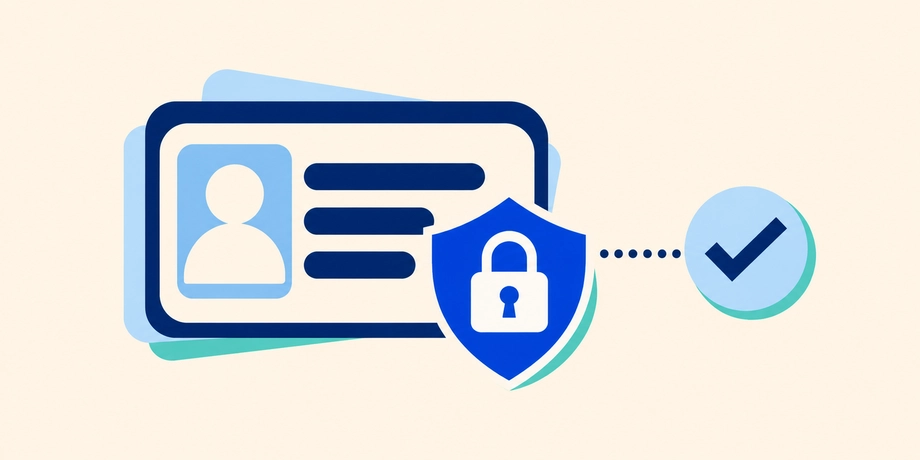
With 2026 local elections approaching, PTT administrators and cryptography developers are testing a narrower idea: prove that a user holds an eligible Taiwanese credential, while keeping the user's name, national ID number and other certificate details private. The proposed mark is a blue check beside an account.
The plan comes from a civic technology researcher who worked on Taiwan's Digital Identity Wallet at the Ministry of Digital Affairs and was a Policy Fellow at the Allen Lab for 2025 and 2026. The argument is that a person who speaks, votes in an online community or joins a public discussion should prove only what that action requires.
Digital identity means the proofs people use online to show who they are or what they are allowed to do. A bank login, a benefit application and a forum account can all involve identity, but they do not all need the same proof. That distinction is at the centre of the PTT test.
How the proposed blue check would work
Under the proposal, a user would take a Citizen Digital Certificate issued by Taiwan's government, including its mobile version, and generate a zero-knowledge proof on their own device. A zero-knowledge proof is a mathematical method that lets one side prove a statement is true while keeping the private details behind it hidden. The statement here is that the user holds an eligible credential issued by Taiwan's government.
PTT would check the mathematical proof while the certificate details stay private. The forum could learn that the user has a valid Taiwanese basis for the check, without receiving the legal name, national ID number or address stored in the certificate. No launch date was given for the PTT check, and it remains under development.
The proof covers one condition. Moderators would still need tools for duplicate accounts, stolen accounts, coordinated activity, account recovery and fair sanctions.
Why legal names are a poor fit for PTT
Requiring every account to be tied to a real name sounds like the obvious answer to fake accounts. PTT's history makes that answer less attractive. Pseudonymous posting is part of the forum's culture, and users have built reputations under names that are not their legal names.
Taiwan's geopolitical position adds another reason. A database of legal identities linked to political posts would become a valuable target. If breached, it could expose participants to targeted pressure. The PTT experiment tries to reduce that risk by avoiding a platform database of identity records for a simple eligibility check.
Why digital identity has more than one job
Most identity systems are built around a service provider: a government delivers a service, a bank opens an account, a platform lets a user log in. The Allen Lab's framework for digital civic infrastructure starts with people as participants in public life. It describes three dimensions: Connect, Learn and Act.
Connect is about continuity and trust. A community may need to know who has moderated for years, who contributed code or who can serve in a role. Legal names are often unnecessary. Taiwan's g0v open source community shows how people can build trust under pseudonyms.
Learn is about access to information. Public records and discussions should be readable without signing in. Act is the hard part. Once a system asks whether someone is eligible, has already voted, meets an age threshold or can be held responsible, identity becomes a condition of public action.
Four proofs for four civic needs
The researcher proposes replacing the single question Who are you? with a more exact question: What does this action require you to prove? That shift groups digital identity into four kinds of civic proof.
- Legal identity is needed for tax filings, statutory benefits and legally binding documents. It must rest on an identity recognized by law, with a traceable basis and a way to revoke it.
- Attribute proof establishes one fact, such as being at least 18 or living in a jurisdiction. It does not require a full identity.
- Uniqueness proof supports one person, one vote or one person, one account. It helps resist Sybil attacks, where one actor creates many identities to pretend to be a crowd.
- Pseudonymous participation allows whistleblowing, sensitive consultations and political dissent, while leaving room for review of conduct through fair procedures.
A taxpayer and a whistleblower may both need to verify a claim, but their constraints differ. Demanding the same fields in every case makes surveillance, control and intimidation easier.
Who vouches, and who controls the disclosure
Digital identity has two jobs that are often mixed together. One party vouches for a claim. Another party holds the credential and decides when to present it. Governments and recognised institutions still provide the strongest foundations for identity. Banks verify customers through know your customer procedures, and platform providers such as Google or Microsoft let users sign in elsewhere with an existing account.
Sweden's BankID shows a model in which banks issue credentials that other services accept. Digital identity wallets draw on self-sovereign identity, the idea that people should hold credentials from different issuers and choose when to present them. The issuer still vouches for the claim. Selective disclosure and zero-knowledge proofs can limit the fields revealed, but privacy still depends on the cryptography and the implementation.
Standards are emerging. The W3C Verifiable Credentials Data Model v2.0 sets a framework for credentials and presentations. The W3C Digital Credentials API, still a working draft, is developing browser based exchange.
What Taiwan's wallet is, and what it is not
The Ministry of Digital Affairs' digital credential wallet page says the wallet is a carrier for credentials, not an electronic wallet and not a digital identity card. It could hold digital versions of a student card, driver's licence, graduation certificate or similar documents.
The ministry lists three features: Simple, Safe and Self-sovereign. It also highlights selective disclosure and interoperability between countries. A typical flow has six steps: log in, tap scan, scan a QR code, choose which fields to disclose, verify with biometrics and complete verification.
Minister Huang Yen-nan said the wallet would let people leave home without stacks of cards and called it a milestone in government digital transformation. In translated remarks, he said:
In the future, as long as people have a mobile phone, they will not need to carry so many documents. This is an important milestone in the government's digital transformation.
The ministry has opened a sandbox trial for groups that want to build the wallet ecosystem and convert credentials. It lists [email protected] and 02-89786158 for weekday inquiries from 09:00 to 18:00.
Why the rollout is facing a trust test
Taiwan's wallet programme began in 2024 and is planned over four years. It is described in English as a 4.6 billion New Taiwan dollar programme and in Chinese as 4.6億元, or about 460 million New Taiwan dollars. About 100 million New Taiwan dollars had already been spent by early 2025. The plan has not been formally submitted to the Executive Yuan for full cabinet discussion, and officials say it will move in stages after test results are collected.
Health Insurance Agency spokesman Jiang Shu-liang said at the March briefing that the health card in the wallet could serve as identity proof for picking up parcels but was not planned for collecting medicine. He pointed to medical data and payment reporting issues. In translated remarks, he said:
Whether it will be combined with medical care in the future can be discussed further.
The ministry answered that its video showed an ideal future and that it had agreed with the agency not to enter medical settings for now. The exchange showed how hard cooperation between agencies can be.
Ding Hao-yuan, senior analyst in the ministry's Digital International Division, said the plan counts on network effects, meaning a service becomes more valuable as more people use it. In translated remarks, he said:
The more people use it, the higher the value. The convenience of the wallet itself is an incentive.
Ding said no penetration target had been set. A ticket seller quoted in the same account said a real name concert ticket check now takes staff only seconds and costs nothing. A wallet would require new systems and staff training. Unless usage passed 50 percent or even 80 percent, the business would wait.
What earlier digital identity plans teach
Taiwan Network Information Center chairman Huang Sheng-hsiung said the government should bring all digital services into the wallet instead of spreading them across separate apps, and should create stronger commercial incentives. Taiwan Economic Research Institute associate researcher Wang Wei-hung compared the wallet to a personal insurance box that users open themselves, with government verification support around it.
Wang warned that no security system can promise perfect protection. He said Taiwan needs a clear legal framework and defined liability before a breach becomes a dispute over responsibility. An amendment to the Personal Data Protection Act on data portability, which lets people move data between providers, was still before the Legislative Yuan.
The long history of identity issued by the state in Taiwan adds caution. In 2020, the government planned to replace national identity cards with a New eID built around a chip. Security researchers and human rights groups objected to the legal basis and security risks. The Executive Yuan put the plan on hold in January 2021. More than 2,000 scholars and experts had opposed it, and the decision left 280 million New Taiwan dollars in vendor penalties.
The Citizen Digital Certificate system, operated through the Ministry of the Interior Certificate Authority, continued in its existing role. The Mobile Natural Person Certificate launched in 2022 had about 770,000 users after three years, roughly 3 percent penetration.
A short timeline of the identity push
The two debates now overlap.
- 2014 to 2024: The European Union planned digital identity wallets, adopted the General Data Protection Regulation in 2016, set a technical framework in 2021, ran four pilots in 2023 and approved a revised framework in May 2024.
- 2020 to 2021: Taiwan planned a New eID, then put it on hold in January 2021.
- 2022: The Mobile Natural Person Certificate launched.
- 2024: Taiwan started the wallet programme.
- March 2025: The Ministry of Digital Affairs presented wallet scenarios and opened public testing.
- 2026: Local elections are approaching in Taiwan, and the EU expects to provide wallets to citizens.
The EU comparison matters because its plan took about a decade to reach launch, including rules, pilots and commercial uses such as professional certificates, prescriptions, telecom contracts and financial accounts.
Can pseudonyms still be accountable?
Attacks by anonymous accounts often provoke calls for legal name verification. That response can hurt whistleblowers, dissenters and journalists protecting sources. The civic proposal separates identifying a person from creating a process in which an actor explains conduct, faces review and accepts consequences.
Mark Bovens defines accountability as a relationship between an actor and a forum. The actor explains and defends conduct. The forum questions the account, reaches a judgment and may impose consequences. For some platform functions, that can work through a pseudonym if the account controller can receive notice, respond and face sanctions through a fair process.
Credentials that protect privacy can support eligibility checks while leaving identity disclosure for separate lawful cases. This preserves room for unlawful conduct to be handled by investigators and courts. Cryptography, accountability theory and constitutional law answer different questions: what can be built, how institutions require answers and which freedoms the law protects.
What civic identity should become
PTT's proposed check is not part of the Taiwan digital identity wallet programme, although it shares the same goal of user control over disclosure. It uses a government credential as a source of trust, while civic developers build the proof and the platform's verification process.
The wider proposal asks builders to consider who is excluded, whether the system protects the capacity to act, and whether one actor can control the wallet, operating system, browser or trust list. Civic communities need a say in which actions require which proof and which spaces must preserve anonymity.
The state can issue credentials. Platforms can check necessary conditions. Citizens should help define the boundaries of public life, so that digital identity helps people speak safely, associate on their own terms and sustain collective action.
Key Points
- PTT plans a blue check for the 2026 local election period based on a zero-knowledge proof from a Citizen Digital Certificate.
- The forum would verify eligibility without receiving legal names, national ID numbers or other certificate details.
- Taiwan's Ministry of Digital Affairs describes its wallet as a credential carrier, not an electronic wallet or digital identity card.
- The wallet plan faces questions over budget figures, agency coordination, commercial incentives and legal liability.
- The wider proposal calls for different civic proofs for different actions, with pseudonymous participation preserved where possible.