Korea finishes a seven year shift to real 5G
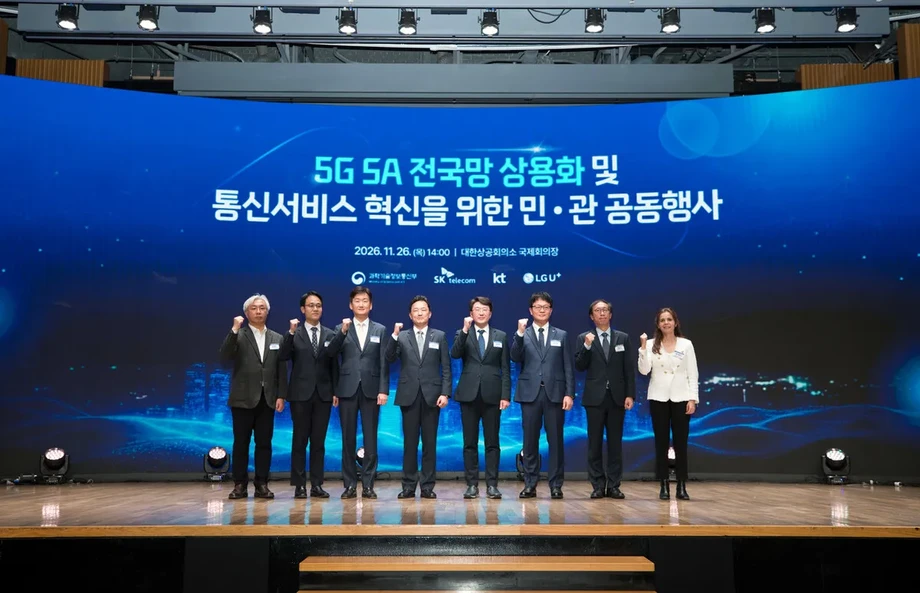
The Ministry of Science and ICT used a Nov 26 public private event at the Korea Chamber of Commerce and Industry to mark the end of a long delay in South Korea's 5G story. LG Uplus will start commercial 5G standalone service on Nov 30, 2026, and SK Telecom will follow on Dec 1. KT already began in July 2021. With those dates, all three carriers will have a nationwide standalone network, more than seven years after the country launched 5G in April 2019 and became the first market to do so.
Contents
- Korea finishes a seven year shift to real 5G
- What a phone user may actually notice
- Why the rollout arrived late
- Who can use standalone service on day one
- Why network slicing matters beyond speed
- What LG Uplus, SK Telecom and KT will show first
- Robots, factories and the AI network case
- Emergency crews want priority when networks are jammed
- How regulators will police promised quality
- Why consumer groups want lower bills, not new add ons
- Where Korea stands in the global standalone race
- What is still undecided
- Key Points
For years, much of Korea's 5G service used a method called NSA, or not standalone mode. In that setup, the radio link to a phone was 5G, but the core network, the part that routes signals, authenticates users and manages calls, still leaned on 4G LTE. Standalone mode, usually called SA, replaces that old core with a 5G core. People in the industry therefore call it the first version of real 5G: the whole path from tower to phone uses 5G technology.
The change is not just a label. It gives operators the ability to split one physical network into several virtual networks, a process called network slicing. One slice can carry a video upload from a crowded concert, another can carry a factory robot's control commands, and another can carry emergency video from a fire scene. The aim is to give each job the quality it needs when the network is crowded.
The promise is arriving after consumers paid 5G prices during years when the service often depended on LTE. The Ministry of Science and ICT made SA a condition of spectrum reallocation for 3G and LTE bands expiring in 2027. The requirement covers 370 megahertz of spectrum, including 350 megahertz of LTE. The main fee was set at 3.1 trillion won, about 15 percent below the earlier reference price of 3.6 trillion won, with a larger cut for carriers that build indoor 5G base stations.
What a phone user may actually notice
Ordinary users may not see a dramatic rise in the biggest number on a speed test. The more visible gains are expected in sending data, rather than just downloading it. Social media posts, live video, short clips and video based AI services all require a phone to push data upward. At a stadium or festival, thousands of people doing that at once can clog a network. Operators say SA gives them finer control over that traffic.
Artificial intelligence makes the uplink more important. Uplink means the path from a device to the network, the opposite of a video stream moving down to a phone. AI services can collect images, sound and sensor readings from many devices, then send them to computers for processing. The ministry said such traffic will grow and that different services will need different levels of reliability.
Voice calls can also improve. Voice over New Radio, or VoNR, carries calls over 5G instead of falling back to LTE. The ministry expects quality evaluations to track call connection, dropped calls and sound quality. The government also expects SA to help battery life because the phone no longer has to manage constant handoffs between 5G and LTE.
Network slicing is harder to see, but the idea is simple. Imagine one highway with lanes marked for different vehicles. Ambulances and delivery trucks can have lanes reserved when traffic builds, while ordinary cars still use the main road. In telecom terms, the lanes are software defined slices of the same network. The ministry says the core principle of treating ordinary internet traffic equally will remain, with narrow exceptions for services that need guaranteed quality.
At the same event, the ministry announced that public Wi-Fi on 32,847 city and intercity buses had been upgraded to Wi-Fi 7 (802.11be), lifting the monthly data allowance from 200 GB to 330 GB, a 65 percent rise, and the minimum guaranteed speed from 20 Mbps to 100 Mbps.
Why the rollout arrived late
Korea launched 5G in April 2019 with a marketing push built on speeds said to be up to 20 times LTE and on promises of very low latency and mass connections. Carriers chose NSA because it let them attach 5G radios to the LTE core and avoid building a full 5G core at once. Building and expanding a dedicated 5G core required hundreds of billions of won in investment, according to industry estimates.
The delay became a policy issue. When SK Telecom applied for 5G service approval in 2019, it told the ministry that NSA meant 5G was a supplement to LTE and that full SA networks were expected from 2020. Seven years later, SA is only now arriving for two of the three carriers. The People Power 21 commentary, published by the civic group, said this lag left people paying high 5G prices for what it called half 5G.
The government moved through spectrum policy. A Dec 1, 2025 briefing at IT Square in Gangnam set out the reallocation conditions; a Dec 10 briefing at Government Complex Seoul supplied the detailed fees and enforcement language. Carriers had to connect 5G base stations to an SA core by the end of 2026. The ministry said it could use corrective orders if a carrier did not follow through. It also said the calculation follows the Radio Waves Act and its enforcement decree and gives preference to past allocation fees.
The fee design tried to balance two goals. Lower LTE prices reflected the expected fall in LTE value as SA spread, while indoor station targets pushed carriers to fix weak coverage. Fees would fall to 3 trillion won with at least 10,000 indoor 5G base stations and 2.9 trillion won with more than 20,000, under an incentive running to 2031 with up to 200 billion won in extra relief.
The same policy kept previous winning bids as the pricing basis in a long dispute over LTE spectrum. SK Telecom had paid 1.3777 trillion won for 60 megahertz of 2.6 gigahertz LTE spectrum in 2016, while LG Uplus paid 478.8 billion won for 40 megahertz in 2013 and received a 27.5 percent discount when it was reallocated in 2021. SK Telecom argued this created a same frequency, double price problem; LG Uplus argued that auction results should stand.
Nam Young-joon, director of spectrum policy at the Ministry of Science and ICT, told the Dec 10 briefing that a temporary loss of speed could appear during the switch. He said operators could add base stations and refine cell design to protect service.
some speed degradation is unavoidable (though temporary)
The spectrum rules also tied the transition to future 6G plans. Use of the 1.8 gigahertz and 2.6 gigahertz bands, 120 megahertz in total, was shortened from five years to three years so the bands could later shift toward time division duplex, a way of sending and receiving on the same frequency at different moments. The ministry plans to revise rules so 3G and LTE spectrum can be used with 5G or later technologies. It gave no date for ending 3G service, saying that issue sits with another policy bureau and that some operators have asked to shut it down.
Who can use standalone service on day one
Not every 5G subscriber will move to SA automatically on Nov 30 or Dec 1. A phone needs a compatible model, the right 5G plan and SIM, and a firmware update. Core network capacity also has to expand area by area. The carriers expect the eligible device pool to grow through 2027.
Samsung Galaxy S20 models released in March 2020 and Apple iPhone 14 models released in September 2022 or later can support SA. SK Telecom said its first wave in December covers Galaxy S25, S26 and Fold 7 models, plus iPhone 17, 18 and Duo models, about three million to five million devices. It wants seven million to 10 million cumulative supported devices by June 2027 and 10 million to 14 million in the second half of 2027.
KT, which has operated SA since July 2021, said 8.27 million devices could connect to its SA network as of late September, equal to 74 percent of its 5G subscribers. KT also runs enterprise 5G work networks for 10 organizations. LG Uplus has not given the same device count in the event material, but its commercial service begins Nov 30.
The gradual rollout matters in homes and offices. In a December 2025 coverage review by the ministry, some busy buildings still had 5G access rates below or near half. The commentary cited sites including Musinsa Standard Hannam in Seoul, where SK Telecom was 40.72 percent and LG Uplus 33.79 percent; Ulsan Daegok Museum, where SK Telecom was 35.49 percent and KT 42.48 percent; Taebaek City Hall, where LG Uplus was 52.76 percent; and Lotte Mart Max Mokpo, where LG Uplus was 53.87 percent.
Why network slicing matters beyond speed
The GSMA adoption analysis, published by the GSMA, says standalone networks use a dedicated 5G core and unlock better speed, lower latency, support for many devices and more flexible service creation. It also warns that SA brings higher infrastructure complexity, investment and staff training costs. That tradeoff explains why many operators around the world first chose NSA and why Korea's government had to push the change through spectrum conditions.
The same analysis, using Ookla Speedtest Intelligence data, counted 230 operators investing in public 5G SA networks by the end of June 2024, more than 37 percent of the 614 operators known to have invested in 5G through trials or deployments. It listed 1,535 devices able to use SA. Those numbers show why a phone ecosystem matters: a network upgrade is only useful when people have handsets that can reach it.
In Korea, the business case remains the harder part. KT has used SA for enterprise and public safety projects since 2021, yet a widely used consumer service has been slow to appear. Policy research cited in the debate found that expected returns on network investment had fallen and that weaker competition in capital spending delayed new services. LG Uplus and SK Telecom are starting with experiments at crowded venues. The industry has asked the government to recognize network slicing as a special service so it can sell add ons or premium plans. A ministry official said business to consumer pricing for SA has not been discussed so far.
What LG Uplus, SK Telecom and KT will show first
Nam Seok, the ministry's communications policy director, framed the launch as a shift from speed competition toward services that guarantee different levels of quality. LG Uplus will put SA in front of the public at the Korea-Japan Dream Players Game at Gocheok Sky Dome on Dec 5. Reporters, creators and baseball fans will use the network at the stadium. A mobile broadcast camera fixed to an umpire's mask will send video to a broadcast station over SA. The company wants to show that reporters can file stories and fans can upload clips even when a crowd is sending data at the same time.
SK Telecom starts commercial SA on Dec 1 and opens a free three month trial for up to 10,000 subscribers on unlimited data plans. People apply through the T World app. The trial is meant to collect feedback from concerts, festivals and outdoor live broadcasts. SK Telecom will then consider services for manufacturing, physical AI, industrial safety and public agencies.
KT is further along in enterprise use. The company plans to commercialize app slicing by the end of 2026. App slicing lets one phone separate work traffic from personal traffic. In a demonstration, work mode blocked YouTube and camera use under company rules and kept work files apart from personal storage. KT also plans a public safety slicing service in the first quarter of 2027.
KT's public safety work grew from a Busan Fireworks Festival test with 15 wireless video terminals. The company said sliced connections kept stable speed and video quality in a crowd. KT will use that experience in a service meant to guarantee important communications during disasters and congestion. Oh Taek-gyun, head of KT's network strategy unit, said the service cannot put everyone first, but can guarantee important communications. An ordinary event package for concerts and stadiums will come first for consumers, followed by plans where customers choose the quality they want.
Robots, factories and the AI network case
SK Telecom is testing SA with SK Hynix for real time asset monitoring and logistics control and with Samsung SDS for logistics work. It is working with Omron, a Japanese industrial automation company, on split computing for autonomous mobile robots. Construction partners are examining AI closed circuit television for hazard detection and worker safety monitoring. The common need is a connection that keeps commands and sensor data moving even when other traffic rises.
LG Uplus equipped the DAL-e Delivery robot with an SA communications board in a trial at the Hyundai Motor and Kia headquarters in Yangjae, Seoul. The system separated critical movement and stop commands from heavy camera and sensor feeds. Such separation matters because a robot can lose control if its command link is delayed while video uses the available capacity.
Heavy industry is another testing ground. KT is taking part in a hyper AI network project with the ministry and the Korea Information Society Development Institute at a shipyard operated by HD Hyundai Samho. LG Uplus says it will expand from stadiums into smart factories, firefighting, emergency medical telemetry and drone or robot rescue. SK Telecom expects commercial SA services for precision robot control on factory floors. The company also says it is preparing an autonomous network that predicts failures and recovers by itself, and plans to take part in 6G standard discussions.
Emergency crews want priority when networks are jammed
Public safety is the field where low latency and reserved capacity can matter most. Korea already gives priority access to emergency rescue communications for about 20,000 firefighter devices nationwide. With SA, emergency teams want to send helmet camera video, thermal images and drone footage to command centers while ordinary mobile traffic stays separate.
An official from the Gangwon Fire Headquarters joined the Nov 26 event by video and described why disaster sites strain networks. The official said cameras, robots and drones now send far more data than voice radios did and that faster links would help command teams direct rescue work.
With 5G SA, we will be able to share video footage and dispatch information from disaster sites with command centers more reliably.
The policy plan gives life critical services an exception from rules that block quality differences. Firefighting, disaster response and emergency rescue communications can take precedence when lives are at stake, provided operators have checked that general internet quality is protected. That exception is narrow. The government is not giving every paid service the right to jump the queue.
How regulators will police promised quality
The Ministry of Science and ICT plans to revise the Network Neutrality Guidelines Explanatory Manual. Network neutrality is the idea that an operator treats all internet traffic the same. Korea's 2020 revision kept that principle while allowing separate rules for specialized services such as autonomous vehicles and telemedicine. The new manual will spell out when everyday internet quality can vary and what counts as a special service.
Choi Woo-hyuk, the ministry's network policy director, said nationwide SA is only the start of the work. He said carriers and device makers now have to turn the network into services people can feel and value in industry.
The construction of a nationwide 5G SA network is not an end but a new beginning; discovering services that citizens can feel and creating practical value in industrial fields are of utmost importance.
Carriers will have to self inspect before launching a differentiated service and face checks afterward. Inspections will look at conditions for quality service, general internet protection and whether capacity is sufficient at busy hours. The aim is to stop a premium slice from stealing quality from ordinary users.
Quality tests will also change. Pilot measurements begin in December 2026, with a full overhaul in the first half of 2027 and implementation in the second half. The indicators will include SA connection retention rate, latency, transmission speed, Voice over New Radio call quality and whether network slicing promises are met. The retention rate shows how often a device stays on SA instead of slipping back to LTE. Latency measures the time data takes to travel, the key ingredient in remote control and immersive services.
Why consumer groups want lower bills, not new add ons
The late rollout has put the cost of 5G back at the centre of the argument. When carriers marketed 5G in 2019, they sold speed and low latency as reasons to move to higher priced plans. Consumers now say the full feature set arrived only after they had paid those prices for years.
Kim Joo-ho, head of the livelihood economy team at People Power 21, said carriers including SK Telecom promised in 2020 plan filings that SA would arrive from 2020. He said seven years was too long and that prices should now fall because consumers carried the cost of network investment.
SK Telecom and others said when applying for 5G plan approval that they would introduce standalone mode from 2020, but it took seven years to introduce it, which is too late. Consumers have paid expensive 5G plans in the name of carrier investment, so now there is a need to lower charges.
The commentary also points to capital spending. It says combined investment by the three carriers fell from about 9.6 trillion won in 2019 to 8.2 trillion won in 2021 and 6 trillion won in 2025. It argues that cost savings and public obligations should now feed into lower basic charges and more reasonable data plans. It also called for an apology and a return of what it described as unfair gains.
Advertising is part of the dispute. The Fair Trade Commission fined the three carriers 33.61 billion won over claims that 5G speeds could reach the technical target of 20 gigabits per second. In 2021, actual average 5G speed was 0.8 gigabits per second, about 4 percent of the advertised target. A more recent industry release compared a 973.55 megabits per second average in areas with 5G base stations with eight overseas cities and said Korean speeds were about 3.2 times faster.
No one has announced a price cut after the SA launch. The ministry has said business to consumer SA plans are not under discussion, and the consumer group wants the government to bring back approval of tariff terms and introduce a universal basic plan. Carriers may redesign packages around latency and reliability instead of data limits. The next fight is likely to be over bills as much as coverage.
Where Korea stands in the global standalone race
Korea was early to commercial 5G but not first to make SA universal. The GSMA analysis says SK Telecom deployed one of the first SA services in the first half of 2020 and supported features such as network slicing and mobile edge computing. Korean accounts put the first domestic commercial SA launch at KT in July 2021. Both timelines point to the same wider pattern: isolated SA projects came well before nationwide coverage across all carriers.
The same analysis ranked Korea near the top for SA performance in the second quarter of 2024. Median download speed was 729.89 megabits per second and median upload speed was 77.65 megabits per second. The United Arab Emirates had the highest download median at 879.89 megabits per second and 70.93 megabits per second upload. Between the second quarter of 2023 and the second quarter of 2024, Korea improved by 12 percent in download performance and 17 percent in uploads.
Other markets show the difficulty of turning SA into scale. T-Mobile in the United States launched SA over 600 megahertz in August 2020 and added a faster mid band service in November 2022. Jio in India started SA in October 2022 and used 3.5 gigahertz and 700 megahertz spectrum to expand coverage. Europe had 45 operators planning SA launches as of the first quarter of 2024, yet many remained cautious because of cost and unclear business cases. The analysis counted only 11 new SA deployments in nine countries among 46 new 5G launches in 2023.
Korea's new rules try to build a market for quality based products while checking that ordinary service is not weakened. Operators still need to show that customers will pay for those products and that factories, stadiums and emergency services will adopt them quickly enough to justify the investment.
What is still undecided
Several practical details are open. Carriers have not published a single national date when every compatible 5G subscriber will be switched over. Firmware updates, SIM conditions and core capacity will decide the pace. The ministry has not set a date for ending 3G. It has also left room to supply more spectrum if SA traffic makes current assignments tight.
Prices are the biggest unknown. Industry representatives want premium services tied to network slicing, but the ministry says business to consumer pricing has not been discussed. No operator has yet set a nationwide consumer price for guaranteed latency or event mode service. KT's consumer launch is planned for the first quarter of 2027, while SK Telecom and LG Uplus are beginning with free trials and demonstrations.
Technical performance also needs proof outside staged events. A switch from NSA to SA can expose weak indoor coverage and can reduce speed where carriers do not add enough sites or spectrum. The new quality tests are meant to catch that by watching SA retention, latency, upload speed and call quality rather than celebrating peak download speed alone.
Key Points
- LG Uplus starts 5G SA service on Nov 30, 2026, SK Telecom on Dec 1, and KT has offered it since July 2021.
- SA uses a 5G core instead of relying on LTE, enabling lower latency, Voice over New Radio and network slicing.
- The government made SA a condition of spectrum reallocation, with the main LTE fee set at 3.1 trillion won and incentives for indoor base stations.
- SK Telecom plans up to 10 million to 14 million supported devices by the second half of 2027; KT already has 8.27 million compatible devices.
- Carrier trials will cover stadiums, concerts, factory robots, logistics, firefighting, emergency medical telemetry and drone or robot rescue.
- Regulators will revise network neutrality guidance and add quality tests for SA retention, latency, upload speed and voice calls.
- Consumer groups say the rollout arrived seven years late and want lower 5G prices; no price cut or business to consumer SA plan has been announced.