A 13.62 Trillion Won Dispute Over Who Controls the Money
South Korea's government and ruling Democratic Party are pressing ahead with a 162.3 trillion won Future Response Fund after parliamentary hearings left every project in the fund undecided. The sharpest dispute concerns a proposed rule that would let the Ministry of Planning and Budget change spending on major items by up to 30 percent without another National Assembly vote. Applied to the 45.4 trillion won in project spending planned for next year, that ceiling represents 13.62 trillion won.
Contents
- A 13.62 Trillion Won Dispute Over Who Controls the Money
- Why the 30 Percent Ceiling Matters
- Borrowing to Build a Fiscal Reservoir
- The Presidential Office Makes Its Case
- How 135 Projects Raced Through Parliament
- The 26 Minute Land Ministry Hearing
- Feasibility Studies Skipped as Budgets Grew
- Duplicate Programmes and Lasting Costs in a Temporary Fund
- Where the Fund's Idle Cash Could Go
- Opposition Demands and the Final Deadlines
- Key Points
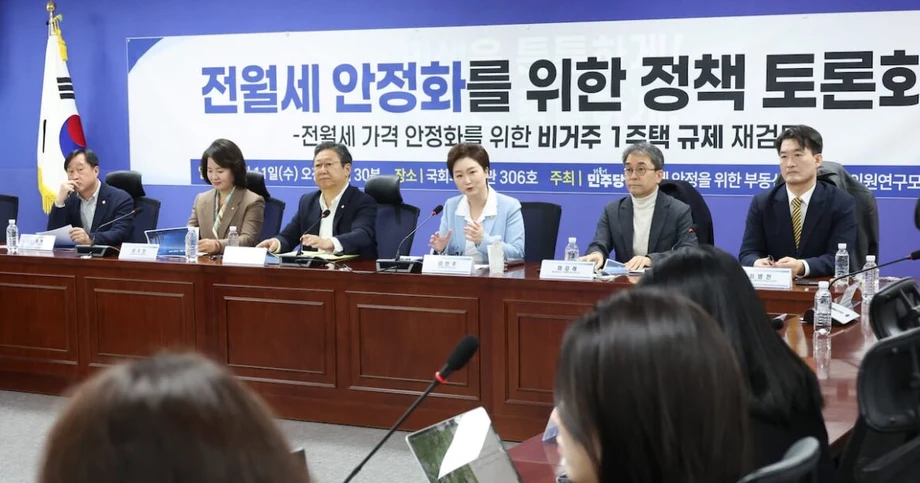
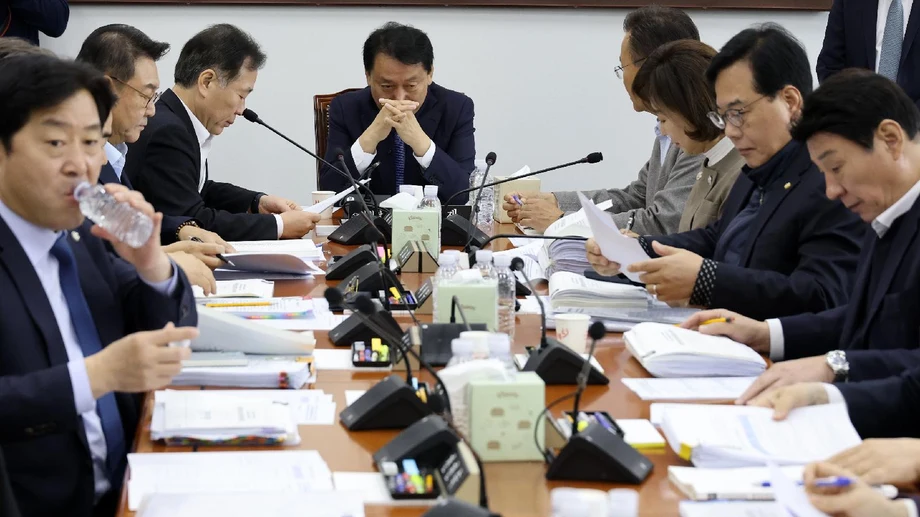
Proposed amendments to the Future Response Fund Act and the National Finance Act were still being discussed by the National Assembly's Fiscal and Economic Planning Committee on November 27. The draft retained the government's 30 percent ceiling despite objections from the opposition People Power Party and criticism from some ruling party lawmakers about the quality of individual projects.
The draft would also create a legal route for using surplus fund money to repay government bonds. It would not require repayment or specify a minimum share. The opposition wants at least 50 percent of excess tax revenue and surplus cash used to reduce debt, leaving a wide gap between the two sides just before the budget deadlines.
The fund is intended to support areas including young people and artificial intelligence while reserving money for future economic crises and tax shortfalls. Of its 162.3 trillion won total, 104.4 trillion won would be set aside and managed after project spending and money connected with reducing new bond issuance are excluded.
Why the 30 Percent Ceiling Matters
General project funds normally operate with a 20 percent limit for such changes, while the 30 percent rate has applied to financial funds dealing with guarantees and insurance. At 20 percent, the potential change to next year's 45.4 trillion won project allocation would be 9.08 trillion won. The government's higher ceiling therefore allows 4.54 trillion won more in changes without a fresh parliamentary vote.
Critics inside and outside the National Assembly have described the arrangement as a standing supplementary budget. Their concern is that a large fund approved in broad terms could later be redirected by the budget ministry, weakening the detailed spending decisions made by elected lawmakers.
The debt repayment provision works through an exception to the budget total accounting principle, which generally requires public revenue and expenditure to be shown fully in the budget. Surplus money from the fund could be transferred to the general account to repay bonds. Previously, the fund's resources could be used to cover a revenue shortfall, and the finance ministry sought the explicit addition of debt repayment.
That change answers criticism that the government could issue bonds while parking additional tax revenue in the fund. Because the amendment sets neither an obligation nor a repayment ratio, however, the amount actually used to reduce debt would remain a government decision.
Borrowing to Build a Fiscal Reservoir
A group of 52 economists and public finance scholars has challenged the financial logic of the plan. Current and former leaders of academic societies issued their statement after 23 years without such a joint intervention. They noted that next year's tax revenue is expected to be 194.2 trillion won higher than this year's, yet the government still plans to increase national debt by 106 trillion won while accumulating roughly 104 trillion won in the fund.
The scholars compared the proposal to borrowing 100 trillion won to create a 100 trillion won fiscal reservoir. Their central argument concerns net debt, meaning debt after financial assets are taken into account. If the state gains about 104 trillion won in assets and about 104 trillion won in liabilities at the same time, they argue, its net asset position and capacity to face a crisis remain unchanged.
The joint statement set out the scholars' position in direct terms.
Paying off debt when times are good is the surest preparation. Debt repaid now becomes the capacity to borrow in the next crisis.
Ryu Deok-hyun, the presidential aide for fiscal planning, rejected that analysis in a social media response. He argued that repaying a bond makes the money disappear from government use, while investing a reserve leaves an asset available for a future revenue shortage.
The 104 trillion won accumulated in the Future Response Fund is not money that disappears. It is a financial asset held by the state.
The practical disagreement is therefore about preparation. The scholars prioritise lower interest costs and restored borrowing room. Ryu prioritises accessible financial assets that can support investment and public services when tax revenue falls. The planned 106 trillion won debt increase is also 1.6 trillion won larger than the proposed 104.4 trillion won reserve.
The Presidential Office Makes Its Case
Ryu placed the fund within the wider 2027 budget. He said total spending would rise by 12.8 percent, while the consolidated fiscal balance would move to a surplus of 59.9 trillion won and the managed fiscal balance would improve to roughly balance. Net issuance of treasury bonds would fall by 13.1 trillion won from this year, he added.
The consolidated balance covers a broad range of government accounts. The managed balance excludes social security funds and is commonly used to assess the underlying fiscal position. Ryu used those figures to reject accusations of fiscal addiction and debt addiction.
He also warned that the semiconductor boom producing additional tax revenue might not last. Previous major revenue shortfalls, he said, had constrained investment in future growth and placed local government finances under pressure. Saving part of a strong revenue period was therefore a responsible way to prepare for another downturn.
Ryu said the International Monetary Fund had welcomed the fund, while the OECD chief economist had called its creation a wise political choice. He also said Moody's and Fitch had responded positively to the government's direction on fiscal health and future growth.
The scholars asked for public answers on five subjects: the size of the reserve, the calculation of net debt, costs and risks, parliamentary control, and assessments by international organisations. They proposed an urgent public debate involving the presidential office, the Ministry of Planning and Budget, the National Assembly Budget Office and economists. No acceptance or debate date had been announced by November 27.
How 135 Projects Raced Through Parliament
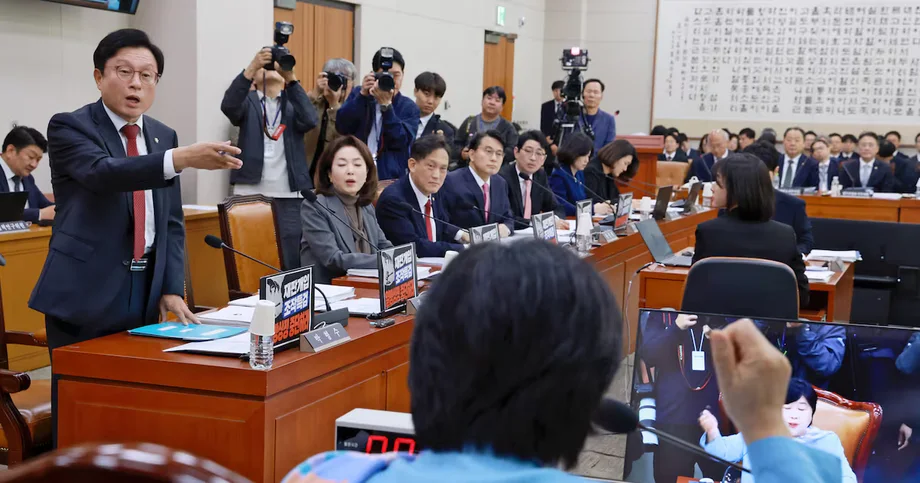
The Special Committee on Budget and Accounts gave the fund two days of public scrutiny while its broader budget adjustment subcommittee approached the end of 11 days of work. About 135 projects were examined alongside more than 120 general account items that had also been left unresolved. On November 27, every Future Response Fund project remained on hold.
A procedural gap helped compress the review. Most fund projects went to 11 standing committees that lacked the power to approve them through a preliminary budget vote. The Fiscal and Economic Planning Committee held that power but approved only the ordinary budgets under its jurisdiction, leaving the fund outside that decision. Delays in handling the fund's legal foundation pushed substantive examination still later.
Lawmakers from both parties objected to incomplete documents, overlapping programmes and spending requests submitted before basic checks were finished. The remaining decisions were expected to move into a smaller private negotiating group, whose meetings do not leave a verbatim transcript, and into talks between the parliamentary floor leaders.
The schedule called for reductions involving the fund and other held items to be completed by November 28, with proposed increases receiving attention on November 29. That left the most consequential choices to the final private bargaining rather than the public hearings.
The 26 Minute Land Ministry Hearing
The Ministry of Land, Infrastructure and Transport provided the clearest example of the breakdown in scrutiny. Officials were told to leave the hearing after 26 minutes on the night of November 26 following questions about a 1.4 trillion won youth housing programme.
Kim Yi-tak, the ministry's first vice minister, was asked by People Power Party lawmaker Na Kyung-won about public criticism of youth housing outside apartment buildings. He replied that he was hearing the criticism for the first time. Subsequent questioning indicated that more than half of an existing stock described as purchases outside the apartment market consisted of unsold apartments in regional areas.
Officials also could not provide occupancy and vacancy figures for the existing programme that bought unsold regional homes for rental use. Democratic Party lawmaker Kim Sung-hoe asked how officials could seek approval for a 1.4 trillion won project without knowing the previous year's results.
Chung Tae-ho, the ruling party secretary on the committee, then delivered a public warning to the ministry.
Do not assume that this will pass automatically. This complacent attitude is damaging trust in the government.
Committee chairman Lee Gwang-jae stopped the examination and sent the officials back, requiring a renewed review. The episode was striking because the strongest rebuke came from the governing side as well as the opposition.
Feasibility Studies Skipped as Budgets Grew
Preliminary feasibility studies became another major point of conflict. These studies test whether a large public project is economically and technically justified before substantial money is committed. People Power Party lawmaker Yoo Sang-beom asked whether any fund project requiring such a study had completed one. Vice Budget Minister Cho Yong-beom answered that none had.
Yoo responded with a warning about the scale of the increases.
Budgets are being increased tenfold, and they are all exempt from preliminary feasibility studies. You are spending freely because there is money, but this cannot go on.
Song Eon-seok, another People Power Party lawmaker, cited a 2.169 trillion won programme supporting shared grid connections for offshore wind farms. He contrasted its exemption with the obstacles faced by projects costing 50 billion or 100 billion won.
The Ministry of SMEs and Startups also sought money for an AI Fellows training programme before settling its total cost or completing a review of whether the plan was appropriate. A water supply project for the Honam semiconductor industrial complex went further: its feasibility study remained unfinished, yet money for research, basic design, detailed design and construction appeared together.
Song asked whether any other project in the 821 trillion won budget combined all four stages in that way. Cho said he would have to look. Similar objections covered the 826.3 billion won Dongbok Dam expansion, where design and construction costs were requested before the feasibility study was complete.
Lee Gwang-jae called for regular national evaluations of the fund's performance and particular care over projects exempted from feasibility studies. He also supported stronger parliamentary control and showed openness to moving suitable programmes into the general account.
Duplicate Programmes and Lasting Costs in a Temporary Fund
Democratic Party lawmaker Kim Sung-hoe focused on similar startup, security and artificial intelligence projects submitted separately by different ministries. He questioned whether the existing workforce could supervise the expanded list and used a household comparison to explain the duplication.
It is like telling your wife that you want to buy an Xbox because it plays different games, even though you already have a PlayStation at home.
His point was that small differences between programmes did not necessarily justify separate budgets, organisations and administrative costs. Song directed a different criticism at the Youth Culture and Arts Pass, which would support cultural attendance for people aged 19 to 34. He argued that the expanded eligibility and cash spending explained why opponents called the fund an election response fund.
The proposed child basic allowance raised a separate structural problem. The fund is temporary and built around investment in future strategic areas, while a child allowance creates a legal commitment that continues every year. Annual spending on the programme was estimated to reach 5.6 trillion won by 2035.
The National Assembly's Health and Welfare Committee had already adopted an accompanying opinion calling for such programmes to be returned to the general account, which is the main budget supported by regular revenue. Even ruling party members questioned whether a recurring allowance belonged in a temporary fund, and a transfer to the general account was discussed.
A marriage support grant drew criticism from both parties as well. It would pay 1 million won to couples registering a marriage. Kim said he would marry his wife again even without the payment, questioning whether the money would change behaviour. People Power Party lawmaker Kang Dae-sik compared it to creating another permanent cash welfare benefit, while his party colleague Lee Jong-wook proposed a tax credit instead.
Where the Fund's Idle Cash Could Go
Park Hong-geun, the Minister of Planning and Budget, addressed another unresolved issue on November 27: who should manage surplus money before the fund develops its own stable asset management system. Speaking at the 25th anniversary event for the Pension Investment Pool at Seoul's Dragon City Hotel, he raised a temporary arrangement.
Until a stable asset management system is established for the Future Response Fund, we will consider entrusting the management of surplus funds to the Pension Investment Pool for a certain period.
The pool was introduced in 2001 to combine idle money from individual public funds and manage it professionally. Its entrusted assets have grown from 1.9 trillion won to about 98 trillion won, more than 50 times the starting amount. Participation has expanded from 43 pension funds to 140 public institutions and related organisations.
Its investments began with money market funds and bond products, then broadened into overseas assets and alternative investments. Park said that growth required more sophisticated asset allocation, liquidity management and risk control.
The pool's current 98 trillion won in entrusted assets is smaller than the proposed 104.4 trillion won fund reserve. Park did not specify how much Future Response Fund money might be entrusted or how long the arrangement could last.
At the anniversary event, commendations went to the Credit Guarantee Fund, the Trade Insurance Fund and the Korea Housing Finance Corporation as exemplary depositing institutions. Six operating institutions, including Samsung Asset Management, received letters of appreciation.
Opposition Demands and the Final Deadlines
The People Power Party opposes the fund's creation and has set out five principal demands before giving its cooperation. It wants at least half of excess tax revenue and surplus money used for debt repayment, existing local allocation taxes and local education finance grants maintained, a complete review of the 45 trillion won project programme, protection against arbitrary changes to the fund management plan, and a unified Public Fund Management Fund system.
Local finances are also part of the final bargaining. Some ruling party members have sought to convert part of the fund's project money into general local revenue that provincial and municipal governments could spend at their discretion. Lee Gwang-jae suggested shifting about 3 trillion won in national projects toward local resources. The opposition has instead demanded restoration of reductions in local grants and transfers of continuing programmes to the general account.
National Assembly Speaker Cho Jung-sik separately designated 49 bills connected to next year's revenue budget. Eighteen came from the government and 31 from lawmakers. These bills must be considered alongside the budget because they affect the revenue needed to support it.
By November 27, the final project list and any debt repayment share remained unsettled. The following dates now govern the remaining negotiations:
- November 28: Private negotiators aimed to finish reviewing reductions to the fund and other held budget items.
- November 29: Attention was scheduled to turn to proposed spending increases.
- November 30: The Special Committee on Budget and Accounts and individual standing committees faced their review deadline, including work on the 49 revenue bills.
- December 1: If the committee misses its deadline, the government's original budget proposal is automatically referred to the full National Assembly.
- December 2: The statutory deadline for passing next year's budget arrives.
If a standing committee produces an alternative to a revenue bill before the deadline, that alternative is treated as the designated proposal. The same compressed timetable applies to the dispute over the fund's legal foundation, parliamentary spending limits and the projects that will survive the weekend negotiations.
Key Points
- The proposed Future Response Fund totals 162.3 trillion won, including 104.4 trillion won to be reserved and managed.
- A 30 percent spending change ceiling could affect up to 13.62 trillion won of next year's 45.4 trillion won project allocation without another Assembly vote.
- The draft permits surplus money to repay government bonds but does not require repayment or set a minimum ratio.
- Fifty two scholars criticised increasing debt by 106 trillion won to build the reserve, while presidential aide Ryu Deok-hyun defended the reserve as a state financial asset.
- All fund projects remained on hold after rushed hearings exposed missing documents, duplicate programmes and unfinished feasibility studies.
- The opposition wants at least 50 percent of excess revenue and surplus funds used for debt repayment, along with local grant protections and a full project review.
- November 30 is the committee review deadline, followed by possible automatic referral on December 1 and the statutory budget deadline on December 2.
Park Hong-geun is considering temporary use of the Pension Investment Pool for surplus cash, without announcing an amount or duration.