The quarter that ended the subsidy slump
Meituan closed the third quarter of 2026 with 115.56 billion yuan in revenue, about 17.4 billion dollars, up 21.6% from about 95.1 billion yuan a year earlier and 10.4% from 104.6 billion yuan in the second quarter. The Chinese on demand services company reported an adjusted net profit of 1.9 billion yuan, about 280 million dollars, reversing a 16.0 billion yuan adjusted loss in the third quarter of 2025. The company's third quarter results report, published on November 27, 2026, says the recovery came as food delivery orders became more valuable and the worst of the subsidy war faded.
Contents
- The quarter that ended the subsidy slump
- What changed in food delivery
- Why profit returned before sales structure changed
- The core business started earning again
- New businesses grew faster and narrowed their loss
- Keeta is finding a model outside China
- Small shops, riders and food safety
- AI moved from models into daily work
- Drone delivery became an export
- A short timeline of Meituan's quarter
- What the numbers mean for investors
- Key Points
The rounded adjusted profit figure was 1.9 billion yuan. The exact adjusted number was 1.85 billion yuan, while profit for the period under standard accounting was 2.07 billion yuan, against a net loss of 18.63 billion yuan a year earlier. Against the second quarter, profit for the period slipped about 4% from 2.16 billion yuan and adjusted profit fell from 2.52 billion yuan. Adjusted profit is a measure that leaves out some accounting items, so it is not the same as statutory profit. A subsidy war means companies spend heavily on discounts to take customers from rivals. Operating profit reached 2.74 billion yuan, compared with a 19.76 billion yuan operating loss in the same quarter of 2025.
Investors responded quickly. Meituan's Hong Kong shares closed at HK$67.85 on November 27, up 8.21% on the day. The stock move showed how closely the market had watched the cost of the delivery contest; a swing of a few billion yuan in marketing spend changed the profit picture.
What changed in food delivery
Meituan chief executive Wang Xing used the earnings call to describe a turning point in the food delivery market. He said average order values had recovered, orders at low prices made up a smaller share of the mix and subsidies became more sensible after the summer promotion season.
The food delivery industry reached an inflection point in the third quarter
An inflection point is a moment when a trend changes direction. For customers, that means fewer very cheap meal deals and more normal priced orders. For couriers and restaurants, it means the pressure to pile on discounts eases. For Meituan, it means each order can leave more money after the company pays for delivery, promotion and support.
Chen Shaohui, Meituan's chief financial officer, explained the order economics in monthly terms. Unit economics, often shortened to UE, means the money gained or lost on one order after direct costs. He said the figure slipped from the second quarter because summer delivery costs rose, then recovered in September and improved in October.
UE rebounded sharply in September, surpassing the second quarter's average level, and improved further in October.
Chen also said fourth quarter unit economics should be better than in the second and third quarters, although winter and year end costs remain seasonal pressures. Meituan said it expects to keep a leading position in the industry through 2027 by improving service and efficiency.
Why profit returned before sales structure changed
Sales costs tell much of the story. Meituan said cost of sales rose 10.8% to 77.9 billion yuan, but fell as a share of revenue from 74.0% to 67.4%. That difference matters because revenue grew much faster than the direct cost of serving it, leaving more money to cover other expenses.
Sales and marketing spending fell 20.1% from a year earlier to 27.0 billion yuan. It represented 23.4% of revenue, down from 35.6%. This was the clearest sign that the company had spent less on coupons, discounts and campaigns after a bruising period of competition.
Core local commerce gross profit increased from 19.523 billion yuan to 30.509 billion yuan, and the segment gross margin rose from 29.1% to 39.0%. Gross profit is revenue left after direct costs; gross margin is that amount shown as a share of sales. Meituan attributed the improvement to more careful marketing, higher revenue per order, lower delivery cost per order and better results in overseas and grocery businesses.
The core business started earning again
Core local commerce, which includes food delivery, instant shopping and in store, hotel and travel services, generated 78.3 billion yuan of revenue, up 16.8% from a year earlier. It recorded an operating profit of 5.7 billion yuan, against a 14.1 billion yuan operating loss in the third quarter of 2025. The swing was about 19.8 billion yuan, close to the nearly 20 billion yuan loss reduction cited by the company.
Delivery services contributed 28.874 billion yuan, up 25.3%. Merchant services added 43.407 billion yuan, up 8.2%, helped by higher transaction value and more active online marketing merchants. Goods sold directly, including medicine and alcohol, reached 4.261 billion yuan, up 75.8%. Instant retail means online orders for everyday goods delivered within about 60 minutes.
The segment operating margin recovered from negative 21.0% to positive 7.3%. In store, hotel and travel kept growing, but the operating margin slipped from the second quarter because Meituan spent more during the peak season. Management said the next stage of competition is less about grabbing traffic and more about winning and keeping good users through merchant coverage, credible information, authentic reviews and reliable fulfilment.
Meituan's premium membership base passed 40 million by the end of the quarter, with joint membership programmes involving more than 2,000 brands. That gives the company another way to keep customers across food, travel and local services instead of relying only on discounts.
New businesses grew faster and narrowed their loss
New businesses, a segment covering grocery retail and overseas ventures, brought in 37.3 billion yuan, up 32.9% from a year earlier. Segment revenue grew faster than in the second quarter, when growth was about 25%. The operating loss was 1.3 billion yuan, down from 1.7 billion yuan in the second quarter.
The segment operating loss rate improved from 4.6% to 3.5%. Loss rate means the loss shown as a share of revenue. Meituan said grocery retail and overseas operations became more efficient, which helps explain why the segment could grow quickly without adding a much larger loss.
Xiao Xiang Supermarket operated in 85 cities at quarter end. Meituan said total transaction value, or GTV, the sum customers pay before some fees and discounts, grew faster than the industry. GTV is a common shopping measure because it shows the size of orders before all revenue is counted. The private label share, meaning products sold under the retailer's own brand, also rose from the previous quarter.
The company opened nine offline Xiao Xiang stores in cities including Beijing, Hangzhou, Shenzhen and Chongqing. Another format, Happy Monkey, uses smaller shops, fewer distinct products and more private label goods to serve nearby communities with lower priced groceries.
Tonghuashun's performance review says group adjusted EBITDA reached 4.6 billion yuan and adjusted profit reached 1.9 billion yuan in the quarter. EBITDA means earnings before interest, taxes, depreciation and amortisation, a broad measure of operating cash earning power. The same review reports operating cash inflow of 4.8 billion yuan for the quarter.
Keeta is finding a model outside China
Meituan's overseas delivery brand Keeta made money in Hong Kong and in Saudi Arabia during the quarter. The Saudi business was profitable for the whole quarter, a stronger result than a single profitable month. Meituan said the Hong Kong margin improved further, showing that the model can work in markets with different dining habits and labour costs.
Brazil is the larger test. Keeta entered 21 more cities in October, taking its total coverage to 32 cities, with São Paulo as the operating focus. By the first anniversary of its Brazil launch, it had 83,000 registered restaurants, 430,000 registered delivery partners and more than 10 million app downloads.
Management pushed back on talk of a rapid nationwide rollout in Brazil during 2027. The company said it would first refine a repeatable model in São Paulo and enter smaller cities through a lighter agency approach. That plan matters because a delivery network can look large on a map while still losing money in each city.
Keemart, the overseas grocery brand linked to Xiao Xiang Supermarket, covered 20 Saudi cities and had more than 80 warehouses by the end of the quarter. Meituan is using food delivery habits to sell groceries and daily essentials, a bigger market but also a harder one because inventory and storage add costs.
Small shops, riders and food safety
Meituan said street corner small shops make up more than 80% of its restaurant merchants. By the end of the third quarter, the company had supported 220,000 small physical restaurants through funds, operating supplies, equipment upgrades, AI tools and store renovation. The aim was to help older shops and small shops run by families keep trading rather than fade out after price wars.
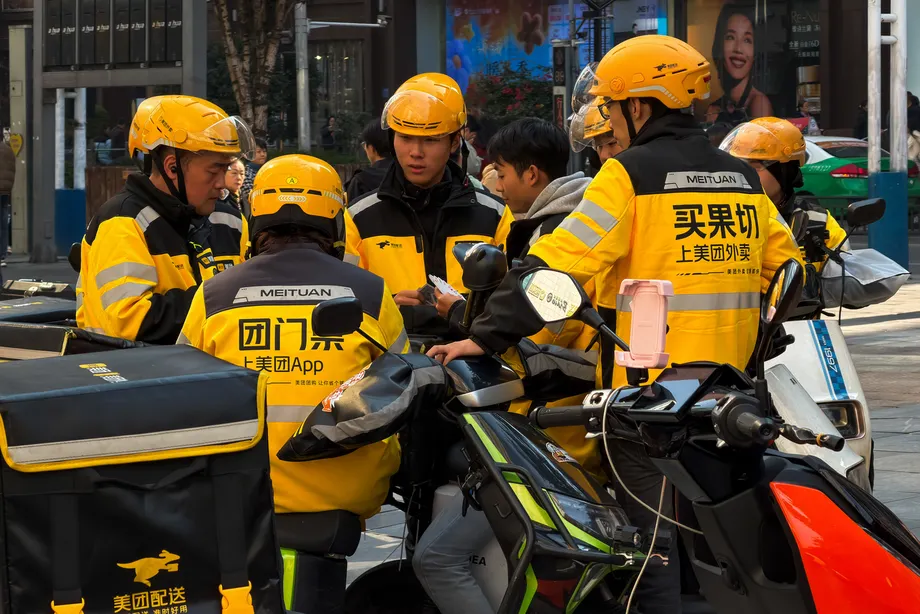
The company also expanded rider protections. Occupational injury cover and pension insurance subsidies reached the national level during the quarter, and Meituan continued its major illness care plan for riders. A year earlier, rider welfare programmes reached more than one million riders and their families through medical checkups, work meals, education funds and travel subsidies.
Food safety work focused on making compliant merchants easier to find. Meituan has pushed the bright kitchen programme, in which restaurants share kitchen video feeds. By mid September 2025, about 300,000 merchants, more than 3,000 chain brands and roughly 60,000 chain stores had joined.
These steps are part of the same profit story. If merchants survive and consumers trust what they see, Meituan needs fewer discounts to hold both sides of the marketplace.
AI moved from models into daily work
Meituan spent 7.7 billion yuan on research and development in the quarter, up 11.3% from a year earlier. In November it released LongCat-2.5, a model developed in house that it said supports multiple forms of data and is comparable with mature closed models and leading open models. Multimodal means the system can work with more than text, for example images or other inputs.
The company put that work into CatPaw, an AI workbench for merchants, which had served more than two million merchants by the quarter end. The tool is meant to diagnose business problems, help with decisions and automate repeated tasks. For a small restaurant, that could mean less time spent checking numbers and more time preparing food.
Consumer assistant Xiao Tuan also gained ground. During the National Day holiday in China, its users and usage calls were more than 60% higher than during the May Day holiday. Chen Shaohui said Meituan would keep combining AI with real business scenes and use technology to support better quality retail growth.
Wang Xing said AI capital spending in 2027 should be lower than in 2026 because some computing power orders were locked in early. No amount was given. The company also recorded 12.2 billion yuan of fair value losses on stakes in Zhipu AI and Unitree outside the main profit statement, while holding stakes in Li Auto, Zhipu AI and Unitree. A fair value loss is an accounting fall in the recorded value of an investment, not necessarily cash paid out.
Drone delivery became an export
Meituan's drone business moved from trials toward wider use. By the end of the third quarter, its drones had completed more than 1.1 million orders worldwide. At the end of September 2025, commercial drone orders were more than 670,000, so the count rose by over 430,000 in roughly a year.
The company opened its Shanghai West Bund low altitude network on September 10, the second systematic city network after Shenzhen. Low altitude logistics means delivery using airspace close to the ground, usually with small drones for short trips. Meituan has also run night delivery trials on several Shenzhen routes.
Overseas expansion followed. In August, users in Astana, Kazakhstan, tried Meituan drone delivery for the first time. In November, the fourth generation M-Drone 4L made its overseas debut, and a rope descent route in Dubai was set to start. No launch date for the Dubai route was given.
Zhao Xiaomin, a logistics and express delivery expert, said drones add capacity to delivery rather than replace riders. The practical test is whether the service can scale for a long period and work closely with merchants, especially within the three kilometre range where many instant retail orders sit.
A short timeline of Meituan's quarter
The results brought together several moves that had been building through the year. The timeline below shows the dates that shaped the quarter and the types of business that investors are now watching.
- March 2, 2026: Meituan opened public testing for its Tabbit AI browser.
- May 2026: Its AI community Miyou entered public testing, and the company opened errand ordering to AI assistants through a tool package.
- June 30, 2026: Meituan released LongCat-2.0, the earlier base model before LongCat-2.5.
- August 2026: Drone delivery arrived in Astana, Kazakhstan.
- September 10, 2026: The Shanghai West Bund drone network began operating.
- October 2026: Keeta announced 21 new Brazilian cities, taking its total to 32.
- November 2026: LongCat-2.5 was released and opened, the M-Drone 4L debuted overseas, and Meituan published its third quarter results on November 27.
The sequence shows that profit recovery did not happen in isolation. The company cut marketing pressure at home while continuing to push AI, drones, grocery retail and overseas delivery.
What the numbers mean for investors
Meituan ended September with 104.1 billion yuan in cash and cash equivalents plus 53.4 billion yuan in short term treasury investments, giving 157.5 billion yuan in cash and investments. That buffer helps the company fund overseas expansion and technology work even while parts of the business still lose money.
Trailing 12 month revenue reached 403.3 billion yuan, but trailing net income was still a 17.7 billion yuan loss and operating income was a 26.4 billion yuan loss. Trailing means the total of the most recent four quarters. The third quarter rebound therefore repaired a large hole, but it did not erase the losses built during the subsidy war.
The shares traded at about 23 times expected earnings and 0.94 times sales on November 27. A price to earnings ratio compares the share price with expected profit per share; a price to sales ratio compares company value with sales. Those multiples show investors were willing to pay for a recovery, while still valuing the company below its sales base.
Meituan gave no financial outlook in the results. The next test is whether fourth quarter unit economics improve as management expects, whether Keeta can keep its Saudi profit and whether offline retail and AI spending remain disciplined.
Key Points
- Meituan revenue rose 21.6% to 115.56 billion yuan in the third quarter of 2026.
- Adjusted net profit was 1.9 billion yuan, with an exact adjusted figure of 1.85 billion yuan and statutory profit of 2.07 billion yuan.
- Core local commerce earned 5.7 billion yuan in operating profit, reversing a 14.1 billion yuan loss a year earlier.
- New businesses revenue rose 32.9% to 37.3 billion yuan and the operating loss narrowed to 1.3 billion yuan.
- Sales and marketing spending fell 20.1% to 27.0 billion yuan as subsidies became more rational.
- CatPaw served more than two million merchants, and LongCat-2.5 was opened in November.
- Keeta was profitable in Saudi Arabia for the whole quarter and expanded to 32 Brazilian cities.
- Meituan said no financial outlook, and a Dubai drone route launch date was not given.