What happened inside GMO Pepabo's systems
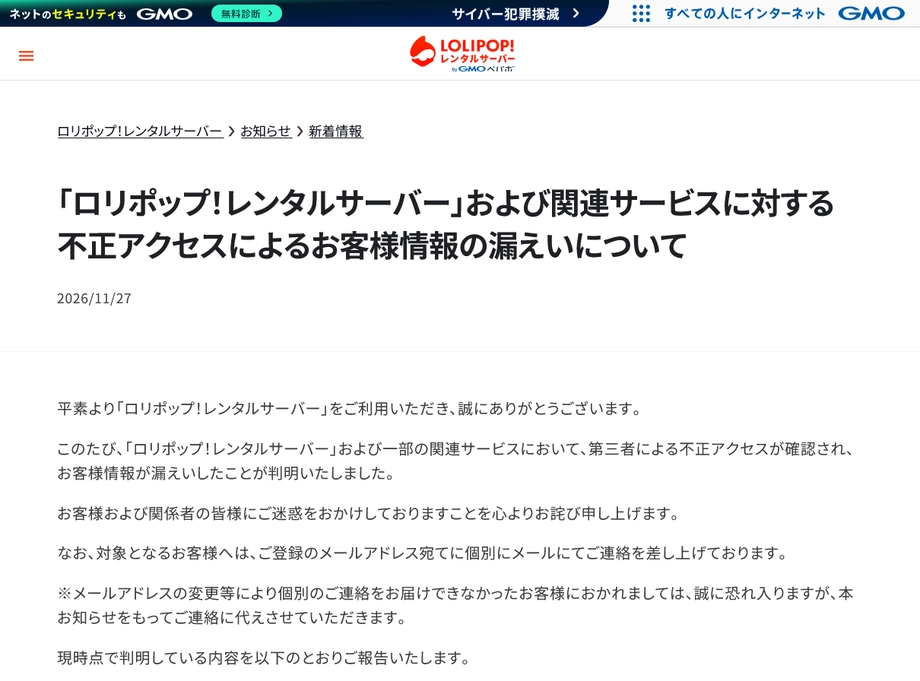
GMO Pepabo said on November 27, 2026, that unauthorized access to its internal systems led to customer data being taken from Lolipop Rental Server and three related services. The affected services are Lolipop Rental Server, Lolipop Deploy Now, Lolipop AI Homepage and Lolipop AI Agent Cloud. The company put the current number at 516,564 customer records.
Contents
- What happened inside GMO Pepabo's systems
- How the breach was found and stopped
- Whose records were exposed
- Why plain text passwords matter
- Which credentials were taken
- What is still under review
- What customers should do now
- What site owners and companies should check
- What hosting providers should change
- Support, compensation and next steps
- Key Points
The leak did not begin with a customer website, according to the company. It was found in its data analytics platform, a system used to collect and examine business data. In plain language, the intruder appears to have entered GMO Pepabo's internal environment and used that data system as the exit door for a large download. GMO Pepabo said it blocked the access route and disabled the authentication information used in the intrusion.
GMO Pepabo published a notice on November 27, 2026, and Lolipop's notice lists the services, record count, leaked fields and response steps. The company's Q&A adds details for customers trying to work out what they should do next.
GMO Pepabo, as the operator of Lolipop, opened the notice with an apology to customers and others affected. It said:
We sincerely apologize to our customers and everyone concerned for the trouble we have caused.
The company also said it was treating the issue as its own security management failure and would keep investigating with relevant authorities.
How the breach was found and stopped
On November 24, an audit log in the data analytics platform gave the first clear signal. An audit log is a record of actions such as logins, downloads and changes. GMO Pepabo saw an unusual data download and began checking whether customer information had been copied.
- November 24: GMO Pepabo detected a suspicious download in the data analytics platform's audit log, disabled the credentials used in the access, blocked the access route and carried out maintenance on related functions.
- November 25: The company finished a forced reset of affected passwords and reported the incident to Japan's Ministry of Internal Affairs and Communications.
- November 27: GMO Pepabo sent individual emails to affected customers and made the public announcement.
Before that disclosure, Lolipop had already taken several service steps. New signups were stopped on October 24 as a precaution, WebDAV use was stopped on October 25, new backup option orders were stopped on October 28 and backup data provided through inquiries was stopped on November 26. Those earlier notices did not announce a confirmed breach.
GMO Pepabo said the access route was blocked on November 24 and the affected passwords were changed or invalidated by November 25. It told customers to set new passwords through the user page and said old passwords could no longer be used for login.
Whose records were exposed
The 516,564 figure is a record count, not a confirmed count of unique people. GMO Pepabo used the words target records and did not say that every record contained every data field.
The confirmed fields are names, postal codes, prefectures and email addresses. Birth dates are included for customers who signed up for Lolipop Rental Server before August 2014, or who signed up through Muumuu Domain. Detailed addresses below prefecture level, including city, ward, street and building details, were not included. Card and bank details were also excluded. GMO Pepabo said card payments are processed by an outside payment provider and card data is not stored in its systems.
A postal code and prefecture can still narrow a person to a rough area, the company warned. That matters because names, email addresses and rough location can make fake messages sound more convincing.
Some former customers also received notices. The company said a system mismatch left some data that should have been deleted after cancellation.
Why plain text passwords matter
The most serious detail in the Q&A concerns passwords. GMO Pepabo said three groups of credentials were stored in plain text, meaning the password sat in storage as ordinary characters that a person or program could read if they obtained the file or database entry. Proper password storage usually uses a one way hash, which turns a password into a value that is hard to reverse, plus a unique salt for each user.
GMO Pepabo, the company that operates Lolipop, answered its own Q&A question asking why the passwords were stored in plain text. The company admitted the storage method and said it would review password storage across its services. Its answer said:
All of the FTP/WebDAV temporary passwords, user page initial login passwords and Basic authentication ID and password pairs that leaked were stored in plain text.
No reason was given for the storage choice. The company said password storage methods would be inspected and improved across other services.
The Password Storage Cheat Sheet from OWASP, a security project, advises using a password storage hash designed for this purpose, such as Argon2id, with a salt. A salt is a unique random add on that makes two identical passwords produce different stored values. A fast general hash such as SHA-256 is not enough on its own for password storage because attackers can test guesses too quickly.
Which credentials were taken
GMO Pepabo listed 8,322 temporary FTP and WebDAV passwords set by the company when customers signed up. FTP and WebDAV are ways to send, receive and manage website files. If such a password were active, misuse could include viewing, copying or changing files within the permission granted to that account.
Another 4,170 initial login passwords were set by the company for the user page when customers signed up through Muumuu Domain. That page handles contracts and service settings. The company said passwords changed by customers after signup for FTP, WebDAV and the user page are not part of this leak.
The largest group was 105,608 Basic authentication ID and password pairs set by customers through the access restriction feature. Basic authentication puts an ID and password gate in front of a web page. Businesses often use it for staff pages, partner pages, draft pages or a protective layer in front of site tools. Of the 118,100 credential records listed across the three groups, Basic authentication makes up about 89 percent.
Those three figures may overlap because one customer could have more than one kind of credential. They should not be added to the 516,564 customer record figure. GMO Pepabo said it reset or invalidated the affected passwords and had not confirmed unauthorized logins or misuse using them at the time of announcement.
A password reset closes the Lolipop account door, but it cannot undo reuse. If someone used the same password for email, a content management system, a cloud console or a bank, that other service needs its own password change. This is why the company urged customers to change the old password wherever it was reused.
What is still under review
Website display and email sending were working at the time of the announcement. GMO Pepabo also said the intrusion route was blocked and the credentials used in the intrusion were invalidated. Service availability, however, is a separate check from file and mail data integrity.
The company is still examining whether customer website files or mail data were copied or altered. It said it had put backup protection measures in place and would notify customers if an impact is confirmed. A site owner should not assume from a live homepage that every stored file is unchanged.
Muumuu Domain and heteml are also under review for customer information impact. Muumuu Domain was temporarily stopped from November 24 for a safety check and later resumed, with some functions still under maintenance at the time of the notice. The company said it had not confirmed unauthorized changes to domain registration information or settings.
Other GMO Pepabo services, including minne, SUZURI and Color Me Shop, were checked and no unauthorized access to their customer information had been confirmed at that point. A Muumuu Domain connection to some leaked initial Lolipop passwords does not mean Muumuu Domain management passwords were leaked.
GMO Pepabo said it had not confirmed misuse of the personal information, secondary harm or public posting of the taken data on the internet as of November 27. Open points include the initial intrusion route, the analytics platform product name and the count and fields of retained former customer data. No date was given for the next update, and the company said follow ups would be published when facts are confirmed.
What customers should do now
Customers who receive a reset notice should open the user page through a bookmark or the official site, not through a link in a message. GMO Pepabo said the sender address for its notices is [email protected], but a sender name can be faked, so the address alone is not a safe check. Companies should also check who reads the registered email address, since notices may sit with a former agency or staff member.
Anyone affected should set a new, unused password and use a different one for each service. Email accounts, domain management accounts and other services that can reset passwords deserve priority, because they can be used to recover access elsewhere. Where available, multi factor authentication or passkeys add another check beyond a password.
Customers using Basic authentication should check each protected page. They should set a fresh password, confirm that only approved users can open the page and make sure an unauthenticated visitor cannot view it. If a design agency or internal colleague shared the old password, the new one should be shared through a safe channel.
One site operator described first treating a sudden Basic authentication failure as a maintenance issue before the disclosure. Anyone who restored access by putting the old password back should change it again to a password never used before.
Phishing is a practical risk after a breach of names, email addresses and some birth dates. Customers should not enter passwords or card details after following a message about unpaid bills, contract renewal or password confirmation. GMO Pepabo said it does not ask for passwords or card information by email or phone. Suspicious messages should be checked against the official notice list or the support desk.
The reset function was temporarily paused on November 27 from about 7:26 a.m. to 8:54 a.m. because access was concentrated on the user page. The company reported recovery later that day and guided users who could not finish the reset to try again.
What site owners and companies should check
Companies using Lolipop for a corporate site, shop or media service need to handle two questions separately. One is the leak of contract holder information. The other is whether the company's own server files, databases or mail data were touched. The first question has figures and names. The second is still open.
Site owners should preserve web access logs, management operation logs and file transfer logs where their plan allows. Logs are the trail that shows who accessed a site, when files changed and whether transfers occurred. If logs cannot be exported, customers should ask the provider whether they can be preserved or investigated.
WordPress users should review administrator accounts, plugins and themes, unusual files, external redirects and signs of data being sent out. Domain and DNS settings should be checked for unexpected records or name server changes. Mail settings should be reviewed for login history, forwarding rules, filters and sent messages. External APIs and databases need attention too, especially if configuration files hold secrets that may need to be revoked and replaced.
GMO Pepabo's announcement did not say WordPress login passwords or database credentials were among the leaked fields. If a site owner sees signs of server file access, the review should extend to connected systems because those systems may hold their own secrets.
Backups should be kept in a location separate from the hosting contract and tested for restore use. A backup taken while a site was compromised can carry the same unwanted changes, so file comparison against a known clean copy matters.
There is also a responsibility divide. A customer's web application firewall or content delivery network cannot protect a provider's internal analytics platform. Company technology teams should ask the provider about the investigation scope, log access, impact decisions, notice timing and who handles backup and recovery. If customer personal data held by the company is affected, privacy and legal staff should decide whether notifications or regulator reports are required.
What hosting providers should change
This incident puts three design questions in focus: why credentials were in an analytics platform, why readable passwords were stored, and why data meant for deletion remained. Each is a data lifecycle issue, from collection to deletion.
Service providers should separate data needed to run a service from data needed for analysis. Passwords and access tokens usually have no place in an analytics copy. Existing copies, exports, backups and logs should be checked for credentials, and analytics accounts should have the least permission needed. Admin rights and viewing rights should be separated.
Password storage should use a dedicated password hash with a unique salt. If a protocol requires a reversible secret, providers should use a secret management system, encryption, key control and narrow use. Initial passwords should expire quickly, and temporary setup credentials should not remain valid for long periods.
Large downloads and unusual access patterns should be monitored closely, with alerts that staff act on. The suspicious download in this case was found through an audit log, which helped GMO Pepabo respond quickly, but the same log also shows that sensitive data was reachable from the analytics environment.
Deletion processes should follow data into every copy, including analytics systems, data warehouses, external links, backups and logs. A cancellation screen is not the same as verified deletion. Providers need checks that detect failed deletion and retry it. Some records must be kept under law, so the retained set and the deleted set need to be clearly defined.
Former customers who get a notice should read it even if they believe their account was closed. GMO Pepabo said people who want personal data deleted can use the support channel, while some information must be kept for a required period. Cancellation can also be requested through the user page or support desk.
Support, compensation and next steps
GMO Pepabo directed customers with questions to Lolipop Customer Support. The phone number is 03-6631-9609, with weekday reception from 10 a.m. to 6 p.m. The official notice also lists an online contact form. Press inquiries go to [email protected].
The company said compensation and refunds are not planned at this stage. It also said it would work with investigative authorities to confirm the scope and cause, then create measures to prevent a repeat.
For customers, the immediate picture is a mix of contained risk and open reviews: known passwords were reset, payment details were not included and no misuse had been confirmed by November 27.
For ordinary users, the lesson is simple. Change reused passwords, check official notices through known paths and watch for convincing fake messages. For site operators, the work is broader: preserve evidence, check access points and keep backups outside the service being investigated.
Key Points
- GMO Pepabo said 516,564 customer records from Lolipop and three related services were exposed.
- Names, postal codes, prefectures, email addresses and some birth dates were included, while card and bank data were excluded.
- About 118,100 credential records were listed, including 105,608 Basic authentication pairs, and all three credential types were stored in plain text.
- Affected passwords were reset by November 25, and no misuse or public posting of the data had been confirmed by November 27.
- Website files, mail data, retained data from former customers and the initial intrusion route remain under investigation.
- Customers should use official pages for password resets, change reused passwords elsewhere and watch for phishing messages.