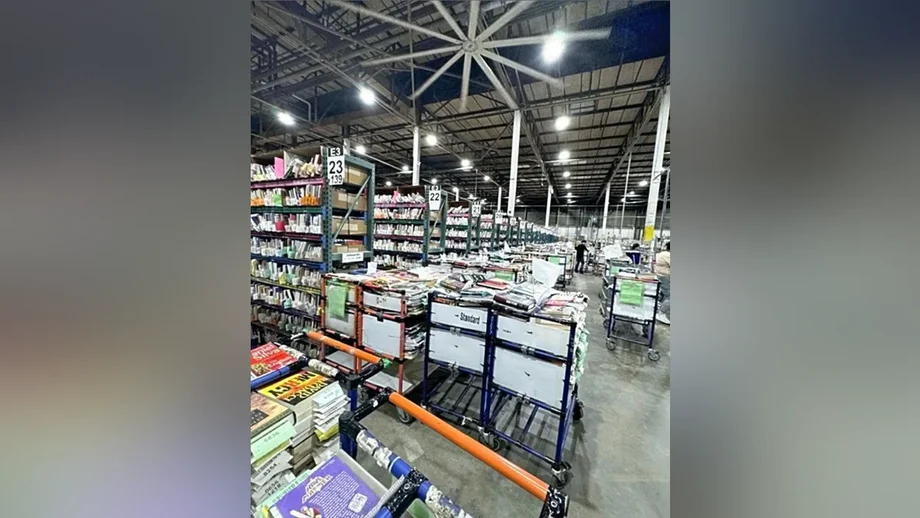
The Titles No Bookshop Could Order Any More
Several of the Japanese books that a subsidiary of the distributor Nippan Group Holdings sold to Anthropic were out of print, which means no bookshop in Japan can order them any more. Multiple publishers found this out only after Nippan explained the deal to them, according to people in the industry who were briefed on the talks. The books had been shipped on the basis of a list that Anthropic supplied, not one that the distributor drew up.
Contents
- The Titles No Bookshop Could Order Any More
- A Second Letter, and a Demand That Nippan Protest
- Sixteen Months of Shipping, One Month of Questions
- Out of Print Does Not Mean Out of Copyright
- Project Panama and a Ruling in California
- Bulk Orders Nobody Has Traced to Anthropic
- Why an AI Company Wants Paper, and Why Japanese Paper
- What Is Still Missing
- Key Points
Nippan IPS, the group company that handles overseas business, signed a business agreement with the American AI developer in November 2024 and sent books between December 2024 and December 2025. The volume of the trade ran to tens of thousands of copies. Nippan has declined to give the total number of books or the amount paid, saying it will answer questions from individual publishers instead, and it has not released the titles. According to people who have seen how the terms were described, the contract stated no purpose of use such as training an AI model.
What the shipments contained is what unsettled the publishers as much as the size of the order. An executive at one publishing house described a mix of subjects alongside a striking number of titles that had long left the market.
The number of copies alone is big, but the shipment also included humanities and non-fiction, and the number of out-of-print titles stood out, which was a shock. I can only think there was an intent behind the books Anthropic chose to buy.
Nippan's own account rests on a claim about what it knew. The company said it confirmed with Anthropic before signing what the books would be used for, and that it did not understand the purchase to be for AI training. That explanation has not settled the matter for the publishers' association, which is now asking whether it should have.
A Second Letter, and a Demand That Nippan Protest
The Japan Book Publishers Association held a standing board meeting in Tokyo on 24 November and decided to send Nippan another written request, dated the same day and due to be delivered within the week. It is the association's second letter on the case. The first, dated 17 September, asked whether Nippan had dealt with Anthropic at all. Nippan answered in writing on 5 October, acknowledging the sales, and that acknowledgement became public the following day.
The new letter presses Nippan on four points.
- Whether the company checked Anthropic's intended use closely enough before it signed the agreement.
- Whether Nippan will lodge a protest with Anthropic if the books were used for AI training contrary to what it was told.
- Whether it will open a dedicated inquiry desk for authors and copyright holders and explain the situation to them.
- Where the out-of-print copies came from, which routes were used to collect them, and what the Anthropic list actually contains.
The association, whose list of member publishers runs to about 380 companies, was founded in 1877 and is led by Sadaharu Egusa. Concern among its members has been building since the sale became known, with authors and rights holders asking whether their own work may have gone into a training pipeline. The letter asks Nippan to explain to those people directly rather than only to their publishers.
Sixteen Months of Shipping, One Month of Questions
The sequence of dates shows how late the questions came relative to the shipments.
- November 2024: Nippan IPS and Anthropic sign a business agreement.
- December 2024 to December 2025: books are shipped from Japan to Anthropic.
- 17 September 2026: the publishers' association writes to Nippan Group Holdings asking whether it sold anything to Anthropic.
- 5 October 2026: Nippan replies in writing and acknowledges the sales.
- 6 October 2026: the acknowledgement is made public.
- 24 November 2026: the association's standing board approves a second letter, dated that day, to be sent within the week.
Notification came after the fact on every side. Publishers learned which of their titles had gone only when Nippan gave its explanation, and they identified the out-of-print titles from that explanation. The books were already in the United States by then, and the association has been asking since September for details of a contract that had been running for a year.
Out of Print Does Not Mean Out of Copyright
"Out of print" describes a commercial condition, not a legal one. A book that can no longer be bought in a shop is still a protected work, and the rights in its contents stay with the author or the publisher for decades after the author's death. The paper and the words on it belong to different people.
Three permissions are routinely mistaken for one. Buying a copy transfers that copy. Copying the text and distributing the copies requires the rights holder's consent. Whether training an AI on the text requires that consent is a further question, and it is the one now being argued in courtrooms abroad and weighed in Japan. Japanese copyright law allows certain uses without permission, and among them is a provision, Article 30-4, that permits works to be used for information analysis, the clause that AI developers have leaned on. Anyone who publishes writing online sits inside the same rules as a printed author, because a blog post is a protected work from the moment it is written.
The practical problem for an out-of-print title is not that the right disappears. It is that oversight of the right thins out. While a book is selling, somebody counts the stock, tallies the sales and telephones the author about a reprint. Once distribution stops, those reasons fade, the contact details go stale, and the author becomes harder to reach. Text can be copied in that silence without anyone noticing at the other end of the chain.
Project Panama and a Ruling in California
Anthropic's internal paperwork, disclosed in January 2026 in the authors' class action known as Bartz v. Anthropic, described an effort to "destructively scan every book in the world". The method it set out was industrial: buy millions of paper books, cut the spines off with hydraulic cutters, run the pages through high-speed scanners and send the paper for recycling. The suppliers described were large resellers of secondhand stock, buying tens of thousands of copies at a time. A contractor's proposal in the files suggested handling 500,000 to 2 million books in about six months on a budget in the tens of millions of dollars.
The company hired Tom Turvey, who had run partnerships for Google Books, in February 2024. A court order of 23 June 2025 recorded his task as acquiring "all the world's books" while keeping legal and commercial trouble to a minimum. That same order drew the line that governs this story. Cutting and scanning lawfully purchased books for use in training counted as transformative use and so as fair use. A separate library Anthropic had built by downloading from pirate sites did not, and the company settled those claims for $1.5 billion, covering roughly 482,460 works at about $3,000 each, with final approval on 20 July 2026.
The internal files recorded dealings with "Nippan Japan" inside Project Panama. Nothing in the Japanese documents shows what happened to the books after they arrived, and the court filings redact the number of volumes, the sums and the kinds of books involved.
Anthropic has rejected the buy and destroy picture the documents suggest.
Our data acquisition program does not involve buying and destroying rare books or used books.
Bulk Orders Nobody Has Traced to Anthropic
Since the summer of 2026, secondhand bookshops around Japan have been filling orders that do not look like ordinary retail. Slow moving subjects, philosophy, history, medicine and law among them, have been requested in bulk with no obvious link between the titles, and the parcels have gone to logistics centres in Okayama and Chiba prefectures.
At Yomitaya in Kichijoji, western Tokyo, an online seller that moves about 1,000 books a month, an extra 500 copies went out in each of August and September 2026. Its representative, Yoshihiro Sumida, said unfamiliar accounts that looked like purchasing agents had been ordering several times a day since July. The buyers, in his account, were not one company: several firms with similar names shared addresses close together. He also said plainly that it was not known whether the buyers were American AI companies.
Claire Book in Fukuoka City received orders almost daily, addressed to the same logistics centre in Okayama under the names of four or five people who appeared to be foreign nationals, one of whom had a purchase history of 45 items. An online secondhand shop in the Kanto region had days of 100 sales and a fivefold rise in revenue, past 1,000 books in all. Because the gaps between orders were so even, the owner suspects a mechanical system is placing them.
A Japanese business magazine reported in October 2026 that a French company and a logistics centre belonging to a large staffing and logistics group in Okayama City were involved in the Amazon side of the trade. The French company was not named in the published portion, and the final buyer is unknown. The rumoured telephone call from the United States has not been substantiated in Japanese or English sources; what has been documented is orders through online marketplaces and questions sent by email.
Timing has fed the connection to AI. Used book listings out of stock on Amazon.co.jp rose by 130,000 titles in 2026 compared with the two previous years, the same magazine reported. In September 2026 a broadcast report described more than 50 tons of books, about 100,000 volumes, labelled Japanese books leaving a company in the Nippan group for the United States, with no document naming who received them.
Why an AI Company Wants Paper, and Why Japanese Paper
Three reasons explain the appetite, and the subjects in the orders fit all three. Text on the open web has largely been harvested already, and material published since about 2022 can contain writing produced by AI models, which is weaker as training material. Edited books are long and dense, and a title printed before generative AI spread cannot contain AI output.
Second, local history, specialised research, older technical manuals and small press runs often have no digital edition at all, so a web search cannot reach their text. Philosophy, history, medicine, law and writing on the Edo period, the genres being ordered, sit in that undigitised space.
Third, edited long-form Japanese is scarcer in digital form than English. Japan also translates a large share of the world's writing, so a shelf of Japanese books carries Japanese language and knowledge that began in other languages. Collecting in Japanese is a way of collecting widely.
What Is Still Missing
Five things have not been disclosed. The titles, total volumes, sums paid and the split by publisher remain private. The contents of the Anthropic list and the criteria behind it have not been described. The origin of the out-of-print copies and the routes used to gather them are still unexplained. Whether the Nippan books were scanned or used in training has not been established in any document. Anthropic has not given an official account of the Japanese purchase.
No date has been set for Nippan's reply to the 24 November letter. The association has asked for answers in writing, for a channel through which authors can ask about their own titles, and for a protest to Anthropic if the use turned out to be different from what Nippan says it was told.
Key Points
- Nippan IPS signed a business agreement with Anthropic in November 2024 and shipped Japanese books between December 2024 and December 2025.
- The trade ran to tens of thousands of copies and was filled from a list supplied by Anthropic.
- Several sold titles were out of print, and publishers noticed only after Nippan explained the deal.
- Nippan says it asked about the intended use before signing but did not understand the books were for AI training.
- The Japan Book Publishers Association sent a first letter on 17 September 2026 and a second on 24 November 2026, asking for procurement sources, the list, a protest to Anthropic and an inquiry desk for authors.
- Nippan acknowledged the sales in writing on 5 October 2026 and has not disclosed volumes, money or titles.
- Anthropic's Project Panama documents described destructive scanning of books worldwide, and a June 2025 US ruling treated scanning of lawfully bought books for training as fair use.
- Bulk orders to Japanese secondhand bookshops since summer 2026 have not been traced to Anthropic in any document.