A small battery line with a national purpose
Suzuki Motor and Tokyo battery specialist Eliiy Power will invest about ¥44.7 billion, roughly US$280 million, to develop and manufacture lithium iron phosphate batteries in Japan. Japan's Ministry of Economy, Trade and Industry, known as METI, certified the project on November 26, 2026. Production is scheduled to begin in October 2029 at a new manufacturing base in Kosai, Shizuoka Prefecture, with annual capacity of 0.48 gigawatt hours.
Contents
- A small battery line with a national purpose
- What has the government certified?
- Why does LFP chemistry matter?
- Why is Suzuki changing its supply base?
- One battery, two jobs and a second use
- What did the farm trial test?
- How much can the factory make?
- Why is public money involved?
- What does the project mean for Suzuki and its rivals?
- What happens next?
- What to Know
The government will provide a maximum grant of about ¥18.7 billion under the Economic Security Promotion Act. The batteries are intended for homes, businesses, industrial sites and electric vehicles. If the vehicle version enters production as planned, it is expected to become Japan's first mass production of lithium iron phosphate batteries for cars.
The project addresses two problems at once. Suzuki wants cheaper batteries for small electric cars, while the government wants to reduce the risk that export restrictions or other disruptions abroad could stop supplies. For drivers, the eventual test will be whether the batteries help lower purchase and ownership costs. For Japan, the project adds a modest amount of domestic manufacturing capacity in an industry now dominated by Chinese and South Korean producers.
What has the government certified?
The official approval is more specific than a general announcement about electric car batteries. METI certified a supply assurance plan for stationary storage batteries, covering the development and mass production of cells and modules. A cell is the basic unit that stores electricity, while a module combines cells into a larger component. The same basic design is intended to be usable in vehicles.
The joint certification notice published by Suzuki identifies the approval as plan number 2026 Storage Battery No. 1-1, dated November 26, 2026. Support covers construction of a production base and the introduction, development and improvement of production technology. The companies have requested grant funding.
At the maximum amount, the grant would cover about 41.8 percent of the ¥44.7 billion project cost. That would leave ¥26 billion for the companies and any other financing sources if the full budget were used. An earlier outline described the investment as more than ¥40 billion and public support as just under ¥20 billion; the certification supplies the exact figures and the subsidy ceiling.
The choice of Kosai places the battery operation in the same city as Suzuki's Kosai vehicle plant. The certified plan sets production capacity and a starting month, but it does not divide future output among residential, industrial and automotive customers.
Why does LFP chemistry matter?
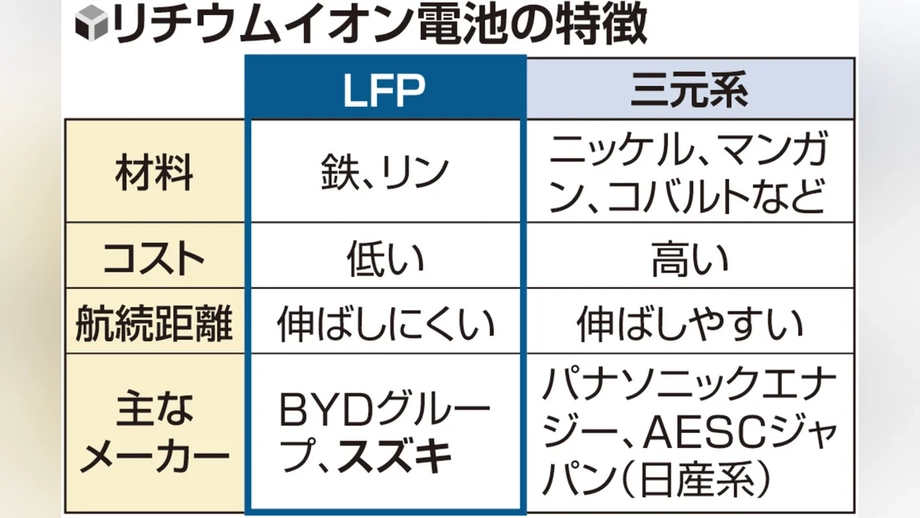
LFP stands for lithium iron phosphate, the material used in the battery's positive electrode, or cathode. Its main ingredients include iron, phosphorus, oxygen and lithium. This recipe avoids nickel and cobalt, which are used in the ternary batteries commonly fitted to Japanese electric vehicles. Ternary chemistry can offer high energy efficiency and longer driving range, but its scarce metals can be expensive and their suppliers are concentrated in a limited number of countries.
LFP batteries are generally cheaper to make and are regarded as strong on safety. Eliiy Power also stresses that the thermal stability of the cathode material must be combined with careful design of the entire cell. The engineering target for the new project is to combine that safety with two different requirements: durability through years of charging and discharging in stationary storage, and high energy density for vehicles. Energy density describes how much electricity can be extracted for a given weight or volume.
Cost explains much of Suzuki's interest. Batteries typically account for about 30 to 40 percent of an electric vehicle's price. Cheaper cells therefore give an automaker more room to reduce the showroom price, add equipment or protect its margin. The chemistry still requires lithium, however, and other battery ingredients present their own procurement challenges.
Why is Suzuki changing its supply base?
Suzuki already uses LFP batteries in its e Vitara electric vehicle and the e-Sky, an electric kei car launched in November 2026. Kei cars are Japan's smallest passenger vehicles, designed around strict limits on dimensions and engine or motor output. People familiar with the procurement say Suzuki has obtained LFP batteries from China's BYD Group. The certified plan itself does not name the existing supplier.
Suzuki, the Hamamatsu-based automaker led by President Toshihiro Suzuki, described the project's supply objective in a company statement.
We will work to build a supply chain that does not depend on a specific country.
Domestic production would make it easier for Suzuki to maintain supplies if China restricted exports of finished batteries. It also arrives as the e-Sky faces comparisons with BYD's Racco, a Chinese kei electric car introduced to Japan earlier in 2026. Because the battery represents such a large share of vehicle cost, the Kosai project is part of a price contest as well as a supply security measure.
One battery, two jobs and a second use
The shared design gives the companies more than one potential market. A car battery must deliver considerable energy without adding excessive weight or taking up too much space. A battery installed in a house or factory can be larger, but it must withstand repeated charging and discharging over many years. Suzuki will contribute its small vehicle development and production knowledge, while Eliiy Power will supply its LFP technology and experience with storage systems.
The companies also intend to design the batteries for repurposing. This means that, after their first use in a vehicle, suitable batteries could be removed and installed again as stationary storage. Batteries gradually lose capacity as they are charged and discharged. A unit that no longer meets the requirements of a car may still be able to meet the different requirements of a home or industrial storage system.
That second use could retain economic value after the battery's automotive service ends. Returning some of that value to the vehicle owner could reduce the total cost of owning an electric car. The actual saving will depend on the condition of used batteries and the expense of collecting, testing and converting them.
Adoption is planned in stages from fiscal 2030, covering residential storage, commercial and industrial systems, and vehicles. The companies connect this approach with lower ownership costs, wider use of electric vehicles and their stated goal of contributing to a carbon neutral society.
What did the farm trial test?
A demonstration begun in February 2026 offers an early look at the shared-use idea. Suzuki started working with farmers using an electric vehicle based on its Carry small truck. The vehicle served farm work, while electricity stored in its battery could also be used at home.
Eliiy Power supplied a battery adapted from a design originally made for stationary storage so that it could be used in the vehicle. The arrangement links transportation with the electricity needs of a home or workplace, rather than treating the car battery as useful only while driving.
The trial gives the partners practical experience before commercial production begins. It also illustrates what Suzuki means by infrastructure mobility connected closely to daily life: a small vehicle can be both a work tool and a store of electricity. The certified factory project will still need to deliver the durability, energy density and manufacturing consistency required for much larger volumes.
How much can the factory make?
One gigawatt hour equals one million kilowatt hours, so the planned annual capacity of 0.48 gigawatt hours is 480,000 kilowatt hours. The e-Sky has a 26 kilowatt hour battery. Dividing the factory's annual energy capacity by that pack size gives enough energy for approximately 18,000 cars.
That is an energy comparison rather than a promised allocation to the e-Sky. Actual output will also serve stationary storage, and manufacturing losses and different battery sizes will affect the number of finished products. The planned volume is small beside Suzuki's total vehicle production, which remains concentrated on gasoline and hybrid models.
The figure is also modest beside Japan's national ambition. The government wants domestic battery production capacity to reach 150 gigawatt hours a year by the mid-2030s. The Kosai project's 0.48 gigawatt hours equals 0.32 percent of that target. Its importance therefore lies as much in establishing technology, supplier relationships and a reusable battery design as in the initial volume.
Why is public money involved?
Japanese producers held about half of the global market for vehicle batteries in 2015, but their share had fallen below 10 percent by 2024. Chinese and South Korean companies together now hold about 90 percent. At the same time, the global market for batteries that use lithium ions is forecast to grow from ¥23 trillion in 2025 to ¥46 trillion in 2035, doubling over the decade.
METI's support is intended to preserve a domestic production base while that market expands. It also reflects concern about materials. LFP removes nickel and cobalt from the cathode recipe, but most lithium batteries still use graphite in the negative electrode, or anode. The International Energy Agency estimates that more than 90 percent of refined graphite passes through Chinese ports. Japanese manufacturers have also faced requirements to seek quarterly Chinese permission for graphite following export curbs.
Making cells in Shizuoka will therefore still require careful procurement of lithium, graphite and other inputs. Domestic manufacturing reduces exposure to restrictions on imported battery packs, while future material contracts will determine how much upstream exposure remains. Japan is separately pursuing rare earth extraction near Minamitorishima Island and encouraging development of motors that operate without rare earth magnets.
The wider supply pressure was already visible before the battery certification. In January 2026, China supplied 76% of Japan's rare earth imports, up from 72.6 percent a year earlier even though the volume shipped from China had fallen. By October, Japan was seeking American help over a shortage of yttrium, as China defended export restrictions affecting Japanese industry.
Nickel and cobalt belong to the broader industrial category of scarce metals and are not among the 17 elements formally called rare earths. The disputes nevertheless point to the same manufacturing problem: a factory can be vulnerable when a small but essential input is controlled by a limited number of suppliers.
What does the project mean for Suzuki and its rivals?
Eliiy Power was founded in 2006 and is chaired by its chief executive, Hirokazu Yoshida. Suzuki first invested in the company in 2012 and now holds approximately 20 percent. The partners expanded their relationship in November 2023 through an additional investment and a business alliance covering batteries that could serve both storage systems and mobility products.
For Suzuki, the factory supports a broader electric vehicle program. The company plans to introduce six electric models in Japan by fiscal 2030 and also expand its electric range in India and Europe. Batteries from the new project are expected to support that expansion after production starts, although Suzuki has not announced output allocations for individual models.
The fixed launch plan contrasts with caution elsewhere in Japan's car industry. Toyota postponed construction of a battery plant in Kanda, Fukuoka Prefecture, that had been expected to begin production in 2028. Nissan abandoned plans for a battery factory in Kitakyushu in May 2025. Suzuki's small initial capacity and access to stationary storage demand give its project a different shape, but it will still need competitive costs and a successful production start.
What happens next?
The partnership has developed through several stages, with the main future milestones now set by the certified plan.
- 2006: Eliiy Power was founded to develop and sell storage batteries.
- 2012: Suzuki made its first investment, beginning technical exchanges between the companies.
- November 2023: Suzuki added investment and signed a business alliance for joint battery development.
- February 2026: Suzuki and farmers began demonstrating a Carry-based electric vehicle that could also supply electricity for home use.
- November 26, 2026: METI certified the ¥44.7 billion supply assurance plan.
- October 2029: Production is scheduled to start in Kosai with annual capacity of 0.48 gigawatt hours.
- Fiscal 2030 onward: Residential, commercial, industrial and vehicle adoption is planned in stages.
The announcement provides no cell price, detailed construction timetable, employment figure or division of output among the three markets. Future suppliers of lithium and graphite have also not been identified. Those details will help determine whether the project can match imported batteries on price, create valuable second uses and reduce material exposure as well as finished-battery import risk. The grant figure is a maximum rather than a statement that the entire amount has already been paid.
What to Know
- Suzuki and Eliiy Power plan to start LFP battery production in Kosai, Shizuoka Prefecture, in October 2029.
- The project costs about ¥44.7 billion and has a maximum government grant of about ¥18.7 billion.
- Annual capacity will be 0.48 gigawatt hours, equivalent in energy terms to batteries for roughly 18,000 e-Sky cars.
- The certified product is stationary storage designed so that it can also serve vehicles.
- LFP chemistry avoids nickel and cobalt, although lithium and materials such as graphite remain necessary.
- The batteries are intended for homes, businesses, industry and vehicles from fiscal 2030, with used vehicle batteries designed for possible stationary reuse.
- The project supports Japan's supply security goals, but its initial capacity equals just 0.32 percent of the national target of 150 gigawatt hours a year.