Four leaders reunite in Manila with technology and supply chains at stake
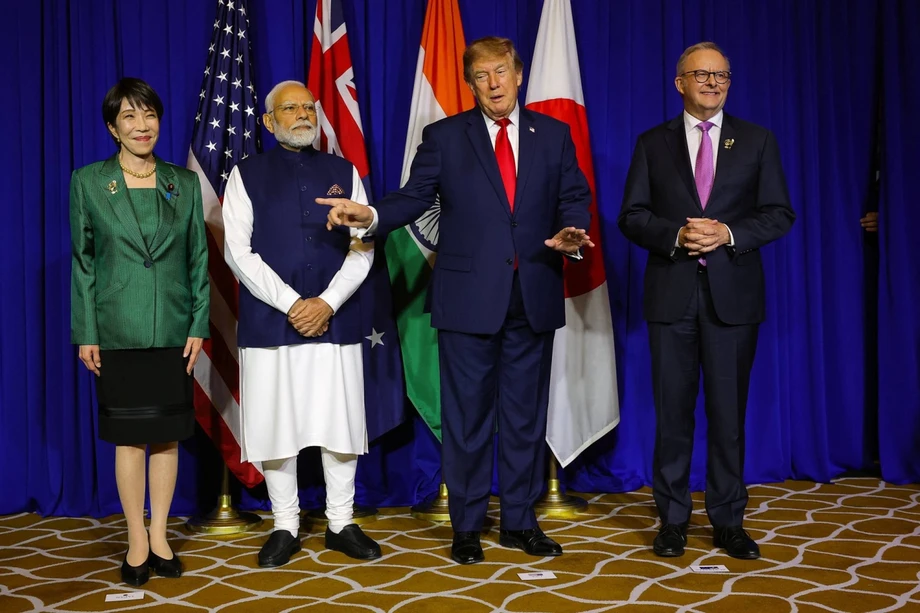
U.S. President Donald Trump announced more than $85 million in Quad spending to expand trusted artificial intelligence and a new technology accelerator on Tuesday as he joined the leaders of Japan, India and Australia in Manila. The meeting was the grouping's first summit since September 2024 and came two days before planned talks between Trump, Chinese President Xi Jinping and Russian President Vladimir Putin.
Contents
- Four leaders reunite in Manila with technology and supply chains at stake
- What the AI accelerator promises
- Why critical minerals matter to Japan
- Japan seeks reassurance before Shenzhen
- India and Australia want practical results
- How a disaster response became a leaders' partnership
- Why ASEAN rearranged its schedule
- A different diplomatic test awaits in China
- Key Points
Trump met Japanese Prime Minister Sanae Takaichi, Indian Prime Minister Narendra Modi and Australian Prime Minister Anthony Albanese shortly after arriving in the Philippine capital on November 17. He also announced critical mineral agreements intended to reduce the four countries' dependence on individual foreign suppliers.
The gathering was Trump's first Quad leaders' summit across his two presidential terms. For Japan, Australia and India, his attendance restored direct engagement at the top of a partnership whose planned meeting in India in 2025 had been delayed.
The announcements connected two immediate priorities: developing advanced technology and securing the materials that modern industries need. They also gave Takaichi a show of cooperation with Washington before she travels to China amid a bitter dispute between Tokyo and Beijing.
What the AI accelerator promises
Trump announced the new Quad SI accelerator alongside more than $85 million in spending to expand technology described as trusted. His administration uses the term "Super Intelligence," or SI, for artificial intelligence. An accelerator generally helps projects develop faster by bringing together resources, technical support and potential partners.
Quad foreign ministers had announced their intent on October 31 to provide more than $85 million in technical and financial assistance to support access to trusted AI across the Indo-Pacific, including through the Quad AI Accelerator. The announcement followed their meeting alongside the G20 Foreign Ministers' Meeting in Atlanta. No funding allocation or accelerator terms were specified.
Trump, the U.S. president, framed the initiative as a way for countries with shared interests to influence the development of AI:
We want to ensure that the future of this critical technology is dominated by nations that share our values and our common interests.
AI systems can generate text, examine large amounts of information and help automate tasks. The Quad initiative puts cooperation over those capabilities alongside the group's existing security agenda. Funding allocations, project selection rules and the detailed terms of the mineral agreements were not announced in the opening remarks.
Trump also announced a Quad Business Leaders Forum to launch in 2027. That would give companies a dedicated channel for economic cooperation, extending the partnership beyond meetings between governments.
Why critical minerals matter to Japan
Trump described the mineral arrangements as a response to the risk that a country could use its position as a major supplier to pressure others. Critical minerals are materials considered important to industry and economic security whose supply may be difficult to replace quickly. Rare earths, a group used in products such as powerful magnets, are part of that concern.
Following the Atlanta ministerial meeting, the United States separately committed $10 million to critical-minerals recycling initiatives in India and ASEAN countries, as part of efforts to build resilient supply chains and improve access to materials needed for advanced technologies.
Trump said the agreements would secure supply chains:
and ensure that none of our nations is vulnerable to coercion by any single foreign supplier.
China was not named in that announcement, but Japan's current dispute with Beijing gives the issue immediate weight. After Takaichi's remarks last November about possible Japanese military intervention in a Taiwan crisis, China placed dozens of Japanese companies on an export blacklist, barred shipments of goods with both civilian and military uses, and cut off rare earth exports to Japan.
For Japanese manufacturers, restrictions of that kind can make essential materials harder to obtain. Diversifying supply means creating alternative routes to purchase or produce them, reducing the power of any one government to interrupt deliveries.
Quad foreign ministers had already expressed concern at their meeting in Atlanta the previous month about economic coercion, arbitrary export restrictions and industrial overcapacity. The last term describes production capacity that exceeds demand, potentially putting pressure on competing producers elsewhere.
Japan seeks reassurance before Shenzhen
Takaichi encouraged Trump's participation in Manila and used her opening remarks to press for stronger cooperation. The Japanese prime minister said the Quad would help shape the region's future:
will shape the future of the Indo-Pacific
She also urged the leaders to give further momentum to the framework, identifying maritime security, economic security, energy and emerging technologies as areas for joint work. Her next stop was Shenzhen, where the Asia-Pacific Economic Cooperation summit begins on Wednesday, November 18.
Tokyo is concerned that Trump could pursue a conciliatory approach toward Beijing and Moscow while Japan faces growing Chinese military activity in the region and Russia continues its invasion of Ukraine. Japanese concerns also include the possibility that Republican losses in the U.S. midterm elections, which returned both chambers of Congress to Democratic control, could encourage Trump to seek diplomatic successes abroad.
Takaichi had been seeking a separate meeting with Trump during his Manila visit, which runs through Wednesday. The White House schedule did not list one. The Quad session nevertheless gave her direct access to the president before his meetings with Xi and Putin.
India and Australia want practical results
Modi described the Quad as a constructive and trusted partnership working on maritime security, reliable supply chains, new technologies and disaster response. He pointed to five foreign ministers' meetings since January of the previous year as evidence that cooperation had continued during the gap between leaders' summits.
The Indian prime minister said the Manila gathering should help establish concrete goals for the next phase. His focus linked the diplomatic meeting to practical work, from responding to emergencies to protecting the movement of goods by sea.
Albanese similarly highlighted maritime security and economic cooperation, with critical minerals, rare earths and AI among the issues for discussion. The Australian prime minister described the value of the four countries acting together:
The world will be a safer and more secure place
Australia will chair the Quad next year. That gives Canberra a role in carrying the Manila announcements into the next stage, including the planned business forum in 2027. Japanese officials expected an outcome document after the summit, with maritime and economic security among the main subjects.
How a disaster response became a leaders' partnership
The Quad began with cooperation after the 2004 Indian Ocean earthquake and tsunami, when Australia, India, Japan and the United States coordinated emergency assistance. Its development into a diplomatic framework was encouraged by Japan's late prime minister, Shinzo Abe.
The partnership expanded through several stages before Tuesday's return to a leaders' meeting:
- 2004: The four countries coordinated humanitarian assistance after the Indian Ocean tsunami.
- 2007: The Quad framework took shape in Manila, with Abe promoting cooperation among the four democracies.
- 2019: Cooperation rose to the foreign minister level during Trump's first administration.
- 2021: Leaders began holding summits under U.S. President Joe Biden.
- September 2024: Biden hosted the previous leaders' summit in Delaware.
- 2025: A planned summit in India was delayed by scheduling difficulties.
- November 17: Trump, Takaichi, Modi and Albanese met in Manila.
China regards the Quad as an attempt to encircle it. Members say the partnership is not directed against any single country and present its purpose as supporting a free and open Indo-Pacific, including cooperation at sea and in economic affairs.
Why ASEAN rearranged its schedule
The Philippines, which hosted the gathering but is not a Quad member, made considerable efforts to secure Trump's visit. ASEAN shifted its meeting schedule so he could travel from Manila to the APEC summit in Shenzhen.
Trump arrived after the closing ceremony of the main ASEAN meetings. The regional grouping nevertheless arranged a special summit and dinner for him, while a meeting with Philippine President Ferdinand Marcos Jr. was scheduled for November 18.
The treatment reflected concern about keeping the United States engaged in Asia. That matters especially to the Philippines, a U.S. ally that disputes Chinese territorial claims in the South China Sea.
Other leaders followed different schedules. Cambodian Prime Minister Hun Manet arrived on November 17 after Cambodia hosted an international conference on November 15 and 16. Chinese Premier Li Qiang attended an ASEAN leaders' meeting on November 16 and left Manila shortly afterward. Marcos exchanged words with Li but held no formal bilateral meeting with him.
A different diplomatic test awaits in China
Trump's next major engagements are scheduled for Thursday, November 19, in Shenzhen: a bilateral meeting with Xi, followed by the first face to face summit of the U.S., Chinese and Russian presidents. China's Foreign Ministry confirmed the three leader meeting after announcements from the White House and Kremlin.
Mao Ning, the Chinese Foreign Ministry spokesperson, said the leaders would discuss world peace and strategic stability among major powers. She also invoked World War II:
Historically, these three countries stood shoulder to shoulder to secure victory in the World Anti-Fascist War.
That historical framing carries particular sensitivity for Japan. At a September meeting, Trump described the United States and China as allies in World War II, while Xi recalled their shared fight against fascist aggression. The Chinese government allied with Washington during the war was led by the Kuomintang; the People's Republic of China was founded in 1949.
Shanghai University of Political Science and Law professor Ni Lexiong said the trilateral meeting could create an impression that three major powers were deciding global affairs, leaving countries such as Japan and India feeling excluded. Scott Kennedy of the Center for Strategic and International Studies described the gathering as reflecting a major change in how Washington handles international affairs, with Trump cultivating closer personal relationships with leaders traditionally treated as competitors or adversaries.
The Manila summit and the Shenzhen talks place two forms of diplomacy next to each other: cooperation among four Indo-Pacific partners, followed by direct bargaining among Washington, Beijing and Moscow. For Takaichi, Modi and Albanese, the practical test is whether the technology funding, mineral agreements and continuing ministerial work give the Quad lasting activity between leaders' meetings.
Key Points
- Trump joined the first Quad leaders' summit since September 2024 in Manila on November 17.
- He announced more than $85 million for trusted AI cooperation and a new Quad SI accelerator.
- Critical mineral agreements aim to reduce dependence on individual foreign suppliers.
- A Quad Business Leaders Forum is planned for 2027, when Australia will chair the grouping.
- Takaichi attended amid Japanese tensions with China over Taiwan and export restrictions.
- Trump is scheduled to meet Xi and Putin in Shenzhen on November 19.