Japan's draft puts a warning about three countries at the center
Government officials planning Japan's year end security documents are considering an explicit reference to deeper military cooperation among China, Russia and North Korea since Russia's war against Ukraine, people familiar with the plan said on November 26. The draft treats that cooperation as one reason Japan must keep building stronger defenses. The final wording will be settled after talks with the ruling party, and no final date for the announcement was given beyond the government's goal of finishing the review by the end of 2026.
Contents
- Japan's draft puts a warning about three countries at the center
- What wording Tokyo is likely to keep
- A Beijing parade made the three country picture harder to ignore
- A short timeline of the turn
- Russia and North Korea turn war support into a formal bond
- China and Russia rehearse in the seas and skies near Japan
- Trade, energy and technology bind Moscow and Beijing
- Can Japan pay for the strategy it is writing?
- Russia answers by accusing Japan of remilitarization
- What changes for Japan and its neighbors
- Key Points
The three documents are the National Security Strategy, the National Defense Strategy and the Defense Buildup Program, last updated in 2022. The National Security Strategy is the top level paper that names threats and explains what capabilities Japan needs. The government's starting point is that the region around Japan has become worse than when the current set was written, especially around the Korean Peninsula, the seas near Japan and Taiwan.
The proposed text is expected to keep Russia as a serious security concern and North Korea as an even more serious and imminent threat. It is also expected to keep China as the greatest strategic challenge, the phrase used in the current strategy. The current document lists each country as particularly important in the Indo Pacific. Officials want readers to see the strategy as a map of connected risks rather than three separate files.
What wording Tokyo is likely to keep
Japan's 2026 Defense White Paper, published in August, describes the security environment around Japan as the most severe since World War II and warns that a crisis like Ukraine's could emerge in the Indo Pacific, especially East Asia. It identifies China as the greatest strategic challenge because of military expansion and activity near Japan and Taiwan. It also flags Russian pressure and North Korea's missile work, including advanced hypersonic missiles.
Hypersonic missiles travel very fast and can change course, which makes them harder to stop with older defenses. The white paper says Chinese and Russian bombers flew near Japan's southern islands in December 2025, prompting Japanese fighter jet scrambles. It also says North Korea could use cooperation with Russia to build military strength and calls that prospect a serious worry. China and Russia's cooperation is described as a serious concern.
Inside the Liberal Democratic Party, some lawmakers want a tougher assessment of Russia because of growing pressure on Japan. The government is more cautious, aware that sharper wording could affect diplomacy. That tension helps explain why the draft is expected to preserve the main labels while adding a broader account of how China, Russia and North Korea are working together.
A Beijing parade made the three country picture harder to ignore
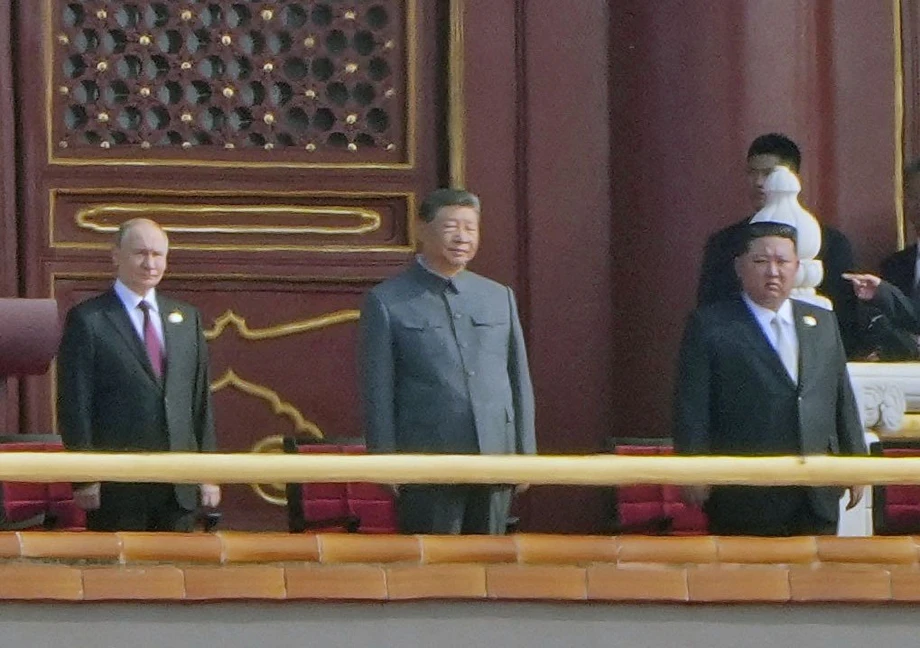
Japan's National Institute for Defense Studies published the NIDS China Security Report 2026, dated November 2025 and edited by editor in chief Shoji Tomotaka. The document points to a military parade in Beijing in September 2025 that brought together President Xi Jinping, President Vladimir Putin and North Korean leader Kim Jong Un. A summit between China and North Korea was held on the sidelines, at the 80th anniversary of victory in the War of Resistance Against Japan.
The gathering matters to Tokyo because it placed the three leaders on one stage at a moment when their militaries were already working more closely. The document says that, from Japan's security perspective, the nature of cooperation among the three countries has become a key issue. It also counts China's partnership relations with 106 countries and organizations as of 2024, with 52 upgraded. China had 56 such partnerships in 2012, when Xi became Communist Party general secretary, and 72 by 2014.
Partnership, in this use, is a diplomatic label for a close relationship that may stop short of a formal alliance. Japan's concern is that repeated military contacts can turn broad partnerships into practical habits: shared routes, shared drills and shared expectations about how forces move around Japan.
A short timeline of the turn
Events behind the current draft stretch across several years. The sequence shows how military cooperation grew from planning documents into exercises, combat support and high level diplomacy.
- November 2021: China and Russia signed the Roadmap to Expand Military Cooperation for 2021 to 2025.
- February 24, 2022: Russia launched its military operation in Ukraine. North Korea backed Moscow and recognized the Donetsk and Lugansk republics claimed by Russia backed separatists.
- June 19, 2024: President Putin visited Pyongyang for the first time in 24 years and signed the Comprehensive Strategic Partnership Treaty with Kim Jong Un.
- July 14 to 17, 2024: China and Russia held Joint Sea-2024 in the South China Sea and set up a joint command center made up of naval teams from both countries.
- July 24, 2024: A joint air patrol came near Alaska, and fighter jets from the North American Aerospace Defense Command scrambled.
- October 23, 2024: Ukraine's military intelligence said North Korean troops had been confirmed on the battlefield in the Kursk region.
- April 28, 2025: President Putin publicly acknowledged that North Korea had sent troops and taken part in the fighting.
- May 2025: Chinese and Russian leaders said in a joint statement that they would expand the scale and scope of joint exercises.
- September 2025: Xi, Putin and Kim appeared together at the Beijing parade, with a China and North Korea summit on the sidelines.
- November 26, 2026: Japan's draft security language surfaced, while Chinese and Russian defense officials held their first strategic consultation by video.
The sequence matters because each step gave the next one more structure. A roadmap was followed by larger drills. A treaty was followed by shells, missiles and troops. A parade then showed the political side of relationships that Japan had been tracking at sea and in the air.
Russia and North Korea turn war support into a formal bond
The June 2024 treaty between Russia and North Korea is central to Japan's concern. Article 4 says that if either country is put in a state of war by armed invasion from one state or several states, the other must provide military and other assistance with all means in its possession without delay. The NIDS document says that language points to a de facto military alliance, meaning an arrangement that works like an alliance even without that exact label.
Moscow gained practical support. Satellite imagery from September 2023 to March 2025 was used to estimate that four Russian flagged cargo vessels made 64 round trips between Rajin port in North Korea and Dunai and Vostochny ports in Russia's Primorsky Krai. The estimate says 15,809 containers carried at least 4.2 million and possibly up to 5.8 million artillery shells of 122 mm and 152 mm. Figures cited in the same document said Russia needed 5.6 million shells while its domestic production capacity was no more than 2.1 million.
The Multilateral Sanctions Monitoring Team said on May 29, 2025 that Russia and North Korea traded military supplies and deployed troops in violation of UN Security Council resolutions. It said that since autumn 2024 Russia had transferred air defense systems, electronic warfare systems and operational support, including the Pantsir surface to air system. Sanctions are meant to limit military trade and oil supplies to North Korea; Russia's support has weakened that system.
Troop numbers show the scale of the change. Ukraine's military intelligence announced on October 23, 2024 that North Korean troops had been confirmed in Kursk and were part of a contingent of about 12,000 trained in Russia's Far East. Ukrainian and United States estimates in early November put Russian forces in Kursk at about 50,000, including more than 10,000 North Korean soldiers. President Volodymyr Zelenskyy said on December 23 that 3,000 North Korean soldiers had been killed or wounded. John Kirby, the United States National Security Council coordinator for strategic communications, estimated on December 27 that 1,000 had been killed or wounded in the previous week alone. The NIDS document later says that, of about 11,000 North Korean troops who took part in combat, around 4,000 were casualties, including around 1,000 killed.
Zhang Tuosheng, senior research fellow at the Grandview Institution, gave a sharp assessment of the regional balance. He said political and military cooperation among the United States, Japan and South Korea was moving closer while the partnership among China, Russia and North Korea was also growing.
On the one hand, political and military cooperation among the United States, Japan, and the ROK has been upgraded on the whole, bringing the three countries closer to a quasi-alliance. On the other hand, the partnership among China, Russia, and North Korea has been strengthened continuously. In particular, the growing military cooperation between Russia and North Korea is drawing attention. If this trend of confrontation continues, it will inevitably have a profoundly negative impact on the regional security situation.
North Korea's own military policy adds another layer. Its 2022 Law on DPRK's Policy on Nuclear Forces lowered the threshold for nuclear use and allowed first use if an attack is judged imminent. It has announced drills simulating tactical nuclear warheads and tests of the Hwasong-18 and Hwasong-19 solid fueled intercontinental ballistic missiles, or long range missiles able to travel between continents. Russia's Defense Minister Sergei Shoigu's attendance at North Korea's Victory Day parade in July 2023 added a public sign of military closeness.
China and Russia rehearse in the seas and skies near Japan
China and Russia have spent years practicing together. The Joint Sea exercise series began with a geopolitically symbolic Mediterranean phase from May 11 to 21, 2015, the largest exercise China had conducted with a foreign navy. A second phase in the Sea of Japan from August 20 to 28, 2015 included the first participation by China's air force. The September 2016 edition in the South China Sea came only two months after an arbitral award in the China and Philippines dispute, and included air defense, anti submarine work, search and strike drills, and island seizure.
Later editions added skills that matter in a crisis. Joint Sea-2019 in the Yellow Sea included the first drill in which ships fired missiles at air targets. Joint Sea-2021 in the Sea of Japan added minesweeping. Joint Sea-2022 in the East China Sea included a blockade and visit, board, search and seizure drill, a procedure for stopping and inspecting ships. Joint Sea-2024 in the South China Sea created the joint command center. In 2018, China sent 3,200 troops, 900 tanks and military vehicles, and 30 fixed wing aircraft and helicopters to Russia's Vostok-2018 strategic exercise.
Air patrols have also become routine. China and Russia held their first joint bomber flight in July 2019. In July 2024, their eighth joint flight crossed the Chukotka Sea, the Bering Sea and the northern Pacific off Alaska, coming within 200 miles of the United States mainland. Joint patrol aircraft again approached Alaska on July 24, 2024, leading to the North American Aerospace Defense Command scramble. Their bombers and naval vessels have repeatedly operated around Japan, and joint maritime cruises have passed through the Tsugaru and Osumi straits.
The March 2023 China Russia leaders' statement said the two countries would regularly organize maritime and air joint patrols and joint exercises. The May 2025 statement said they would expand the scale and scope of those exercises. An assessment cited in the NIDS document said such drills help forces develop operational concepts, meaning plans for how forces would fight, and countermeasures against Western military advantages.
Trade, energy and technology bind Moscow and Beijing
China's military relationship with Russia sits inside a much larger economic relationship. Total bilateral trade rose 29.3 percent in 2022 to US$190.2 billion and reached US$240.1 billion in 2023. China hit its US$200 billion trade target with Russia by 2024 ahead of schedule. Russia overtook Saudi Arabia as China's largest crude oil supplier in 2023, and Russian natural gas exports to China rose 61.7 percent to US$6.4 billion. Chinese exports to Russia rose 46.9 percent to US$110.9 billion. China's share of Russia's total trade doubled from prewar levels to about 40 percent, and its share of Russia's imports reached 52 percent.
At a Valdai Club meeting in October 2019, President Vladimir Putin described Russian assistance to China on missile warning. The NIDS document records him as saying:
helping our Chinese partners create a missile attack warning system.
During President Xi's visit to Moscow in March 2023, nuclear authorities from both countries agreed on long term cooperation that included building fast neutron reactors in China. Those reactors can produce plutonium, which can be used in nuclear weapons, so the program matters to Japan's assessment of China's nuclear buildup.
North Korea remains far more dependent on China than on Russia for economic survival. External trade amounts to only 9.5 percent of North Korea's economy, and China accounts for more than 90 percent of that trade. UN Security Council Resolution 2397 caps North Korean imports at 4 million barrels of crude oil and 500,000 barrels of refined petroleum products each year, less than half of the 9 million barrels North Korea needs annually. North Korea has accumulated a US$20 billion trade deficit with China. Even 2024, the declared year of North Korea China friendship and the 75th anniversary of diplomatic ties, passed without a summit between the two countries.
Can Japan pay for the strategy it is writing?
The security draft arrives beside a budget fight. Officials are considering ¥56.3 trillion, about US$353 billion, for defense over the five years starting in April 2027. That is ¥13.3 trillion more than the current five year allocation of ¥43 trillion, about 31 percent higher using those figures. It is still below the roughly ¥80 trillion sought by some defense officials and ruling party lawmakers. Finance Minister Satsuki Katayama said defense needs should determine spending, but the final amount remained under discussion.
Paul Midford, a specialist in Japan's foreign affairs at Meiji Gakuin University, said Tokyo was strengthening its defenses while facing a spending ceiling. He said:
Japan is doubling down on self-defense. Yet it appears defense spending will not rise past the 2% of GDP level it has already reached, as Takaichi is unwilling to raise taxes.
The capabilities under discussion include area denial, which means making it hard for an enemy force to use nearby seas and airspace, plus unmanned coast defense systems and more integrated drone, missile and air defenses. Japan is also considering nuclear powered submarines and the basing of United States atomic arms on Japanese soil. Such ideas challenge a nuclear taboo rooted in the 1945 atomic bombings of Hiroshima and Nagasaki.
Washington also expects Tokyo to triple its host nation support payments for United States troops in 2027. Host nation support is the money Japan pays to help fund the American military presence stationed on its soil. Prime Minister Sanae Takaichi said Tokyo will keep funding the International Criminal Court, headed by Tomoko Akane, after United States sanctions announced in October.
Russia answers by accusing Japan of remilitarization
On the same day that Japan's draft became known, Chinese and Russian defense officials held their first strategic consultation by video. Russian Deputy Defense Minister Vasily Osmakov took part, with coordination from the Russian Defense Ministry's main directorate for international military cooperation. The Russian side said the two delegations discussed situations around the world and agreed to make the dialogue regular. It described the talks as productive and friendly. The Chinese side said the discussion followed the leaders' agreements, deepened military relations and aimed to defend regional peace and stability.
Russian Foreign Ministry spokeswoman Maria Zakharova rejected the idea that Russia, China and North Korea were pushing Japan to build up its military. Speaking at a briefing in Moscow on November 26, she said Defense Minister Shinjiro Koizumi was using invented threats to justify military buildup and remilitarization.
[Koizumi] justifies the need for accelerated military buildup, as he put it, by citing alleged threats from Russia, China and North Korea. We consider such statements by a high-ranking Japanese politician absolutely unfounded and inappropriate. It is perfectly clear to us that Japan's current leadership, hiding behind various fabricated pretexts, is persistently pursuing a path toward remilitarizing the country and building up the offensive capabilities of its so-called Self-Defense Forces, while attempting to align fundamental doctrinal documents with this policy.
China also avoided a direct judgment on the Russia and North Korea treaty. Its Foreign Ministry said Russia and North Korea are sovereign states and that the development of their bilateral relations is their own matter.
What changes for Japan and its neighbors
Prime Minister Sanae Takaichi, 65, returned from the Asia Pacific Economic Cooperation summit in Shenzhen, China, facing criticism over her meetings with Xi, Putin and President Trump. She won no breakthrough on Russia's seizure of Japan Tobacco assets or the imprisonment of a Japanese journalist on espionage charges. Beijing had already reacted angrily to her 2024 remark that a Taiwan contingency would activate Japan's Self-Defense Forces and her 2025 description of a Chinese attack on Taiwan as an existential crisis for Japan. China responded with rare earth restrictions, tourist travel bans and a diplomatic and information campaign.
The security debate is linked to a wider worry about 2027. The Davidson Window is a planning phrase from a 2021 warning by United States Pacific Command Admiral Philip S. Davidson to the United States Senate that China could be capable of invading Taiwan in 2027. It is a date used in military planning, not a statement that war will happen. For Japan, the worry is that conflict near Taiwan would put Japanese bases, sea lanes and islands under pressure.
Japan has already ended a decades long ban on arms exports and offered weapons, including used destroyers, to the Philippines. The Philippines occupies a strategic position near Taiwan's southwestern flank and has a United States alliance. Haruko Satoh, who teaches foreign policy at Osaka University, said Takaichi's remarks about Taiwan were costing Japan. Midford said China's diplomatic slights toward Takaichi angered Japanese conservatives.
South Korea is another possible partner because both countries face tariff pressure and demands from Washington. Japan faces higher payments for United States troops, while South Korea plans to remove its troops from United States command by 2030. History disputes remain a barrier. Some Japanese argue that reparations and apologies settled the issue of Japan's 1910 to 1945 colonial rule; many Koreans point to textbooks and visits by politicians to Yasukuni Shrine, where Japan's war dead, including a small number of convicted war criminals, are honored.
For ordinary people in Japan, the draft could shape taxes, procurement and the role of the military. For people in nearby countries, it could shape how quickly Japan moves missiles, drones and interceptors during a crisis. The year end revision will show whether Tokyo turns the three country cooperation warning into new capabilities, or keeps it mostly as a statement of concern.
Key Points
- Japan is considering an explicit reference to deeper military cooperation among China, Russia and North Korea in its revised National Security Strategy.
- The draft is expected by the end of 2026 after talks with the ruling party, with no final wording or announcement date yet set.
- Tokyo is expected to keep China as the greatest strategic challenge, Russia as a serious security concern and North Korea as an even more serious and imminent threat.
- The NIDS China Security Report 2026 points to the September 2025 Beijing parade, expanded China Russia drills and the June 2024 Russia North Korea treaty.
- North Korea supplied shells, missiles and troops to Russia, while Russia is believed to have provided military technology and political support.
- Japan is weighing ¥56.3 trillion in defense spending for the five years from April 2027, below the roughly ¥80 trillion sought by some officials and lawmakers.
- Russia rejects Japan's threat framing and accuses Tokyo of using it to justify remilitarization.