From construction bills to shareholder cash
Azerbaijan's Southern Gas Corridor is approaching a moment its builders have worked toward for more than a decade: the pipeline chain may begin sending dividends to shareholders in 2027. A dividend is a payment from company profits to owners. The prospect appeared in a Fitch Ratings review released on November 25, 2026, which affirmed Southern Gas Corridor CJSC at BBB-, a credit rating Fitch treats as investment grade, with a stable outlook and projected the company to remain net cash positive through 2029, meaning its cash is expected to exceed its debt.
Contents
- From construction bills to shareholder cash
- What the rating review says about the company
- Why dividends are suddenly in view
- The profit mix is moving from wells to pipes
- Why Azerbaijan remains the backstop
- Abu Dhabi's stake brings a second energy interest
- How much gas can actually move west?
- Why the old skepticism still matters
- Europe's energy shift changes the investment case
- What dividends would mean for Baku
- Key Points
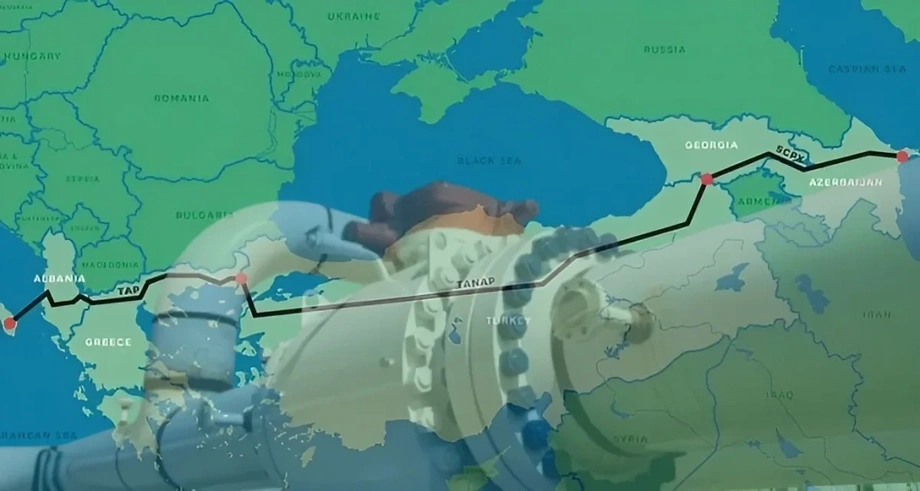
The project began as a costly bet. Baku created SGC in 2014 to manage its interests from the Shah Deniz field in the Caspian Sea to customers in Europe. The state put about $2.4 billion into the company, and the State Oil Fund of Azerbaijan bought $2.5 billion of its bonds, repaid in 2024. The corridor now runs about 3,500 kilometres through Georgia, Türkiye, Greece and Albania to Italy. It links Shah Deniz production with the South Caucasus Pipeline, TANAP and TAP.
The scale helps explain why Baku stayed with the project through years of financing risk. SGC combines production, transport and sales in one structure, so Azerbaijan earns from gas in the ground and from fees paid to move it west. That design gives the state more than one route to revenue, while tying its income to the same fuel at every step.
For Azerbaijan, the change is practical. The corridor was funded before regular output could prove the business case. Now it is carrying gas, earning revenue and reducing debt. If dividends begin, the state would receive cash back from a project that once depended on public money and development bank loans.
What the rating review says about the company
The Fitch Ratings review, published by the credit rating agency on November 25, 2026, attached the same BBB- rating to SGC and to Azerbaijan, both with stable outlooks. Fitch said the link exists because all SGC debt was guaranteed by the state at the end of October 2026, meaning the state promises to cover the debt if SGC cannot. That guarantee matters more than the company's own balance sheet when investors judge the risk of its bonds and loans.
Fitch Ratings, the credit rating agency that issued the review, described a company with strong cash generation and clear revenue from contracted transportation. It also listed pressures: volatile oil and gas prices, natural depletion at Shah Deniz, counterparty risk and operating limits in Azerbaijan, Georgia and Türkiye. Its standalone credit profile was bbb-, a measure of the company without counting direct state support. The agency assessed the operating environment as bb and reduced the standalone score by one rating step.
Fitch also said the Iran conflict had not damaged SGC's assets or disrupted logistics, despite the corridor's proximity, and that prices above expectations for oil and gas helped 2026 cash flow.
Fitch Ratings has affirmed Southern Gas Corridor Closed Joint-Stock Company's (SGC) Long-Term Issuer Default Rating (IDR) at 'BBB-' with a Stable Outlook.
The wording is careful: the review is a cash flow forecast, not a dividend declaration. Fitch is saying the company can likely keep enough cash while beginning distributions, under a set of assumptions about prices, spending and debt.
Why dividends are suddenly in view
SGC's accounts show a company with far more cash than debt due soon. It reported $3 billion of revenue and $1.6 billion of net profit for 2025, with consolidated equity of $9.1 billion. At the end of October 2026, it held $3.4 billion in cash and bank deposits, against about $1.4 billion in loans from development banks.
The repayment schedule is light before the 2030s. SGC finished paying its Eurobonds in March 2026. Fitch expects only about $120 million a year in loan principal payments in the next few years, with the remaining development bank loans maturing from 2032 to 2046. Those lenders include the European Bank for Reconstruction and Development, the Asian Infrastructure Investment Bank, the International Bank for Reconstruction and Development and the Asian Development Bank.
Fitch also assumes annual capital spending of only $200 million from 2026 to 2029. In plain terms, the company no longer needs to spend like a builder of a new pipeline system. Most of the cash it generates can be set aside for owners, subject to what the company can safely pay. Fitch assumes no new debt.
No dividend amount or payment date has been announced. Fitch's statement that dividends could start in 2027 is a forecast based on cash flow, not a board decision. Not every dollar of consolidated cash can be paid out either, because SGC holds interests in several projects and needs cash for operations, loans and minority shareholders.
The profit mix is moving from wells to pipes
SGC's earnings are changing shape. Fitch expects gas transportation to account for about 80% of EBITDA in 2028, up from about 60% in 2025. EBITDA means earnings before interest, tax, depreciation and amortisation, a rough way to measure the cash a business earns from operations.
The better share reflects steady pipeline earnings alongside weaker well earnings. Fitch expects transportation income to stay fairly stable in dollar terms, while upstream earnings weaken. SGC owns 16.02% of Shah Deniz, where production naturally falls as the field ages.
Fitch put upstream EBITDA at about $700 million in 2025, with a temporary rise in 2026 and a decline from 2027. Price assumptions add pressure. The agency assumes Brent crude at $87 a barrel in 2026, $65 in 2027 and $60 in 2028 and 2029. It assumes European gas prices at the title transfer facility, or TTF, at $18 per thousand cubic feet in 2026, $9 in 2027 and $7 in 2028 and 2029.
The pipeline side is steadier because much of the revenue comes from contracts that require shippers to pay for booked capacity even if they send less gas. That arrangement protects the operator against changes in how much gas actually flows. It leaves other risks in place, including buyer credit problems, regulation and accidents or outages.
Why Azerbaijan remains the backstop
SGC may look increasingly like a toll road for gas, but its credit rating remains tied to the Azerbaijani state. Fitch equalises the company's rating with Azerbaijan because the government guarantees all of its debt. If Azerbaijan's rating falls, SGC's rating would come under pressure as well.
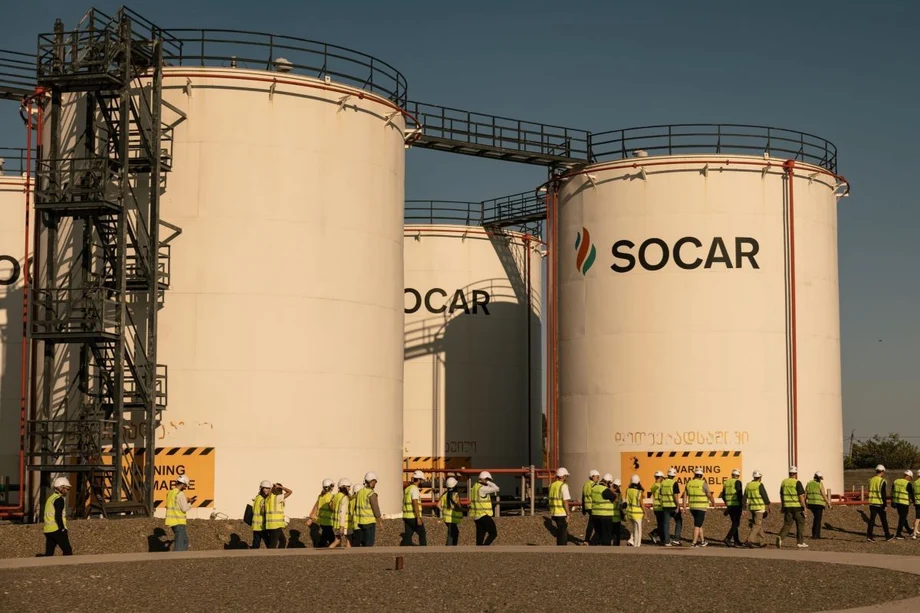
State control is direct and indirect. Azerbaijan's Ministry of Economy holds 36.5% of SGC, and SOCAR, Azerbaijan's state oil company, holds 51%. Fitch said the government has strong oversight over strategy and finance. The agency also noted that a default could damage Azerbaijan's standing as a reliable energy partner for the European Union.
Peer comparisons show why Fitch treats SGC as strong within the region. It rated Kazakhstan's JSC KazTransOil at BBB, the same as its parent, and Slovakia's eustream at BBB+ with a business mix weighted toward domestic transportation. Kazakhstan's QazaqGaz sat at BB+ because domestic gas sales were less profitable and dividends from joint ventures mattered more. Within Azerbaijan, Fitch gave SGC a stronger business and financial profile than SOCAR, whose standalone profile was bb.
The company's loans from development banks keep its name visible in international finance. Fitch said a default would carry contagion risk for other companies linked to the state. It also applies a parent and subsidiary framework if SGC's standalone profile ever became stronger than Azerbaijan's, because there are few legal barriers separating the company from the state and the state has broad access and control.
Rating warning lines are specific. Fitch would view EBITDA net leverage above 1.5 times, a measure of debt against operating earnings, as negative for SGC's standalone profile. The issuer rating would still be constrained by Azerbaijan's own credit rating. An upgrade would require an upgrade of Azerbaijan while state support remains strong.
Abu Dhabi's stake brings a second energy interest
September 2026 changed the ownership map. Azerbaijan sold 12.5% of SGC to XRG SGC Limited, the international investment arm of Abu Dhabi National Oil Company (ADNOC). SOCAR kept 51%, and Azerbaijan's state kept 36.5% directly. The direct state share fell from 49% at the end of 2025. Fitch said Baku would keep control and the power to decide, so the rating structure did not change.
The sale gave XRG a stake in assets already producing cash: 16.02% of Shah Deniz, 51% of TANAP, 21.02% of the South Caucasus Pipeline and 20% of TAP. SOCAR continues to represent the holding company in those projects. Fitch described the transaction as positive for corporate governance and technology, and said SGC could gain from XRG's other projects in the Caspian region.
Twelve days after the stake sale, SOCAR, XRG and TotalEnergies approved an expansion at Absheron, another offshore gas field. XRG already held 30% there. TotalEnergies, the operator, and SOCAR held 35% each. Planned annual capacity was set to rise from 1.5 billion to 6 billion cubic metres, with production expected in 2029.
BP said in its October results that it had agreed in September to carry Absheron gas through the South Caucasus Pipeline. Abu Dhabi now has a financial interest in both the gas produced in Azerbaijan and the pipelines that carry it west. How much cash will be kept for future expansion depends on later decisions by the shareholders and the company.
How much gas can actually move west?
Volumes are the hard part. The European Commission said Azerbaijan delivered 11.4 billion cubic metres of gas through the corridor in 2025. A cubic metre is a box one metre on each side, so one billion cubic metres is a billion of those boxes of gas. Deliveries to Germany and Austria began in January 2026, widening the customer base beyond southeastern Europe.
Azerbaijan's energy ministry said the country sent 8.6 billion cubic metres to Europe in the first nine months of 2026, down 8.5% from the same period a year earlier. The International Energy Agency expects TAP to run close to its design capacity this winter. Extra supplies therefore need more than willing buyers. They need gas that can be sold, contracts and capacity at the right points on the network.
TAP added 1.2 billion cubic metres of annual transport capacity in 2026 after a market test, a process in which shippers book pipeline space. The extra space came from bookings in the 2021 test. The compressor at Kipoi, near the Greek and Turkish border, was confirmed as fully operational in March 2026. The 2023 test closed in December 2025 without allocating more capacity. Route choice also matters. Gas for southern Italy crosses Greece, Albania and the Adriatic Sea. Gas for Bulgaria through the Greek interconnector uses a different part of the network, so two contracts of the same size can require investment in different places.
- 2008: the route to bring Caspian gas to Europe was first proposed.
- 2014: SGC was created, with about $2.4 billion of state equity and $2.5 billion of bonds bought by the State Oil Fund.
- March 2026: SGC completed Eurobond repayment, and TAP's added capacity was confirmed as operational.
- September 2026: XRG bought 12.5% of SGC, and partners approved the Absheron expansion.
- 2027: Fitch assumes dividends can begin.
- 2029: Absheron expansion production is expected, and BOTAŞ deliveries are scheduled to start.
- 2032 to 2046: about $1.4 billion of development bank loans mature.
Absheron gives Azerbaijan a possible answer. The field has supplied Azerbaijani consumers since production began in 2023. Türkiye's BOTAŞ contracted in June 2026 to buy 33 billion cubic metres over 15 years, averaging 2.2 billion cubic metres a year from 2029. SEFE of Germany signed a contract lasting ten years with SOCAR in June 2025, under which annual deliveries rise gradually to about 1.5 billion cubic metres. SEFE also signed a memorandum with XRG and ADNOC in September covering natural gas and liquefied natural gas, gas cooled into liquid for shipping, but it left source and volume open. If Absheron supplies more gas for Azerbaijani consumers, some gas from other fields could become available for export, depending on existing contracts.
Why the old skepticism still matters
The corridor was first proposed in 2008, and its present strength is easier to see than its original promise. In 2016, the board of the Extractive Industries Transparency Initiative set conditions for Azerbaijan to keep its membership. Baku was told to end reregistration requirements for NGOs, or civil society groups, and stop requiring domestic and foreign NGOs to register grants with the government.
At the time, financing from the World Bank and the European Bank for Reconstruction and Development was tied to Azerbaijan staying in good standing with the initiative. Without that financing, replacing the money with private capital would have been difficult, and the project's future would have been in doubt.
The expected scale was also modest. An Oxford Institute for Energy Studies estimate put Azerbaijan's possible supply at 10 billion cubic metres a year by 2025, less than 2% of anticipated European demand. Gazprom supplied Europe with 198 billion cubic metres in the first half of 2016 alone. Political support for the corridor rested on reducing Russian influence, but the volumes then in sight were small beside Russia's.
Rumors circulated that the United States pushed against Azerbaijan's expulsion from the initiative because the corridor would counter Russian dominance. No named official confirmed that claim. Activists who had campaigned for expulsion reacted with a mix of caution and dissatisfaction, arguing that the dispute went beyond registration rules. The 2016 argument now reads differently: the corridor became a working route with contracted revenue, even as Europe's need for gas changed after Russian supplies fell.
Europe's energy shift changes the investment case
Gas still has a role in European supply security after the fall in Russian imports. The European Union's decarbonisation policies, meaning policies to cut carbon emissions, narrow the years in which new infrastructure for fossil fuels can be justified. For SGC, that makes an existing pipeline with contracts more valuable than a speculative new route that needs buyers before it can be financed.
Fitch's price path reflects a market expected to cool after 2026. The agency assumes Brent falls from $87 a barrel in 2026 to $60 in 2028 and 2029. It assumes TTF gas falls from $18 per thousand cubic feet to $7 over the same span. Those prices affect Shah Deniz revenue, because a large share of contracted gas volumes is linked to commodities.
The corridor's future income therefore rests on three practical conditions: enough gas in Azerbaijan, pipes that are maintained well and buyers that keep taking delivery. XRG's entry gives Abu Dhabi a reason to support both production and transport. Azerbaijan still controls the company, and the state remains the guarantor of its debt.
The March meeting of the Southern Gas Corridor Advisory Council considered how to finance increased deliveries. The European Union can use its energy dialogue with Baku to press for clear purchase commitments, delivery dates and pipeline bookings. Buyers with contracts ending in 2029 may want early volumes, while others committed into the 2030s may prefer larger supplies later.
What dividends would mean for Baku
Dividends would give Azerbaijan a way to recover money from a project it financed when the route was still unproven. The state could receive cash while keeping strategic control through SOCAR and the Ministry of Economy. XRG would receive its share as a minority owner, with an interest in both the corridor and Absheron.
The money would still come from gas. SGC earns from extracting condensate and gas at Shah Deniz, transporting gas through Georgia and Türkiye and selling gas. A dividend would return cash to owners, but it would leave the state exposed to the same commodity market and the same pipeline demand.
Fitch's assessment ties that exposure to Azerbaijan. SGC's BBB- issuer rating sits at Azerbaijan's level because every debt obligation carries a state guarantee. The company has paid down its Eurobonds and holds a large cash pile, yet its financial story cannot be separated from Azerbaijan's credit standing.
The next markers are clear. Fitch assumes dividends from 2027, Absheron expansion output in 2029 and loan maturities from 2032 to 2046. For Europe, the next task is to identify buyers that will sign purchase deals and points where shippers will book capacity if Azerbaijan offers more gas.
Key Points
- Fitch affirmed SGC at BBB- with a stable outlook on November 25, 2026.
- Fitch projects net cash through 2029 and assumes dividends can begin in 2027, but no payment has been announced.
- SGC held $3.4 billion in cash and deposits at the end of October 2026, against about $1.4 billion in development bank loans.
- Gas transportation is expected to rise from about 60% of EBITDA in 2025 to about 80% in 2028 as Shah Deniz output declines.
- XRG bought 12.5% of SGC in September 2026; SOCAR holds 51% and Azerbaijan's state holds 36.5% directly.
- Absheron expansion could lift annual capacity from 1.5 billion to 6 billion cubic metres by 2029, while TAP has limited room for more bookings.
- SGC's rating remains tied to Azerbaijan because the state guarantees all of the company's debt.