A partnership reaching beyond gas
Greece and Azerbaijan are widening an economic relationship long centered on oil and natural gas. At the sixth session of the Joint Interministerial Committee on Economic, Industrial, and Technological Cooperation in Athens, the two sides signed the Protocol of the Sixth Session and the Joint Action Program for Tourism 2026-2028. Officials held more than 100 meetings between companies and discussed trade, investment, infrastructure, transportation, digital technology, agriculture and tourism.
Contents
- A partnership reaching beyond gas
- What the Athens meetings produced
- Why Greece is a gateway, not just a buyer
- Air connectivity becomes a business issue
- What the tourism program puts on paper
- The gas forecast that shadows the deal
- What Greece receives, and what could replace it
- Europe's deadline adds pressure
- A short timeline of ties
- What is still undecided
- Key Points
Baku's forecast gives the talks urgency. Azerbaijan expects marketable gas production to fall to 33.2 billion cubic meters in 2028 from 38.9 billion in 2025, a decline of almost 15 percent. Greece buys Azerbaijani gas and also hosts the final European leg of the pipeline route that carries it west. For Athens, the wider talks are both a business drive and a way to prepare for a tighter gas market.
Marketable gas means the volume available to sell after some gas is used in operations or pumped back into fields to keep pressure steady. That detail matters because Azerbaijan can still produce gas while having less to export, and Europe is entering a period when it is trying to replace Russian supplies.
For companies, the practical change is a wider list of counterparts. Firms in energy, infrastructure, transport, farming and technology now have a formal channel to meet officials and seek partners, instead of a relationship discussed mainly around gas purchases and pipeline routes.
What the Athens meetings produced
The sixth committee session brought together Greek and Azerbaijani officials for a review of work since their previous meeting in Baku two years earlier. Their agenda covered trade and investment, industry, small and medium sized companies, infrastructure, tourism, agriculture and food, and road, maritime, port and air transportation. Digital technologies, space, the environment and cooperation between customs authorities were also on the table.
A business conference ran alongside the talks, the first such event between the two countries since 2013. It was organized by the Greek Foreign Ministry's General Secretariat for International Economic Relations, Enterprise Greece and AZPROMO, Azerbaijan's Export and Investment Promotion Agency. Haris Theoharis, Greece's Deputy Foreign Minister, and Parviz Shahbazov, Azerbaijan's Energy Minister, opened the conference. Presentations set out chances for cooperation, and more than 100 meetings between companies explored specific trade and investment deals.
In their bilateral meeting, Theoharis and Shahbazov focused on energy, trade, investment and connectivity. They described Greece as a gateway from the South Caucasus to the European market and discussed stronger energy and transport links connecting Europe with the South Caucasus and Central Asia. Agriculture and food production, infrastructure, digital technologies, renewable energy and tourism were part of the same conversation.
Why Greece is a gateway, not just a buyer
The Greek Foreign Ministry's Economic Relations page describes the bilateral relationship as based on Azerbaijani oil and natural gas supplies. It says a memorandum of understanding on energy issues entered into force on 28 March 2017, and that the Trans-Adriatic Pipeline carries Azerbaijani gas through Greece to European markets. The same page records that the fourth Joint Interministerial Committee was held on 26 and 27 May 2016.
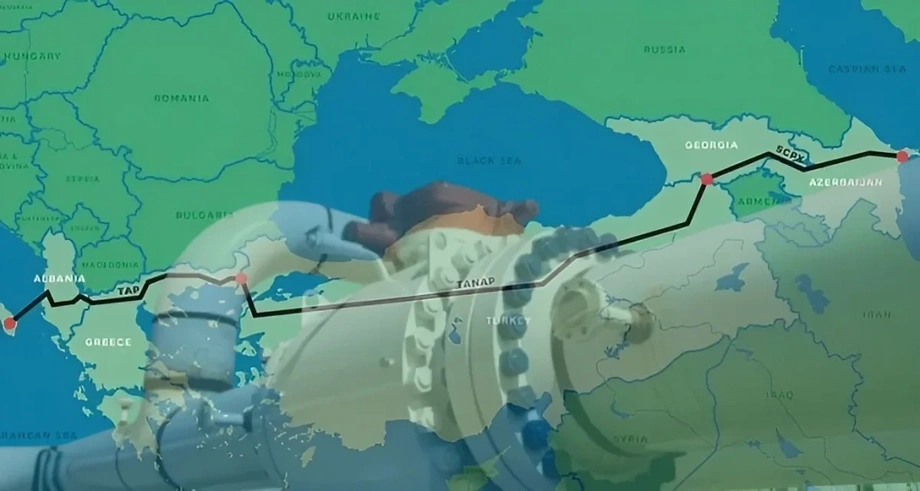
The pipeline route is central to the relationship. The Southern Gas Corridor is a chain of pipelines about 3,500 kilometers long that starts at Azerbaijan's Shah Deniz field, crosses Georgia and Turkey, enters Greece, then continues through Albania and the Adriatic Sea to Italy. The Trans-Adriatic Pipeline, known as TAP, is the last section of that route. An interconnector between Greece and Bulgaria can move gas onward to the Bulgarian market.
Greece also sits at the point where imported Caspian gas enters its national network. In 2025, 11.08 terawatt hours entered the Greek gas system at Nea Messimvria, where TAP links to the national grid. That volume equaled 14.1 percent of total imports into the Greek system. Azerbaijan's Energy Ministry called the Southern Gas Corridor a strategic foundation of bilateral energy cooperation in a September statement and stressed the role of the interconnector between Greece and Bulgaria in regional supply security.
Air connectivity becomes a business issue
The Athens to Baku air connection was presented in Athens as a practical tool for trade and tourism. At the time of the latest tourism outreach, there were no direct flights between the two capitals. Azerbaijan Airlines operated seasonal flights between Baku and Crete from July to September 2026, but regular service between Athens and Baku has not been in place.
The Azerbaijan Tourism Board hosted Greek media in Athens on 18 November, with CEO Florian Sengstschmid and Arif Mammadov, Ambassador of Azerbaijan to Greece, attending a networking dinner. The next day, the board joined the AVIAREPS Around the World Roadshow Greece 2026, meeting Greek travel agents and tour operators. Officials are also discussing direct flights with AEGEAN, with Azerbaijan Airlines considered as an alternative. In July, State Tourism Agency Chairman Fuad Nagiyev and Greek Ambassador Maria Papakonstantinou discussed restoring regular direct flights and stronger tourism promotion.
Florian Sengstschmid, CEO of the Azerbaijan Tourism Board, said talks were under way with AEGEAN for a business case for a direct route, supported by incentives at Baku airport and on the tourism side. He said Azerbaijan Airlines remained an alternative if AEGEAN did not proceed.
Very soon we'll have a flight established by one or the other airline.
The lack of a direct route shapes what Greek travel companies can sell. Packages would be easier to build if travelers could reach Baku without a stopover, and business travelers would gain a faster path between the two capitals. No launch date or airline choice was announced.
What the tourism program puts on paper
The Joint Action Program for Tourism 2026-2028 was signed in Athens on 1 October during the sixth committee session. It sets a framework for joint work in sustainable tourism, digitalization, innovation, investment and tourism education. It gives the next two years a structure, but it does not list project budgets or a schedule for individual investments.
The Azerbaijan Tourism Board plans familiarization trips for Greek tour operators and media in 2027. Those trips are designed to let travel professionals see destinations before selling them. Greece is listed as a new connection market in the Marketing and Communications Strategy 2024 to 2026 of Azerbaijan's State Tourism Agency and the tourism board, alongside Switzerland, Brazil and Singapore.
Tourism numbers show why the push matters. Azerbaijan welcomed 2,446 visitors from Greece in 2025. From January to October 2026, arrivals reached 1,837, down 11.4 percent from the same period in 2025. Greece received 5,267 Schengen visa applications from Azerbaijan in 2025 and refused 3 percent of them. The refusal rate means the share of applications denied. It was lower than the 9.8 percent rate across the Schengen area.
Florian Sengstschmid, the Azerbaijan Tourism Board CEO, said Greek travelers often holiday at home in summer and travel abroad in winter. He said Azerbaijan's quieter months, including the Novruz spring festival in March, could fit that pattern.
In winter, Baku is a beautiful city for a city break.
Baku pairs the medieval Old City, which is on the UNESCO list, with buildings from the oil boom around 1900, Soviet era landmarks and newer architecture. Beyond the capital, the country offers the Silk Road heritage of Shaki, hiking trails, winter sports in the Caucasus Mountains, fire temples, mud volcanoes, wineries and heritage villages. Sengstschmid said a traveler could move from subtropical forests in the south to Caucasus peaks in about five hours and ski in the mountains before returning to the capital in the evening.
Practical details also shape demand. Sengstschmid put the price of a hotel with four stars in Baku outside peak season at around 100 euros per night for two people, breakfast included. Greek citizens can apply for an electronic visa through evisa.gov.az. Standard applications take three working days, while an urgent option takes a few hours. The visa allows stays of up to 30 days.
The gas forecast that shadows the deal
On 4 November, a committee of Azerbaijan's parliament began examining the 2027 budget plan. Forecasts attached to the plan show marketable gas output at 35.6 billion cubic meters in 2027, 33.2 billion in 2028, 35.3 billion in 2029 and 36.6 billion in 2030. Azerbaijan's state statistical service put 2025 marketable output at 38.9 billion cubic meters.
Official data already showed a softer trend before the forecast became public. In the first nine months of 2026, marketable gas production fell 1.6 percent from the same period in 2025. At Shah Deniz, the country's largest field, BP recorded a drop from about 21 billion cubic meters to about 20 billion over that period.
The budget documents did not explain what causes the deeper fall expected in 2028. They show total extraction staying almost flat in 2027 while marketable gas falls, which means more of the gas produced may not be available for sale. Some extracted gas is returned underground to maintain field pressure.
BP plans to bring a new compression unit at Shah Deniz into use gradually from 2029 to reach reserves with lower pressure. The Absheron field supplies the domestic market, and its expansion is expected to cover local needs as well as exports to Turkey. Those projects matter because they arrive after the year in which Baku expects the largest fall in marketable output.
What Greece receives, and what could replace it
Greece's state gas buyer, DEPA, has a 25 year contract with SOCAR and the Shah Deniz consortium for gas supplied through TAP. Greece received 1.1 billion cubic meters of Azerbaijani gas in 2025. Azerbaijan's Energy Ministry said in September that about 700 million cubic meters had been exported to Greece in the first eight months of 2026.
If Azerbaijani deliveries through TAP fall, Greece could cover part of the gap with more liquefied natural gas through Revithoussa or Alexandroupolis. LNG is natural gas cooled until it becomes liquid so ships can carry it. The United States was Greece's largest LNG supplier in 2025, with about 88 percent of the declared weight of LNG imports.
United Nations trade data show that Greece declared 725 million dollars of Azerbaijani gas imports in 2025 and 1.25 billion dollars of American LNG. Dividing value by weight gives an average of 514 dollars per ton for Azerbaijani gas and 654 dollars per ton for American LNG, a 27 percent higher declared value for the American cargo. The WITS dataset shows an even wider gap in 2024, at 489 dollars per ton for Azerbaijani gas and 841 dollars for American LNG.
Europe's deadline adds pressure
European gas prices were already high when the latest forecasts emerged. On 19 November, the European benchmark price at the Dutch TTF gas hub stood at 84 euros per megawatt hour, compared with about 31 euros on the same day a year earlier. Underground storage in the European Union was about 70 percent full on 17 November, down from about 82 percent at the same point in 2025.
The European Union has started a gradual ban on Russian gas imports. Transitional periods for most shorter contracts have ended. The ban applies to Russian LNG under existing longer contracts from 1 January 2027 and to Russian pipeline gas from 30 September 2027. The pipeline deadline can move to 1 November 2027 for a member state at risk of missing its storage target, if the European Commission makes that finding.
Azerbaijan has a defined place in the European plan. In 2022, European Commission President Ursula von der Leyen presented a goal in Baku of expanding the corridor's capacity to 20 billion cubic meters a year. A joint statement by the European Commission and Azerbaijan's Energy Ministry said supplies to European Union member states reached 12.5 billion cubic meters in 2025, almost 54 percent above 2021 levels. TAP has already added 1.2 billion cubic meters of annual capacity.
The calendar is tight. The 2028 production forecast falls in the first full year after the planned end of Russian pipeline gas imports under the current timetable. Brussels is therefore watching how much extra gas can actually arrive from the Caspian when Russian volumes are no longer part of the plan.
A short timeline of ties
The relationship has developed through a series of dated agreements, committee meetings and energy projects. The main markers are:
- 26 and 27 May 2016: The fourth Joint Interministerial Committee was held.
- 28 March 2017: The memorandum of understanding on energy issues entered into force.
- 2022: The European Commission set out a goal of 20 billion cubic meters of annual corridor capacity.
- 2025: Greece received 1.1 billion cubic meters of Azerbaijani gas, and Azerbaijan welcomed 2,446 visitors from Greece.
- 1 October: The sixth committee session in Athens ended with the Protocol of the Sixth Session and the Joint Action Program for Tourism 2026-2028.
- January to October 2026: Greek arrivals in Azerbaijan reached 1,837, down 11.4 percent from a year earlier.
- 2027 and 2028: Baku forecasts marketable gas output of 35.6 billion and 33.2 billion cubic meters, and tourism officials plan familiarization trips during 2027.
- From 2029: BP plans to start using a new compression unit at Shah Deniz.
What is still undecided
Direct flights between Athens and Baku have no launch date or confirmed airline. The tourism program sets broad areas of work, with no project budgets or schedule for individual investments. Azerbaijan's budget forecasts do not explain the expected 2028 fall in marketable gas output. The next dated markers are the EU ban on Russian LNG on 1 January 2027, the pipeline deadline on 30 September 2027 with a possible move to 1 November 2027, the 2027 and 2028 gas forecasts, and BP's planned compression unit from 2029.
For companies, the immediate change is a larger network of official contacts and a clear agenda for follow up talks. For travelers, the change depends on flights and tour packages that have yet to be announced. For Greece's energy system, the change is a sharper view of how much Azerbaijani gas may be available at the moment Europe needs other sources most.
Key Points
- Greece and Azerbaijan widened talks beyond energy to trade, investment, infrastructure, transport, digital technology, agriculture and tourism.
- More than 100 meetings between companies were held alongside the sixth Joint Interministerial Committee session in Athens.
- The two sides signed the Protocol of the Sixth Session and the Joint Action Program for Tourism 2026-2028.
- Azerbaijan forecasts marketable gas output falling to 33.2 billion cubic meters in 2028 from 38.9 billion in 2025.
- Greece received 1.1 billion cubic meters of Azerbaijani gas in 2025, while 11.08 terawatt hours entered its system through Nea Messimvria, equal to 14.1 percent of imports.
- Tourism officials are seeking a direct Athens to Baku route, but no launch date or airline choice has been announced.