The clerk may be sitting at home
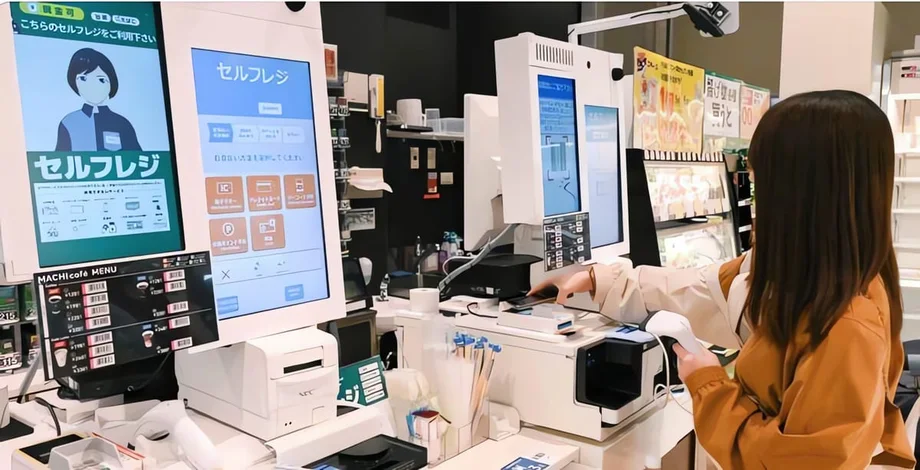
A shopper at a Lawson convenience store in Japan may be greeted by Aoi or Sorato, two animated characters displayed on a monitor. The person providing that greeting could be sitting at home, possibly far from the store. Lawson is recruiting remote Lawson Avatar Operators to control the characters from personal computers, guide customers through registers that shoppers operate themselves, answer questions and promote products.
Contents
- The clerk may be sitting at home
- Pay, hours and the room required for the job
- What Lawson says changed inside stores
- Why generative AI has not replaced the operator
- From Green Lawson to a national trial
- The original target was 1,000 operators
- The Osaka flagship made avatars an attraction
- What workers and franchise owners need next
- Key Points
The trial had reached 108 stores nationwide, with about 90 operators working, as of November 27, 2026. Expansion was still continuing. Lawson announced on November 18 that avatar service would be introduced at 13 stores in Miyagi Prefecture, beginning with four stores that day. Nine more were scheduled to follow on November 28.
The current recruitment notice advertises pay starting at 1,280 yen per hour and allows someone to work from one day per week. The central idea separates the place where a clerk works from the place where customers shop. One operator can cover several stores at the same time, rather than being assigned to a single branch. Lawson has not disclosed how many stores one person normally handles during a shift.
Pay, hours and the room required for the job
Working hours are negotiated mainly within the period from 1:00 p.m. to 9:00 p.m. Training can also be completed at home, according to recruitment information published on October 16, 2026. Applicants must have graduated from high school. The position involves live conversations with shoppers, so the requirements extend beyond experience or a willingness to work unusual hours.
An applicant needs an internet connection providing at least 20 Mbps in both directions, for uploads and downloads. The workspace must be a room that other people cannot enter during working hours, and sound from inside must not leak outside. As of November 27, Lawson was lending operators a computer for work, while requiring them to supply their own headset and mouse.
These conditions show the practical bargain behind the flexibility. A person can avoid commuting and work from one day per week, but still needs a private space, suitable equipment and a reliable connection. The current notice gives a starting wage rather than a complete pay scale. In 2022, the first public recruitment offered 1,100 to 2,000 yen per hour, with increases tied to an operator's skills. The present starting figure is 180 yen above the original lower limit, but no current upper limit was published.
What Lawson says changed inside stores
Lawson released results from roughly 50 participating stores on November 18, 2026. During hours when avatar customer service was operating, the usage rate for registers operated by shoppers improved by 5% or more. Operators can explain the register controls through the monitor and direct customers who appear uncertain, reducing congestion and the time that employees inside the branch spend assisting at the registers.
Store employees can then concentrate on work that requires their physical presence. Lawson listed cooking fast food, preparing dishes for Machikado Chubo, its service for cooking food inside the branch, and organising the sales floor. The company said evening and nighttime sales, measured against the corresponding period a year earlier, were 2% to 3% above the results at stores without avatars.
The published figures connect remote guidance with a division of labour inside the store, but Lawson has not disclosed the conditions used to select and match stores for the sales comparison. Additional data would be needed to isolate how much of the sales difference came from the avatars themselves. Factors such as store location, customer traffic and local product ranges could also matter, but the public announcement did not provide enough detail to assess them.
Why generative AI has not replaced the operator
AVACOM, the avatar customer service system supplied by AVITA, can support both automatic responses generated by artificial intelligence and conversations controlled remotely by people. Generative AI can produce a spoken or written answer without a person composing each sentence. Lawson nevertheless continues to recruit operators, and the company did not explain that choice by saying that AI replacement was too difficult.
Lawson instead described the value of a person who can judge where a customer is struggling and how much of an explanation has been understood. An operator can change the wording, repeat part of the instructions or continue the conversation until the customer can proceed. That flexibility is particularly relevant when the task involves watching a shopper respond to a machine, rather than simply answering a fixed list of questions.
Lawson president Sadanobu Takemasu also addressed the human presence in an interview published by AVITA. He said some customers feel a greater sense of familiarity when they learn that a person is remotely operating the character. Takemasu recalled that one person had begun working from bed, illustrating how the arrangement can accommodate someone for whom commuting or standing in a store is difficult.
Lawson names people raising children, providing care for family members and people with disabilities among those whose employment opportunities the project could widen. The original partnership also referred to restrictions involving time, location, age and gender. The avatar is therefore both a customer service interface and a way of moving some store work to a place accessible to the worker.
From Green Lawson to a national trial
Lawson and AVITA began examining avatar technology together in April 2022 and announced their partnership on September 22 that year. The 2022 partnership announcement presented the project as a response to labour shortages, Japan's shrinking and ageing population, and demand for service without physical contact following the coronavirus pandemic. AVITA said avatars could give people a place to belong and widen their possibilities.
The first installation used AVACOM at Green Lawson, a Tokyo store designed to test environmental measures and ways of operating with fewer staff. The AVITA launch release also proposed explanations of new products and entertainment created through collaborations with virtual online performers.
- April 2022: Lawson and AVITA began testing how avatar technology could be used.
- September 22, 2022: The companies announced the partnership and opened public recruitment for the first group of avatar workers.
- November 2022: AVACOM was introduced at Green Lawson, with Aoi and Sorato selected as the store characters.
- September 6, 2024: Lawson JAM BASE opened in Osaka. By then, avatar service had expanded to 14 stores across Tokyo, Osaka, Fukuoka, Saitama, Chiba and Kanagawa.
- October 16, 2026: Recruitment guidance stated that training as well as regular work could be completed at home.
- November 18, 2026: Lawson announced 13 Miyagi Prefecture installations and released performance figures from about 50 stores.
- November 27, 2026: The trial was described as covering 108 stores with approximately 90 operators. Nine additional Miyagi installations were scheduled for the following day.
The store count shows substantial growth even without treating the trial as a completed national rollout. The 108 stores reported in November 2026 are about 7.7 times the 14 stores identified in September 2024, an increase of 94 locations.
The original target was 1,000 operators
The first recruitment round sought between 10 and 30 people. Applications opened at 3:00 p.m. on September 22, 2022, and closed at 6:00 p.m. on October 7. The selection plan began with an initial test, followed by document screening in early October and practical and interview examinations in the middle of the month. Results were due in late October.
Successful applicants were expected to complete training lasting about one week in early November, receive certification in the middle of the month and begin practical work between late November and mid-December. Lawson then aimed to train 50 certified operators working across 10 stores in Tokyo and Osaka during fiscal 2023. Its longer goal was to train 1,000 operators for stores across Japan during fiscal 2025.
The roughly 90 people working in November 2026 were far below that ambition. Ninety equals 9% of 1,000, although the original target referred to people trained, while the newer figure refers to people working. Asked about staffing, Lawson said it was examining the appropriate number needed for operations, taking into account the ability of one person to cover several stores. Its answer did not provide a replacement numerical target or a new deadline.
The Osaka flagship made avatars an attraction
Lawson JAM BASE opened at 11:00 a.m. on September 6, 2024, on the second floor of JAM BASE in the North Building of Grand Green Osaka. Its address is 6-38 Ofukacho, Kita Ward, Osaka. The store was described as the first experiential flagship developed jointly by Lawson and AVITA, and it had the largest number of avatars installed at one store up to that point. Its stated business hours were 7:00 a.m. to 11:00 p.m., generally following the facility's closing days.
The Osaka flagship announcement described a space where customers could eat while interacting with avatars and generative AI. An original character named Tane-chan was created for that experience. Remote Lawson Avatar Operators continued to provide customer assistance and support at registers, while a vending machine was also designed to incorporate avatar service.
At the opening, the vending machine offered original goods connected with the virtual performers Ponpoko and Peanuts-kun. The announcement said avatar customer service would not operate during that vending machine collaboration, and no closing date for the goods sales had been decided. The Osaka project consequently tested entertainment and AI interaction alongside the remote assistance already used in other Lawson branches.
AVACOM itself is designed to work across several platforms, including websites, stores and reception desks. AVITA presents it as a way to handle enquiries, support sales and contracts, and reduce staffing pressure. The company said the service draws on more than 20 years of avatar research by its chief executive, Hiroshi Ishiguro, including rights to use more than 70 patents and knowledge gained through demonstration projects.
What workers and franchise owners need next
For workers, the immediate value is access to customer service employment without daily travel to a branch. The requirements also set clear limits: a private room, a 20 Mbps connection in both directions and personal spending on a headset and mouse. For store owners, the value depends on whether remote guidance frees enough employee time, improves register use and contributes to sales to justify continued operation.
Takemasu said in the AVITA interview that franchise owners must perceive benefits if avatar customer service is to become a sustainable business. That matters because Lawson operates a franchise chain, leaving local store operators with a direct interest in the costs and results. Customers must also find the assistance useful, while operators need conditions that make the work practical to continue.
The next scheduled expansion step was the activation of nine more Miyagi stores on November 28, 2026. Beyond customer service, the original partnership identified possible uses including remote security during late night hours, online consultations with specialists, and remote or mobile sales of regional products. Those were presented as uses under consideration, without introduction dates.
Key Points
- Lawson's avatar customer service trial covered 108 stores and about 90 remote operators as of November 27, 2026.
- Operators control Aoi or Sorato from home, greet shoppers, explain customer operated registers and promote products.
- Pay starts at 1,280 yen per hour, with work available from one day per week, mainly between 1:00 p.m. and 9:00 p.m.
- Lawson reported an improvement of at least 5% in register usage during avatar service hours at about 50 stores studied.
- Evening and nighttime sales comparisons were 2% to 3% above stores without avatars, but the store selection method was not published.
- The original 2022 plan sought 1,000 trained operators by fiscal 2025; Lawson is now examining the staffing level its operations require.
- Thirteen Miyagi Prefecture stores were added to the rollout schedule, including nine planned for November 28, 2026.