What the draft asks viewers to imagine
On November 24, 2026, Japan's Ministry of Internal Affairs and Communications put a bold question before its Broadcasting Policy Committee: should the country aim, by 2040 at the latest, to make in principle every terrestrial television program available online? The idea would cover both simultaneous streaming, meaning watching a program at the same time as the broadcast, and streaming after broadcast, meaning watching it later. It would include local stations, not only the major Tokyo broadcasters.
Contents
- What the draft asks viewers to imagine
- What the official meeting actually covered
- Why 2040 keeps coming up
- Could some relay stations disappear
- What happens before broadband reaches everywhere
- Why broadcasters welcome and fear the plan
- Local stations face a harder version of the same problem
- Who is pushing the policy, and how cautious are they
- The radio and regional journalism question
- A short timeline from digital television to 2040
- What viewers may notice at home
- What remains undecided and what comes next
- Key Points
The proposal appeared in a draft discussion paper called Issues Concerning Broadcasting Infrastructure. It was presented by the ministry secretariat at the committee's sixth meeting. The paper asks how Japan can maximize viewing opportunities as television habits change, and it treats news as a special case. Because false and misleading information can spread quickly online, the draft also asks whether news programs should be streamed simultaneously earlier than the 2040 target.
For viewers, the change would be practical. A person on a train or living away from home could watch a regional festival, a local baseball program, or a prefectural news bulletin through the internet. For broadcasters, the same idea raises hard questions about rights, equipment, advertising income, and who pays. The plan is a discussion paper, not a final rule.
What the official meeting actually covered
Japan's Information and Communications Council published the sixth committee meeting record. It shows the meeting took place by web conference. The agenda began with a hearing of the Japan Commercial Broadcasters Association, followed by the state of satellite broadcasting, a hearing of the Satellite Broadcasting Association, and a question and answer session.
The second half covered the results of chair led hearings with local stations and viewers, then the infrastructure draft itself, then another exchange of questions. The distributed documents included material 6-1 from the commercial broadcasters association, material 6-2 on satellite broadcasting, material 6-3 from the Satellite Broadcasting Association, material 6-4 on local station and viewer hearings, and material 6-5, the infrastructure draft. Reference papers from the fourth and fifth meetings were also attached. The range of items matters because the 2040 idea touches transmitters, satellite capacity, local news, online rights, and ordinary viewers at the same time.
Why 2040 keeps coming up
The year 2040 is tied to equipment age. Terrestrial television reaches homes through a chain of transmitters and relay stations. A relay station is a small facility that receives a broadcast signal and sends it onward, often from a hill or tower. Many Japanese relay facilities were installed around the digital terrestrial transition completed in 2012. The draft says the next round of equipment renewals is expected to cluster in the early 2040s.
Money is the pressure point. A 2022 survey of 127 commercial broadcasters found that small relay stations and mini satellite stations served just under 3% of households but cost about 8 billion yen a year to maintain. A mini satellite station covers a very narrow area. In places with mountains, islands, or scattered villages, a facility with few viewers can still be essential. Population decline, weaker television advertising, and younger viewers moving away from television make those costs harder to carry.
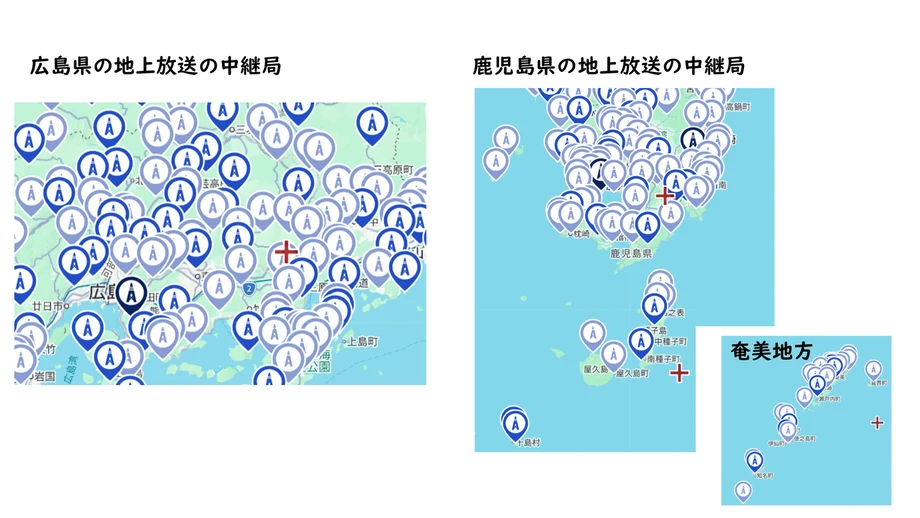
Regional differences add another layer. Maps from A-PAB, the broadcast service association, showed Hiroshima and Kagoshima with higher numbers of relay stations than many other areas. In both prefectures, the main transmitter covered less than 50% of the area, so broadcasters had to use less efficient transmission chains. Japan Broadcast Network, known as J-BN, was set up with NHK fee reserves to manage mini satellite stations. A support program also shares part of the cost of power outage measures and spare equipment for disaster preparation.
Could some relay stations disappear
The draft links the future of relay stations to the availability of other ways to watch. If internet distribution or another method can secure a viewing environment, the paper says the abolition of small relay stations and mini satellite stations can be considered. That means the plan keeps terrestrial broadcasting in the picture while imagining a network built from several tools rather than radio waves alone.
Frequency repacking is also on the table. In simple terms, repacking means moving broadcast frequencies so that spectrum can be used more efficiently after old facilities close. The order matters for viewers. The draft's logic is to secure another way to watch first, then decide what to do with the old equipment. Remote community antenna systems, which collect signals and send them by cable to homes, are already under strain in some areas because the facilities are aging and membership associations are shrinking.
What happens before broadband reaches everywhere
The ministry paper does not assume that broadband covers every home during the transition. It proposes a temporary safety net using satellites to deliver terrestrial programs. The official agenda included both a report on the current state of satellite broadcasting and a hearing with the Satellite Broadcasting Association, showing that satellite capacity is part of the policy calculation.
Satellite delivery can reach wide areas without a dense chain of local relay stations, but it has limits. A transponder is a satellite channel that carries a fixed amount of data, so it can carry only a limited number of programs. Cost is another limit. The draft leaves several questions open: which programs would be carried, what roles national government, municipalities, and broadcasters would take, and whether viewers would accept the substitute. If only a small set of programs can be carried, some households could have fewer choices than people with fast broadband.
Why broadcasters welcome and fear the plan
The Japan Commercial Broadcasters Association, the industry body for private broadcasters, told the committee that expanding online distribution of programs and news is urgent for commercial broadcasting. It also said broadcasters are not all in the same financial position and are making their own management decisions. The association submitted material 6-1 to the meeting and set out the rights problem in direct terms.
Online distribution of broadcast content requires separate rights clearance, and commercial broadcasters are spending human and financial costs on it. We expect appropriate government measures so that the barrier between broadcasting and distribution can be lowered and rights clearance can be made smoother.
Commercial broadcasters already stream some programs through TVer, centered on the five main Tokyo stations. Simultaneous streaming by those five stations began in April 2022, and TVer had 41.2 million monthly users in January 2025. Journalist Soichiro Matsutani, who covers broadcasting, said NHK streams almost all hours while commercial broadcasters focus largely on prime time. He called the 2040 target very slow because it is 14 years away. Online comments on November 25 welcomed local programs and local baseball, questioned the distant deadline, raised concerns about NHK fees, and pointed to rights problems involving films, national team matches, and baseball games.
Rights clearance is the quiet barrier behind the promise. Television broadcast rights and internet distribution rights can be separate. A variety show may need new permission from performers, a film may involve an original rights holder outside the station, and a sports broadcast may have limits set by the competition or league. Online commenters also asked how TVer and ABEMA would fit into a system built around nearly all terrestrial programs.
Local stations face a harder version of the same problem
Local broadcasting shows both the attraction and the difficulty of the plan. The Nagaoka fireworks relay shows the production problem in concrete terms: video and sound can be sent to people by the river and to a distant cinema, while the switching team must know whether the remote screen is showing the same shot and where to switch if the line fails. Streaming could let people outside a prefecture follow festivals, high school sports, disaster information, and local teams.
The hearing with local stations and viewers pointed to a tougher business equation. Digital advertising income from local content is very limited, while distribution and rights work cost money upfront. Variety and information programs require permission from people who appear on screen. Local stations described the gap between what online distribution can earn and what it costs. Some also said that outside cable television service areas, it can be hard to secure any alternative way to watch terrestrial programs.
Local advertising adds another question. A regional company may pay to reach viewers in one prefecture. If a program becomes available nationwide online, the broadcaster needs a way to show who saw the advertisement and how money returns to local production. A station may have the technical ability to stream a program while lacking the legal right to stream every part of it.
Who is pushing the policy, and how cautious are they
The Broadcasting Policy Committee was set up in May 2026 under an internal affairs minister's question about the future of broadcasting in a diversified information space. It has 12 experts. Tsunehiro Shishido, a professor at the University of Tokyo Graduate School of Law and Politics, serves as chair. At the meeting, members said the draft placed too many major issues before them at once and asked for careful debate. The committee decided to continue considering the draft.
Tsunehiro Shishido, the committee chair, told members that discussion with stakeholders had to be careful. He said:
It goes without saying that we need to move forward carefully with stakeholders. We will move the discussion forward with care.
Broadcast law explains why relay stations are sensitive. NHK has a duty to make broadcasts receivable across the country, while commercial broadcasters have a best efforts obligation. Those duties shape public expectations in rural areas, where a small transmitter may matter more to daily life than its audience size suggests.
The radio and regional journalism question
The same committee is also looking at radio rules. Commercial broadcasters have asked about converting AM broadcasting to FM, and about letting radiko serve as a complement or replacement where FM signals cannot reach. Some radio and television companies face harder finances than television only companies, and some have separated radio operations to improve management. Radiko has been in service for more than 15 years, so the question is no longer theoretical.
Keiko Murakami, a writer and participant in the hearing, argued that the line between broadcast signals and internet replacement needs public discussion before rules change. She said large disasters can cut internet service for long periods, and she questioned whether NHK alone should carry the burden if private broadcasters stop reaching some areas by radio. Radio operators have long described themselves as a first informer in emergencies.
Murakami also pointed to overseas support for regional media. She cited South Korea's use of spectrum charges and local government funds, Britain's national funding and receiving licence fee, France's foundations, local government money, and tax incentives for regional companies, and Germany's sharp debate over direct state support for media, especially newspapers. Japan's committee now faces a practical question about whether regional media's public value should be supported by society as a whole.
A short timeline from digital television to 2040
The 2040 proposal sits at the end of a long chain of changes in Japanese television and online viewing. The dates below show why the ministry framed the issue as infrastructure rather than only as a new app.
- 2012: The digital terrestrial television transition was completed.
- April 2022: Simultaneous streaming by the five main Tokyo commercial stations began on TVer.
- 2022: A survey of 127 commercial broadcasters put small relay and mini satellite station maintenance at about 8 billion yen a year for just under 3% of households served.
- 2023: A legal change allowed NHK and commercial broadcasters to share relay stations.
- October 1, 2025: Internet distribution became a required business for NHK, NHK ONE began, and viewer protection rules for relay station closure took effect.
- December 2025: NHK and commercial broadcasters reached agreement on joint use of mini satellite stations through J-BN.
- May 2026: The Broadcasting Policy Committee was established under the minister's question on broadcasting's future.
- November 24, 2026: The sixth meeting considered the infrastructure draft and the 2040 streaming question.
- December 9, 2026: A seventh meeting is planned to consider the framework of a first draft report.
- Spring 2027 onward: Part of the council's answer is expected to be issued in stages.
- Early 2040s: The next wave of relay station renewals is expected to peak.
- 2040: The proposed latest target for in principle all terrestrial programs to be available online.
What viewers may notice at home
Households that already receive television through a home antenna or cable television should see little immediate change. Broadcast signals will continue, and the living room television remains the main screen for many people. The first visible change is likely to be more convenience: more programs on phones and computers, more catch up viewing through apps, and wider access to regional content.
Households using remote community antenna systems could face bigger changes. Many such systems are old, and associations that maintain them have fewer members. Those households should ask their association, municipality, or cable operator whether a fiber or cable conversion plan exists. Government support covers two thirds of eligible costs for some conversions to cable television and one half for some fiber cable upgrades, with applications made by municipalities or cable operators rather than individual households.
Viewers who already use phones and computers stand to gain the most. NHK ONE began on October 1, 2025, after NHK's online distribution became a required business. People with an existing NHK television contract do not need a second contract for NHK ONE. People without a television who use the online service need a contract at the same fee as a terrestrial television contract, 1,100 yen a month, or 965 yen in Okinawa. Owning a phone or computer alone does not create the contract.
Emergency planning still needs both broadcast and internet habits. During the 2024 Noto Peninsula earthquake and heavy rain, relay stations and cable television were disrupted in some places. Mobile networks and internet service can also fail during power cuts. Simultaneous online streams usually arrive slightly after broadcast signals, which matters when seconds count. A battery radio, a mobile power bank, and a known local broadcast channel remain useful.
What remains undecided and what comes next
Several key points are still open. No date was given for the early simultaneous streaming of news. The committee has not fixed which programs a satellite safety net would carry, how costs would be shared, or how rights clearance would be made smoother. It has not settled which relay stations would close or how each viewer would be protected in practice.
The next formal step is the December 9 meeting, where members are expected to discuss the framework of a first draft report. The committee aims to pull together a draft by the end of 2026, with parts of the council's answer expected from spring 2027 onward. Until then, the 2040 formula is a planning target that tells broadcasters, local governments, and viewers where the discussion is heading.
Key Points
- Japan's Broadcasting Policy Committee considered a draft aiming for in principle all terrestrial TV programs to be streamed simultaneously and after broadcast by 2040 at the latest.
- The draft links the goal to relay station renewals expected in the early 2040s and to the cost of maintaining small facilities.
- News programs could be streamed simultaneously earlier, but no date was given.
- Small relay stations and mini satellite stations could be abolished where other viewing methods are secured, with frequency repacking also considered.
- Satellite delivery is proposed as a temporary safety net until broadband is available nationwide, though capacity and cost remain unresolved.
- The commercial broadcasters association supports expansion but warns that separate rights clearance requires staff, money, and government action.
- Local stations face limited digital advertising income, rights costs, and areas where alternatives to terrestrial reception are hard to secure.
- The committee will continue discussing the draft, with a seventh meeting planned for December 9 and partial answers expected from spring 2027 onward.