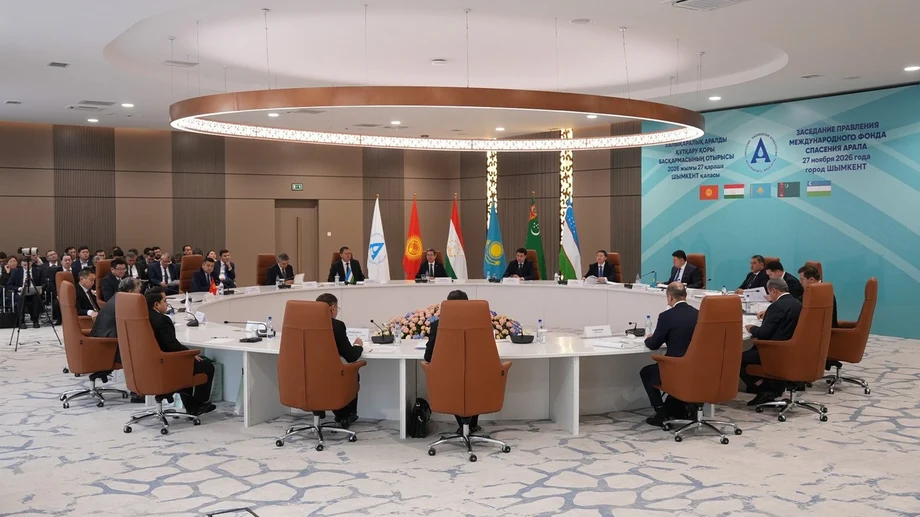
A funding result and a leadership handover in Shymkent
About $170 million in grants, a plan to automate water measurement in the Syr Darya basin and a change of leadership topped the agenda when the board of the International Fund for Saving the Aral Sea met in Shymkent on November 27, 2026. Kazakhstan's government said the funding was attracted during the country's 2024 to 2026 chairmanship of the fund, known as IFAS, to support more efficient water use and regional environmental projects.
Contents
- A funding result and a leadership handover in Shymkent
- What makes up the nearly $170 million
- Why automated water accounting matters on the Syr Darya
- What the Astana summit added to the agenda
- The dates that shape the transition
- Uzbekistan prepares 133 projects worth $3.3 billion
- How Uzbekistan wants to change the fund's work
- A regional water convention and a proposed UN organization
- Where the North Aral fits into the program
- What to Know
The meeting closed Kazakhstan's term and set up a much larger next phase. Uzbekistan will assume the chairmanship on January 1, 2027, and says it has prepared 133 projects with a combined value of $3.3 billion for its 2027 to 2029 term. Its program would extend the agenda beyond grants and restoration to shared databases, desertification control, institutional reform and closer water cooperation with Afghanistan.
Kazakh Deputy Prime Minister Kanat Bozumbayev chaired the Shymkent meeting. The participants included Kazakh Water Resources and Irrigation Minister Nurzhan Nurzhigitov, Tajik Deputy Prime Minister Sulaimon Ziyozoda, Uzbek Presidential Advisor Shukhrat Ganiev and Durdy Genjiyev, chairman of Turkmenistan's State Committee for Water Management. Kyrgyzstan attended as an observer. M. Oshurbayev, Kazakhstan's vice minister of ecology and natural resources, also joined the Kazakh delegation.
The subject reaches far beyond the Aral Sea's shoreline. The Amu Darya and Syr Darya cross national borders, and their water supplies farms, power generation, industry and households. A country cannot measure or allocate its share effectively in isolation, which is why the fund's technical decisions can matter as much as its headline funding figures.
What makes up the nearly $170 million
Kazakhstan's government said the IFAS Executive Committee worked across ten areas during the chairmanship. Three funding items were identified in the results:
- $20 million for the CAWEC regional cooperation project with the World Bank, aimed at improving the efficiency of water use.
- $145.2 million for REMIT, the Regional Electricity Market Interconnectivity and Trade Program.
- €2 million for projects supported by the French Development Agency.
The two amounts denominated in dollars total $165.2 million before the French contribution in euros is added. The government summarized the complete result as nearly $170 million. The fund also concluded 13 memorandums and agreements with international organizations and financial institutions during Kazakhstan's term.
The funding list covers a mixture of water cooperation, regional programs and environmental work rather than a single construction project at the sea. CAWEC is directly connected with water efficiency, while REMIT concerns electricity market connections and trade. The government announcement did not provide a completion date or spending breakdown for every activity covered by the grants.
Delegates also reviewed the Fourth Aral Sea Basin Program, known as ASBP-4, which organizes assistance for countries in the basin. Another item was the working group examining the fund's organizational structure and legal framework. That review now connects with Uzbekistan's intention to update the way IFAS is governed and how its agreements operate.
Why automated water accounting matters on the Syr Darya
The clearest new operational decision in Shymkent concerned the Syr Darya. The board endorsed a decision by the Interstate Commission for Water Coordination, or ICWC, to prepare a work plan for an automated water accounting system in the river basin and to create a working group representing the basin states.
Water accounting means measuring how much water enters a river system, where it is diverted and how it is used. Automation can replace scattered manual readings with more consistent information. On a shared river, that can give national agencies a common basis for discussing withdrawals and distribution instead of relying on figures assembled in different ways.
The first tasks are organizational. Each participating country must identify a national coordinator. The working group must then draft and agree on the plan before it goes to the ICWC for approval and to the IFAS board for endorsement. The Executive Committee has been instructed to discuss technical and financial support with development partners.
No budget, equipment list or completion date was announced. The immediate result is therefore a planning process, with coordinators, common methods and financing still to be settled. For water agencies, the eventual prize is more transparent measurement. For farms, cities and other users, the practical value would depend on whether better information leads to more predictable and accepted decisions about shared water.
What the Astana summit added to the agenda
The Shymkent board also examined decisions made at the Council of Heads of IFAS Founding States in Astana on April 22, 2026. The leaders signed the Astana Statement and adopted a package of decisions. One designated March 26 as the International Day of the Aral Sea and the Amu Darya and Syr Darya Rivers, creating an annual focus for the region's water and environmental concerns.
Bozumbayev, speaking as Kazakhstan's deputy prime minister and the meeting chair, described the Astana gathering as the central event of the chairmanship. He closed his remarks by recognizing the institutions involved in the regional initiatives:
Over this period, the Executive Committee and development partners launched several regional initiatives. I would like to thank the board members, the Executive Committee, the Interstate Commission for Water Coordination, and the Interstate Commission for Sustainable Development for their collaboration.
The Astana Statement gives Kazakhstan's term a political document alongside its grant totals. The Shymkent decisions show the next layer of work: carrying out ASBP-4, reconsidering the fund's structure and converting summit commitments into plans that national agencies and international partners can implement.
The dates that shape the transition
- April 22, 2026: IFAS founding leaders met in Astana, signed the Astana Statement and approved the March 26 international day.
- November 10, 2026: Kazakhstan presented a new project for restoring the North Aral at the UN climate conference.
- November 27, 2026: The IFAS board met in Shymkent, reviewed Kazakhstan's results and approved planning for automated water accounting in the Syr Darya basin.
- December 8 to 10, 2026: The UN Water Conference in Abu Dhabi is expected to discuss Kazakhstan's proposal for an International Water Organization.
- January 1, 2027: Uzbekistan takes over the IFAS chairmanship for the 2027 to 2029 period.
The Abu Dhabi conference is the next fixed international date in the announcement. No date was given for the ICWC and IFAS board to consider the completed Syr Darya work plan.
Uzbekistan prepares 133 projects worth $3.3 billion
Uzbekistan's incoming chairmanship comes with a project portfolio that has already been presented to President Shavkat Mirziyoyev. The 133 prepared projects address water management, environmental protection and socioeconomic development across the region.
At $3.3 billion, the proposed portfolio is about 19 times the roughly $170 million in grants reported for Kazakhstan's term. The figures measure different things. Kazakhstan's total concerns grants attracted during its chairmanship, while Uzbekistan's figure is the estimated value of a project pipeline for which it intends to seek support.
Uzbekistan expects to approach the World Bank, the Asian Development Bank, the European Bank for Reconstruction and Development, the Green Climate Fund and the Global Environment Facility. Those institutions have different mandates, ranging from development lending and reconstruction to finance for climate and environmental projects.
The announcement did not say how much each institution might provide, which projects would begin first or when the full portfolio could be completed. The immediate test for the incoming chairmanship will be turning the prepared list into financed agreements with defined schedules.
How Uzbekistan wants to change the fund's work
Uzbekistan's plans include a unified database for the Amu Darya and Syr Darya basins and new initiatives against desertification. The database would cover both great river systems, while the automated accounting plan approved in Shymkent focuses specifically on measuring water in the Syr Darya basin. One concerns organizing basin information more broadly; the other concerns obtaining consistent measurements.
The incoming chairman also intends to update the IFAS organizational structure and its legal and contractual framework. This continues an issue already examined by the working group reviewed in Shymkent, giving the institutional discussions a place in the next chairmanship rather than leaving them with the outgoing one.
The Tashkent Institute of Irrigation and Agricultural Mechanization Engineers is intended to become a scientific and analytical hub supporting the initiatives. Such a role would give the program a designated institution for research and analysis as projects are prepared and implemented.
Afghanistan is also included in Uzbekistan's plans through stronger cooperation on water issues. No individual Afghan project, funding amount or negotiating timetable was announced. Along with desertification control, the proposal widens the incoming agenda beyond the funding and administrative achievements emphasized in Kazakhstan's closing review.
A regional water convention and a proposed UN organization
Nurzhigitov briefed the board on two separate diplomatic initiatives. The first is a draft Central Asian Framework Convention on Water Use. A framework convention would provide a regional agreement within which countries could establish common principles and obligations, but the final terms of the draft were not disclosed.
The second is President Kassym-Jomart Tokayev's proposal to create an International Water Organization within the United Nations system. The initiative is expected to be discussed at the UN Water Conference in Abu Dhabi from December 8 to 10, 2026. The conference provides a venue for debate; no decision to establish the organization, or details of its possible structure and budget, has been announced.
The initiatives operate at different levels. The convention concerns cooperation among Central Asian states, while the proposed organization would sit within a global institution. Both were presented in Shymkent as work still being developed, alongside the more immediate technical planning for the Syr Darya.
Where the North Aral fits into the program
Kazakhstan had previously approved 131 projects aimed at saving the North Aral. On November 10, 2026, it presented a new restoration project for the northern part of the sea at the UN climate conference. Kazakhstan also presented results and experience from restoring regional ecosystems at COP31 in Antalya, Türkiye.
Those restoration activities sit beside the broader financial and institutional program reviewed by IFAS. The announcement did not assign each of the 131 North Aral projects to a particular grant within the approximately $170 million total.
Kazakhstan leaves the chairmanship with three kinds of work underway: grants and agreements already attracted, restoration initiatives presented internationally and technical plans that still require national coordination. Uzbekistan inherits those processes while adding its own 133-project portfolio. The next visible steps are the appointment of Syr Darya coordinators, negotiations with development partners and the Abu Dhabi discussion in December.
What to Know
- Kazakhstan's government said IFAS attracted nearly $170 million in grants during the country's 2024 to 2026 chairmanship.
- The listed funding includes $20 million for CAWEC, $145.2 million for REMIT and €2 million for French Development Agency projects.
- The IFAS board met in Shymkent on November 27, 2026, and agreed to plan automated water accounting in the Syr Darya basin.
- The April 22 Astana summit produced the Astana Statement and designated March 26 as the international day for the Aral Sea and its two great rivers.
- Uzbekistan takes over on January 1, 2027, with 133 prepared projects valued at $3.3 billion.
- Uzbekistan also plans a unified basin database, desertification initiatives, institutional reforms and stronger water cooperation with Afghanistan.
- Kazakhstan's proposal for an International Water Organization within the UN is expected to be discussed in Abu Dhabi on December 8 to 10, 2026.