Five days of worsening air bring a regional warning
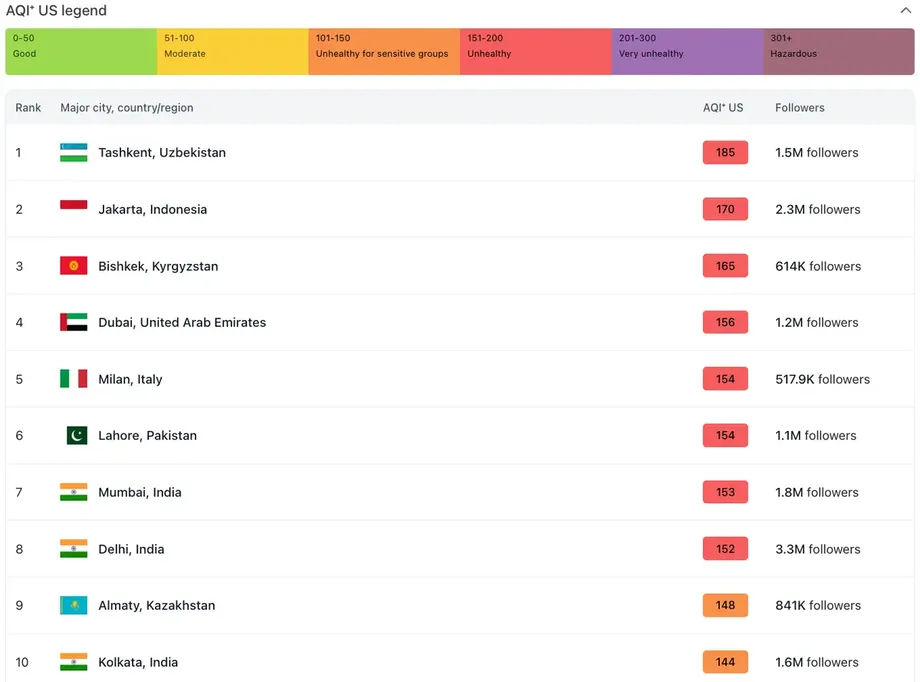
Tashkent's daily average air quality index rose from 93 on October 21 to 164 on October 26, 2026, an increase of 76%, according to an analysis published by Uzbekistan's National Committee on Ecology and Climate Change. By October 28 at 17:57 local time, IQAir recorded an index of 185, putting the Uzbek capital first in its ranking of major cities at that moment.
Contents
- Five days of worsening air bring a regional warning
- What the readings mean for residents
- How the October episode unfolded
- Why pollution became worse at night
- Little rain left dust in the air
- Laboratory tests separate dust from combustion
- Why neighbouring cities worsened together
- Earlier improvements and daily alerts tell different parts of the story
- Warnings target construction, factories and power plants
- Key Points
The deterioration spread across Central Asia. Six of eight major cities examined had an air quality index above 100 on October 26. Kazakhstan issued warnings about weather conditions that allow pollution to accumulate in 10 cities by October 27, up from four on October 24.
Erkin Abdulakhatov, a climatologist and laboratory head at the Hydrometeorological Research Institute, attributed the episode to several forces working together: a persistent anticyclone, weak winds, little rain, dust arriving from distant dry areas and emissions from human activity. An anticyclone is a weather system associated with high atmospheric pressure that can keep air stagnant for days.
Laboratory findings show why both dust and emissions matter. Samples collected in three Tashkent districts from October 12 to 16 contained an average of 39.7% natural mineral dust and 42.6% material associated with fuel combustion in transport, industry and energy production.
The late October surge followed improvements earlier in 2026. Automatic monitoring data showed average PM2.5 concentrations falling 28% between January 1 and October 19 compared with the same period in 2025. Residents therefore faced a sharp deterioration after months of lower average particle pollution, with weather restricting the city's ability to disperse the material entering its air.
What the readings mean for residents
AQI, the air quality index, translates pollution measurements into a scale used to communicate health risks. On the US scale used for the October 28 reading, values from 151 to 200 fall in the unhealthy category. At those levels, anyone may experience health effects, while people more sensitive to pollution face greater risks.
Tashkent's reading of 185 placed it ahead of Jakarta at 170 and Bishkek at 165 in the October 28 ranking. The list changes throughout the day as measurements are updated. The city's position described conditions at 17:57.
Children, older people, pregnant women and people with heart or respiratory conditions are among those advised to take particular care. Recommendations during the episode included reducing time outdoors, postponing strenuous outdoor exercise and ventilating rooms when outdoor air is cleaner.
A well fitted N95 or FFP2 respirator can reduce exposure to fine particles outdoors. Ordinary medical masks provide much less protection against these particles. PM2.5 means particles measuring 2.5 micrometres or less across, small enough to enter deep into the lungs. PM10 covers particles measuring 10 micrometres or less.
How the October episode unfolded
Tashkent's deterioration developed through several stages, from an earlier dust episode to increasingly stagnant weather late in the month. Monitoring stations, laboratory samples and satellite observations recorded different parts of that sequence.
- September 28 to October 6: Natural dust averaged 64% of PM2.5 in samples from three Tashkent districts, ranging from 52% to 78%.
- October 4 to 5: Rain coincided with AQI readings of 66 to 71, within the moderate category.
- October 12 to 16: Laboratory samples contained an average of 39.7% natural dust and 42.6% material linked to combustion.
- October 21 to 26: Tashkent's daily average AQI rose from 93 to 164.
- October 25 to 26: Satellite images showed large dust masses over Tashkent and surrounding areas.
- October 28: IQAir recorded Tashkent at 185 at 17:57 local time.
Uzhydromet warned that dust and other pollutants could increase or remain elevated through November 1. The Ecology Committee also said adverse conditions could continue into the beginning of the following week.
Why pollution became worse at night
Tashkent's nighttime measurements show the effect of air becoming trapped near the ground. Over the preceding 30 days, average AQI at 23:00 was 119, compared with 82 at 17:00. The nighttime figure was about 45% higher, calculated from the 37 point difference between those readings.
Autumn nights cool the ground quickly. A layer of warmer air can then sit above colder air near the surface, limiting upward movement. This arrangement, called a temperature inversion, acts like a lid: particles and gases collect underneath it.
Measurements at the Tashkent television tower during the night of October 24 to 25 found air higher up was as much as 4.2 degrees Celsius warmer than air near the ground. Nighttime wind speeds in Tashkent were only 0.6 to 1.2 metres per second, according to Abdulakhatov's analysis.
Doniyor Turgunov, director of the Hydrometeorological Research Institute at Green University, explained at an October 21 briefing that the layer in which air mixes can shrink from 2 to 3 kilometres in summer to several hundred metres in autumn. Pollution then accumulates in a much smaller volume of air.
Under these conditions, particle concentrations can rise even while emissions remain steady. Tashkent's central heating season had not yet begun during the late October episode, according to the analysis, making weather and incoming dust especially relevant to the sudden deterioration.
Little rain left dust in the air
Tashkent received just 3.9 millimetres of rain through October 26, against a normal total of 23.7 millimetres for the whole month, according to Farrux Sattarov, director of the National Climate Change Centre. By that date, the city had received about 16% of its normal October rainfall.
Rain removes some airborne particles by carrying them to the ground. Dry weather also leaves exposed soil more available for winds to lift. The institute's analysis recorded no precipitation across Uzbekistan from October 19 to 25, including in mountain areas.
The Ecology Committee compared AQI observations with satellite imagery and the SILAM atmospheric modelling system for October 1 to 26. SILAM is a computer system used to track and forecast the movement of substances through the atmosphere. The comparison showed rising AQI during periods when dust entered Tashkent and nearby areas.
EUMETSAT and Meteosat imagery showed dust masses on October 25 and 26 over Tashkent city and Tashkent region, extending into parts of Sirdaryo and Jizzakh. Earlier rain on October 4 and 5 coincided with much lower index readings of 66 to 71.
Laboratory tests separate dust from combustion
Researchers collected PM2.5 samples in Yunusabad, Almazar and Mirzo Ulugbek districts. Sampling locations included Green University, Tashkent State Technical University and the Tashkent Institute of Irrigation and Agricultural Mechanisation Engineers.
Dust accounted for an average of 64% of sampled PM2.5 during the strong dust transport period from September 28 to October 6. Its share varied from 52% to 78%. On October 13 and 14, dust components made up 47% to 52%, while the wider October 12 to 16 sampling period produced the lower average of 39.7%.
The October 12 to 16 analysis also identified 42.6% associated with combustion, 6.8% associated with heavy metal emissions from transport and metallurgy, and 11.2% whose source remained unidentified. The published percentages total slightly more than 100%, consistent with rounding.
A study by the World Bank and Uzbekistan's Ecology Committee estimated Tashkent's annual PM2.5 source shares at 36% windblown dust, 28% building heating, 16% transport and 13% industry. Urban dust and waste burning were among the remaining sources.
Heating, transport and industry together accounted for 57% in that annual estimate, compared with 36% from windblown dust. Those figures explain the need for two kinds of action: managing dust exposure and cutting emissions from fuel use. The balance changes with the season and the arrival of individual dust masses.
Why neighbouring cities worsened together
Bishkek recorded an AQI of 160 on October 26, followed by Tashkent at 157, Shymkent at 149, Karaganda and Dushanbe at 134, and Samarkand at 114 in the regional comparison. Salor, near Tashkent, reached 148. Bishkek ranked fourth in IQAir's global city ranking that day.
The Hydrometeorological Research Institute separately gave Tashkent's daily average for October 26 as 164. Its regional city comparison used 157. These measurements describe the same broad deterioration through different reported readings.
Central Asia contains extensive sources of airborne dust, including the Karakum, Kyzylkum and Aralkum deserts. Aralkum occupies the dried bed of the Aral Sea. Dust also travels from dry areas around the Caspian Sea and southern Balkhash.
A HYSPLIT trajectory analysis, which reconstructs the route travelled by air, indicated that air reaching Tashkent on the night of October 24 had moved more than 1,000 kilometres from the north in 72 hours, crossing desert areas of Kazakhstan and Uzbekistan.
The World Bank's 2025 report, Air Quality Management in Central Asia, estimated that soil and desert dust contribute 20% to 50% of annual PM2.5 exposure in cities across the region. Shared forecasting therefore has a practical purpose: it can warn a city about pollution moving towards it before local monitors record the full increase.
Earlier improvements and daily alerts tell different parts of the story
Turgunov's October 21 briefing presented substantial improvements through October 19. Compared with the same period in 2025, PM2.5 fell 28% and PM10 fell 32% from the beginning of the year. From September 1 to October 19, the respective reductions were 28% and 37%.
The first 19 days of October showed larger declines of 40% for PM2.5 and 56% for PM10. The committee's later analysis also gave an October average AQI of 104, down from 124 in the comparison period a year earlier.
The briefing recorded no unhealthy AQI days in its 2026 comparison period, against 11 in 2025, and an increase from 21 to 38 days rated moderate or better for PM2.5. Tashkent nevertheless had an unhealthy morning reading of 154 at 09:00 on October 19. A reading at a particular hour and an assessment of a whole day use different averaging periods.
Longer averages also varied across Central Asia. IQAir's 2025 report listed annual PM2.5 concentrations of 39 micrograms per cubic metre in Tashkent, 57.3 in Dushanbe, 72.6 in Karaganda, 29.7 in Bishkek, 22.8 in Almaty and 16.8 in Astana. Residents experience both the accumulated exposure reflected in annual figures and the immediate deterioration captured by daily alerts.
Warnings target construction, factories and power plants
The Ecology Committee said it warned 30 construction organisations to suppress dust and 131 major businesses in environmental impact categories I and II to reduce atmospheric emissions by half. Seven thermal power plants operating in and around Tashkent also received warnings.
Local authorities were asked to remove sand and dust from main roads and roadsides and arrange operation of existing fountains. The warnings were announced as response measures; no results showing the resulting emission reductions were given.
Uzbekistan's national air monitoring platform had 28 automatic stations connected, with readings available to the public in real time. Zikrilla Alimov, head of the Specialised Atmospheric Laboratory Centre, said filtered air samples were being collected across all Tashkent districts to identify pollution sources. Expansion of that work across the country was planned.
Researchers proposed faster information exchange between Uzbekistan, Kazakhstan, Kyrgyzstan and Tajikistan, regular laboratory testing during adverse weather, and forecasts combining monitoring stations, satellite observations and air trajectory models. They also called for cleaner transport and energy production, better energy efficiency, construction dust controls, planting on exposed land and protection of urban corridors through which air circulates.
Sattarov said adverse weather conditions affecting natural air exchange during the colder half of the year had increased 57% over the preceding decade compared with earlier years. Warming, drought and reduced soil moisture create more opportunities for dust to become airborne. For Tashkent, the immediate task is to reduce emissions while improving warnings about the weather and dust movements that concentrate pollution near homes, roads and schools.
Key Points
- Tashkent's daily average AQI rose from 93 on October 21 to 164 on October 26, an increase of 76%.
- IQAir recorded an unhealthy reading of 185 at 17:57 on October 28.
- Weak winds, temperature inversions, limited rain, incoming dust and local emissions combined to worsen air quality.
- Natural dust averaged 39.7% of PM2.5 samples collected from October 12 to 16; combustion accounted for 42.6%.
- Average PM2.5 concentrations through October 19 were 28% lower than in the same period of 2025.
- Authorities warned construction organisations, major businesses and power plants, while Uzhydromet warned elevated pollution could persist through November 1.