A Chiang Mai fare exposes two different problems
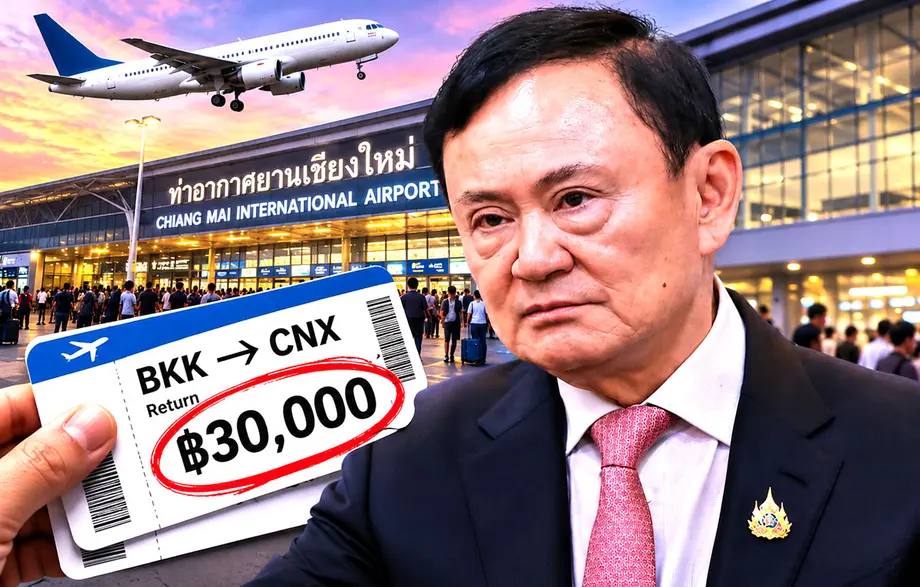
A return ticket on a low cost airline between Bangkok and Chiang Mai approached 30,000 baht during the Loy Krathong travel rush, prompting former prime minister Thaksin Shinawatra to demand effective maximum fares on 27 November 2026. He said his secretary found return prices starting above 13,000 baht, rising to 23,000 baht after a ticket change and reaching almost 30,000 baht through a booking website. He did not identify the airline, website or travel dates.
Contents
- A Chiang Mai fare exposes two different problems
- What the government asked six airlines to do
- How high can airlines legally charge?
- Why the fare cap stops at some online sellers
- The Chiang Mai seat squeeze behind the prices
- Why low cost does not always mean a low fare
- Earlier warnings from Phuket and Hat Yai
- Three questions for the 2 December hearing
- What New Year travellers should watch now
- What to Know
Thaksin said the price exceeded a return journey to Hong Kong and recalled promotional Bangkok to Chiang Mai return fares of 999 baht when his Thai Rak Thai government encouraged low cost aviation two decades ago. He asked the Transport Ministry for a maximum price mechanism that he called Cap Max, with fair adjustments for fuel costs. He also said an earlier complaint during Paetongtarn Shinawatra's government had met slow cooperation from agencies.
Thaksin argued that airlines created to make flying affordable were now competing on high prices while retaining economy service.
Carriers now compete to be a "High Cost Airline".
Deputy Prime Minister and Transport Minister Phiphat Ratchakitprakarn said initial checks had found no airline selling above the Civil Aviation Authority of Thailand's ceilings. He described aviation as a partially liberalised business, so the government could not dictate every price, and said volatile energy costs affected airlines. Phiphat said he had never personally encountered Chiang Mai return fares of 23,000 to 30,000 baht, although he had seen last minute tickets costing 7,000 to 10,000 baht each way to Phuket or Hat Yai.
Deputy Transport Minister Siripong Angkasakulkiat gave a different emphasis, blaming resellers who exploit scarce seats during festivals. He thanked Thaksin for exposing weaknesses in supervision and asked his booking team to identify whether the prices came from an agent or an airline. The dispute now runs alongside a parliamentary hearing scheduled for 2 December.
What the government asked six airlines to do
At 2:50 pm on 27 November, Supamas Isarabhakdi, a minister attached to the Prime Minister's Office, and Deputy Transport Minister Phattraphong Phattraprasit chaired a meeting at the Office of the Consumer Protection Board. Transport officials, the Civil Aviation Authority of Thailand (CAAT), the Department of Internal Trade and consumer protection officials joined representatives of Thai Airways, Thai AirAsia, Bangkok Airways, Vietjet, Nok Air and Thai Lion Air.
The government asked the six carriers to consider promotional fares and reduce New Year ticket prices by 20% from the legal ceilings. It also asked them to display prices plainly and publish the applicable ceilings on their website home pages and sales channels. The airlines took the request away for consideration. Officials did not announce an agreed reduction or a deadline for every carrier to introduce one.
CAAT director Manat Chavanaprayoon said the authority would monitor fares throughout the New Year period and coordinate passenger protection with other agencies. Passengers were advised to book through airline websites, applications or counters, where the base fare and travel conditions can be checked directly.
Supamas said the meeting was not prompted by Thaksin's post, stating that the agencies had begun discussing short, medium and long term measures during Loy Krathong and Yi Peng. She said recent comparisons indicated that this year's fares remained lower than last year's. Phattraphong was due to meet CAAT during the following week to settle festival measures and discuss longer reforms.
How high can airlines legally charge?
The fare system uses distance rather than one national ticket price. Under the 2018 Civil Aviation Committee announcement, controlled domestic routes longer than 300 kilometres have a maximum base fare of 9.40 baht per kilometre for low cost airlines and 13 baht per kilometre for full service carriers such as Thai Airways and Bangkok Airways. Routes of no more than 300 kilometres where ground travel is difficult have a ceiling of 22 baht per kilometre.
On the 566 kilometre Bangkok to Chiang Mai route, those rates produce limits of 5,320 baht for low cost service and 7,358 baht for full service, for each leg. A return calculation therefore reaches 10,640 baht and 14,716 baht respectively. Airport charges, value added tax and optional purchases such as checked baggage or seat selection come on top.
A website total can consequently contain several different charges. Investigators need an itemised receipt separating the airline fare, taxes, agent fees and extras before deciding whether a ceiling was breached. CAAT has published the following maximum base fares for each leg on 13 routes, with the low cost figure listed first and full service second.
- Bangkok to Chiang Mai, 566 kilometres: 5,320 baht and 7,358 baht.
- Bangkok to Chiang Rai, 675 kilometres: 6,345 baht and 8,775 baht.
- Bangkok to Nan, 552 kilometres: 5,188 baht and 7,176 baht.
- Bangkok to Phuket, 698 kilometres: 6,561 baht and 9,074 baht.
- Bangkok to Krabi, 669 kilometres: 6,288 baht and 8,697 baht.
- Bangkok to Surat Thani, 553 kilometres: 5,198 baht and 7,189 baht.
- Bangkok to Nakhon Si Thammarat, 609 kilometres: 5,724 baht and 7,917 baht.
- Bangkok to Hat Yai, 773 kilometres: 7,266 baht and 10,049 baht.
- Bangkok to Trang, 740 kilometres: 6,956 baht and 9,620 baht.
- Bangkok to Udon Thani, 456 kilometres: 4,286 baht and 5,928 baht.
- Bangkok to Ubon Ratchathani, 484 kilometres: 4,549 baht and 6,292 baht.
- Bangkok to Khon Kaen, 388 kilometres: 3,647 baht and 5,044 baht.
- Bangkok to Buriram, 332 kilometres: 3,120 baht and 4,316 baht.
Suphanat Minchainan, the People's Party MP for Bangkok's constituency 9, said his preliminary checks of AirAsia and Nok Air's official websites found Bangkok to Chiang Mai tickets that were expensive but remained within the ceilings. He also found some Thai Vietjet flights whose fares raised questions, but said CAAT and the airline must explain the price components before anyone concludes that those sales broke the limit.
Why the fare cap stops at some online sellers
Online travel agencies, including platforms such as Expedia, Trip and Traveloka, create a separate regulatory problem. Their prices can be lower than direct airline sales during quiet periods, which encourages passengers to use them. During peak demand, complaints instead describe offers above the fare ceilings, sometimes while an airline's own website shows no seats.
Deputy government spokesperson Lalida Persvivatana said on 17 November that CAAT had no power over agencies registered abroad, some of which had sold domestic tickets above the ceilings. Manat said CAAT directly controls domestic fares and flights departing Thailand, but cannot supervise those foreign sellers in the same way. Flights originating abroad also sit outside Thailand's fare control.
The proposed response crosses several agencies. The Commerce Ministry could require businesses selling in Thailand to register locally. CAAT could seek help from the National Broadcasting and Telecommunications Commission to block online sales channels that refuse to follow the law, while the consumer protection board could handle complaints and mediation. Manat acknowledged that these steps would take time because several laws and regulators are involved.
Consumer protection officials are also examining whether automated programs bought tickets for resale through agencies registered abroad. Ronnarong Phoolpipat, the board's secretary general, said legal action would have to be considered case by case. The Department of Internal Trade and CAAT could establish a reference price, with possible action under the Price of Goods and Services Act when a complaint concerns an unreasonable price.
Registration will initially be sought through cooperation. Platforms that refuse could face restrictions on access after consultation with the relevant agencies, but no firm registration timetable has been announced.
The Chiang Mai seat squeeze behind the prices
CAAT had already warned on 12 November that unusually high online prices were appearing alongside strong demand and limited seats. It said platform pricing systems could raise offers when flights were nearly full, while some platforms displayed seat availability that did not match the airline's actual sales position. The sharpest shortages affected journeys to Chiang Mai on 23 and 24 November and returns on 25 and 26 November.
Chiang Mai airport cancelled 52 flights and retimed another 137 during Yi Peng to keep sky lanterns away from aircraft. Those 189 schedule changes served a safety purpose, but cancellations removed seats precisely when festival travel was concentrated. Suphanat wants organisers, the airport, aviation agencies and airlines to plan safer flying periods and spread demand earlier.
Chiang Mai's provincial public relations office expected more than 250,000 visitor trips during the three days ending 25 November, an increase of 8.37%. It put hotel occupancy at 91.45% and festival spending at about 3.64 billion baht. Expensive or unavailable flights therefore affect tourism businesses as well as families trying to reach the province.
Airlines nevertheless increased capacity compared with the previous year. They operated 691 flights from 21 to 26 November, up from 588, an increase of 103 flights or about 17.5%. Supplementary services rose from 46 to 63. Officials and six airlines also cited fuel, which they said accounted for roughly 35% of operating costs. The extra flying still had to absorb exceptional demand and the lantern related disruption.
Why low cost does not always mean a low fare
Airlines use dynamic pricing, meaning that fares move with bookings, remaining seats, competition and costs. The International Air Transport Association describes the underlying practice as revenue management: airlines forecast demand, divide seats among fare classes and decide how many tickets to release at each price.
Two passengers in adjacent economy seats can therefore pay very different amounts. When the cheapest allocation sells out, the booking system opens a more expensive fare class. An empty seat also loses all its sales value once an aircraft departs, which explains why airlines sometimes release very cheap tickets to avoid flying with vacant capacity.
Five forces identified in the fare explanation shape the final price:
- Demand, especially during festivals and long holidays.
- Supply, including aircraft, crew, seats and airport takeoff and landing slots.
- Booking time, since cheaper allocations often disappear near departure.
- Competition, which is weaker on routes served by few airlines.
- Operating costs and ticket conditions, including fuel, maintenance, refunds and flight changes.
A low cost airline reduces expenses through measures such as using similar aircraft and charging separately for baggage, food and seat selection. That business model can support competitive prices, but it does not guarantee that every ticket will be cheap or cheaper than full service on a particular flight.
Earlier warnings from Phuket and Hat Yai
CAAT faced a similar affordability debate on 7 April 2023. Its March examination of Bangkok to Phuket tickets found that 82.5% were priced below 2,500 baht, while 17.5% were above that level. The authority said prices climbed during festivals and close to departure, although direct airline sales were still supposed to remain below the ceilings.
The authority then linked scarce capacity to the recovery after COVID-19. More than 140,000 foreign tourists were entering and leaving Thailand each day, while ground handling at Suvarnabhumi airport had only 50% of the required capacity. Airlines also lacked aircraft, sent aircraft abroad for maintenance and sometimes cancelled flights after receiving airport slots. Routes with one carrier presented another problem because high fares were used to cover costs, further reducing passenger numbers.
On 29 November 2025, flooding in Hat Yai brought complaints that bookings had been cancelled and replaced with more expensive tickets. CAAT opened an investigation and repeated that a full service fare of up to 10,049 baht each way could remain legal on that route. Prime Minister Anutin Charnvirakul threatened licence revocation if an airline was found exploiting passengers, while Phiphat ordered urgent checks. The statements at the time did not give the investigation's outcome.
The three episodes show why legality and affordability require separate answers. A fare can comply with the ceiling and still strain household budgets, while an excessive agency charge requires enforcement against a seller that the aviation rules may not reach.
Three questions for the 2 December hearing
Suphanat has placed airfare oversight on the House transport committee's agenda for 2 December, with CAAT, Aeronautical Radio of Thailand and the airline association invited to explain the system. His first question is whether ceilings that permit almost 11,000 baht for a low cost return journey to Chiang Mai, and almost 15,000 baht for full service before extras, match current costs and purchasing power.
His second concern is enforcement. He wants CAAT and airlines to connect fare information so regulators can inspect prices in real time and receive alerts when an offer may exceed the ceiling, rather than relying mainly on passengers to discover problems and complain.
The third concern is resale through online agencies. Proposals for consideration include extending the rules to those sales, requiring the fare, fees and final payment total to be displayed, and examining whether airline contracts with distributors can prohibit resale above the ceiling. Yi Peng planning forms another part of the hearing, including how to add flights during safe periods and reduce the concentration of demand.
The committee's wider agenda also covers assistance for passengers affected by a Thai AirAsia X delay in Japan, slow warehouse management and cargo backlogs. Those items give the hearing a broader passenger protection and logistics remit beyond festival fares.
What New Year travellers should watch now
CAAT's New Year survey, published on 6 November 2026 using prices from 2 November, provides an early benchmark rather than a guaranteed fare. Across eight low cost routes, it put the average of the lowest prices at 2,532 baht and the average of the highest at 3,512 baht. Across six full service routes, the corresponding figures were 3,566 baht and 5,028 baht.
The requested 20% reduction illustrates what is at stake. Applied to the full Bangkok to Chiang Mai ceiling, it would produce a base fare of 4,256 baht for low cost service and about 5,886 baht for full service, before taxes and extras. These are calculations from the request, not announced promotional prices, and the six airlines have not publicly committed to them.
Passengers can reduce risks by comparing the final payable amount, checking seat availability with the airline and reviewing baggage, flight change and refund conditions before paying. CAAT recommends retaining screenshots, flight details and charge breakdowns when a price appears excessive. Complaints about airline fares can go to CAAT, while the consumer protection board and provincial Damrongtham centres also accept complaints involving cancellations, delays and resulting hotel, car rental or work losses.
- 27 November 2026: Officials and six airlines discussed New Year fares and the requested 20% reduction.
- The following week: Phattraphong was scheduled to seek conclusions with CAAT on festival and longer term measures.
- 2 December 2026: The House transport committee is due to question aviation agencies and airline representatives.
- New Year 2027: CAAT says it will continue fare monitoring, while online agency registration still has no firm timetable.
What to Know
- Thaksin Shinawatra said a Bangkok to Chiang Mai return booking approached 30,000 baht during Loy Krathong.
- The government asked six airlines to consider New Year fares 20% below the legal ceilings, but did not announce their agreement.
- Bangkok to Chiang Mai base fare limits are 5,320 baht for low cost and 7,358 baht for full service each way, excluding taxes and extras.
- CAAT says agencies registered abroad can sit outside its direct authority, prompting proposals for local registration and possible channel blocking.
- Chiang Mai airport cancelled 52 flights and retimed 137 during Yi Peng for lantern safety.
- The 2 December parliamentary hearing will examine the ceilings, enforcement, festival capacity and online resale.
- Passengers are advised to compare final totals, verify seats directly with airlines and preserve evidence for complaints.