A Bang Heard Across Eastern Bangkok
Just before 3 p.m. on Thursday, 26 November, people living and working around Soi Sukhumvit 62 in Bangkok's Phra Khanong district watched black smoke climb above the Bangchak refinery and heard a bang that carried through the surrounding streets. The Phra Khanong fire and rescue station logged the call at 14:51. Crews from Phra Khanong and Bang Na raced to the site, reached it at 14:58 and then waited to be let into the compound.
Contents
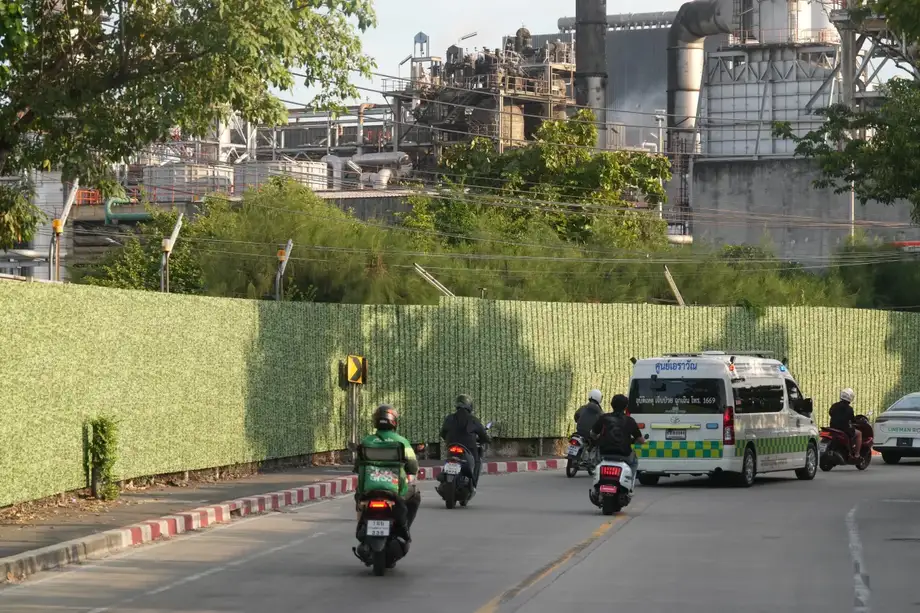
Flames could be seen from the port area at Khlong Toei, several kilometres away, and a condominium near the plant told residents to follow safety instructions. Video shared online showed schoolchildren being hurried out of the area. The Bang Na district office posted a warning telling people close to the Bangchak oil depot to leave immediately for their own safety, and asked drivers to stay off the road along the old railway line because emergency and fire vehicles were using it.
Bangchak Corporation's own emergency bulletin, the first it issued that day, put the start of the fire at about 14:45 at its Phra Khanong refinery. The company said it moved at once, shut down every production unit and brought the situation under control, with the flames out by 15:15. Radio traffic from the city's Rama emergency centre recorded the fire as calm at 15:29 and gave an early count of four people injured. That number rose as hospitals finished receiving casualties.
- 14:45: Bangchak later places the start of the fire at its Phra Khanong refinery.
- 14:51: The Phra Khanong fire and rescue station takes the call.
- 14:58: Bang Na fire crews arrive and ask for access to the site.
- About 15:00: A mobile phone alert tells residents to avoid the area.
- 15:15: Bangchak reports the fire extinguished after all units were shut down.
- 15:29: Rama radio reports the blaze under control and four injured.
- 17:30: The Pollution Control Department reports air readings within normal standards within three to four kilometres of the plant.
Nine People Hurt, Three of Them in Critical Condition
By evening, the Erawan Medical Center, the emergency medical service run by the Bangkok Metropolitan Administration, had recorded nine injured people, most of them with burns. Seven are men and two are women, all Thai nationals. Four were taken to Thai Nakarin Hospital, three to Ruamjai Raks Hospital, one to Synphaet Srinagarindra Hospital and one to Kluay Nam Tai Hospital.
Triage staff sorted the patients by urgency. Three are red cases, the most serious, with severe burn wounds, and two of those three were on ventilators under close medical supervision. Four are yellow cases needing urgent care and two are green cases with minor injuries. No deaths had been reported among the patients taken to hospital.
Public Health Minister Phakphum Ploenchit said his ministry would coordinate burns specialists and transfers to hospitals with the highest capacity as doctors see fit, and that it would keep watching for health effects from smoke and chemical exposure among people living around the plant.
I want to send my concern and encouragement to the injured and their families.
Patients who qualify as critical emergencies fall under UCEP, a state scheme that covers treatment costs for the first 72 hours. The ministry said it would link patients to their own insurance entitlements and to the relevant funds so that care can continue after that window, and that it would accept every transfer request.
What the Air Monitors Showed
The Pollution Control Department sent officials to assess air and water quality around the refinery, and Bangchak ran its own checks. The company says it has automatic ambient air quality monitoring stations, known as AQM stations, in the Phra Khanong, Bang Na and Bang Nam Phueng areas, and that these instruments measure air around the refinery continuously.
Bangchak said its readings found nothing unusual, and pointed to an independent check later in the afternoon. The department measured air quality within a radius of three to four kilometres of the refinery, the same band the company's stations cover, and confirmed the results were within normal standards.
It was found that the air quality in the surrounding area of the refinery is within normal standards.
Authorities still told residents they could go home but should be cautious about air pollution if they live within five kilometres of the facility, a wider zone than the area that had been measured at that point. Smoke from a fire at an oil plant can carry fine particles and chemical compounds, which is why health officials watch symptoms such as coughing and irritation in the days after such an event.
A Refinery That Sits Inside the City
The plant off Sukhumvit Road is listed at 120,000 barrels a day of refining capacity, which makes it the fifth biggest of Thailand's refineries and, according to the government's account, the only one built inside an urban area. A barrel of crude oil holds about 159 litres, so the site handles the equivalent of roughly 19 million litres of feedstock a day when running at full rate.
That location shapes the risk. The neighbourhoods around Soi Sukhumvit 62 hold schools, condominiums and busy roads, and a fire of any size puts smoke, traffic and emergency vehicles close to homes. The evacuation of students and the district office warning to clear the streets around the old railway line both followed from that geography. Officials in the area had to move people first and investigate later.
The Minister's Condition for Restarting
Energy Minister Akanat Promphan said the fire appeared to have started at one of the refinery units, roughly 100 metres from where the oil is stored. He said he would inspect the site himself to make sure there is no further danger, and set a plain test for whether the plant can go back to work.
If we're not a hundred percent certain that the oil storage is safe, we won't allow them to resume operations.
Bangchak has already stopped all production and said the cause of the fire is still being investigated. It has promised to tell the public about any progress. The plant's restart therefore depends on two things running in parallel, the company's own inquiry into what failed and the government's inspection of the storage area next to the damaged unit.
Why the Fuel Supply Is Not at Risk
Akanat said Thailand's oil supply should not be affected, because five other refineries operate in the country and this facility is not among the largest. The comment points to how refined fuel moves through the Thai market: several plants feed the same pipeline, truck and tanker networks, so one site going offline can be absorbed if the others can lift output.
Stopping production at a refinery is not a small step. Shutting down units means interrupting chemical processes that run hot and under pressure, and restarting them takes careful sequencing. That is why Bangchak's decision to halt every unit within minutes of the fire was as much a safety measure as an operational one.
The 2012 Fire and What It Cost
This is not the first serious incident at the site. An explosion and fire at the refinery in July 2012 damaged a nearby residential neighbourhood, and repairs to the facility took two weeks. Residents of the streets around Soi Sukhumvit 62 have lived with that memory, and Thursday's smoke, seen from as far away as the Khlong Toei port, brought it back.
What Is Still Unknown
No cause has been established. Bangchak has not said which part of the unit failed or when it expects the investigation to conclude, and the government has given no date for the minister's inspection or for a decision on restarting production. The Pollution Control Department had published readings for the band three to four kilometres from the plant by 17:30, and residents beyond that line who were told to watch for air pollution have no later figures yet. Hospital updates on the three critical patients, two of whom were on ventilators, will determine how the casualty picture develops.
Key Points
- A fire and explosion struck the Bangchak refinery off Soi Sukhumvit 62 in Bangkok's Phra Khanong district on Thursday, 26 November, starting at about 14:45.
- Bangchak shut down all production units and reported the fire out at 15:15; the Rama emergency centre recorded the blaze as calm at 15:29.
- Nine people were injured, seven men and two women, all Thai, with three in critical condition and two of those on ventilators, according to the Erawan Medical Center.
- Patients were split between Thai Nakarin, Ruamjai Raks, Synphaet Srinagarindra and Kluay Nam Tai hospitals; no deaths were reported.
- Residents within five kilometres were told to watch for air pollution, while the Pollution Control Department found readings within normal standards three to four kilometres from the plant at 17:30.
- Energy Minister Akanat Promphan said the fire started at a refinery unit about 100 metres from oil storage and that operations will not resume until the storage is confirmed safe.
- The refinery has a listed capacity of 120,000 barrels a day, is Thailand's fifth biggest and the only one in an urban area; five other refineries mean fuel supply should hold.
- A July 2012 explosion and fire at the same plant damaged a nearby residential neighbourhood and took two weeks to repair.