A market rout becomes a test of political responsibility
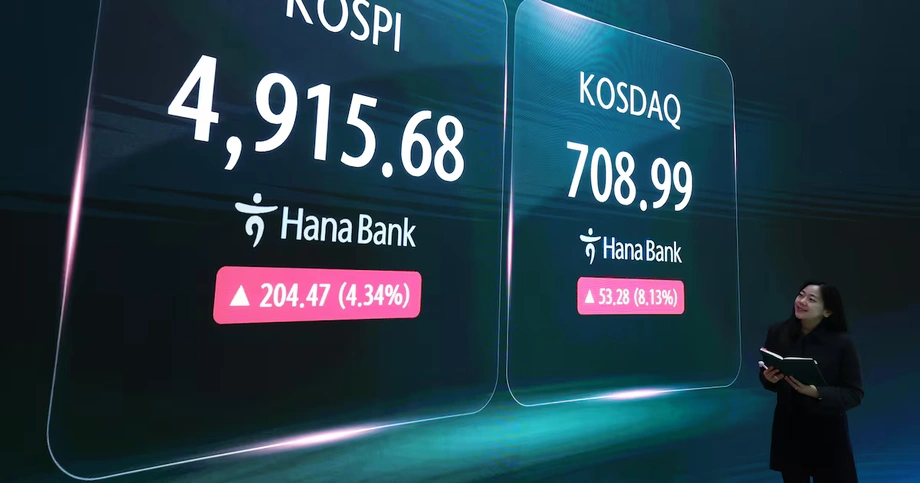
South Korea's KOSPI closed at 4,711.21 on Nov. 26, rising just 0.29% a day after a 6.16% collapse left it at 4,697.51. The modest recovery did little to repair the damage. The index stood 48.3% below its June peak of 9,114.55, meaning a market that had been presented as evidence of successful economic policy had lost almost half its value in five months.
Contents
- A market rout becomes a test of political responsibility
- From KOSPI mania to repeated breaks below 5,000
- Why small investors say they were encouraged into the fire
- Warnings, faster approvals and rules tightened after the fall
- Global AI fears hit a market concentrated in two chipmakers
- Emergency measures face a simple problem of scale
- The fight over who claimed credit for the rally
- Household losses widen the pressure for economic answers
- Key Points
The break below 5,000 has become a political reckoning because that number was never just a trading milestone. President Lee Jae Myung had made KOSPI 5,000 a national objective, while his administration encouraged household investment, allowed leveraged exchange traded funds tied to individual stocks and increased the National Pension Service's target for domestic shares. With prices now falling, opponents say the presidential office has pointed toward American technology stocks instead of accepting responsibility for decisions made in Seoul.
The People Power Party is leading the attack, but the discomfort reaches beyond ordinary party conflict. The Democratic Party's own capital market committee warned about the products before the worst losses, and market specialists are asking why a president who claimed confidence in his policies helped drive the rally should escape blame when the market falls. Lee's earlier declaration that a broken stock market was entirely the government's fault has given that argument added force.
From KOSPI mania to repeated breaks below 5,000
The collapse unfolded through several violent stages rather than one isolated bad session. July supplied an early warning about magnified trading and crowded semiconductor investments, while November brought a broader reassessment of artificial intelligence spending, interest rates and foreign demand for Korean shares.
- Late May and June: Leveraged ETFs tied to one stock entered the market, and individual investors put approximately 78 trillion won into the KOSPI during May and June.
- July: The index fell 22%, its largest monthly decline since the global financial crisis, and trading was halted four times. Individuals recorded net sales of 8.284 trillion won, a KOSPI record, even as the index surged 18% on the final day of the month. A separate 10% fall on Black Tuesday was followed by two consecutive sessions in which the index traded below 6,000.
- Early November: The KOSPI fell as much as 8.8% in one session, taking its decline from recent highs to nearly 15%, despite still being up more than 70% for 2026. Foreign investors had sold more than $10 billion of KOSPI shares during the previous week, and the won reached its weakest level against the dollar since March 2009.
- Nov. 17: The index closed at 4,968.48, down 132.02 points, or 2.59%. It was a fourth consecutive daily decline and the lowest level in more than nine months.
- Nov. 20: A fall of 267.93 points, or 5.21%, left the KOSPI at 4,869.96. That was 46.6% below the June peak and the lowest close since Jan. 16, when it finished at 4,840.74.
- Nov. 24 and 25: A 6.32% rebound restored the 5,000 level for one day. The index then surrendered those gains, closing at 4,697.51 after a sell sidecar suspended program sell quotations for five minutes just eight minutes after the market opened.
A sidecar is a temporary restraint on program trading, intended to slow a surge of automated orders. The Nov. 25 intervention was the KOSPI's 62nd sidecar of the year and its 33rd on the selling side. Across the KOSPI and KOSDAQ, such curbs have been activated more than 100 times this year.
Why small investors say they were encouraged into the fire
A conventional ETF spreads money across a basket of assets. The products introduced in May instead used derivatives to magnify movements in one company's shares. That structure can produce rapid gains during a rally, but it can also erase capital quickly. Investors using borrowed money face a margin call when their collateral becomes insufficient, requiring them to provide more cash or accept a forced sale.
The government presented the products as a way to expand investment choices and keep Korean money from moving overseas. Many buyers were already chasing Samsung Electronics and SK hynix because of the artificial intelligence boom, while fear of missing out encouraged others to enter after prices had risen sharply.
Kim Han-kyung, a Seoul investor in his 30s who bought Korean shares for the first time in May, described how that enthusiasm turned into fear.
I first invested in Korean stocks in May this year and was completely swept up in the frenzy. Now, honestly, I'm scared. I've set two rules in my mind: first, never invest in the Korean stock market again; second, stick to the first rule.
Lee Jung-min, who borrowed 50 million won against an apartment to invest, said the government had "poured gasoline on the fire" and turned the stock market into a casino. Chung Eui-jeong, head of the Korean Individual Investors Association, said investor anger and criticism of the government had reached their peak. Their reactions help explain why a price rebound alone may not bring household money back.
Warnings, faster approvals and rules tightened after the fall
People Power Party Chief Spokesperson Choi Bo-yun said the Financial Supervisory Service completed its review of the leveraged products in 29 days, compared with an average of 62 days, to meet the listing schedule announced by the Financial Services Commission. She said risk warnings reached investors only two days before sales began. Citing supervisory data, Choi put retail losses from the products at 6.3 trillion won in less than three months, including 2.3 trillion won in confirmed losses.
A separate decision involved retirement savings. On May 28, one day after the leveraged ETF listing and six days before local elections, the national pension fund management committee raised its domestic equity target to 20.8%. Choi called the timing too close to be dismissed as a coincidence and demanded the committee's minutes, documents from the product approval process and the underlying risk assessments.
Concern was not confined to the opposition. Democratic Party Representative Oh Ki-hyung, chair of its Korea Premium K-Capital Market Special Committee, said after a July 27 meeting that the term ETF might be inappropriate for products with such risky derivative characteristics. He said the party was prepared to pursue legal amendments if necessary.
At a July 29 session of the National Assembly Political Affairs Committee, Financial Services Commission Chairman Lee Eog-won announced that a higher cash deposit requirement would take effect on July 31, earlier than planned.
The plan to strengthen the cash deposit requirement to 30 million won will be implemented earlier than scheduled, starting on the 31st, along with improvements to the minimum trading unit.
New listings had already been suspended temporarily in the middle of July. Authorities also promised stronger management duties for securities companies and asset managers, together with better investor education, during August. Choi additionally said a private January meeting chaired by then Policy Chief Kim Yong-beom, identified as the starting point for the products, left no minutes. Kim has since stepped down, but the opposition says no one has accepted responsibility.
Global AI fears hit a market concentrated in two chipmakers
The immediate trigger for the Nov. 25 collapse came from New York. Nvidia fell 5.86%, AMD lost 8.86% and Micron dropped 11.01%, while the Philadelphia Semiconductor Index plunged 7.88%. The S&P 500 declined 0.5% and the Nasdaq Composite fell 1.48%, but the Dow Jones Industrial Average rose 0.85% as money moved into other industries.
South Korea had far less protection from that kind of rotation. Samsung Electronics and SK hynix had together accounted for more than half of KOSPI market capitalization during the rally. On Nov. 25, Samsung fell 9.87% and SK hynix dropped 11.05%. Samsung's market value fell to approximately 998 trillion won, below 1,000 trillion won for the first time in about eight months. Taiwan's main index declined 4.8% and Japan's Nikkei fell 2.78%, both substantial drops but smaller than Korea's 6.16% fall.
The two Korean companies supply memory chips, including high bandwidth memory used in AI computing. Unlike companies that design AI processors, memory suppliers are especially exposed to fears that too much production capacity will create a glut. BNP Paribas warned that memory prices could fall 20% in 2028 because of excess supply and cut its Micron price target from $1,700 to $775.
Rolf Bueh, head of semiconductor and infrastructure research at Futurum Group, said Jensen Huang's return at Nvidia had not resolved concerns about continuing AI demand, financing for data centers or access to sufficient electricity. Seok Byeong-hoon, an economics professor at Ewha Womans University, argued that the circumstances surrounding Huang's return had instead increased policy uncertainty, including the possibility of tighter American restrictions on semiconductor exports to China.
Kim Yong-beom offered a broader official explanation on July 28, citing China's narrowing competitive gap in semiconductors and skepticism about global AI demand. He also said Korea's large retail investor base, widespread derivatives use and concentration in Samsung and SK hynix made the market structurally vulnerable. Those factors explain why an American technology selloff can become a much larger national market event in Seoul.
Emergency measures face a simple problem of scale
The government is preparing to expand the Securities Market Stabilization Fund, a pool of money supplied by financial companies to buy shares during severe market stress. Korea Development Bank has asked major securities firms, banks and insurers how much they could contribute beyond commitments made in 2020. The existing fund totals about 10.76 trillion won and has not been deployed for market intervention since the 2008 global financial crisis.
Its size illustrates the difficulty. The fund equals roughly 0.3% of the stock market's 3,840 trillion won capitalization and is comparable with recent average daily trading value of about 15 trillion won. A larger pool could reassure frightened investors, but it would still be entering a market where foreign investors have recorded net sales exceeding 255 trillion won this year.
Lee Hyo-seop, a senior research fellow at the Korea Capital Market Institute, examined five occasions since 1990 when such a fund was created or reactivated. He said a clear rebound in share prices had not been confirmed. Authorities are also preparing three months of closer monitoring for illegal short selling and an easing of daily limits on listed company share repurchases. Enforcing short selling rules may improve transparency, while buybacks can support individual companies, but neither step creates enough demand on its own to reverse a national selloff.
Household cash is also less abundant. Investor deposits have fallen from more than 120 trillion won in June to about 90 trillion won. The National Pension Service, which supported prices by maintaining a larger domestic share allocation during the rally, now faces pressure to reduce holdings after a grace period expired. No date has been announced for deploying an expanded stabilization fund or for deciding its final size.
The fight over who claimed credit for the rally
President Lee said at a June news conference marking his first year in office that he had expected the KOSPI to reach 5,000 in two or three years, only for it to pass that level within six months. He attributed the speed to confidence, while also acknowledging that the semiconductor boom had added another 2,000 to 3,000 points.
Park Sung-hoon, the People Power Party's chief spokesperson, said on Nov. 21 that the administration and Democratic Party had touted rising prices during elections and then abandoned the market when it collapsed. He accused them of an unprecedented political hit and run and demanded an investigation into policy failures, including the use of the national pension fund, followed by concrete stabilization measures.
More fatal than the stock market crash is the collapse of trust in the government. Even if the market rebounds, shattered trust will not be easily restored.
Choi Bo-yun returned to the same argument the next day. She recalled Lee's campaign YouTube broadcast telling viewers that he was in the same boat as 14 million retail investors and contrasted that message with the margin calls that followed the crash.
He was the captain on the way up and a passenger on the way down.
Choi also criticized Lee's remark at a Nov. 13 capital market symposium: "If the valley is deep, won't the mountain be high again?" To opponents, the phrase sounded like optimism without a plan. The PPP has threatened parliamentary investigations and a special prosecutor, although those steps remain political demands rather than agreed proceedings.
Kim Tae-kyu, the party's floor leader spokesperson, later revived Lee's words from two years earlier, when Lee led the Democratic Party: "The causes of the stock market's breakdown are clear. It is all the government's fault." Kim asked who should bear responsibility under that standard now.
Household losses widen the pressure for economic answers
Estimates put the market value erased since the June peak at roughly 3,500 trillion won, equivalent to $2.63 trillion. Citigroup separately estimated household stock valuation losses at 563 trillion won for the second half of 2026. Those figures measure broad declines in paper wealth, unlike the 6.3 trillion won that Choi attributed specifically to losses involving the new leveraged products.
The PPP has also contrasted those losses with Lee's personal finances. Kim Tae-kyu said asset disclosures released in March showed the president's wealth rising by 1.888 billion won in one year to 4.977 billion won, while a KOSPI ETF held by Lee returned 26.4% last year. Kim argued that a president's priority should be household living standards rather than his own assets.
The opposition statement placed the crash beside other pressures: Seoul apartment prices rising for 94 consecutive weeks, three Bank of Korea benchmark rate increases this year and a youth employment rate of 42.9% after 30 consecutive monthly declines. The number of employed young people was down 196,000 from a year earlier. For families facing interest payments, housing costs and weak job prospects, stock losses can reduce spending and make retirement planning more uncertain.
Lee's response at the Korea Exchange in the middle of November focused on the long-standing undervaluation of Korean companies. He called it unreasonable for shares to be worth less simply because the businesses were Korean and identified stock manipulation, abuse of management control by dominant shareholders, duplicate listings and deliberate price suppression to reduce inheritance and gift taxes as threats to confidence.
The Democratic Party's K-Capital Market Special Committee, formerly the KOSPI 5000 Special Committee, is now promising faster institutional changes, including a stock price suppression prevention bill that would amend inheritance and gift tax law. The immediate test for the administration is whether those reforms, tighter product rules and possible stabilization funding can restore participation without again encouraging households to treat rising prices as a government guarantee.
Key Points
- The KOSPI closed at 4,711.21 on Nov. 26, approximately 48.3% below its June peak of 9,114.55.
- The index first closed at 4,968.48 on Nov. 17, then fell to 4,869.96 during the Nov. 20 Black Friday selloff.
- A one-day recovery above 5,000 was erased on Nov. 25, when the KOSPI dropped 6.16% to 4,697.51.
- Individual investors invested about 78 trillion won in May and June, then recorded net sales of 8.284 trillion won during July's 22% monthly decline.
- Opposition lawmakers blame the rapid introduction of leveraged ETFs and a higher domestic equity target for the national pension fund.
- Global AI concerns triggered the latest selling, but concentration in Samsung Electronics and SK hynix magnified the Korean decline.
- The proposed expansion of the 10.76 trillion won stabilization fund faces doubts because it represents only about 0.3% of total market capitalization.
- President Lee is promoting governance and tax reforms, while the opposition demands document releases, accountability, a parliamentary investigation and a special prosecutor.