A record payout meets a relieved market
Samsung Electronics paid 30.003 trillion won ($22.37 billion) in cash dividends on Nov. 27, 2026, the largest single dividend by a South Korean company. Shareholders received 4,601 won for each common or preferred share held on the Sept. 30 record date. The payment combined the regular quarterly dividend with a special distribution.
Contents
- A record payout meets a relieved market
- Who receives the money?
- The earnings behind the cash
- How much more will Samsung return?
- Why did the Kospi and Kosdaq surge?
- Robots, biotechnology and batteries join the rally
- What could the stabilization fund do?
- Will the dividend cash return to equities?
- Why currency traders are watching the foreign share
- The dates that matter next
- A data breach and higher property tax bills
- Key Points
The cash arrived on a dramatic day for Korean markets. The Kospi closed at 4,915.68, up 204.47 points or 4.34%, while the Kosdaq jumped 53.28 points or 8.13% to 708.99. The main index recovered the 4,900 level in three trading sessions, and the Kosdaq closed above 700 for the first time in 12 sessions.
The dividend was 12.3 times the 374 won paid for each share in the second quarter. It was also 2.7 times Samsung's entire 2025 dividend of 11.1079 trillion won and more than double the roughly 13.1 trillion won distributed with a special dividend in April 2021. Even so, Samsung and SK hynix entered the payment week trading more than 50% below their June peaks, making the destination of the cash especially important.
Who receives the money?
An investor with 100 Samsung shares had a gross dividend of 460,100 won. After the standard 15.4% withholding for dividend tax and related charges, the payment was approximately 389,200 won. A holder of 1,000 shares received about 3.892 million won, although individual tax circumstances can change the final amount. Domestic individuals held 17% of Samsung's common shares and 22% of its preferred shares at the end of September, and their combined dividend was estimated at more than 5 trillion won before tax.
Samsung Electronics Chairman Lee Jae-yong received approximately 448.8 billion won before tax. His eligible holdings on Sept. 30 were 97,414,196 common shares and 137,757 preferred shares. Another 18,825,100 shares purchased or received as gifts from his mother, Hong Ra-hee, honorary director of the Leeum Museum of Art, were acquired after the record date and did not qualify for this payment.
Those additional shares increase Lee's holdings eligible for future dividends to 116,377,053 shares, including preferred stock. If the fourth quarter dividend remained at 4,601 won, his payment would be about 535.5 billion won and his receipts for 2026 would reach approximately 1.0571 trillion won. That calculation illustrates the effect of an unchanged dividend; the board has not set the fourth quarter amount.
Foreign shareholders were estimated to receive 15.2858 trillion won, or 50.9% of the total. Korea Exchange holdings data showed that they owned about 2.71665 billion common shares and 605.62 million preferred shares on the record date. SK hynix is preparing a separate dividend of 20,000 won for each common share, totaling about 14.1 trillion won, taking the two chip companies' combined distributions beyond 44 trillion won.
The earnings behind the cash
Samsung's third quarter results, announced on Oct. 29, explain the scale of the payout. Consolidated revenue reached 195.3 trillion won for the quarter ended Sept. 30, up 14% from the previous quarter and another quarterly record. Operating profit was 107.4 trillion won. Samsung said this made it the first technology company to exceed 100 trillion won in quarterly operating profit.
The Device Solutions division, which covers semiconductors, produced 147.1 trillion won of revenue and 106.5 trillion won of operating profit. Its memory business set records for revenue and profit by concentrating on products for artificial intelligence, increasing sales of HBM4 memory and server solid state drives during capacity constraints. Strong server demand also raised prices across memory applications.
The results were much weaker outside chips. The Device eXperience division recorded an operating loss of 800 billion won despite an 8% revenue increase from the previous quarter. Mobile and network businesses posted combined revenue of 37.7 trillion won and a loss of 600 billion won. Visual display and appliances reported revenue of 13.9 trillion won and a loss of 200 billion won. Samsung Display earned 1.1 trillion won on revenue of 8 trillion won, while Harman's earnings improved with audio and automotive sales and refunds of United States tariffs.
Samsung expects investment in AI infrastructure to continue through the fourth quarter and reach a historic level in 2027. It plans to increase sales of high bandwidth memory, server DRAM, DDR5 products and solid state drives using QLC technology, which stores more data in each memory cell. Its foundry business also reported orders centered on 2 nanometer chips for computing customers and expects its new factory in Taylor, Texas, to begin operating in 2027.
Profit growth at both major chipmakers has been extraordinary. Samsung's net profit for the first nine months of 2026 was 193.6 trillion won, compared with 25.57 trillion won a year earlier. SK hynix reported 174 trillion won, up from 27.7 trillion won. Samsung's consolidated dividend payout ratio, meaning dividends as a share of earnings, rose to 18% at the end of September from 4.1% at the end of June. SK hynix's ratio increased to 8.4% from 0.4%.
How much more will Samsung return?
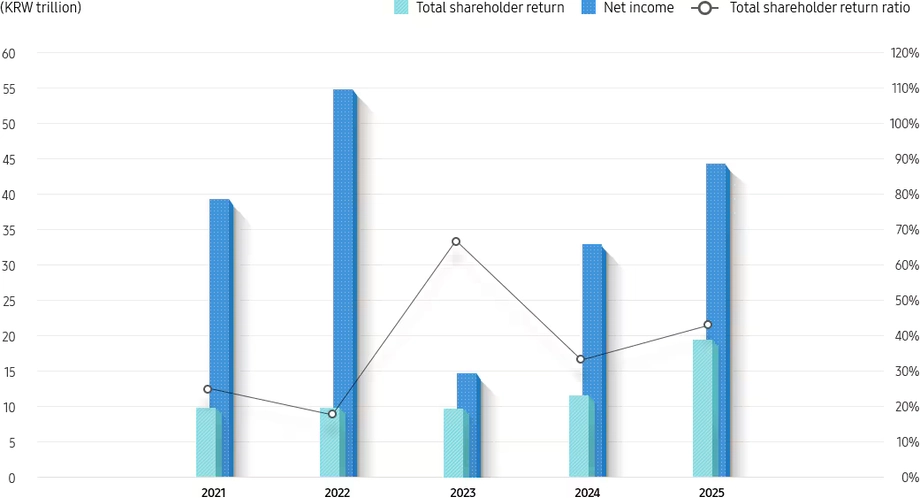
Samsung's shareholder return policy for 2024 to 2026 calls for a regular annual dividend of 9.8 trillion won and total shareholder returns equal to 50% of free cash flow. Free cash flow is the money left after a company funds its operations and investment. The board maintained the main terms of the previous three year program when it announced the current framework in January 2024.
For 2026 alone, Samsung estimates total shareholder returns at 90 trillion to 110 trillion won. About 35 trillion won had already been planned or completed, leaving 55 trillion to 75 trillion won. The company said the remainder would include cash dividends and a substantial program to repurchase and cancel shares. Cancelling repurchased stock reduces the number of shares outstanding, giving each remaining share a larger claim on future earnings.
Samsung also acknowledged investor interest in the price difference between its common and preferred shares. It said market conditions would guide the proportion of preferred stock included in the repurchase and cancellation program. The final 2026 amount, the execution plan and the next shareholder return policy are scheduled for a board meeting in late January 2027, followed by an announcement.
Investment will remain substantial alongside these distributions. Third quarter capital expenditure reached 29 trillion won, including 27.2 trillion won at Device Solutions and 1.1 trillion won at Samsung Display. Spending from January through September totaled 56.9 trillion won. Samsung expects approximately 84.4 trillion won for the full year, with 76.8 trillion won directed to Device Solutions for factories and infrastructure serving demand from AI and high performance computing.
Why did the Kospi and Kosdaq surge?
The Kospi began Nov. 27 at 4,728.80, slipped to 4,682.43 around 9:30 a.m., and then reversed as bargain buying entered the market. It touched 4,922.94 before closing near its high. Advancing shares outnumbered decliners by 782 to 109, with 16 unchanged. On the Kosdaq, 1,540 stocks rose, including 12 at their daily upper limits, while 141 fell and 47 were unchanged.
Foreign investors bought a net 1.1298 trillion won on the main board, their first purchase above 1 trillion won in about two months. Institutions bought approximately 237 billion won, including 288.3 billion won from pension funds, while individuals sold a net 1.77 trillion won. On the Kosdaq, foreigners purchased about 303 billion won and institutions bought 586.6 billion won. Individual investors sold another 884.2 billion won there.
Samsung Electronics closed 4.55% higher at 179,100 won after falling as low as 169,000 won early in the session. Foreign investors bought a net 442.4 billion won of its shares. SK hynix gained 5.41% to 1.11 million won despite trading without rights to its latest dividend for the first time. Foreign purchases of that stock reached 378.3 billion won.
Samsung SDI rose 8.25%, Samsung C&T gained 5.50%, SK Square added 5.37%, and Samsung Life Insurance advanced 5.13%. Mirae Asset Securities surged 15.87% on expectations surrounding the stabilization fund and higher trading activity. Shinhan Financial Group and KB Financial Group moved lower as investors considered the possible capital burden of additional fund commitments.
The external setting also helped. With New York markets closed for Thanksgiving, Nasdaq 100 futures rose about 2%. Nvidia and Japan's Kioxia demonstrated technology using solid state drives to expand graphics processor memory capacity to petabyte scale, supporting sentiment toward memory companies. Expectations that some Samsung dividends would be reinvested added another source of optimism.
Robots, biotechnology and batteries join the rally
The Kosdaq's rise was its steepest percentage gain since an 11.63% advance on July 31. A buy sidecar was triggered shortly after 10:20 a.m. when futures and spot prices surged. This mechanism temporarily suspended program buy orders for five minutes, giving the market a brief pause. It was the 23rd Kosdaq buy sidecar of 2026.
Robot shares benefited from expectations that Samsung will present its first humanoid robot developed internally at CES 2027 in Las Vegas. Rainbow Robotics, a Samsung subsidiary, closed 13.70% higher at 531,000 won. Robotis gained 7.84% to 302,500 won after partner Pollen Robotics began mass production of its Microduck robot. Mirae Asset Securities projected that the number of robots operated by Samsung's Device Solutions division could rise from about 100 in 2026 to more than 10,000 by 2030.
Biotechnology stocks had company specific catalysts. Alteogen rose 9.40% after receiving a technology payment of 53.8 billion won, approximately $40 million, connected to a subcutaneous formulation of the cancer drug Keytruda. Peptron jumped 15.66% after signing a technology evaluation agreement with Ferring. Battery companies EcoPro and EcoPro BM advanced 13.91% and 13.44%, respectively, as expectations grew for energy storage demand.
Baek Jun-ki, an analyst at NH Investment & Securities, connected the broader rally to depressed prices, seasonal events and changing fund flows.
CES and major biotech conferences are clustered around the end of the year and the start of the new year, which tends to lift interest in small- and mid-cap growth stocks. With share prices already low, seasonal factors added on top, and fund flows showed a recovery.
What could the stabilization fund do?
Authorities began preparing on Nov. 24 for possible activation of the stock market stabilization fund. The existing facility is commonly described as a 10 trillion won fund, while detailed discussions put commitments at 10.76 trillion won. Officials were reviewing an expansion to between 20 trillion and 40 trillion won and whether managers should begin buying shares.
An emergency investment management committee meeting was scheduled for Nov. 29. Financial Services Commission Chairman Lee Eog-weon was then expected to meet the heads of Korea's five largest financial groups and Korea Development Bank on Nov. 30 to assess additional contributions. Exchange traded funds following the Kospi 200 and Kosdaq 150 were considered likely purchase vehicles. No final purchase amount or start date had been announced by the close on Nov. 27.
Finance Minister Lee Hyoung-il separately met Bank of Korea Governor Shin Hyun-song, FSC Chairman Lee and Financial Supervisory Service Governor Lee Chan-jin on Nov. 27. Their review found no unusual developments in trading volumes or outstanding balances. Authorities said they remained ready to respond as uncertainty about the global AI industry continued to feed volatility.
The FSC and FSS had already changed financial rules in their December 2024 stability measures. For insurers purchasing the stabilization fund, the amount counted toward risk exposure in their Korea Insurance Capital Standard ratios was reduced from the full contribution to half. The package also postponed a new stress capital buffer for banks until the second half of 2025 and excluded certain foreign exchange positions, such as investments in overseas branches, from calculations of currency risk.
Other changes allowed variable capital charges for some technology and venture investment funds instead of a blanket 400% risk weight. Businesses were also permitted to use ratings from overseas credit assessment institutions, while the treatment of nonfinancial holding companies was revised. The regulators said regulatory upgrades would be completed by the first quarter of 2025. Those measures expanded financial companies' capacity; the current meetings concern the fund's size and actual operation.
If stock purchases begin, it would be the first intervention of this kind since the 2008 global financial crisis. The Korea Capital Market Institute offered a cautionary comparison: Taiwan's market rose 10.01% in the first week after activation of its National Financial Stabilization Fund was approved on Nov. 6, but had surrendered that gain by Nov. 25 as foreign selling continued.
Lee Hyo-seop, a senior research fellow at the institute, argued that execution criteria should reflect whether trading is functioning properly rather than the size of an index decline. Han Ji-young, an analyst at Kiwoom Securities, said the fund might mainly reduce volatility in the near term unless concerns ease about delayed revenue at AI companies and reductions in capital spending.
Will the dividend cash return to equities?
A holder of 1,000 Samsung shares received enough after standard tax to buy 22 common shares at the Nov. 26 closing price of 171,300 won. Such purchases could lower an investor's average acquisition cost after the steep decline. Other recipients may choose different large companies or exchange traded funds that follow an index, spreading demand beyond semiconductors.
Previous payment dates show why the outcome is uncertain. Across 23 Samsung dividend payments from April 2021 through August 2026, investor deposits increased on 19 occasions, by an average of about 604 billion won on the payment day. Samsung's share price rose on only 10 of those days and was higher five sessions later in just nine cases.
On April 16, 2021, when approximately 13.1 trillion won was distributed, investor deposits increased by about 1.35 trillion won but Samsung shares fell 0.24%. On April 17, 2026, deposits rose by roughly 1.51 trillion won after a 3.8 trillion won payment, while the stock declined 0.69%. The direction of foreign buying or selling matched the direction of Samsung's share price on 18 of 22 comparable payment days, or 81.8%.
Foreign investors had sold approximately 3.4 trillion won of Samsung stock earlier in November through Nov. 26. Their combined net sales of Samsung and SK hynix exceeded 11.3 trillion won. Reinvested dividends could therefore finance new purchases, absorb continuing sales or simply leave investors with cash.
Why currency traders are watching the foreign share
Foreign shareholders can keep their Samsung stock while converting only their dividends into dollars for transfer abroad. That route directly affects currency trading rather than equity ownership. Lee Min-hyuk, an economist at KB Kookmin Bank, estimated from past remittance patterns that foreign Samsung shareholders could send about $5 billion overseas.
Kim Jin-wook, an economist at Citibank Korea, estimated that 70% to 90% of approximately 18.7 trillion won in dividends after tax for foreign shareholders of Samsung and SK hynix could be remitted abroad. The Korea Center for International Finance calculated that dividends paid to foreigners by Korean listed companies on Nov. 27 equaled about 65% of average daily spot currency turnover. Chip companies selling dollars to assemble their dividend funds can provide an offsetting supply.
The won nevertheless strengthened on Nov. 27. The exchange rate closed at 1,337.9 won per dollar, down 4.8 won from the previous session, as appetite for risk recovered and exporters sold dollars near the end of the month.
The dates that matter next
The payment, earnings and policy decisions span several months. These are the principal dates for investors and market authorities:
- January 2024: Samsung maintained the main terms of its shareholder return program covering 2024 through 2026.
- Sept. 30, 2026: Shareholders on Samsung's register secured rights to the third quarter dividend.
- Oct. 29: Samsung announced revenue of 195.3 trillion won and operating profit of 107.4 trillion won.
- Nov. 24: Authorities began preparations for possible activation of the stabilization fund.
- Nov. 27: Samsung paid its dividend, senior financial officials met, and the Kospi and Kosdaq closed sharply higher.
- Nov. 29 and Nov. 30: Emergency fund and market stability meetings were scheduled. Nov. 30 is also SK hynix's dividend record date.
- Within one month of Nov. 30: SK hynix's roughly 14.1 trillion won dividend is due for payment. An early market schedule listed Nov. 29, while a later schedule listed Dec. 29.
- Late January 2027: Samsung's board is expected to decide the remaining 2026 returns and announce the policy applying from 2027.
A data breach and higher property tax bills
A separate corporate incident involved CJ Olive Young. A hack of its work systems exposed personal information belonging to 790 people, including employees and customers. The type of information, the date of the intrusion and the breakdown between employees and customers were not given, leaving the full scope unclear.
Seoul's housing price surge is also affecting household finances. The number of owners of one home required to pay the comprehensive real estate holding tax increased 53% from the previous year, while the average tax amount rose 42%. This national tax applies when property holdings exceed set thresholds, so rising values can bring additional owners into the system as well as increase bills for existing taxpayers. A citywide taxpayer total and the average bill in won were not provided.
Key Points
- Samsung Electronics paid a record 30.003 trillion won on Nov. 27, or 4,601 won for each common and preferred share.
- A holder of 100 shares received about 389,200 won after standard withholding; Chairman Lee Jae-yong received approximately 448.8 billion won before tax.
- Samsung's third quarter revenue was 195.3 trillion won and operating profit was 107.4 trillion won, driven overwhelmingly by semiconductors.
- Between 55 trillion and 75 trillion won of 2026 shareholder returns remains to be allocated, with a board decision expected in late January 2027.
- The Kospi closed 4.34% higher at 4,915.68, while the Kosdaq jumped 8.13% to 708.99 as foreign and institutional investors bought heavily.
- Officials discussed expanding the stabilization fund to 20 trillion to 40 trillion won, but no final purchase schedule had been announced.
- Foreign investors received an estimated 50.9% of Samsung's dividend, making reinvestment in Korean assets and conversion into dollars important market variables.
- SK hynix plans a separate dividend of about 14.1 trillion won, taking combined distributions by the two chip companies beyond 44 trillion won.