Exams Under Pressure as AI Cheating Cases Surge
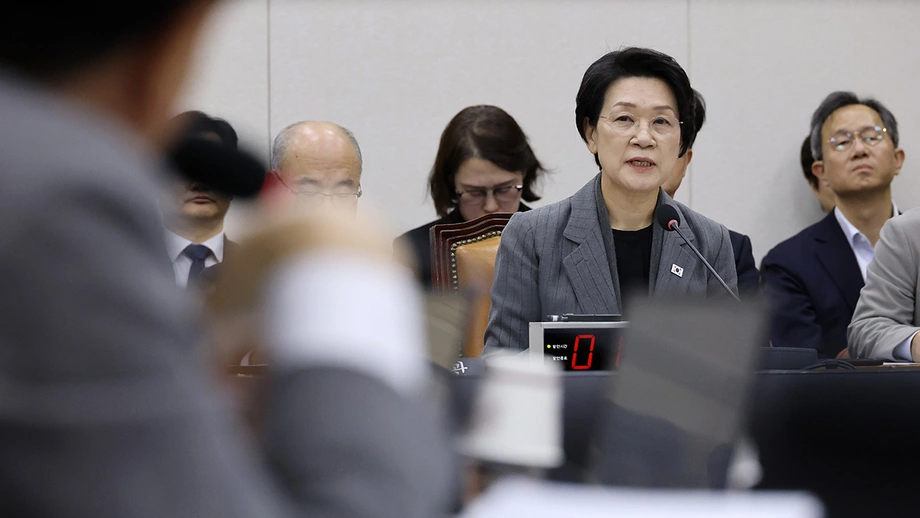
On Friday, Nov. 27, 2026, Acting Education Minister Choi Eun-ok told the National Assembly's Education Committee that technology to detect smart glasses has been developed and is entering commercialization. Radio frequency detectors already exist, she said, but exam ready versions still need to be prepared for next year's College Scholastic Ability Test, or CSAT, known as Suneung. The announcement came after a month in which artificial intelligence, tiny cameras and ordinary phones forced South Korea to rethink how it protects its most consequential exams.
Contents
- Exams Under Pressure as AI Cheating Cases Surge
- What the Committee Heard About Detection
- The Confession That Changed the Exam Season
- Key Dates in a Fast Moving Dispute
- How Exam Halls Became Security Zones
- Why the Tally Rose During the Crackdown
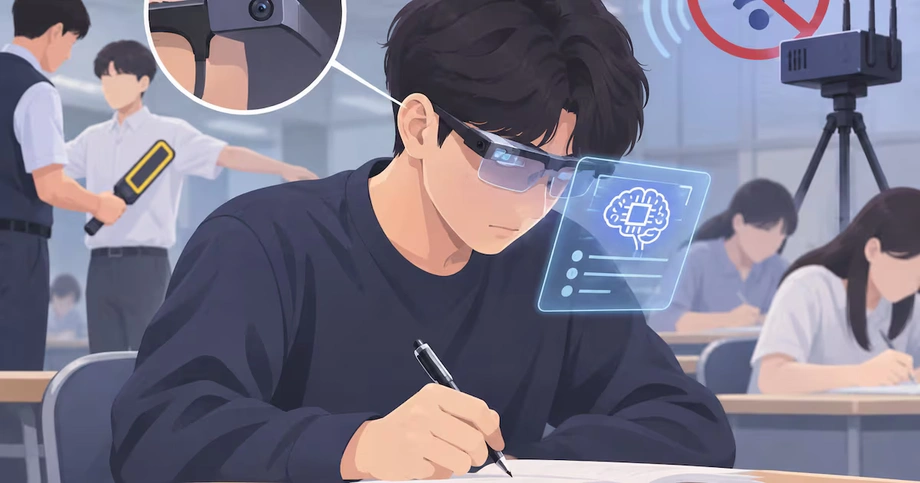
- What Smart Glasses Can Do and Why Detectors Are Difficult
- A Minister Resigns as Lawmakers Demand Safeguards
- Universities Face the Same Scrutiny
- Beyond the CSAT, a Wider Exam Security Push
- Key Points
The ministry's figures show why the pressure built so quickly. As of Wednesday, Nov. 25, 474 misconduct cases had been recorded in this year's CSAT, up 69.9 percent from 279 a year earlier. Smart device cases rose from 31 to 112, nearly a quarter of all violations. Choi also said the ministry would align the paper retention period for university essay and interview tests with the CSAT period and would find technical alternatives to reduce the supervision burden on teachers during high school internal exams.
What the Committee Heard About Detection
Radio frequency detection means looking for signals sent by a phone or a pair of smart glasses when Bluetooth or Wi-Fi is active. Choi said detectors are available, but officials need equipment suited to crowded exam halls. The ministry also plans to screen students at entrances with metal detectors, then use radio frequency devices inside test sites. It estimated that regional and district education offices would need about 40 billion won for such equipment.
Some cheating tools can work without a network connection. Software that runs on the glasses or phone itself can answer questions without sending data to a remote server, so the Education Ministry is consulting the Ministry of Science and ICT on ways to detect that form of cheating. Officials also discussed disabling public Wi-Fi at test sites. A full rollout date for the detectors was not given.
The Confession That Changed the Exam Season
The crisis sharpened on Nov. 15, when Han Won-seok, a 34 year old test taker who had scored at the top of the tax accountant exams taken in April and July, published a video confession. He said he used a miniature camera, a phone and generative AI, software that can produce answers from prompts, to solve questions. He told Seoul police about the fraud in a written confession.
In the video, Han said he wanted other students to understand that investigators would follow the evidence.
I cheated using electronic devices and generative AI. My passing the exam with the top score was not the result of fair effort.
Prime Minister Han Seong-sook called an emergency meeting and ordered the Education Ministry to require test takers to hand over smart devices before exams. The prime minister sought to invalidate Han's results and bar him from national exams. Education Minister Choi Kyo-jin told parliament that cheating with smart devices could bring criminal punishment. In July, smart glasses had already been banned from exams, and officials were seeking to extend the one year exam ban for smart device cheating to three years.
Key Dates in a Fast Moving Dispute
The sequence helps explain why rules changed so close to the exam and why students and test centers struggled to keep pace.
- July: Education authorities banned smart glasses from exams and planned one dedicated anti cheating staff member for each of 1,312 CSAT test sites.
- October: Three students were caught using smart glasses during tests at universities in Seoul.
- Nov. 15: Han Won-seok published the video confession about the tax accountant exam.
- Nov. 19: The CSAT was held for more than 550,000 test takers under tightened security.
- Nov. 22 and Nov. 23: Education Minister Choi Kyo-jin resigned, President Lee Jae Myung accepted the resignation, and the ministry filed criminal complaints against six test takers.
- Nov. 25: The ministry counted 474 misconduct cases, including 112 involving smart devices.
- Nov. 27: Acting Education Minister Choi Eun-ok told the National Assembly committee that detection technology was entering commercialization.
The late stage changes meant students learned some rules only days or hours before they had to follow them.
How Exam Halls Became Security Zones
Education Minister Choi Kyo-jin, speaking before the exam as the minister responsible for CSAT preparations, promised a close check of eyewear.
a thorough inspection of all glasses in each test session to ensure a fair and safe testing environment
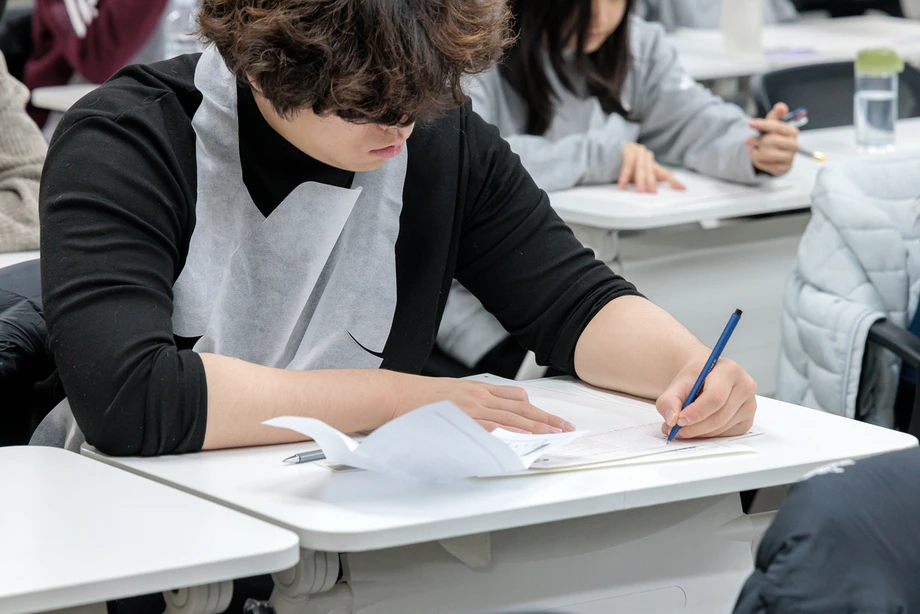
Smart glasses were added to the prohibited list. Two days before the CSAT, the ministry announced 8,400 extra personnel, including about 1,800 focused on smart device detection and 6,600 hallway proctors. Test takers had to cover clothing buttons with stickers. A day before the exam, authorities also barred students from bringing their own computer readable marking pens, correction tape, erasers and mechanical pencil lead. Some sites used disposable gowns or aprons to block hidden cameras.
The CSAT is treated as an eight hour test, though the full school day with breaks runs close to 10 hours. It shapes university access and social standing in South Korea, so flights are stopped during the half hour English listening section and drivers are asked not to honk. This year, the government used the national disaster alert system three times on exam day. One alert had been announced beforehand, while two came without warning.
The alerts went over the highest priority protocol. They overrode volume controls and worked even without an active data connection, which meant a hidden phone could ring at full volume. The Education Ministry said 111 candidates were caught with prohibited devices, and 54 of them were exposed by the alerts. The parliamentary tally later listed 112 smart device violations as of Nov. 25.
Why the Tally Rose During the Crackdown
The 474 cases included 127 for writing answers after the end bell and 127 for answer sheet breaches in the fourth period social studies session. The first category had been 25 cases a year earlier. The second rose by 53. Possession of electronic devices stood at 51, down from 53, while other violations, including failure to follow proctors' instructions, rose from 19 to 57.
The ministry filed criminal complaints against six CSAT test takers over serious misconduct. Three were accused of photographing questions with smartphones in restrooms. One used a phone inside a testing room, one used a miniature camera to photograph exam papers and one possessed smart glasses. Officials also said five cases involved actual use of devices such as smart glasses and miniature cameras.
The ministry kept its CSAT cheating reporting center open indefinitely and said people could report suspected cheating in this year's exam or earlier exams. In the week after the exam, 306 suspected cases were reported. Officials were still reviewing them and had not confirmed violations from those tips; some appeared to be rumors or attempts to damage reputations. President Lee Jae Myung had pledged rewards of at least 100 million won for each confirmed case.
What Smart Glasses Can Do and Why Detectors Are Difficult
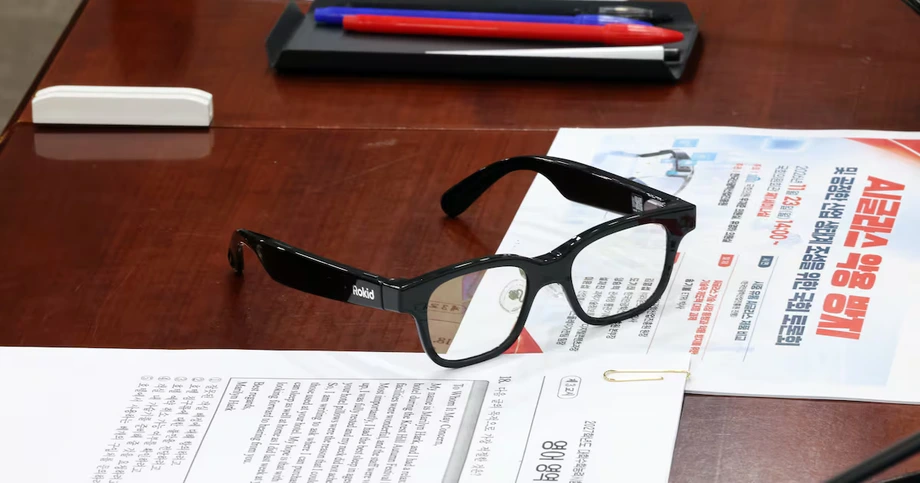
Smart glasses can combine cameras, microphones, speakers, sensors and AI in a frame that looks ordinary. A test taker can glance at a question and hear or see an answer within seconds. Meta launched AI glasses with Ray-Ban in late 2023, and more than seven million pairs were sold last year. Once a niche product, the devices have moved into mainstream use.
South Korea is not alone. Two students were caught using smart glasses earlier this year in an English skills exam often used for hiring decisions. In Taiwan, National Taiwan University disqualified a medical school applicant in June after proctors noticed odd staring and found that the glasses frame was giving off heat. In Japan, an 18 year old was accused in 2024 of using smart glasses to photograph questions during a Waseda University entrance test. China required screening of all glasses for the Gaokao, taken by more than 10 million students each year, and equipped sites with security gates.
Detecting the devices is hard because the same features that make them useful also make them subtle. Early glasses had visible cameras; newer frames can hide cameras and rely on signals that come and go. On Nov. 16, an examiner demonstrated a radio frequency detector at a driver's license testing center. Chang Kyung-Hi, a mobile communications professor at Inha University, noted that covert cameras and wireless gear can span frequencies from 400 megahertz to 6 gigahertz.
Wireless jamming, the practice of flooding signals to block phones, is illegal under South Korea's Radio Waves Act because it can also disrupt mobile service and banking transactions outside school grounds. Radio detectors can spot Bluetooth or Wi-Fi traffic in a room, but they cannot identify which student is carrying a device unless proctors interrupt the exam and check desks one by one. The ministry's search for a detector that works without internet traffic is meant to close that gap.
A Minister Resigns as Lawmakers Demand Safeguards
The exam changes arrived late for many students. The ministry first concentrated on smart glasses, then widened its focus after the tax accountant confession. New rules came two days before the CSAT and again on the eve of the test. Proctors had to complete online training a day before the exam. The possibility of postponing the CSAT was raised, but the ministry ruled it out because a delay would cause even greater disruption.
Education Minister Choi Kyo-jin, then in charge of the preparations, faced a direct question at a National Assembly Education Committee hearing about whether he could prevent AI assisted cheating.
Perhaps because of my age, I don't think I could.
Choi offered to resign, saying last minute changes caused inconvenience to the public and test takers. President Lee Jae Myung accepted the resignation within an hour and assigned Prime Minister Han Seong-sook to oversee follow up measures after the CSAT. Presidential spokesperson Kang Yu-jung said the appointment of a new education minister would follow established procedures.
Vice Education Minister Choi Eun-ok said the government believed excessive measures were necessary and described an unfair exam as disruption worse than a disaster. Ruling and opposition lawmakers pressed for stronger safeguards. Democratic Party of Korea spokesperson Shin Hyun-young called for a minister with expertise and a sense of responsibility. People Power Party leader Jang Dong-hyeok said the resignation was not enough and called for an investigation, accountability and stronger measures.
Jang put the concern in blunt terms.
Even the CSAT can no longer be trusted.
Universities Face the Same Scrutiny
The Education Ministry reviewed countermeasures with the Korea Council for University Education, which covers 46 universities holding essay tests and interviews for the 2027 academic year. The ministry shared CSAT measures, key cases and detection methods, while universities compared their own tools and gaps. The two sides launched a joint Emergency Response Unit for Cheating in University Specific Exams. It will share detection information until those exams conclude. The council is considering cancellation of admissions, expulsion of enrolled cheaters and bans from member universities lasting up to 10 years, though those steps need changes to laws and university rules.
Individual universities moved on their own. Hanyang University planned to restrict future applications for up to three years based on the severity and intent of cheating. The University of Seoul removed two test takers from a natural sciences mathematics essay exam, one wearing smart glasses and one possessing them, and filed complaints alleging obstruction of business. Seoul National University planned disposable gowns for interviews and oral exams, while Kyung Hee University planned disposable aprons for essay exams.
Universities also planned checks of all eyeglass wearers, restrictions on personal writing tools and metal detector screenings. No smart device cheating had been reported in essay based entrance exams administered by individual universities over the weekend. As of Nov. 27, 23 of the 46 universities had finished their exams, and most were expected to conclude in the first week of next month. The ministry told universities to re examine the test papers and answer sheets of all prospective successful applicants.
Beyond the CSAT, a Wider Exam Security Push
The ministry plans to manage six national examinations under its authority at the same level as the CSAT. For kindergarten, elementary and secondary school teacher recruitment exams, it wants to raise the restriction period from five years to 10. For the Legal Education Eligibility Test, known as LEET, it wants an increase from four years to 10. Officials will also examine AI assisted cheating detected in those two exams between 2022 and 2026.
The Test of Proficiency in Korean, or Topik, could see its cheating ban rise from two years to 10. Overseas Topik tests will be managed with Korean Education Centers and diplomatic missions. The Korean History Proficiency Test could move from a ban on three consecutive attempts to a ban lasting five years. The high school graduation equivalency exam and the Self Study Degree Examination could both move to bans lasting up to five years. A detailed investigation of the equivalency exam is set for next month, and a full scale investigation of high school internal exams is planned for January after academic record exams end.
For exam staff, the ministry plans higher allowances, help with complaints, legal assistance and liability insurance. It also wants to analyze stored Wi-Fi and Bluetooth signal records from exam day, along with public tips, to find more violations. A pan government task force began work on Friday. The government is seeking ways to develop tools that reduce the burden on teachers who supervise school tests. Those steps show how a single exam scandal has widened into a national exam security exercise for classrooms.
Key Points
- Acting Education Minister Choi Eun-ok said smart glasses detection technology has been developed and is entering commercialization, with exam ready radio frequency devices being prepared for next year's CSAT.
- This year's CSAT recorded 474 misconduct cases as of Nov. 25, up 69.9 percent from 279, and smart device cases rose from 31 to 112.
- Han Won-seok's confession that he used a miniature camera, phone and AI to cheat on tax accountant exams triggered a rapid expansion of exam security.
- The government used three national emergency alerts, added 8,400 personnel and inspected glasses, buttons, clothing and writing tools during the CSAT.
- Six test takers faced criminal complaints over serious violations, while the ministry continued reviewing 306 tips received after the exam that had not been confirmed.
- Universities and other national exams face tougher rules, including possible bans lasting 10 years, signal record analysis and new support for proctors.