Duterte says quitting would betray 32.2 million voters
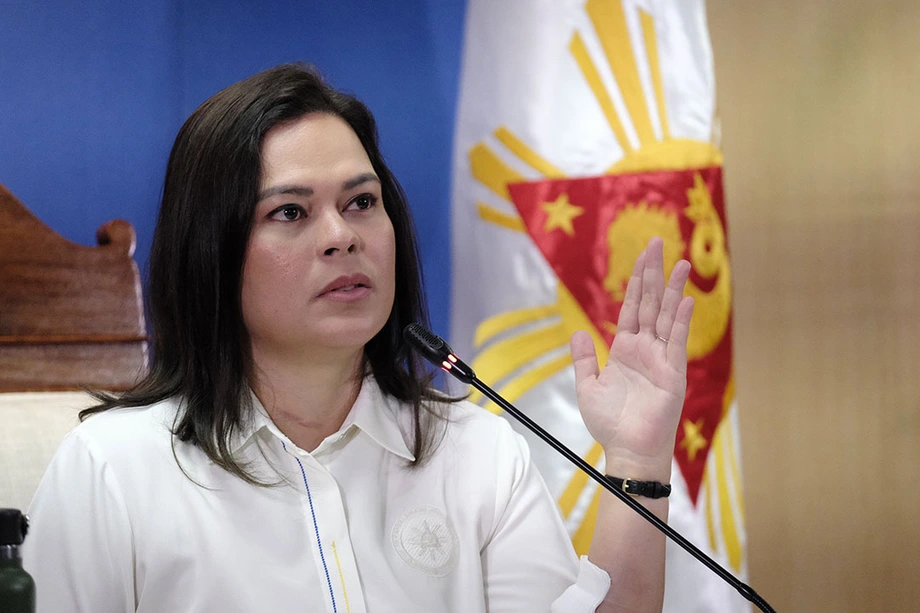
Vice President Sara Duterte said on Friday, November 27, 2026, that she would not resign, even though a conviction in her Senate impeachment trial could remove her from office and bar her from public office for life. She denies wrongdoing and has described the proceedings as political harassment.
Contents
- Duterte says quitting would betray 32.2 million voters
- One wealth allegation now carries the political stakes
- How a collapsed alliance produced two impeachments
- Inside the Senate courtroom
- Why bank, tax and asset records sit at the center
- A dentist, a banana chips company and customs records
- What a verdict would change inside Duterte's office
- Rodrigo Duterte faces charges in The Hague
- The ICC schedule stretches into April 2027
- Key Points
Speaking to reporters at a gathering near the end of the year, Duterte tied her decision to the mandate she received in the 2022 election.
Resignation, that is out of the question. It is something that I cannot do because I feel that it's a betrayal of the 32.2 million people who voted for me, and of course the general public if I resign.
Duterte remains the frontrunner in independent opinion polls for the 2028 presidential election. She formally announced her campaign on February 18, 2026, and has continued preparing despite the possibility of disqualification. She said she had approached a potential running mate, who replied that it was too early to decide. She did not identify that person. She is also assembling election lawyers and an information technology team to combat election cheating.
Her political partnership with President Ferdinand Marcos Jr. delivered their sweeping victory in 2022 but later collapsed. Marcos cannot seek another presidential term in 2028. Their rivalry now forms the backdrop to a trial that could either clear Duterte's path toward the next election or end her eligibility to participate in it.
One wealth allegation now carries the political stakes
House prosecutors have dropped three other impeachment articles to concentrate on Article II, which alleges that Duterte accumulated ₱817.9 million in unexplained wealth. They hope to finish the trial before the end of 2026, before public attention turns more fully toward the next presidential election.
Impeachment is the constitutional process for charging and removing certain senior officials. The House of Representatives brings the case, while senators sit as judges. A guilty verdict against Duterte would remove her as vice president and disqualify her permanently from public office. An acquittal would allow her office to continue its present activities and planned projects.
If the vice presidency becomes vacant, Marcos would nominate a replacement from Congress. Malacañang has said he has not decided on a possible replacement. Marcos himself has called the impeachment a legislative matter.
Duterte also faces a separate criminal case containing three counts of grave threats. Those charges concern her statements about Marcos, First Lady Liza Araneta Marcos and former House Speaker Martin Romualdez. She denies wrongdoing in that case as well.
How a collapsed alliance produced two impeachments
The present trial is the second attempt to remove Duterte through impeachment. The first impeachment record shows that the earlier case included allegations about confidential funds, an assassination plot, unexplained wealth, failures in her asset declarations and other conduct. Duterte remained in office because the Senate never delivered a final verdict.
- February 5, 2025: A fourth complaint secured 215 supporters among 306 House members, exceeding the constitutional threshold of one third. Another 25 lawmakers were verified as supporters, bringing the total to 240. Sandro Marcos, the president's son, signed first, while Speaker Romualdez signed last.
- June 10, 2025: The Senate voted 18 to 5 to return the articles to the House, seeking certification that the complaint complied with the Constitution and asking whether the next Congress wanted to continue.
- July 25, 2025: In Duterte v. House of Representatives, G.R. No. 278353, 13 of 15 Supreme Court justices supported a ruling that the fourth complaint was unconstitutional. The Court said earlier complaints had already activated the constitutional prohibition on repeated impeachment proceedings within one year. It also required notice, fairness and an opportunity to answer allegations.
- August 6, 2025: Nineteen senators voted to place the articles in the archives, with four opposed and one abstaining, halting the proceedings while the House pursued reconsideration.
- January 28, 2026: The Supreme Court denied reconsideration with finality. It clarified that session days meant calendar days on which the House actually held session.
- February 23 to May 4, 2026: Four new complaints were referred to the House Justice Committee. The committee found probable cause by 53 votes to zero on April 29 and approved its report by 55 votes to zero on May 4.
- May 11 to July 6, 2026: The House voted 257 to 25 to impeach Duterte, with nine members abstaining and 27 not voting. House Resolution No. 989 and Committee Report No. 261 reached the Senate on May 13. The Senate convened as an impeachment court on May 18, and the trial proper opened on July 6.
The 257 affirmative votes in 2026 were 42 more than the initial 215 supporters in 2025, although the procedures were different. The first case advanced through signatures after crossing the one third threshold, while the second followed committee hearings and a formal vote of the full House.
Inside the Senate courtroom
The Senate trial record lists four original articles: betrayal of public trust, culpable violation of the Constitution, graft and corruption, and bribery. The allegations covered confidential funds at the Office of the Vice President and the Department of Education, where Duterte served as secretary from 2022 to 2024, as well as unexplained wealth, payments to education officials and threats against Marcos, his wife and Romualdez.
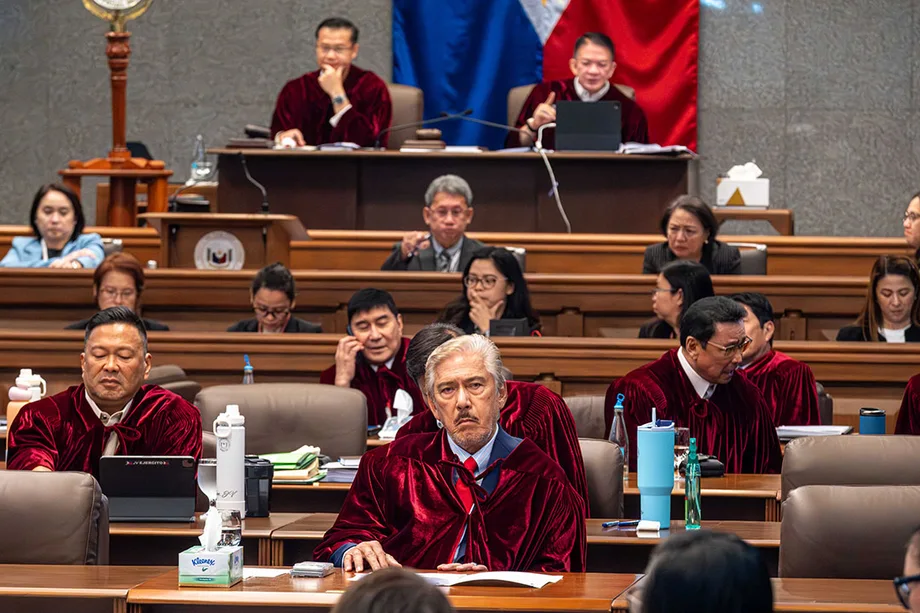
Twenty one senators were present when the trial opened on July 6. Francis Escudero was elected presiding officer by 12 votes to 8 after the Senate changed its rules to permit someone other than the Senate president to preside. Alan Peter Cayetano objected that the Constitution required the Senate president to lead the proceedings, and the dispute delayed matters by about an hour. Escudero pledged to act without fear or favor.
Eleven House prosecutors are led by Batangas Representative Gerville Luistro. Litigator Sheila Sison leads Duterte's defense team, with Michael Poa serving as spokesperson. Early witnesses included National Bureau of Investigation Senior Agent Mark Calilung, who addressed evidence including a recording of Duterte's November 2024 online media conference. NBI Regional Director Jeremy Lotoc subsequently testified that her statements about Marcos, the first lady and Romualdez amounted to serious threats outside the protection of free speech.
The voting requirement has also changed during the proceedings. Escudero ruled on July 6 that conviction required at least 16 affirmative votes, applying the constitutional requirement of two thirds to all 24 Senate seats regardless of absences. The Senate approved a lower threshold in October. Under that decision, 14 votes are sufficient while four senators are absent: Jinggoy Estrada and Rodante Marcoleta are detained, Ronald dela Rosa is a fugitive subject to an International Criminal Court arrest warrant, and Loren Legarda is abroad on extended medical leave.
Why bank, tax and asset records sit at the center
Article II rests heavily on documents. These include Duterte's Statements of Assets, Liabilities and Net Worth, which are declarations required from public officials, together with income tax returns filed with the Bureau of Internal Revenue, business records from the Securities and Exchange Commission, property records from the Land Registration Authority and firearms records from the Philippine National Police.
Anti Money Laundering Council material also covers 630 covered transaction reports and 33 suspicious transaction reports totaling ₱6,771,227,712.55. Covered transaction reports record transactions that banks must submit under reporting rules, while suspicious transaction reports concern activity that banks consider unusual. This transaction total measures activity across the reports, while the ₱817.9 million figure is the prosecution's specific allegation of unexplained wealth.
The 2026 complaints additionally cited ₱500 million in confidential funds released to the Office of the Vice President and ₱112.5 million released to the Department of Education. Those allegations belonged to the wider case before prosecutors narrowed the trial.
Luistro, the lead prosecutor and chair of the House Justice Committee, argued that the defense faces difficulty because many documents originated with Duterte, her banks or government registries rather than with the prosecution.
I think they're trying their best, but due to the strength of the evidence of the prosecution, it is really very hard.
Luistro asked how the defense could dispute documents associated with its own client. Eight defense witnesses had taken the stand during the first two weeks of its presentation, but none had explained the alleged ₱817.9 million by November 27, according to the prosecution's assessment. The defense canceled hearings on November 26 and 27 because a witness was unavailable.
A dentist, a banana chips company and customs records
Cale88 Foods Corporation, a banana chips producer owned in part by Duterte's husband, Manases Carpio, and Dr. Lourdes Tingson-Lebosada, is central to the next stage of the defense presentation. Lebosada is also the vice president's dentist.
Anti Money Laundering Council records showed ₱776 million in cash inflows for Cale88, compared with ₱125,000 in capital actually paid in and ₱208 million in declared sales. Cash inflows describe money entering accounts rather than profit. Lawyer Alex Cabrera, who prepared a forensic financial report on Duterte's bank and financial records, called the company's business model implausible. He compared its operations to a revolving door and said that pattern indicated money laundering.
In a submission dated November 25, defense lawyers sought orders requiring Lebosada and Bureau of Customs Deputy Commissioner Agaton Teodoro Uvero to testify and bring documents. Lebosada is expected to address Cale88's organization, registrations, operations, ownership and finances. Uvero, who serves in the bureau's Assessment and Operations Coordinating Group, is expected to address export records held by customs.
Court spokesperson Reginald Tongol said both subpoenas were served on November 26. Uvero received his personally at 9:05 a.m., while Lebosada was served by electronic mail in Davao City at 9:54 a.m. The trial paused for Senate deliberations on the proposed ₱7.2 trillion national budget and is scheduled to resume with hearings from December 1 to 4.
What a verdict would change inside Duterte's office
The Office of the Vice President estimates that removing Duterte would terminate employees whose tenure depends on her position, affecting around 300 families nationwide. Officials have also discussed relocating. The present office in Mandaluyong City was chosen because it had served as Duterte's campaign headquarters in 2022.
Duterte said her office was prepared for the worst and warned that a guilty verdict would carry many consequences, including those job losses. She also raised the possibility of public anger if voters saw an elected vice president replaced by an appointee. She nevertheless promised to accept the Senate's judgment.
We will accept whatever it is that the judgement of the Senate impeachment court will give for the impeachment trial. We will all have to live with the consequences of this.
Her own attendance at the verdict remains undecided. She said she might stay in Davao if thanksgiving activities were taking place there in December. As many as eight defense witnesses remained, raising the possibility that proceedings could extend into the Christmas break even though both sides have discussed finishing before the end of the year. No verdict date has been announced.
Duterte also said she had wanted to represent herself in court but that Poa had not accepted her request. In the same briefing, she joked that a third impeachment case might make her resign because she would no longer have money to pay lawyers.
Rodrigo Duterte faces charges in The Hague
Former President Rodrigo Duterte, the vice president's 81 year old father, is scheduled to go on trial at the International Criminal Court on Monday, November 30. He faces three counts of crimes against humanity, a category covering serious abuses committed as part of a widespread or systematic attack on civilians. A conviction on any count could bring life imprisonment.
The allegations concern 84 murders and two attempted murders from 2011 to 2018, spanning part of his tenure as Davao City mayor and the early years of his presidency. Prosecutors describe those victims as a sample from as many as 30,000 people killed by death squads targeting users and sellers of illegal drugs. Philippine law enforcement agencies acknowledged 6,248 deaths, a figure covering the deaths those agencies recorded.
Rodrigo Duterte was arrested in March 2025 and taken to The Hague, where he is detained in a unit for war crimes suspects within a Dutch prison. His lawyers deny the charges and argue that there was no state or organizational policy to murder. Judges rejected their argument that cognitive decline made him unfit for trial, although court sessions have been shortened to accommodate his age.
Sara Duterte said she did not expect her father to receive a fair hearing and accused powerful countries of pressuring the court. She has also said that no foreign court or nation should stand above Philippine sovereignty. Objecting to a requirement that he appear daily, she said:
I don't think he can focus and give his time and attention. It's unfair to demand that of an 81-year-old man.
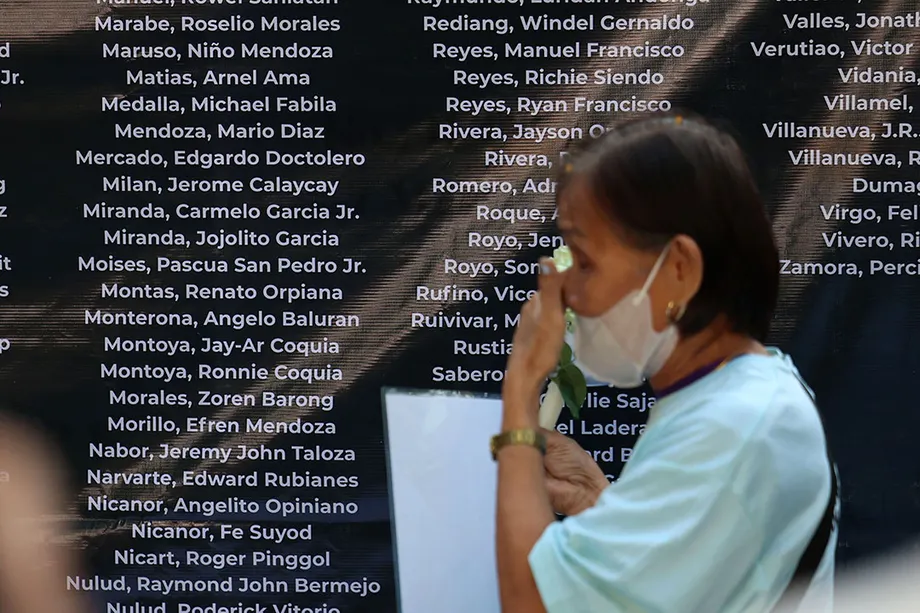
Families of people killed during the campaign against illegal drugs have taken a different view. Llore Pasco, who lost two sons, planned to attend the opening in The Hague on her 73rd birthday.
My only wish is not just justice for my children, but for all those killed during the time of Rodrigo Duterte. I hope the killings stop for the next generation.
The ICC schedule stretches into April 2027
An order issued on November 26 by ICC Trial Chamber III gives prosecutors two hours and 15 minutes for opening statements. Representatives of victims will receive one hour and 30 minutes, while the defense will have one hour before the first prosecution witness appears.
Four sessions are planned each day, running from 5:00 p.m. to 11:00 p.m. Philippine time. Proceedings will pause on December 18 for the judicial recess. Prosecution evidence is scheduled in three blocks during 2027: January 12 to February 19, March 1 to 24, and April 5 to 30. ICC spokesperson Oriane Huber Maillet expects as many as 100 prosecution witnesses. More than 500 alleged victims will be represented during the trial.
The case also tests a court operating under United States financial sanctions and calls from Washington for member states to withdraw and isolate it. The ICC is the world's permanent tribunal for cases involving genocide, war crimes and crimes against humanity when national jurisdictions do not act. Rodrigo Duterte is the second former national leader to appear before it over alleged crimes committed while in power, after Laurent Gbagbo of Ivory Coast, who was acquitted in 2019.
The family calendars now overlap. Rodrigo Duterte's trial opens on November 30, his daughter's Senate hearings resume from December 1 to 4, and the ICC enters its recess on December 18. Sara Duterte's defense and the House prosecution have both raised the possibility of a Senate verdict before the end of December, but the court has not set one.
Key Points
- Sara Duterte ruled out resignation on November 27, saying it would betray the 32.2 million people who voted for her in 2022.
- The Senate case has been narrowed to an allegation of ₱817.9 million in unexplained wealth. Conviction would remove her and permanently disqualify her from public office.
- Escudero initially required 16 votes to convict. A later Senate decision makes 14 votes sufficient while four senators are absent.
- Hearings are scheduled for December 1 to 4, with testimony expected from Duterte's dentist and a Bureau of Customs official about Cale88 and its records.
- Duterte's office estimates that her removal would affect around 300 families through staff job losses. No verdict date has been announced.
- Duterte is continuing preparations for 2028, including discussions with a potential running mate whom she has not identified.
- Rodrigo Duterte's ICC trial begins November 30 on three counts of crimes against humanity involving allegations related to 84 murders and two attempted murders.