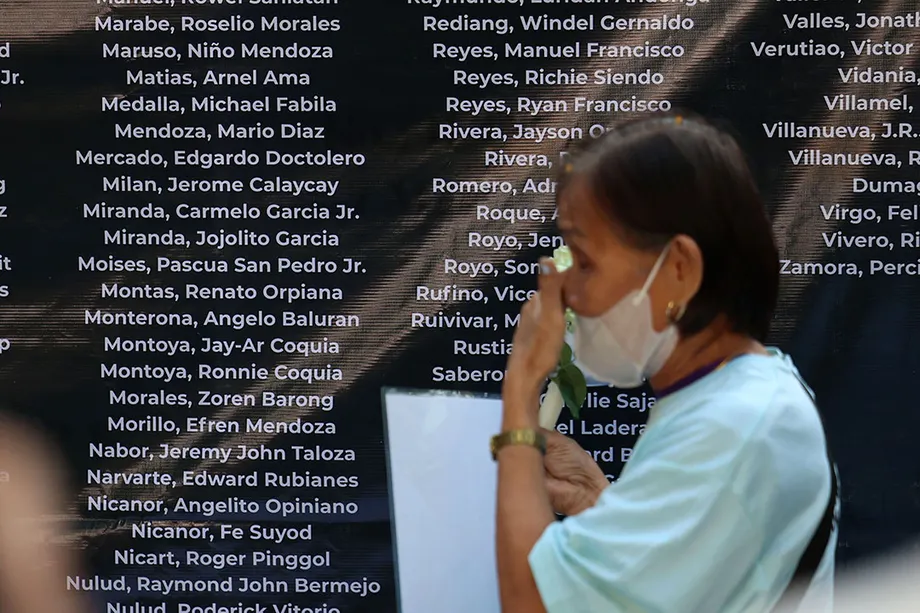
A Registry of 8,320 Names and an Official Count of 6,252
The Philippine Truth Commission said on Monday, Nov. 23, 2026, that it has documented 8,320 deaths tied to former President Rodrigo Duterte's drug campaign between 2016 and 2022, a figure it can tie to names, places and sources that the public can check. The commission released its first report, a document of 52 pages, at Philippine Normal University in Manila, one week before Duterte's trial for crimes against humanity is scheduled to open at the International Criminal Court in The Hague.
Contents
- A Registry of 8,320 Names and an Official Count of 6,252
- Who the Dead Were
- Why the Killings Followed the Police
- One Family, One Case, No Account
- Records That Do Not Hold Up
- The Justice Department Prepares a Review
- What the ICC Trial Will Test
- Public Opinion Turns Toward Accountability and Reparations
- Timeline: From Launch to Trial
- What to Know
The commission is led by Raul C. Pangalangan, a former ICC judge. It found that no alleged perpetrator has been held accountable in eight killings it examined in detail. It also said its findings point to persistent gaps in accountability nearly a decade after the campaign began, and that the 8,320 deaths are documented cases in its Victims Registry, not a final death toll. The findings remain preliminary.
The number does not match the government's most cited figure. The Philippine National Police (PNP) has recorded 6,252 suspects killed in police and Philippine Drug Enforcement Agency (PDEA) operations through May 2022. That count leaves out people shot by masked gunmen and bodies found on roadsides. ICC prosecutors have cited 12,000 to 30,000 deaths, drawing on several published sources. Commission researchers traced the often repeated 30,000 figure and could not find an original count that anyone can reproduce. No single government agency has adopted the 8,320 total.
Pangalangan wrote that the registry is unfinished and that some victims remain unidentified. He described the record as the first condition of justice.
Establishing that record is the first condition of justice, and it is the work this Commission exists to do.
The commission expects the number to grow as families come forward with more verified cases. It has put the registry online at truthcommission.ph and says each entry is tied to a source the public can verify. It has also promised to correct any entry that a family or researcher shows to be wrong.
Who the Dead Were
The record shows a campaign that fell heavily on poor urban communities. Of the 8,320 documented victims, 56 percent were killed in Metro Manila and Central Luzon, an area holding less than a quarter of the country's population. About 96.6 percent were men of working age. Where age is known, four in five were between 25 and 54, meaning breadwinners and parents. Sixty were children. The youngest named victim, Marjon Ocampo, was 1.
Killings were documented in 730 of the country's 1,633 cities and towns, and in 75 provinces and 2,031 barangays. They were not spread evenly. Just 25 cities and towns account for half of the dead. Within those places, the killings clustered in waterfront, resettlement and informal settler communities such as Tondo, Bagong Silang and Payatas. In North Bay Boulevard North in Navotas, about one in every 550 residents was killed.
The commission also kept in its count 499 victims who are still listed without a name. Executive director Christopher Magno wrote on Nov. 21 that reading each registry entry aloud at about 10 seconds each would take nearly a full day and night, and that for 499 entries there would be no name to read. His own research contributed 7,893 cases, while Program Paghilom and Caritas Kalookan added the rest from church and survivor support records. Some of the unnamed dead were found with packing tape around their heads or with other marks of torture, and some were buried in mass graves. The commission said it kept those entries rather than drop them because a person killed without being named was still killed.
Why the Killings Followed the Police
The commission said the timing and location of the killings point to a national campaign rather than scattered violence. Killings began in nearly every region within weeks of July 2016. When police were pulled from the campaign in January 2017, documented killings fell by 58 percent, and killings attributed to police fell by 91 percent. When PDEA took sole charge in October 2017, killings fell by 78 percent. Each time police returned under a renamed operation plan, the killings rose again. Arrests held steady at 4,000 to 5,000 a month through 2022, which the commission said shows that killing was never a necessary part of enforcing the law.
The commission also tested the official explanation that suspects fought back. If thousands had drawn guns on police at close range, many officers would have died too. The commission's news archive records nine police officers killed by ordinary drug suspects from 2016 to 2020, against 1,269 people killed in police operations in its dataset, a ratio of about 141 to one. Of 805 buy and bust operations with an undercover buyer, 781 ended in death. Only 15 mentioned the signal that is supposed to lead to an arrest. Where the method is known, 99.5 percent of the killings were shootings. Forensic examinations of 46 exhumed victims showed that 24 had been shot in the head.
The commission said the official account that suspects resisted arrest, known in Filipino as manlaban, did not hold up. It also said the evidence was sufficient to conclude that the drug war killings were organized by the state, and that the government's official account cannot be accepted at face value. Police reject accusations of systematic murders, cover ups and staged crime scenes. They have denied involvement in slum killings that ran parallel to their operations and have blamed turf wars and vigilantes.
One Family, One Case, No Account
Behind the count are cases that families brought to the commission. Darwin Hamoy was 17 when he was shot at a birthday gathering in Payatas, Quezon City, in August 2016. Police said he fought back. His body was removed before the scene was processed. His mother, Mariza, obtained the police spot report only after threatening to go to the media, and when it came, it did not even name him. The Commission on Human Rights found in 2017 that his right to life had been violated. The Ombudsman dismissed the criminal complaints in 2018, and the Office of the President dismissed the administrative case in 2022. More than 10 years on, no one has been held to account, not for Darwin and not for any of the eight killings that families brought before the commission in detail.
Luzviminda Siapo was the first to light a candle at the commission's first session with families. She is the mother of Raymart Siapo, who was 18 and had a disability when he was killed in Navotas City in March 2017. She was working as an Overseas Filipino Worker in Kuwait at the time. She recalled speaking with her son after a neighbor reported him to the local barangay over a missing chicken and household items. One day later, Raymart was killed.
I couldn't stop crying because I couldn't accept that my eldest son was gone. Even while working, even while holding my tools, the tears kept coming.
Siapo returned to the Philippines and went to the barangay hall and the police station to demand answers. She found that Raymart had been placed on a drug watchlist for allegedly selling marijuana. She said police later claimed he had shabu and a gun. Forensic pathologist Dr. Raquel Fortun, a commission member, examined Raymart's remains and confirmed that he died from a gunshot wound to the head.
The commission said families have effectively carried out the state's investigative work. Mothers searched hospitals and morgues for their sons, paid funeral parlors to release their bodies and chased records for months. Its report sets out 27 reforms drawn from their testimony. Five are flagged as urgent: preventing deaths in custody, responding to threats, protecting witnesses and families, preserving evidence and correcting death records. The commission said 12 existing laws and issuances already set out duties that families described as unmet, and many reforms need no new law.
Records That Do Not Hold Up
The commission found official records incomplete and at times unreliable. It found case files that cannot be opened, folders holding documents from unrelated incidents, and reports that give the same person different names and ages. A 2014 PNP circular had already admitted inconsistent crime recording and, in some offices, deliberate under reporting. The commission's archive of 4,110 news articles also shows how the public record was shaped. Of those articles, 1,942 cite police reports or officials, while only 531 cite families, neighbors or witnesses.
The commission has asked the Professional Regulation Commission to investigate the doctors who signed the death certificates of 13 victims. The request followed its earlier move to flag disputed death certificates, including cases in Caloocan and Quezon City, and to seek an investigation of five doctors. In those cases, bodies that bore gunshot wounds were recorded as having died from illnesses including pneumonia, stroke and sepsis. The commission has offered legal assistance to affected families and planned to write to the Philippine Medical Association.
The commission also said the drug war did not end in 2022. It listed that finding alongside other conclusions: operations began almost everywhere at once and followed the police, many killings bore the marks of execution, and official records were incomplete. The commission proposed 27 structural reforms to address gaps in investigations, official records and accountability.
The Justice Department Prepares a Review
Justice Secretary Fredderick Vida said the Department of Justice will form a panel to review the commission's evidence before any case is filed. He spoke at the commission's national conference on Monday. No date for the panel was given.
Yes, definitely we will have a panel to review everything because we will check on the verifiable facts. What are the pieces of evidence? Are they purely testimonial? Are they purely physical evidence?
Vida said the department does not want to file weak cases. He described the work as very challenging because much of what families told the commission is hearsay in court terms.
Yes, very challenging, because, as mentioned earlier, a family member might say, 'Someone told me my child was already kneeling when he was shot.' Isn't that hearsay?
The department's previous review panel, under former Justice Secretary Menardo Guevarra, resulted in 52 cases reaching court and nine convictions involving five victims. Vida said he was not in favor of holding local proceedings at the same time as the ICC trial, saying that running both could raise a conflict and that the approach could involve sequencing instead. He said the department must first determine the proper legal strategy.
What the ICC Trial Will Test
Duterte is detained at the ICC detention facility in The Hague. His trial before Trial Chamber III is scheduled to open on Nov. 30. He faces charges of crimes against humanity of murder and attempted murder over alleged crimes from 2011 to 2019, when he was Davao City mayor and president. He denies the charges. Judges ruled him fit to stand trial in September.
The court is also weighing a dispute over 16 of 539 recognized victims in the case. More than 500 victims were authorized to participate in the ICC proceedings in June 2026. Victims' lawyers have asked judges to allow closed session testimony, warning that pseudonyms and voice distortion may not stop witnesses from being identified. A search is ongoing for former police chief Ronald dela Rosa, a senator wanted by the ICC for alleged crimes against humanity. He has denied inciting or involvement in unlawful killings.
Amnesty International's Agnès Callamard spent the week in Manila meeting the families behind many of the registry's entries. Pangalangan said the commission is willing to provide its findings to the ICC if needed.
These gathered reports can serve as evidence. If the ICC needs them for their ongoing investigation, we will make sure to extend a copy to them as well.
Public Opinion Turns Toward Accountability and Reparations
A survey by Momentum Research released on Monday found that 78 percent of Filipino adults believe Duterte should personally appear at his trial before the ICC to face the charges against him. Sixteen percent said he should not, and 6 percent were unsure or refused to answer. Support crossed demographics and political lines: 85 percent of Gen Z respondents, 66 percent of residents in Mindanao and 70 percent of Duterte's own political supporters backed his personal appearance.
The same poll found that 53 percent agree with the ICC ruling that Duterte is fit to stand trial, while 38 percent disagree and 9 percent were unsure or declined to answer. Mindanao, the Duterte family's political stronghold, was the only region where a majority disagreed with the fitness ruling, at 57 percent, compared with 30 percent who agreed. The survey used in person interviews with 1,401 Filipino adults from Oct. 16 to 19 and has a national margin of error of plus or minus 2.6 percentage points. It was not commissioned.
Another finding pointed to reparations. Sixty percent of Filipinos believe the government should compensate families of drug war victims, while 32 percent oppose it and 8 percent were undecided or refused to answer. Support was highest in Metro Manila at 71 percent, followed by the rest of Luzon at 68 percent and the Visayas at 58 percent. Mindanao was the only region where opposition prevailed, with 50 percent rejecting compensation and 41 percent supporting it. Duterte supporters were nearly evenly divided, with 49 percent favoring reparations and 45 percent opposing them. Support was 62 percent among supporters of Marcos, 64 percent among independents and 78 percent among opposition supporters. Gen Z respondents showed the strongest support at 67 percent, followed by baby boomers at 59 percent, Gen X at 58 percent and millennials at 56 percent.
Lawmakers have filed measures seeking compensation. House Bill 6677, the proposed Extrajudicial Killing Victims Recognition and Reparation Act, was filed in December 2025 by Akbayan Reps. Chel Diokno, Percival Cendaña and Dadah Kiram Ismula, and Dinagat Islands Rep. Kaka Bag-ao. It seeks to investigate human rights violations during Duterte's drug campaign and provide monetary compensation and other assistance to victims and their families. It remains pending before the House Committee on Human Rights.
Timeline: From Launch to Trial
- May 28, 2026: The Truth Commission is launched, led by former ICC judge Raul Pangalangan, to document killings and prepare case files for referral to the justice ministry, police and National Bureau of Investigation.
- Nov. 9, 2026: The commission asks the Professional Regulation Commission to investigate doctors who signed the death certificates of 13 victims.
- Nov. 20, 2026: The commission says its public registry now names 8,320 people and expects the number to grow.
- Nov. 23, 2026: The commission releases its first report at Philippine Normal University in Manila.
- Nov. 30, 2026: Duterte's trial for crimes against humanity is scheduled to open at the ICC in The Hague.
What to Know
- The Philippine Truth Commission has documented 8,320 drug war deaths from 2016 to 2022, against the PNP's official count of 6,252 suspects killed in operations through May 2022.
- No alleged perpetrator has been held accountable in eight killings examined in detail, the commission said.
- Of the documented victims, 96.6 percent were men of working age, 60 were children and 499 remain unnamed.
- Killings fell by 58 percent when police were pulled from the campaign in January 2017 and by 78 percent when PDEA took sole charge in October 2017.
- The commission proposed 27 reforms, with five urgent measures on custody deaths, threats, witness protection, evidence preservation and death records.
- The Department of Justice will form a panel to review the evidence, but no date was given.
- Duterte's ICC trial opens on Nov. 30 on charges of crimes against humanity of murder and attempted murder from 2011 to 2019.
- Momentum Research found 78 percent want Duterte to appear personally at the ICC, and 60 percent support compensation for victims' families.
- House Bill 6677, a reparations measure, remains pending before the House Committee on Human Rights.