A second attempt after April's defeat
India's government has set up a second parliamentary test of its plan to expand the Lok Sabha and implement reservation for women. The Lok Sabha will reconvene on Monday, November 30, and the Rajya Sabha on Wednesday, December 2, with sittings possibly ending on December 3, 2026. The government is expected to revive delimitation legislation intended to make the women's quota effective before the 2029 parliamentary election and raise the Lok Sabha's maximum strength from 550 to 850.
Contents
- A second attempt after April's defeat
- What delimitation has to do with women's reservation
- How Parliament reached this vote
- The arithmetic that will decide the bill
- DMK sets a Tamil Nadu test for support
- Other regional parties attach their own conditions
- Why Congress and its allies object to the process
- Cabinet and party meetings precede the sitting
- What passage would change, and what remains undecided
- Key Points
Parliamentary Affairs Minister Kiren Rijiju said requests had been sent to Lok Sabha Speaker Om Birla and Rajya Sabha Chairman C. P. Radhakrishnan to transact essential government business. The government's official session notice confirms that both Houses will meet at 11 am on their respective dates. Rijiju indicated that the entire agenda could be completed quickly.
Subject to exigencies of business, the sitting of both Houses may conclude on Dec 3, 2026.
The announcement did not identify the bills to be introduced. Even so, the political calculation is unmistakable after the Constitution (131st Amendment) Bill was defeated on April 17. Of the 528 MPs who voted, 298 supported it and 230 opposed it. The government needed 352 votes and fell short by 54, suffering its first defeat on the floor of Parliament. Another failure would be especially damaging before assembly elections in Uttar Pradesh and other states.
What delimitation has to do with women's reservation
Parliament passed the women's reservation law in 2023, providing for 33 per cent of seats in the Lok Sabha and state assemblies to be reserved for women. Its implementation was tied to a delimitation exercise using figures from the first Census conducted after the law came into force. Delimitation means deciding how many parliamentary seats each state receives and redrawing constituency boundaries. It can therefore change both the size of Parliament and the political weight of individual states.
The proposed package would connect that process with a much larger House. The existing elected Lok Sabha has 543 sanctioned seats, while the maximum cited for the current arrangement is 550. Three vacancies leave 540 serving MPs. Raising the maximum to 850 would produce the biggest realignment of Lok Sabha constituencies since Independence. The strength of state assemblies would be the next to increase if the legislation passes.
Prime Minister Narendra Modi used an article on Thursday to attack the opposition over April's defeat. He said blocking legislation intended to give women adequate representation should fill hearts with shame, directing his criticism at one opposition party in an attack aimed at Congress. Modi then offered women this assurance.
no force can prevent us from ensuring that justice is done to them.
For the Bharatiya Janata Party, passage would supply a major campaign argument about women's representation. For several opposition parties, the method matters as much as the quota. They supported reserving seats for women in 2023 but object to joining its implementation to a redistribution of political power among states.
How Parliament reached this vote
The immediate dispute stretches across several sessions and involves both the 2023 law and Tamil Nadu's campaign to protect its representation.
- 2023: Parliament passed the women's reservation law, linking implementation to delimitation after the next applicable Census.
- February 14, 2024: M. K. Stalin, then Tamil Nadu's chief minister, moved an Assembly resolution urging the Centre to preserve every state's existing share of parliamentary and Assembly seats, based on the 1971 population, if total seats were increased.
- April 14, 2026: The government made the delimitation bills public on the evening of Ambedkar Jayanti.
- April 16, 2026: A session lasting three days began, with the Constitution amendment package as its central business.
- April 17, 2026: The Lok Sabha defeated the Constitution (131st Amendment) Bill by 298 votes in favour to 230 against, well below the required 352.
- August 13, 2026: Both Houses were adjourned sine die, meaning without a date to return, but the Monsoon Session was not formally prorogued.
- November 26, 2026: Rijiju announced the requests to reconvene Parliament on Constitution Day.
- November 30 to December 3, 2026: The Lok Sabha and Rajya Sabha are scheduled to meet on staggered dates, with December 3 the possible final day.
The Lok Sabha Secretariat describes the returning House as the Second Part of the Eighth Session of the Eighteenth Lok Sabha. Prorogation formally ends a session. Because that step was not taken in August, the government can resume the existing session rather than follow the timetable for summoning an entirely new Winter Session.
The arithmetic that will decide the bill
A Constitution amendment requires a majority of the House's total membership and support from two thirds of members present and voting. If all 540 current Lok Sabha MPs vote, the second requirement produces a target of 360. Absences and abstentions can reduce that target, explaining why the government is counting possible supporters and also watching who might stay away.
An itemised party count puts the National Democratic Alliance at 320 MPs. It comprises the BJP's 241, the National Citizens Party of India's 20, the Telugu Desam Party's 16, Shiv Sena's 13, Janata Dal (United)'s 12, Lok Janshakti Party (Ram Vilas)'s five, and two each from the Rashtriya Lok Dal, Janata Samajwadi Party and Janata Dal (Secular). The NCP, Shiromani Akali Dal, AGP, AJSU, Apna Dal (S), HAM and SKM contribute one each. Government political calculations have also used an NDA figure of 321. Either estimate leaves the alliance well short of 360 on a full vote.
The switch of 20 of the Trinamool Congress's 29 Lok Sabha MPs to the NDA has improved the government's position since April. Attention has now turned to the DMK's 22 MPs, the eight MPs of NCP (Sharadchandra Pawar), and four from the YSR Congress Party. Three calculations using the detailed NDA base of 320 show why none of those groups alone guarantees passage.
- If the DMK, NCP (SP) and YSR Congress all support the bill, their 34 votes would take the government to 354. It would still be six votes short if all 540 MPs voted.
- If the DMK stays away but the other two parties support the bill, the government could reach 332. With 518 members voting, the threshold would be 346, leaving a gap of 14.
- If both the DMK and NCP (SP) stay away while YSR Congress supports the bill, the government could reach 324. With 510 members voting, the threshold would be 340, leaving a gap of 16.
Ministers expect some abstentions to work in the NDA's favour and have kept the identities of other possible backers private. The Lok Sabha remains the hardest test because the alliance considers its position in the Rajya Sabha more favourable.
DMK sets a Tamil Nadu test for support
The DMK's condition is precise: Tamil Nadu must retain roughly 7.2 per cent of Lok Sabha seats after delimitation. DMK Deputy General Secretary and Leader of the Opposition Udhayanidhi Stalin has stated the party's position around protecting state interests, while senior party leaders have said they can accept more seats if the state's percentage remains safe. DMK sources also say the Centre approached the party with proposed changes to the legislation.
Tamil Nadu holds 39 of the Lok Sabha's 543 elected seats, equal to approximately 7.18 per cent. Its argument is that southern states should not lose political influence because they succeeded in controlling population growth. A purely population-based expansion could give faster-growing states a larger share of power even if every state gained some additional constituencies.
Union Home Minister Amit Shah sought to answer that concern during the earlier debate. He said Tamil Nadu's representation could increase from 39 seats to 59. In April, he also assured the Lok Sabha that no state would suffer an erosion in its relative strength because seats in each state would rise by around 50 per cent. Writing a 50 per cent increase across the board into the legislation is one way the government could try to satisfy the DMK and other regional parties.
DMK MP Kanimozhi has identified the remaining weakness in a spoken assurance: what recourse would states have if the Delimitation Commission did not follow it? Her question explains why the party wants protection in the bill's language rather than relying only on a minister's statement. Party chief M. K. Stalin will finalise the DMK's stand after examining the text.
Two senior DMK leaders have described an approach of equal distance from the BJP and Congress, with decisions determined by Tamil Nadu's interests. The party is now out of power in the state and has drifted away from its former opposition partners after Congress aligned with Chief Minister Vijay's TVK. Its leaders say political opposition to the BJP does not require rejecting every proposal with the same intensity.
Other regional parties attach their own conditions
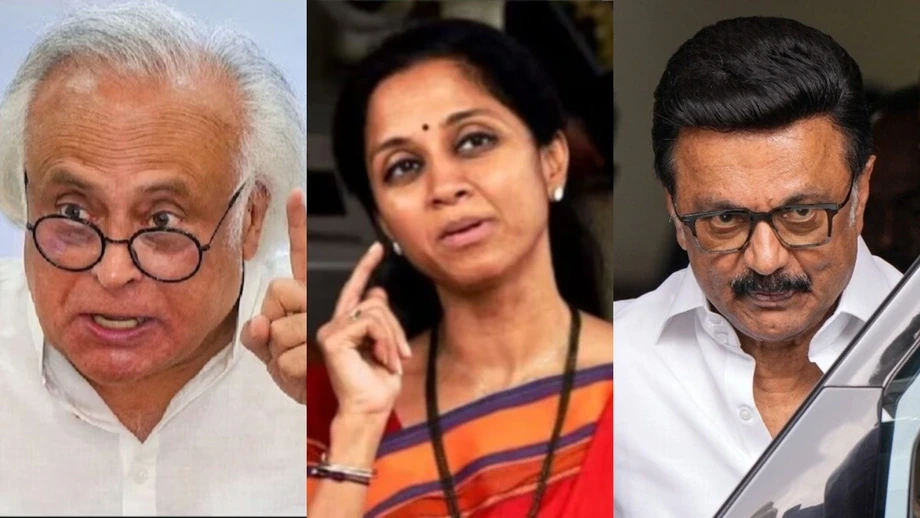
NCP (SP) working president Supriya Sule has set three conditions for support. Women's reservation must be implemented, every state must receive a 50 per cent increase in Lok Sabha seats, and opposition parties must receive adequate representation in the Delimitation Commission. Party leader Shashikant Shinde said no delimitation proposal had yet been placed before its MPs, who would study the provisions before the leadership decided its position.
The Biju Janata Dal is also waiting. BJD vice president Prasanna Acharya said party president Naveen Patnaik would decide after consulting colleagues. The BJD has no representation in the Lok Sabha but does have members in the Rajya Sabha, so its vote becomes relevant when the legislation reaches the Upper House. Acharya said he hoped the government would address objections raised during the earlier debate.
I don't know what the character of the Bill is this time, but we hope that the points which were objected to by the Opposition parties will be amicably settled and the government will change its stand.
YSR Congress's four MPs feature in the government's hoped-for majority, but the voting calculations treat their backing as a possibility rather than a declared commitment. Together, the positions of these parties give the government several routes to negotiate, while leaving it without a publicly secured majority.
Why Congress and its allies object to the process
Congress has chosen to fight both the expected legislation and the decision to reconvene Parliament. Senior leader Jairam Ramesh recalled that the bills were released on April 14 and defeated on April 17. He called the new sitting an insult to and assault on the Constitution, objected to its announcement on Constitution Day, and referred to 105 days of Operation Lotus, the opposition's term for alleged BJP efforts to win over rival legislators.
Congress general secretary K. C. Venugopal used the phrase Sansad Chori, meaning theft of Parliament, to describe what he expects the delimitation legislation to do.
They are Vote Chors. They are Seat Chors. There is no doubt that their Delimitation Bill will be nothing more than an exercise in Sansad Chori.
Venugopal vowed that Congress would not allow the bill to pass. Congress MP Manish Tiwari separately argued that a special sitting should not replace the regular Winter Session. He said the government could call that regular session and bring back legislation that had already been rejected.
Left MP D. Raja objected that a regular Winter Session would require at least 14 days' notice, while this sitting was arranged with barely three days' notice. He also criticised the absence of an announced agenda and consultation with opposition parties.
No agenda. No consultation. No clarity. No meaningful opportunity for MPs to hold the government accountable through Questions, Zero Hour and other parliamentary devices.
The official schedule confirms that there will be no Question Hour, Zero Hour or business initiated by non-government members. Question Hour allows MPs to question ministers directly, while Zero Hour lets them raise urgent public matters. Their exclusion means the short sitting will concentrate on government business rather than the usual range of parliamentary scrutiny.
Other opposition reactions range from procedural caution to outright hostility. Shiv Sena (UBT) MP Sanjay Raut called the expected bill an anti-national move and said supporters would be regarded as traitors. RJD MP Manoj Kumar Jha questioned the government's claim that it could assemble the necessary numbers. JMM MP Mahua Maji recalled broad opposition support for women's reservation in 2023 and pointed to defections while asking how the government would pass a delimitation package. Samajwadi Party MP Ramji Lal Suman said the meetings themselves were effectively assured after the presiding officers were approached, but the business to be taken up remained the central issue. AAP is expected to oppose the delimitation bill if it is introduced in either House.
Cabinet and party meetings precede the sitting
The Union Cabinet headed by Modi was expected to meet on Friday, November 27, to discuss the Constitution amendment and women's reservation bills. One possible change is to incorporate Shah's assurance that every state will receive roughly a 50 per cent increase and retain its relative strength. No Cabinet outcome or revised bill text had been published when the parties were setting out their positions.
Sonia Gandhi is scheduled to chair a Congress meeting before Parliament reconvenes as the party coordinates its opposition. The BJP is also holding a meeting in Delhi over two days to prepare for the 2027 assembly elections. Those parallel gatherings show that the vote is being approached as both a legislative contest and an election campaign test.
Passage would allow the BJP to present itself as having delivered representation for women after blaming Congress for April's obstruction. Defeat would expose the limits of its efforts to increase support through defections and negotiations with regional parties. The government's decision to proceed despite that risk reflects its belief that the numbers can be changed through revised safeguards, additional supporters or opposition absences.
What passage would change, and what remains undecided
Passage would not create an 850-member Lok Sabha immediately after the sitting. It would establish the legislative route toward expansion, fresh constituency boundaries and implementation of the women's quota in time for the 2029 election. The timetable for the Census, the Delimitation Commission's work and final constituency maps was not included in the session announcements.
The immediate signals will come from the Cabinet's text, Stalin's decision for the DMK, Patnaik's decision for the BJD and any assurances given to NCP (SP). The voting list will then show whether the government has found enough supporters or benefited from a smaller number of MPs present and voting. Until the agenda and revised provisions are released, the session's dates are certain but its precise legislative business is not.
Key Points
- The Lok Sabha reconvenes on November 30 and the Rajya Sabha on December 2, with sittings possibly ending on December 3, 2026.
- The expected package would raise the Lok Sabha's maximum strength from 550 to 850 and implement 33 per cent women's reservation before the 2029 election.
- April's Constitution amendment bill received 298 votes in favour and 230 against, leaving the government 54 votes short of the required 352.
- A detailed tally gives the NDA 320 MPs, while government calculations have also used 321; a full vote of all 540 MPs would require 360 supporters.
- Support from the DMK, NCP (SP) and YSR Congress would produce 354 votes on the detailed tally, still six short without absences or additional backers.
- The DMK wants Tamil Nadu's roughly 7.2 per cent share protected; Amit Shah has said its seats could rise from 39 to 59.
- NCP (SP) wants reservation implemented, a 50 per cent seat increase in every state and opposition representation in the Delimitation Commission.
- Congress and several allies oppose both the expected bill and the short notice, while the sitting will exclude Question Hour, Zero Hour and non-government members' business.