A Dedicated Court Moves Through Legal Preparation
Cambodia's Ministry of Justice is preparing legislation for a dedicated commercial court, building on an organising committee established on January 21, 2021, under legislation signed by Justice Minister Koeut Rith. The proposed court would give business disputes a specialised forum in a judicial system that currently handles commercial cases through existing courts.
Contents
- A Dedicated Court Moves Through Legal Preparation
- What the Ministry and ADB Are Preparing
- A Proposal With a Long History
- Which Disputes Would Go Before It?
- Why Businesses Want Specialised Judges
- Published Decisions Could Make the Law Easier to Understand
- The Cost of Taking a Dispute Abroad
- ADB's Focus Is on Reliable Decisions
- Key Points
The ministry has rejected criticism from Canada's ambassador that Cambodia's courts are ineffective at resolving business disputes. Its response points to preparations for a commercial court, an initiative supported by technical assistance from the Asian Development Bank (ADB) and backed by business representatives seeking faster, more predictable decisions.
The work involves more than creating a new institution. Officials and legal practitioners have discussed which disputes the court would hear, the procedures it would follow and the experience its judges would need. Publishing judgments, shortening proceedings and allowing some use of foreign languages have also been raised as possible features.
An earlier account of the drafting process identified the end of 2023 as a possible opening date for a court in Phnom Penh. No confirmed opening date or enacted final text is given in the developments described here, so the status established by the ministry's latest statement is legislative preparation.
What the Ministry and ADB Are Preparing
Justice Ministry secretary of state Chiv Songhak chaired discussions with ADB representatives Fiona Connell and Justice Anselmo Reyes about a draft law covering the commercial court's functions and standard procedures. Those rules would determine both the court's responsibilities and how a case moves from filing to a decision.
Chin Malin, the ministry's spokesman and a secretary of state, described the work following that meeting:
With the assistance of the ADB, we are at the stage of drafting the law,
The ministry has also established separate committees for commercial and labour courts. Malin has linked both projects to judicial reform, saying specialised courts would allow more focused handling of disputes now dealt with in the existing system.
Preparations have included procedural, legal and operational frameworks. A court needs rules for submitting claims, notifying the other party, presenting evidence and challenging a decision. Those details will shape how useful the new institution is to a company trying to recover money or settle a disagreement.
Another account of the initiative described a memorandum of understanding signed between the ministry and ADB in February, followed by completion of a draft law in November. A completed draft would still need to move through the steps required to become an operating court.
A Proposal With a Long History
Jay Cohen, a partner at law firm Tilleke & Gibbins in Cambodia, traced discussion of commercial courts back to at least 2003, when Cambodia expressed its intention to establish them in connection with joining the World Trade Organization. A draft Commercial Court Law followed in 2007, but the initiative subsequently lost momentum.
The main milestones show how long the proposal has been under discussion:
- 2003: Cambodia was considering commercial courts in connection with its WTO accession, according to Cohen.
- 2007: A draft Commercial Court Law was released.
- January 21, 2021: Justice Minister Koeut Rith signed legislation establishing the Commercial Court Organising Committee.
- End of 2023: An earlier account identified this as a possible opening target for a first court in Phnom Penh.
The distance between the 2003 discussions and the 2023 target was about 20 years. The organising committee and subsequent drafting work gave the longstanding proposal an institutional structure, while the ministry's current emphasis remains on preparing the legislation.
Which Disputes Would Go Before It?
A Justice Ministry spokesperson described the proposed court as a forum for all business disputes, separate from criminal courts. Malin has also said that commercial and labour disputes currently go to civil courts, which generally deal with disagreements over rights, obligations and compensation.
Cambodia Logistics Association president Sin Chanthy described trade conflicts as having been handled through criminal courts, whose judges, he said, were not always familiar with business and trade matters. The two descriptions point to a practical concern for businesses: commercial disagreements have been handled within existing institutions without a dedicated commercial forum.
Civil proceedings usually concern a remedy, such as payment of money owed. Criminal proceedings concern alleged offences and possible punishment. A business dispute can involve questions about a contract as well as allegations of criminal conduct, making clear rules on court responsibility especially useful.
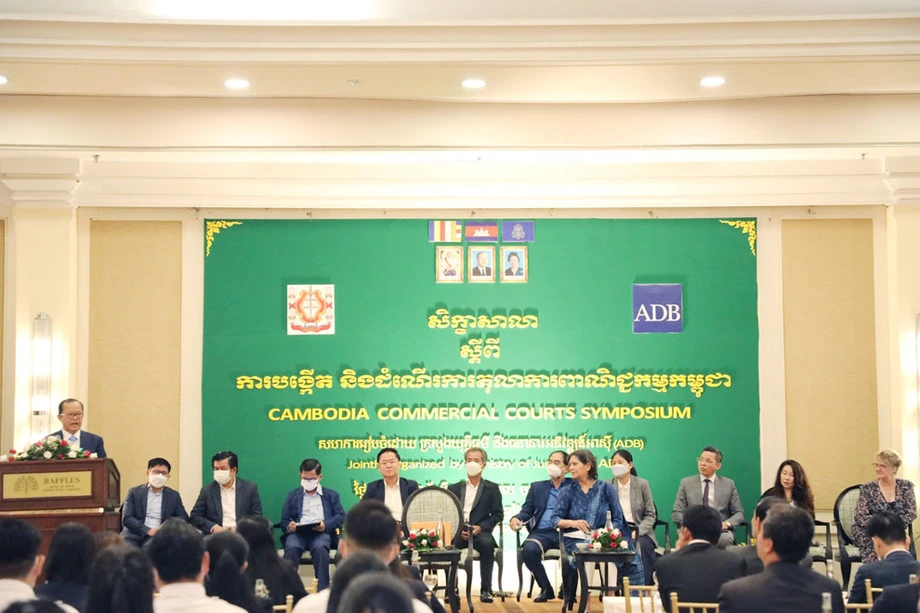
ADB Cambodia country director Jyotsana Varma raised the scope of the proposed court's authority during a commercial court symposium in Phnom Penh on November 29. That issue is known as jurisdiction: the legal boundary defining which cases a court may hear. She also asked whether parties should be able to choose between the commercial court and another court.
Why Businesses Want Specialised Judges
Sin Chanthy supported the proposed court because dedicated staff could develop a stronger understanding of trade and business. For companies, that could mean less time explaining ordinary commercial practices and more attention to the facts and legal obligations at the centre of a dispute.
Lim Heng, vice president of the Cambodia Chamber of Commerce (CCC), said CCC president Kith Meng initiated the proposal to build investor trust. He said businesses operating in Cambodia often turn to courts in Singapore or France to resolve commercial disputes.
Lim Heng described the conditions he believed would win business confidence:
Once we have these courts designated to cover commercial disputes … in a fair, transparent and quick manner without any corruption, we'll earn the trust of local and foreign investors and businesspeople, allowing us to bring in more investments,
Legal expert Sok Sam Oeun said a separate business law and a procedural code designed for the court might be needed. His point concerns the rules judges would apply and the process parties would follow, both of which affect the time and expense of bringing a claim.
The proposed commercial and labour courts are also expected to reduce the backlog in existing courts. Moving relevant cases to specialist institutions could give those disputes more focused attention while reducing the range of matters handled by other judges.
Published Decisions Could Make the Law Easier to Understand
Cohen identified transparency, predictability and the time needed to resolve disputes as longstanding concerns among investors. He said Cambodian court decisions are not routinely published, leaving businesses with limited access to explanations of how judges interpret the law.
A published judgment sets out what a court decided and why. For a business considering a contract, earlier judgments can help clarify how legal rules have been applied to similar disagreements. Lawyers can also use those decisions to advise clients about their obligations and the risks of litigation.
Cohen described publication as one of his hopes for the proposed institution:
it is hoped that the commercial court will publish its judgements so that the public can understand how the Cambodian courts are interpreting Cambodian law.
He also anticipated shorter schedules for hearings and final judgments, potentially narrower grounds for appeals, and Cambodian judges with substantial commercial experience. A more limited appeal process would restrict the reasons a party could use to ask a higher court to review a decision.
Foreign language filings and even hearings in English were among the possibilities Cohen discussed. These were expectations about the court's potential design; the draft's detailed provisions had not been released when he described them.
The Cost of Taking a Dispute Abroad
Cohen recalled that, when he arrived in Cambodia in 2009, some companies had contracts requiring arbitration overseas but found proceedings too expensive to pursue, even when they believed their claims were strong and straightforward. Singapore and Hong Kong were among the preferred destinations he mentioned.
Arbitration is a process in which parties ask an agreed decision maker, rather than an ordinary court, to settle a dispute. Businesses often specify arbitration in their contracts, including where proceedings will take place.
Foreign proceedings can involve legal fees and other expenses that weigh heavily against the amount a company hopes to recover. A business may have a contractual route to a decision yet decide that using it makes little financial sense.
Cohen said a Cambodian commercial court achieving its goals of transparency and efficiency would likely bring more disputes involving foreign investors before judges in Cambodia. Local companies would also have a domestic specialist forum, potentially reducing the need to seek resolution overseas.
The choice of forum matters after an investment has been made. A company needs practical ways to enforce agreements, collect money owed and resolve disagreements with commercial partners. The proposed court addresses that part of doing business.
ADB's Focus Is on Reliable Decisions
Varma told the Phnom Penh symposium that Cambodia could draw on decades of experience from other jurisdictions in establishing and running commercial courts. She said ADB was providing technical assistance to support the judiciary's role in creating a healthy business climate.
Varma explained what businesses need from a dispute resolution system:
Businesses also need a dispute resolution system which is reliable, efficient, and transparent.
Her questions went beyond the subjects a court would hear. They included how judges could understand the business issues underlying disputes and how cases could be managed efficiently while remaining fair to everyone involved.
Cambodia's proposal therefore brings together several connected decisions: who may bring a case, which judges will hear it, how quickly proceedings move and how openly decisions are explained. For businesses, the value of the new court will depend on how those rules work together when an actual disagreement reaches a judge.
Key Points
- Cambodia's Justice Ministry says a committee is preparing legislation for a dedicated commercial court.
- The Commercial Court Organising Committee was established under legislation signed on January 21, 2021.
- ADB is providing technical assistance, including support for work on the court's functions and procedures.
- Business representatives want specialist judges, faster decisions, transparency and proceedings free from corruption.
- Published judgments, narrower appeal grounds and foreign language proceedings have been discussed as possible features.
- An earlier opening target was the end of 2023; the latest statement described here concerns legislative preparation.