Long Bay puts Cambodia's crackdown under scrutiny
Cambodia says it has frozen more than US$300 million in bank accounts linked to online scams and sent 446 cases involving 3,927 suspects to court. Its latest pledge is to stop criminal networks from returning, as allegations surrounding the Long Bay development in Koh Kong province renew scrutiny of who operated scam premises and whether officials protected them.
Contents
- Long Bay puts Cambodia's crackdown under scrutiny
- What authorities found at Long Bay
- How the investigation unfolded
- Police connections draw a separate response
- What the national figures show
- Smaller operations complicate the closure claim
- Officials, assets and criminal leadership
- People forced to scam need protection
- International cooperation moves beyond raids
- Key Points
Senior Minister Chhay Sinarith, permanent vice chairman and head of the Secretariat of the Commission for Combating Online Scams (CCOS), said authorities were continuing to investigate ringleaders and other participants. He argued that undercover footage published on October 10 showed activities before the government's major crackdown.
In the government's statement on Long Bay, Sinarith said Cambodia had never denied the existence of online scams and would pursue those involved without exception. His response puts the focus on two connected tasks: closing places used for fraud and bringing their organisers to justice.
Sinarith, who is also senior minister in charge of special missions, described the government's position:
"Cambodia has never denied the existence of online scams. What matters is that Cambodia is a country actively taking concrete action to combat these crimes and has never backed down," he said.
The government describes progress over more than a year of nationwide operations. Its own accounts also acknowledge that criminal groups have moved from large compounds into houses, apartments and other smaller premises. Preventing that movement, while investigating allegations of protection and corruption, is now central to its promise to keep the networks out.
What authorities found at Long Bay
Long Bay is a tourism development in the Dara Sakor area of Koh Kong. According to Sinarith, authorities discovered several buildings suspected of links to online scams there in February 2026, after suspected criminal groups had fled and left evidence behind.
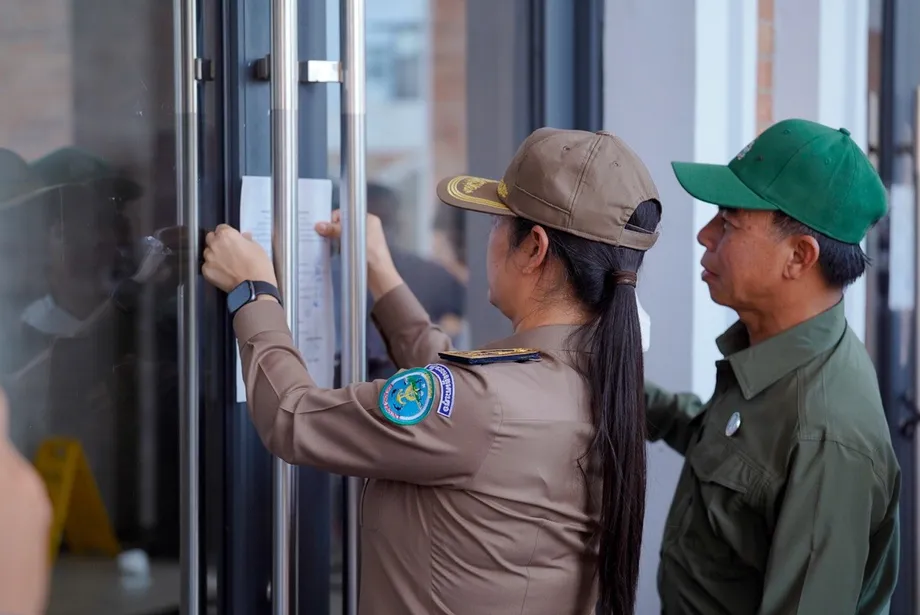
Koh Kong provincial authorities detained several suspects, seized evidence and sealed the suspected premises. The government says the site remains under strict control and will not be allowed to serve as a base for technology related scams.
Prime Minister Hun Manet inspected locations under official control in Koh Kong on September 5, 2026. He instructed authorities to maintain control over the premises and evidence and to conduct thorough investigations.
The documentary published on October 10 raised allegations of online fraud, forced criminal activity, drug use and connections to influential figures. It focused on Chinese born businessman Deng Pibing and included a conversation in which he discussed financial support for police and funding a police station within the development.
Sinarith said the activities shown preceded the crackdown, but gave no exact recording dates or additional evidence documenting the complete closure of scam operations at Long Bay. Authorities have also not disclosed the exact number of buildings searched, people detained or charges filed in the Long Bay case.
How the investigation unfolded
The chronology separates the discovery of suspected scam premises from Deng's departure and the later publication of undercover footage. It also places Long Bay within a national campaign that began in mid-2025.
- Mid-2025: Cambodia launched its major nationwide campaign against online scam operations.
- February 2026: Authorities discovered suspected scam buildings at Long Bay, detained several suspects, seized evidence and sealed the premises.
- Late May 2026: Deng Pibing left Cambodia, according to immigration information cited by Sinarith.
- June 12, 2026: Royal Government Decision No. 70 established a commission to manage evidence and assets connected to online scams.
- August 27, 2026: Sinarith told about 50 diplomatic and international organisation representatives that Cambodia no longer had major scam centres.
- September 5, 2026: Hun Manet inspected sites under official control in Koh Kong.
- September 23 and 24, 2026: Cambodia held an international conference on combating online scams in Phnom Penh.
- October 10, 2026: The documentary examining allegations at Long Bay was published online.
Cambodia's investigation continued after Deng's departure in late May. Sinarith cited the General Department of Immigration for that departure date and said specialised sources indicated Deng was subject to an Interpol Red Notice.
The reported notice has not been independently verified, and no published notice or underlying charges have been identified in the public details of this case. A Red Notice asks police internationally to locate and provisionally arrest a person while extradition or similar legal action is considered; national authorities apply their own laws when acting on it.
Police connections draw a separate response
The Interior Ministry has addressed footage showing a woman apparently acting as an interpreter for Chinese nationals and a vehicle bearing the Cambodian National Police logo. Ministry spokesperson Touch Sokhak said the vehicle used a fake plate and police logo to impersonate a police car.
The documentary identified police officer Chiet Mony as an associate of Deng. It also showed connections involving Deputy General Commissioner of the National Police Yim Leang and a meeting attended by former prime minister Hun Sen.
Touch Sokhak said the meeting with Hun Sen concerned legitimate investment opportunities. He said police officers must meet professional standards and that authorities should assess conduct through evidence and law. The ministry did not announce whether disciplinary or criminal proceedings had begun over the officer's appearance in the footage.
The allegations bring the national campaign's treatment of official involvement into focus. Cambodia has already announced action against senior officials accused of helping scam networks, alongside its operations against suspected fraud premises.
What the national figures show
The CCOS Secretariat's figures, published in a September 18 government briefing, cover July 2025 through August 31, 2026. Authorities inspected 832 suspected locations, conducted crackdown operations at 663 and took control of 86 major scam compounds. Legal procedures to confiscate those compounds were continuing.
The 663 operations represent about 80 percent of the 832 inspected locations. The figures describe the reach of enforcement, while the accompanying court and financial figures show other parts of the campaign: 446 cases involving 3,927 suspects referred to courts and more than US$300 million frozen in bank accounts linked to scams.
Sending a case to court begins a judicial process in which allegations and evidence must be considered. Freezing an account restricts access to its funds while legal action proceeds. Confiscation is a further legal step through which assets can be permanently taken.
An earlier official update, covering July 2025 through August 20, listed 793 inspected locations and 624 raids. It also described nearly 30,000 detained suspects from 39 nationalities, 58,266 foreign nationals rescued and deported, and 3,477 suspects from 29 nationalities held pending trial.
The different labels matter for people caught inside scam operations. Those detained during a raid, those treated as trafficking victims and those prosecuted can face very different outcomes. The authorities' figures do not provide a detailed breakdown explaining the relationship between the rescue, deportation and detention totals.
Smaller operations complicate the closure claim
Sinarith told about 50 representatives of diplomatic missions and international organisations on August 27 that Cambodia had no major online scam centres remaining. A subsequent government campaign review repeated that position while describing how criminal groups were changing their methods.
The CCOS said groups were relocating to rented houses, apartments, condominiums, cafés and mobile locations. One operation in Koh Kong detained 33 Chinese nationals and seized more than 700 mobile phones from a rented house.
Sinarith described the government's assessment:
"Major scam centres have been completely cleared, while strict legal measures have been taken against criminal targets and relevant officials," he said.
Montse Ferrer, Amnesty International's co-regional director, challenged the claim that the industry had been eliminated. She said accountability for the people running operations was essential:
The true test of long-term success is not how many compounds have closed, but whether the actors responsible have been investigated, prosecuted and prevented from resuming operations.
Mark Taylor, an independent consultant on human trafficking, also said significant operations and recruitment continued. The government's account of networks moving into smaller premises makes continued investigations necessary even after authorities secure the large compounds.
Officials, assets and criminal leadership
Cambodia's September briefing described four cases involving 15 officials suspected of involvement in scam activities. The positions listed included a deputy prosecutor, a deputy director general of immigration, a deputy Phnom Penh police commissioner, a former senior Foreign Ministry official, and police and military officers.
The government campaign review said an Anti-Corruption Unit operation had led to the arrest and removal of 15 senior officials and law enforcement officers over alleged collusion with, assistance to or protection of scam compounds.
Authorities have also pointed to action against prominent business figures. Chen Zhi, chairman of Prince Holding Group, was arrested and extradited to China in January 2026. Li Xiong, chairman of Huione Group, was extradited to China in April 2026.
Royal Government Decision No. 70, dated June 12, 2026, created a commission led by Sinarith to examine, monitor, collect, manage and dispose of evidence connected to online scams. Its responsibilities connect criminal investigations with the practical work of preserving seized property and handling assets through legal procedures.
Following money and ownership can help investigators connect a building used for fraud to the people financing or directing the operation. The government's pledge to freeze criminal assets therefore runs alongside its promise to prosecute ringleaders and accomplices.
People forced to scam need protection
The 2026 US Trafficking in Persons Report kept Cambodia in Tier 3, its lowest category, while acknowledging increased raids, arrests, international cooperation and closures of scam centres. It also alleged selective enforcement, official complicity, inadequate screening of potential victims and failures to prosecute connected traffickers.
Forced criminality describes a situation in which someone is compelled to commit crimes, for example after being recruited through a false job offer and then confined or threatened. Investigators need to establish who organised the fraud and who was acting under coercion.
South Korea's arrests after repatriation illustrated that challenge in October 2025. Of 64 citizens flown home from Cambodia, 49 had arrest warrants approved at the time of that coverage. Four returnees told police they had been beaten and forced to work inside scam compounds.
Cambodia's large rescue and deportation figures make victim screening a substantial part of the campaign. Interviews, protection and access to legal help can also allow people who were confined inside operations to explain recruitment methods, chains of command and threats used by organisers.
International cooperation moves beyond raids
Information Minister Neth Pheaktra said Cambodia recognises online scams as a serious problem and considers itself a victim of transnational crime. At the September 18 briefing, he listed cooperation with China, the United States, South Korea, Japan, Australia, ASEAN members and other countries.
The government planned its September 23 and 24 conference in Phnom Penh to bring together officials, law enforcement agencies and other participants. Subsequent accounts said the meeting adopted the Phnom Penh Declaration and produced bilateral initiatives aimed at disrupting scam networks.
Mok Chansothea, secretary of state at the Office of the Council of Ministers and a vice chairman of the CCOS Secretariat, described the operations as interconnected criminal networks crossing national borders. That structure requires cooperation on suspects, evidence and money held in different jurisdictions.
Cambodia is also preparing draft laws on cybersecurity and information technology crimes, along with regulations governing virtual assets. The government has described potential penalties including life imprisonment and asset confiscation. The measures remain under preparation, with no adoption date announced in the statements.
The financial stakes extend to Cambodia's international standing. The Financial Action Task Force placed the country under increased monitoring, commonly called its grey list, in February 2019 and removed it in February 2023 after progress on measures against money laundering. National Bank Governor Chea Serey has warned of a possible return if conditions deteriorate.
Cambodia's promise now reaches beyond shutting gates at large compounds. It includes keeping evidence secure, pursuing organisers and officials implicated in wrongdoing, protecting people forced into criminal work, and stopping smaller operations from becoming the next base for the same networks.
Key Points
- Cambodia says its campaign froze more than US$300 million and sent 446 cases involving 3,927 suspects to court through August 31, 2026.
- Authorities say they discovered suspected scam premises at Long Bay in February 2026, detained several suspects and secured evidence.
- Deng Pibing left Cambodia in late May 2026, according to immigration information cited by Chhay Sinarith.
- The Interior Ministry says a vehicle shown with police markings used a fake plate and logo; proceedings concerning an officer in the footage were not announced.
- The government says major scam centres have closed while acknowledging that groups have moved into smaller premises.
- Investigations into criminal leaders, alleged official protection, assets and potential trafficking victims remain central to preventing operations from returning.