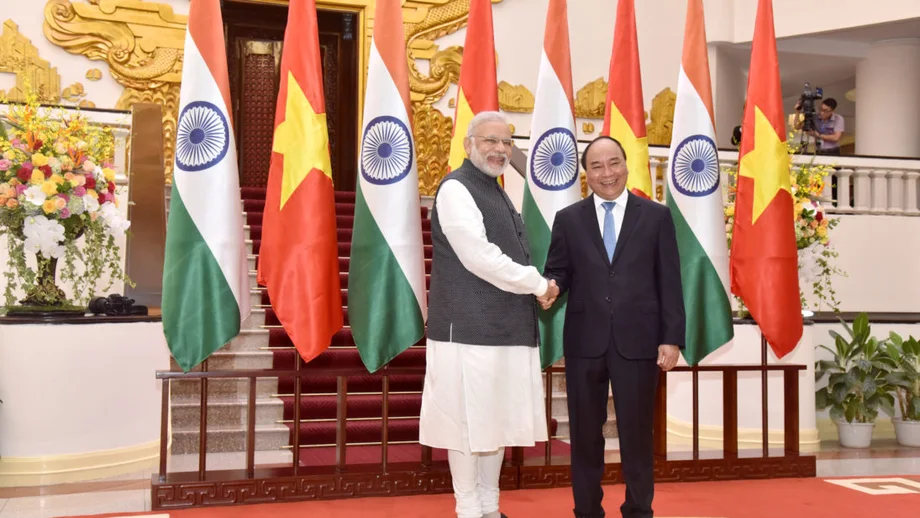
Vietnam takes a wider role in keeping sea lanes safe
Vietnam and India are seeking to turn years of naval contact into broader practical cooperation, with plans for more personnel training, shared information about activity at sea and joint development of technology. The proposals emerged on November 26, 2026, at a roundtable in New Delhi organized by the Embassy of Vietnam in India and India's National Maritime Foundation (NMF). The opening session combined participants attending in person with others joining online.
Contents
- Vietnam takes a wider role in keeping sea lanes safe
- Why do the two countries see a shared problem?
- What are India's three priorities?
- How could Vietnam contribute through the IPOI?
- What mechanisms were proposed?
- How does the May 2026 upgrade widen the agenda?
- Why do factories, minerals and QR codes matter?
- How recent visits built momentum for the talks
- What changes now, and what remains undecided?
- At a Glance
The meeting examined Vietnam's role as a joint leader of the Capacity Building and Resource Sharing pillar of the Indo-Pacific Oceans Initiative (IPOI). This is the initiative's fourth pillar, and Vietnam shares its leadership with India, the European Union, Germany and the Netherlands. Capacity building means giving people and institutions the skills, legal knowledge and technical ability to manage activity at sea. Resource sharing can include training programmes, maritime data, research and assistance with maintaining equipment.
Vietnamese Ambassador Trinh Minh Manh said the role reflected his country's intention to contribute actively to regional maritime mechanisms. Vietnam wants that leadership to produce practical initiatives and draw on the experience and strengths of each participating country. The two governments already have a foundation of naval exchanges, port calls, coast guard cooperation, maritime security dialogues and naval officer training. Ambassador Manh identified room to expand work on maritime information, marine scientific research, hydrography, search and rescue and protection of the marine environment. Hydrography involves measuring and mapping seas and coasts, information that supports safe navigation and other marine activities.
Why do the two countries see a shared problem?
Ambassador Manh told participants that sea lanes have growing strategic, economic and security importance. Disruption can affect coastal countries and the global economy because ships carry goods and energy between the Indian Ocean, Southeast Asia and waters farther east. He listed maritime disputes, piracy, illegal, unreported and unregulated fishing, pollution, natural disasters and the protection of seafarers among the interconnected challenges.
The ambassador then explained why individual national responses would not be enough:
These challenges require us to strengthen maritime cooperation across all areas, from improving maritime domain awareness and information sharing to enhancing maritime law enforcement capabilities.
Maritime domain awareness means building a useful picture of what is happening across a sea area. Ships, coastal radar stations, patrol aircraft and other authorities may each hold part of that picture. Sharing information can help identify a vessel, follow its movement, detect a possible fishing violation or decide where assistance is needed.
Admiral Dinesh K. Tripathi, chairman of the NMF and a former Chief of the Naval Staff of the Indian Navy, described several decades of progress in maritime relations. Drawing on more than four decades of military service, he pointed to trust built through port visits, delegation exchanges and bilateral maritime exercises. He also identified pressure tactics in the grey zone, illegal fishing, threats to undersea infrastructure, climate change and strategic competition as challenges facing shipping lanes connecting the Indian Ocean, Southeast Asia and the East Sea, the name Vietnam uses for the South China Sea. His central argument was that policy statements alone cannot provide maritime security. Countries need regular mechanisms that produce usable training, information and technical support.
What are India's three priorities?
Training comes first. Admiral Tripathi proposed putting maritime instruction and human resource development on a permanent institutional footing rather than relying only on occasional courses. He said capacity building should extend beyond supplying vessels or equipment. Personnel need specialist skills, organisations need the ability to analyse information independently, and agencies need clear procedures for working together.
Information sharing is the second priority. The admiral identified the Information Fusion Centre for the Indian Ocean Region (IFC-IOR) as one possible mechanism. A fusion centre brings together information from different participants so that they can develop a more common understanding of maritime activity. Better coordination in monitoring can support law enforcement, safety and responses to emergencies.
Joint technology development, maintenance and the sharing of technical resources form the third priority. Modern equipment delivers little value if operators cannot interpret its data or keep it working. Cooperation on maintenance and technical skills could therefore help partners become less dependent on outside support.
Admiral Tripathi also called for legal and policy research on exclusive economic zones, search and rescue, and technologies that can serve civilian and military purposes. An exclusive economic zone is an area where international law gives a coastal state particular rights over resources and related responsibilities. Research into those rights and duties can help agencies design cooperation without leaving uncertainty over jurisdiction. Similar legal work is needed when technology developed for science or commerce could also have a military application.
How could Vietnam contribute through the IPOI?
Dr Vu Hai Dang, Acting Director of the Centre for Maritime Diplomacy at the Diplomatic Academy of Vietnam, connected the IPOI role with Vietnam's ambition to become a strong maritime nation. Its goals include sustainable marine economic development, advanced marine science and technology, and modern ocean governance, meaning the laws, institutions and information used to manage activity at sea.
Vietnam's stated IPOI priorities include upholding international law, improving maritime security and law enforcement, sharing information, and coordinating search, rescue and disaster relief. Dr Dang also listed offshore renewable energy, shipbuilding, marine tourism, aquaculture, marine biotechnology and the application of artificial intelligence to ocean governance as areas for wider cooperation.
Vietnam could offer workshops and training programmes for regional countries while sharing its experience in shipbuilding, aquaculture, law enforcement and marine spatial planning. Spatial planning helps authorities decide where fishing, shipping, conservation and other activities should take place. Dr Dang also proposed joint research on biodiversity, the blue economy and adaptation to climate change.
What mechanisms were proposed?
NMF researcher Sushmita Sihwag suggested that Vietnam and India concentrate on maritime domain awareness, law enforcement, humanitarian assistance, disaster relief, shipbuilding, hydrography, oceanography and aquaculture. Her organisational proposals included designated coordination contacts, specialised working groups, a possible Vietnam-India IPOI partnership fund and bilateral pilot projects that could later expand across the region.
Colonel Ranendra Singh Sawan, an NMF senior research fellow, supplied figures showing the scale of India's existing activities. He cited training in exploration of the deep sea for more than 130 personnel from 16 countries, along with maritime information sharing involving 85 countries. Participants agreed that security, science and technology, marine economic development and environmental protection should be connected rather than handled as separate agendas.
How does the May 2026 upgrade widen the agenda?
The New Delhi discussion followed President To Lam's state visit to India in May 2026, when the two countries elevated their relationship to an Enhanced Comprehensive Strategic Partnership. They had established a Strategic Partnership in 2007 and a Comprehensive Strategic Partnership in 2016. The May visit produced 13 agreements covering defence and maritime security, critical minerals, digital technology, health, pharmaceuticals, trade, investment, culture, tourism and urban development.
An India Foundation paper by Sonu Trivedi says the countries also established a new 2+2 Strategic Defence Dialogue. Vietnam announced its intention to join the IPOI as part of the expanding partnership, and its joint leadership of the fourth pillar now gives that commitment a specific regional function.
Trade provides another measure of the ambition. Commerce between the two countries stands at around USD 16 billion, while the target is USD 25 billion by 2030. Reaching that figure from USD 16 billion would require an increase of about 56 per cent. The 13 agreements support that goal through work on digital public infrastructure, artificial intelligence, 6G communications, space and nuclear technology, marine sciences, biotechnology, advanced materials and critical minerals.
Defence remains central. The paper describes advanced negotiations over Indian military exports, including the BrahMos supersonic cruise missile, and says Vietnam is finalising a deal intended to strengthen its coastal defence. It places these developments against China's territorial claims in the South China Sea and wider strategic competition. Both governments advocate freedom of navigation and respect for the United Nations Convention on the Law of the Sea, the international convention setting out many rights and duties at sea. The paper describes IPOI cooperation as a way to work within India's regional maritime architecture without establishing a formal alliance against China.
Why do factories, minerals and QR codes matter?
Economic projects help explain why the two governments present maritime security as part of a much broader relationship. The India Foundation paper identifies a USD 500 million VinFast electric vehicle manufacturing plant in Thoothukudi, Tamil Nadu, as a major investment. It also describes complementary manufacturing ambitions, with Vietnam importing industrial inputs such as iron, steel and vehicle parts from India while both countries seek larger roles in international supply chains.
Rare earth elements and other critical minerals add a strategic industrial dimension. These materials are used in products including electronics, renewable energy equipment, aerospace systems and defence technology. The partnership combines Vietnam's reserves with India's demand and expanding processing capacity. Vietnam has identified mining, including rare earths, as a development priority and has offered measures such as tax incentives, simpler procedures for mining licences and industrial zones for mining and processing.
Financial and cultural connections are also being built. The Reserve Bank of India and the State Bank of Vietnam have agreed to link their retail payment platforms through QR codes, with the aim of making payments easier for tourists and businesses. Other commitments cover digital health, research into traditional medicine, sustainable tourism and more direct flights. A separate memorandum provides for the documentation, conservation, digitisation and online dissemination of ancient Cham manuscripts of Indian origin that are preserved in Vietnam.
How recent visits built momentum for the talks
Military and naval engagements during November supplied working examples of the cooperation discussed in New Delhi.
- November 3 to 5: A delegation of four from the Vietnam People's Army visited the College of Military Engineering in Pune.
- November 21: The Indian Embassy in Vietnam announced the welcome for INS Sahyadri in Da Nang, where the ship was due to remain until November 22.
- November 26: The Vietnamese Embassy and the NMF held the New Delhi roundtable on the IPOI and bilateral maritime cooperation.
INS Sahyadri, an Indian Navy frigate carrying 294 officers and sailors, visited Tien Sa Port in Da Nang for an operational turnaround and goodwill engagements. An operational turnaround allows a deployed ship to replenish and prepare for its next task. The Vietnam People's Navy, local authorities, the city's armed forces and the Naval Region 3 Command welcomed the vessel. The programme included meetings with the Da Nang City People's Committee and Naval Region 3 Command, sports exchanges between personnel and visits to historical and cultural attractions. The Indian Embassy said the visit reaffirmed a shared commitment to peace, stability and security in the region and the Indo-Pacific.
The Pune exchange covered combat engineering, countering improvised explosive devices, humanitarian assistance, disaster relief and engineering support for United Nations peacekeeping missions. The Indian Army said the engagement strengthened professional ties and mutual understanding. During a separate recent official visit to Vietnam, Indian National Security Advisor Ajit Doval met President To Lam and thanked him for his support in strengthening the Enhanced Comprehensive Strategic Partnership.
What changes now, and what remains undecided?
For Vietnam, joint leadership of the IPOI pillar provides a regional platform for its training, research and marine economic proposals. For India, it supports the Act East Policy and creates another route for sharing experience gained through programmes involving dozens of countries. Coastal states with limited resources could gain access to courses, information networks and technical expertise that would be difficult for each state to develop alone.
The practical value for sailors, fishers and coastal communities would come through specific applications. Shared information can help authorities locate vessels or coordinate a rescue. Cooperation against illegal fishing can support efforts to protect marine resources. Training in hydrography and oceanography can improve knowledge of waters used for navigation, while joint research can connect environmental protection with offshore energy, aquaculture and climate adaptation.
The immediate result of the New Delhi meeting was a set of recommendations. It did not publish a budget, a confirmed list of pilot projects or dates for the proposed partnership fund and working groups. The paper discussing the possible BrahMos purchase also gives no contract value or completion date. The clearest fixed deadline in the wider agenda is the 2030 trade target, while the maritime proposals now depend on coordinators and participating institutions turning them into programmes.
At a Glance
- Vietnam and India discussed training, information sharing and joint technology development in New Delhi on November 26, 2026.
- Vietnam jointly leads the IPOI's fourth pillar with India, the European Union, Germany and the Netherlands.
- India's three priorities are permanent maritime training, wider information sharing through mechanisms such as IFC-IOR, and cooperation on technology and maintenance.
- Vietnam offered regional workshops and expertise in shipbuilding, aquaculture, marine spatial planning and law enforcement.
- Proposals include coordination contacts, working groups, a possible partnership fund and pilot projects, but no budget or project timetable was announced.
- The May 2026 partnership upgrade produced 13 agreements, a new defence dialogue and a target of USD 25 billion in trade by 2030.
- INS Sahyadri's Da Nang visit involved 294 officers and sailors, while a separate Vietnamese army delegation attended an engineering exchange in Pune.
- Wider cooperation spans a VinFast factory, critical minerals, QR code payments, healthcare, tourism and preservation of Cham manuscripts.