Two Armies, Three Provinces and a Ceremony at Ream
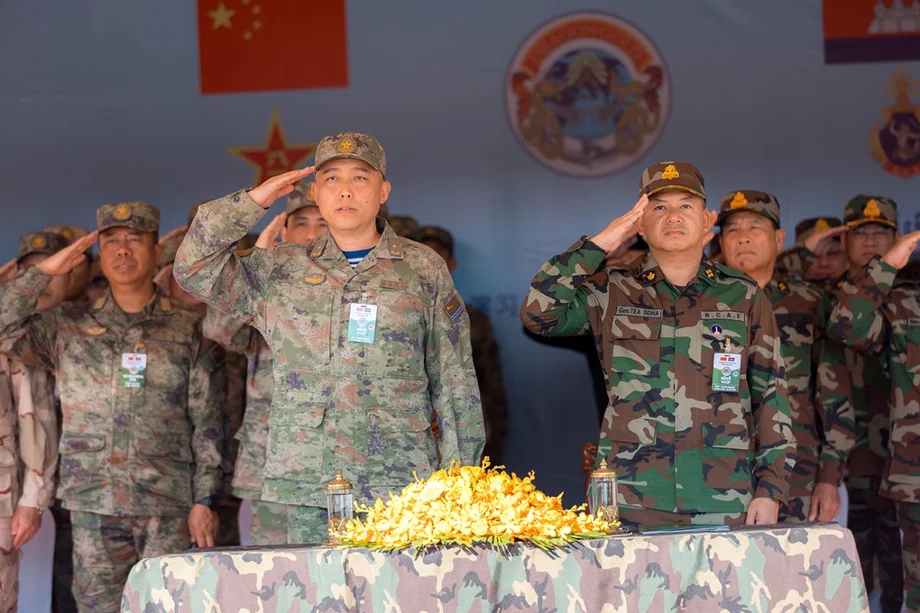
Cambodia and China opened the eighth edition of their Golden Dragon joint military exercise on Wednesday, November 25, 2026, at Ream Naval Base, the headquarters of the Royal Cambodian Navy on the Gulf of Thailand coast in Preah Sihanouk province. Deputy Prime Minister and Defence Minister Gen. Tea Seiha presided alongside Rear Admiral Liu Sumin, commander of the Chinese People's Liberation Army's Guangzhou Naval Base. The drills run for 15 days and close on December 9.
Contents
- Two Armies, Three Provinces and a Ceremony at Ream
- What the Two Armies Say They Are Practising
- A Force More Than a Third Larger Than Last Year
- Tanks, Radar and Three Warships at a Refurbished Port
- December 3 and December 5: The Dates Residents Are Watching
- Why Ream Naval Base Matters Beyond the Drills
- Angkor Sentinel Returns as Beijing's Role Grows
- Key Points
Pen Sokrethvithyea, director of the Training Directorate at the Royal Cambodian Armed Forces General Command, gave the count at the opening ceremony: 2,940 personnel, 1,626 from Cambodia and 1,314 from China. Agence Kampuchea Presse put the number at about 2,000, with more than 1,000 Cambodian and over 800 Chinese troops. Cambodian military spokesman Thong Solimo called the drills the largest since the series began in 2016.
Training is spread across three provinces. Ground and air phases are held at the Combined Arms Officer Training School in Kampong Speu and at the Techo Sen Chum Kiri Training School in Kampot. Naval and air phases run from Ream Naval Base, Koh Kong Air Base and the waters off Preah Sihanouk province.
China's Ministry of Defence announced the exercise on Tuesday, November 24, a day before the ceremony, saying it would focus on joint counterterrorism, anti-piracy and humanitarian assistance and disaster relief operations. The ministry said the drills aim at 'strengthening political mutual trust and expanding military exchanges'. The Royal Cambodian Armed Forces gives the official theme as Joint Counter-Terrorism and Anti-Piracy Operations and Humanitarian Work.
What the Two Armies Say They Are Practising
The programme mixes three formats: adaptive training, command post exercises and comprehensive drills with troops in the field. A command post exercise is a rehearsal run from headquarters, where officers work through an operation using maps, radios and communications systems instead of moving large formations into position. The field drills add warships, helicopters, armoured vehicles, artillery, modern command systems and drones, and the armed forces have said ammunition will be used.
Tea Seiha told the ceremony that this year's edition was more advanced and comprehensive than earlier ones, and that it covers operations on land, at sea and in the air. He framed the exercise as a question of Cambodian law.
Please note that military exercises between the Royal Cambodian Armed Forces and the Chinese People's Liberation Army, as well as other exercises Cambodia conducts with friendly countries, are based on the principles of transparency, equality, mutual respect for sovereignty and compliance with the Constitution of the Kingdom of Cambodia.
The minister, who is also deputy prime minister, repeated the point in a Facebook post, saying the drills rest on transparency, equality and respect for sovereignty, and that it 'is not intended to threaten or adversely affect any third country'.
Liu Sumin set out three priorities for the exercise: strengthening traditional friendship, maintaining high training standards and improving joint operational capability. He called on personnel from both sides to exchange experience and to sharpen coordination in intelligence gathering, planning and command. Speaking through an interpreter, the admiral described the content of the drills in the same terms as his host.
Its content does not target any third party, nor is it related to the regional situation or any specific security issues.
A Force More Than a Third Larger Than Last Year
The Golden Dragon series began in 2016, when China first sent troops to train alongside Cambodian forces. The seventh edition, held in 2025, involved 1,331 Cambodian troops and 845 Chinese personnel, a total of 2,176 by the figures the armed forces released at the time. This year's 2,940 is 764 more, a rise of about 35 percent.
The growth is not even. The Cambodian contingent rose by 295, about 22 percent, while the Chinese contingent rose by 469, close to 56 percent. In 2025, Chinese personnel made up about 39 percent of those taking part. This year, by Pen Sokrethvithyea's figures, they make up 45 percent.
Cambodian officers describe the value in terms of skills. Pen Sokrethvithyea said the exercise is expected to strengthen Cambodia's military capability through knowledge sharing with Chinese forces, covering modern weapons, counterterrorism tactics, humanitarian rescue and cooperation with other militaries. He also placed it in a political frame.
The eighth Golden Dragon exercise not only strengthens cooperation between the defence ministries of the two countries, but also deepens the Cambodia-China comprehensive strategic cooperation partnership and reinforces high-level mutual political trust.
Tanks, Radar and Three Warships at a Refurbished Port
Photographs from the opening showed a Chinese Type 96A main battle tank on display for Tea Seiha, and an LCQ-776 air surveillance radar parked with the Chinese ground contingent, folded down in its travel configuration. The Type 96A is one of the most common tanks in China's army, armed with a 125 mm smoothbore gun that is loaded by an automatic mechanism rather than by a crew member.
Cambodia's Ministry of National Defence listed the equipment as warships, helicopters, armoured vehicles, artillery systems, advanced command platforms and unmanned aerial vehicles. Three Chinese vessels reached Ream earlier in the week to take part, according to the state broadcaster TVK, and Chinese troops and equipment came ashore by sea on Sunday, November 22.
Tea Seiha thanked the Chinese government, the Ministry of National Defence, the PLA and the Chinese people for support in human resource development, military infrastructure, defence modernisation and technical assistance. Cambodia's navy has trained at Ream for years, and the base's pier has been rebuilt with Chinese funding.
December 3 and December 5: The Dates Residents Are Watching
A notice issued from Ream Naval Base scheduled a sea rehearsal for December 3 and the main live firing event for December 5, both in the waters off Preah Sihanouk province. The armed forces asked people living near training areas to expect heavy vehicles, troop movements and the sound of live ammunition.
Residents living near the exercise areas are kindly requested to take note of this information and not to be alarmed by troop movements or the use of live ammunition during the training.
The same statement described social and humanitarian programmes in communities near the exercise areas, alongside the military training, without giving details of what would be provided or where.
The exercise aims to further deepen the comprehensive strategic partnership between Cambodia and China, exchange experience, enhance professional capabilities and strengthen the ironclad friendship between the armed forces of the two countries.
Why Ream Naval Base Matters Beyond the Drills
Ream is the reason the exercise draws attention far beyond the two capitals. Beijing helped fund an expansion of the base, which was originally built partly with American money, and the upgraded facility was inaugurated in April 2025. Washington has warned that the port could give China a strategic position near the South China Sea, most of which Beijing claims, and a foothold in the Gulf of Thailand.
Cambodian leaders have repeatedly denied that the base is reserved for any single foreign power, and say warships from friendly countries are welcome provided they meet certain conditions. Japanese and Vietnamese warships have docked at the new pier since it opened. In January, the US warship USS Cincinnati arrived at Ream, the first US Navy ship to call there since the renovation funded by China was completed in 2025.
Tea Seiha addressed the question at the ceremony, describing the exercise as a contribution to the international community through shared peace and humanitarian relief, and both he and Liu Sumin said the drills are not aimed at any third country or at the region's disputes.
Angkor Sentinel Returns as Beijing's Role Grows
Cambodia suspended its Angkor Sentinel exercise with the United States in 2017, months after holding the first Golden Dragon drills with China. The two countries had run Angkor Sentinel for seven years, with the last edition in 2016. Prime Minister Hun Manet announced in August that the joint exercises with Washington would restart, and US officials say they are due to resume next February.
Beijing remains Phnom Penh's closest political partner in Southeast Asia. Cambodia consistently backs Chinese foreign policy positions, and Chinese aid and investment have helped drive the country's rapid economic growth in recent decades. Chinese instructors also train Cambodian officers in China, and the two defence ministries meet regularly on the margins of the exercise.
For soldiers on both sides the drills change what is available to train with. Cambodian units work with Chinese tanks, radar, artillery and drones, and with instructors who run counterterrorism and maritime security scenarios. Chinese units train out of a port they helped rebuild, on a schedule they have kept every year since 2016, and the 2026 edition is the first to bring all three services into coordinated drills of this size.
What the exercise will produce beyond December 9 has not been announced. No timetable has been published for any follow up training or for the results of the drills, and neither side has said how many of the 2,940 personnel will remain in Cambodia after the closing ceremony.
Key Points
- Golden Dragon 2026, the eighth edition of the China-Cambodia exercise, opened at Ream Naval Base on November 25 and runs to December 9, a span of 15 days.
- Pen Sokrethvithyea of the RCAF General Command put participation at 2,940 troops: 1,626 Cambodian and 1,314 Chinese.
- Ground and air training takes place in Kampong Speu and Kampot provinces, with naval and air phases from Ream, Koh Kong Air Base and waters off Preah Sihanouk.
- Equipment includes warships, helicopters, armoured vehicles, artillery, command systems and drones, with a Type 96A tank and an LCQ-776 radar seen at the opening.
- A sea rehearsal is set for December 3 and the main live firing event for December 5.
- The 2025 edition involved 1,331 Cambodian and 845 Chinese troops, a total of 2,176.
- Defence Minister Tea Seiha and Rear Admiral Liu Sumin both said the drills are not directed against any third country.
- Cambodia's Angkor Sentinel exercises with the United States, suspended in 2017, are due to resume next February.