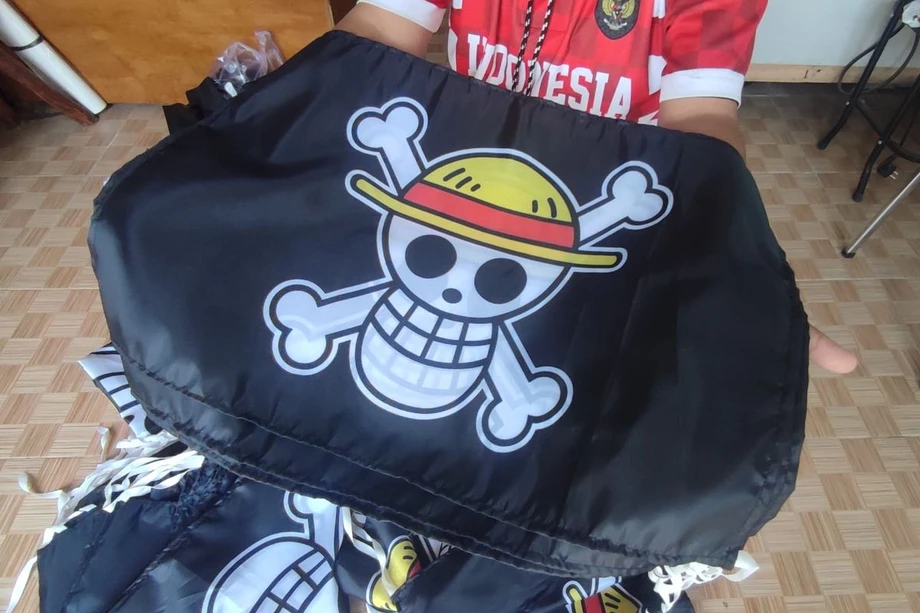
A skull in a straw hat turns up at the birthday party
Indonesia marked 80 years of independence on 17 August 2025, a season when the country normally turns into what officials like to call a sea of Red and White. In the weeks before the parade, another flag appeared instead. Black, with a grinning skull wearing a straw hat above two crossed bones, it flapped from the backs of box trucks along the toll roads of West Java, from bicycle handlebars, from house gates and from student dormitories. The image is the Jolly Roger of the Straw Hat Pirates, the crew at the centre of One Piece, the Japanese manga and anime by Eiichiro Oda that has sold more than 520 million copies since it first ran in Weekly Shonen Jump on 22 July 1997.
Contents
- A skull in a straw hat turns up at the birthday party
- Drivers, a cyclist and a father of two in Kendari
- What a straw hat on a skull actually carries
- Parliament splits over a piece of cloth
- The law names the Red and White, not the skull
- Scholars read a silent protest
- From Kathmandu to Rome
- Then police sealed the flag in an evidence bag
- Typos, test shirts and a courtroom to come
- A new chill before the next march
- Key Points
Truck drivers raised it first, in protests over the Zero ODOL policy against overloaded trucks and over a revision of the road transport law, before it spread through TikTok, Facebook and Instagram feeds. By early August, when the flags first spread from Bekasi to towns far outside Jakarta, the banner had stopped being a fan accessory. Rahmat (30), a box truck driver working in Kranji, Bekasi Barat, tied one to his cab because the numbers around him had turned. Five of the six trucks at his workplace flew the same flag.
"The economy seems to be fluctuating, and it leans more toward decline. The prices of basics, like staple goods, are generally rising," he told Kompas.com on Wednesday, 5 August 2025.
He also pointed to unemployment spreading wider, and described the flag as a symbolic way of voicing the worry he and his colleagues felt on the road.
Drivers, a cyclist and a father of two in Kendari
A second driver, who gave his name as Satya (32) and said that is not his real name, argued the symbol has belonged to One Piece readers since the series began, and that its return in 2025 was driven by something other than fashion. "This symbol aligns with the series. It represents resistance against a corrupt government that oppresses ordinary people. This is purely our concern for the state of the nation," he told Kompas.com on Friday, 1 August 2025.
Satya drew a line between loving the country and obeying its officials, and repeated it in two ways in the same conversation. "We are not fighting the state, but the injustice created by a system and elites that do not side with the people. This criticism is not a form of hatred, but a form of love," he said, adding that silence would amount to letting injustice continue.
Galang, a resident who flew the flag from the bicycle he uses every day, framed the choice as deliberately peaceful. "I am not afraid of putting it up, because this is not a mass organisation flag or anything, this is a form of struggle without violence," he said, in footage broadcast on 2 August 2025. He said he wanted the government to act firmly against corrupt officials and take back assets for public welfare.
Anchy, a father of two in Kendari, Southeast Sulawesi, put the flag on his social media accounts and rejected the idea that it provokes anyone. He pointed to the politics inside the story, where the World Government in Oda's fictional world practises nepotism and ignores the poor, and where pirates turn out to be the ones who care. "Pirates, usually identified with thuggish, cruel figures, appear more on the side of the problems and suffering of the people in One Piece. Caring about the suffering of the people, that is also what I hope happens now," he told Kompas.id on Saturday, 1 August 2025.
What a straw hat on a skull actually carries
Inside the story, the flag was drawn by Usopp, the crew's marksman. The straw hat on the skull is Luffy's own, passed to him by the pirate Shanks, who had taken it from Gol D. Roger, the Pirate King. Fans read that chain of hands as a passing of the will to live freely, which is why the banner reads as a claim rather than a threat. Luffy's stated ambition is to find the legendary treasure One Piece and become Pirate King, because he believes that title means the greatest freedom in the world. "If I die while fighting for it, it does not matter. I will keep fighting," he says in the first episode.
Real pirate flags worked the other way around. British journalist Tim Marshall, in his book A Flag Worth Dying For, traces the Jolly Roger at sea to at least the 18th century, and cites the log of Captain John Cranby of the Royal Navy ship HMS Poole, who recorded a French pirate vessel off Cabo Verde in West Africa in July 1700 flying black cloth with "crossbones, a death's head, and an hourglass." A black flag told a target that surrender would be accepted. A red one meant no quarter. Oda inverted that grammar: in One Piece, crews redesign the skull to match the captain, and the flag announces an identity and a promise of protection rather than a death sentence.
Parliament splits over a piece of cloth
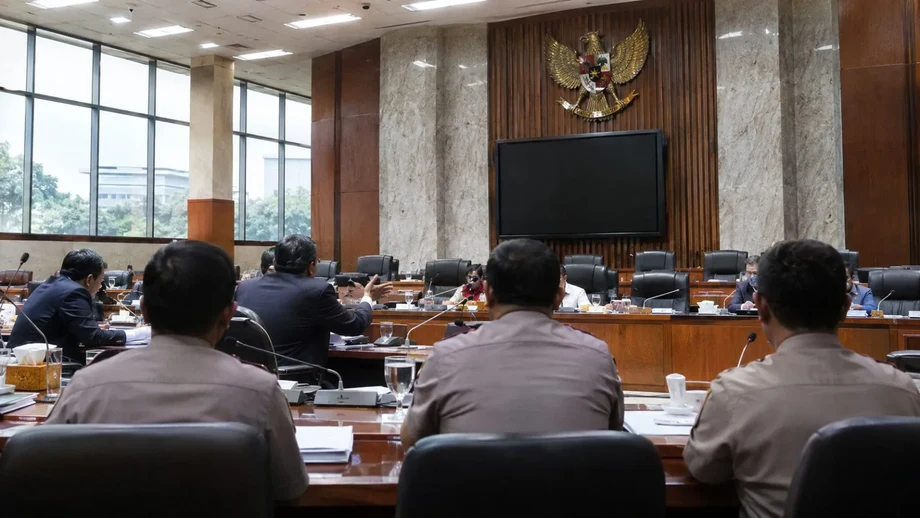
The first official reaction was suspicion. Sufmi Dasco Ahmad, deputy speaker of the House of Representatives, said on the evening of Thursday, 31 July 2025 at the Senayan parliament complex that the wave of flags pointed to something organised. "We have also detected, and received input from intelligence and security institutions, that there are indeed efforts to divide the unity of the nation," he said, urging citizens not to be provoked. Asked whether foreign parties were involved, he did not rule it out, saying many people did not want Indonesia to advance.
Two weeks later the tone from the same building had changed. Speaking at the annual session of the People's Consultative Assembly and a joint session of the House and the Regional Representatives Council in the Nusantara Building on Friday, 15 August 2025, House speaker Puan Maharani listed the flag alongside other recent slogans as evidence of a more inventive public. "Today, public criticism arrives in various creative forms and uses technological progress, especially social media, as a channel for public voice," she said.
These expressions can be short phrases like 'kabur aja dulu', sharp satire like 'Indonesia Gelap', political jokes like 'negara Konoha', up to new symbols like the 'One Piece flag', and many more spreading widely in digital space.
In a democracy, Puan said, people must have wide room to associate, assemble, state opinions and deliver criticism. Dasco returned to the subject that same Friday and asked the government to capture public aspirations and make improvements, saying the House had received the concerns and would pass them on.
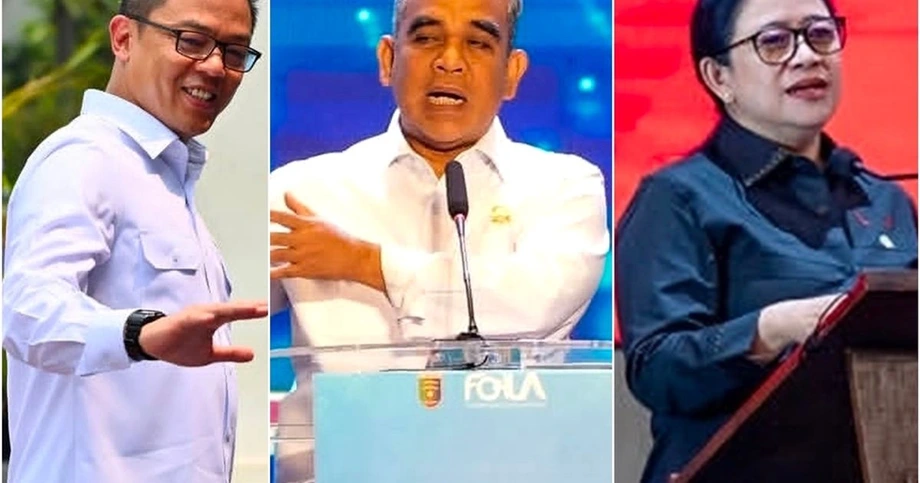
Ministers were equally divided. Deputy Home Affairs Minister Bima Arya Sugiarto called the trend a natural democratic phenomenon and a subtle form of citizen critique, comparable to the flags of community groups that Indonesians routinely fly, while insisting the Red and White must always take precedence. Human Rights Minister Natalius Pigai took the opposite line, saying the government reserves the right to ban Straw Hat flags during independence commemorations and arguing the international community would not object, since the aim would be to protect national symbols rather than limit expression.
The law names the Red and White, not the skull
Coordinating Minister for Political and Security Affairs Budi Gunawan put the legal case on 1 August 2025 in a written statement, warning that anyone who flies the national flag beneath another emblem faces consequences under Law No. 24 of 2009 on the Flag, Language, State Emblem and National Anthem. "There are criminal consequences for actions that damage the honour of the Red and White flag," he said, asking citizens to respect the flag as the country's identity and to hold back from provocation.
As a great nation that respects history, we should all hold back from provoking with symbols that are not relevant to the nation's struggle.
The statute itself is narrower than the warnings suggest. Article 24 governs misuse of the Red and White flag, including flying it under other symbols, and the law does not explicitly ban fictional flags. That gap left the dispute to be fought in public opinion rather than in court during 2025, and it explains why a deputy minister could call the same act both unpunished and unwise.
Scholars read a silent protest
Drajat Tri Kartono, a sociologist at Universitas Sebelas Maret in Surakarta, argued the flag people chose is not the frightening one of legend. "What I see is that what they have taken up is not the flag that represents pirates, with the fierce face, the fierce skull and the black flag, it is more towards animation, towards adventure and informal heroism, a more relaxed heroism," he told Kompas.com on Friday, 1 August 2025. He read it as a statement of creativity, courage and people power, built on the energy of ordinary people who innovate rather than on the comfort of the state.
Drajat placed the trend inside what sociology calls cultural reproduction, the way popular stories are taken up and reused by the people who consume them. "The version that used to look terrifying has been turned towards adventure, and towards the creativity of building freedom and justice," he said.
A study published on 30 January 2026 in the JOMantara journal study took the analysis further. Yuda Syah Putra and Irpan Riana, researchers at Politeknik Negeri Media Kreatif, applied Roland Barthes's semiotics to the flag at three levels: what it denotes (a fictional pirate crew), what it connotes (resistance to injustice, collective solidarity, a quiet critique of systems seen as deaf to public need), and the modern myth it has become. Their paper, in Volume 6 Number 1 of the journal published by Universitas Pasundan, with the DOI 10.23969/jijac.v6i01.31843, finds that social media did the work of normalising the new meaning, and that the flag reflects a crisis of trust in national symbols and a shift among young people from narratives led by the state to symbols drawn from pop culture.
From Kathmandu to Rome
Indonesia was not alone. Japan's National Institute for Defense Studies examined the banner in Commentary No. 408, published on 18 November 2025, in a paper by researcher Koji Matsuo on information security and the new cybercrime convention. On pages 12 and 13, Matsuo notes that the Straw Hat Jolly Roger appeared at demonstrations in Nepal in September 2025 and was also used in protests in Indonesia, Madagascar, Paris, Rome and Serbia, and that a flag from a manga can unite demonstrators whose grievances differ.
Henry Jenkins, a media scholar at the University of Southern California, sees a generation trained by its own entertainment. "This is a generation that has grown up deeply immersed in popular culture and it fuels their civic imagination," he said, placing the flag beside the K-pop light sticks waved at protests against South Korea's president, the three finger salute borrowed from The Hunger Games during rallies in Thailand and Myanmar, and Palestinians dressed as Na'vi characters from Avatar. "It is a vital symbol, it is something that is active within the culture, it is a fun identity," he said of the skull.
Natalie Pang, who heads the Department of Communications and New Media at the National University of Singapore, points to instant recognition among a global fan base. "Its resonance actually really drives its use," she said. "And I can see how, across different contexts, it becomes this sort of uniting symbol that allows youths to rally around common causes and sort of support each other as they pursue what they see as injustice and also corruption." Pang argues that movements travel furthest when they grow out of what people already do and consume, which in Indonesia meant a fan community with a dense social life of its own turning political.
Then police sealed the flag in an evidence bag
More than a year later, on Monday, 23 November 2026, the flag reappeared at a police press conference in Jakarta, this time on a table. The Directorate of General Criminal Investigation at the National Police criminal investigation body, Bareskrim, displayed 20 flags in a treason investigation against the former national police chief, General Listyo Sigit Prabowo, and five other officers identified by the initials LSP, SU, EH, ASN, TK and II. Investigators allege the group tried to weaken public trust in the government of President Prabowo Subianto through actions linked to illegal wiretapping.
Crime investigation chief Commissioner General Asep Safrudin listed the other items seized: 250 black shirts showing a firearm and the words "All Cops Are Bastard", 251 black shirts with a three finger salute and the slogan "Sadar Dipalak, Sadar Dibakar, Sadar Dimiskinkan" plus the hashtag #IndonesiaSadar, a blue notebook holding the task force's analysis and evaluation, and 735 million rupiah in cash. He said the shirts were ordered by suspect Commissioner Iman Imanuddin for demonstrations, while suspect Inspector General Ahrie Sonta Nasution allegedly mobilised crowds through field agents, and that investigators were still tracing who funded the operations.
Brigadier General Susatyo Purnomo Condro, the director of general crimes at Bareskrim, said the shirts and flags were not the central evidence, which he located in a document with about 14 points from a meeting of the group. The items were taken from a search of an alleged coordination post in Cibinong tied to Iman Imanuddin. "On the banners and shirts, once again, these were purely found at the crime scene," he said on Tuesday, 24 November. "Our aim is that these shirts do not spread, slip in and hitch a ride on demonstrations that are lawful, permitted and facilitated by the police, and then turn into riots."
- July 1997: One Piece begins serialisation in Weekly Shonen Jump.
- Late July 2025: Straw Hat flags spread from truck cabs to social media ahead of the 80th anniversary on 17 August.
- 1 August 2025: The coordinating political and security minister warns of criminal consequences under the 2009 national symbols law.
- 7 August 2025: Workers cut up One Piece flags in Karanganyar, Central Java.
- 15 August 2025: The House speaker calls the flag a creative form of public criticism in her annual address.
- 29 August 2025: Protesters carry the flag to the Jakarta police mobile brigade headquarters in Kwitang over the death of motorcycle taxi driver Affan Kurniawan.
- 3 September 2025: A Jakarta rally denounces police violence.
- 23 November 2026: Police display 20 flags as evidence in a treason case.
Typos, test shirts and a courtroom to come
The items on the table drew more ridicule than alarm. The seized flags read "One Peace", not "One Piece". The shirts said "Sadar Di Palak" and "Sadar Di Bakar" with the prefixes split from the verbs, and one hashtag was printed as #Idonesiasadar. For a public that knows the series well enough to spot the straw hat's stitching, the misspellings became the story, and the confiscation turned into a meme.
The mood around protest symbols was already measurable. A sentiment study by Drone Emprit across six social media platforms and several online news channels, covering 27 October to 3 November 2026, found positive sentiment towards the three finger salute at 90.2 percent in online media and 92.7 percent on social platforms, with the gesture spreading from campuses to churches and to music and film award stages.
Whether the evidence meets the legal definition is the question a court will face. Treason, known in Indonesian law as makar, is not dislike of a government, nor mockery, nor symbolic expression. Prosecutors must show a genuine intention to overthrow the lawful government, separate part of the territory or replace the state ideology, a concrete act such as a conspiracy or armed mobilisation, and a real danger to the state. No trial date had been announced when the evidence was displayed, and the wiretapping allegations at the centre of the case remain to be tested in open court.
A new chill before the next march
Khariq Anhar, an activist who was himself a suspect in an earlier case known as the Jakarta Four, said the earlier attempt to link One Piece symbolism to treason collapsed during investigation. He now fears the label will be attached to anyone who carries the flag. "For us, this symbol is the symbolisation of people's resistance, of public unease, of anger from the people themselves," he told kumparan on Wednesday, 25 November 2026.
We have a concern that there is fear for anyone who uses this symbol again to take to the streets, or even to join a demonstration, that they will be branded part of a treason attempt.
Haeril Halim, media manager at Amnesty International Indonesia, warned that mixing protest props into a treason file invites wider damage. "We remind the police to investigate the treason case proportionally and objectively. Do not let the police overreach by turning symbols of economic and social criticism into evidence, so that expressions of dissatisfaction or critical voices are equated with attempts to topple power," he said on Tuesday, 24 November 2026. He added that the One Piece flag and the salute borrowed from The Hunger Games have no connection to the suspects, and that such labelling could open space for arbitrary arrests, persecution of critics and clashes between citizens.
The writer and sociologist Okky Madasari read the move as an attempt to strip protests of legitimacy by suggesting they are staged rather than genuine. She said the misspellings gave the public pause about where the items came from. "We are now in a condition where the public, the younger generation and students can sort information better and can see the oddities," she said.
For the people who tied the flag to their trucks in 2025, the practical change is a calculation about risk. Carrying a cartoon skull to a demonstration now means wondering whether a prosecutor will treat it as a prop of conspiracy. That is the shift the flag's journey has produced: a symbol chosen because it was playful and instantly understood must now be defended in court, by activists, lawyers and the fans who first raised it.
Key Points
- The Straw Hat Pirates flag from One Piece spread across Indonesia in late July and early August 2025, ahead of the 80th Independence Day, first among truck drivers protesting the Zero ODOL policy and a road transport law revision.
- Drivers Rahmat, Satya, cyclist Galang and Kendari resident Anchy described the flag as a peaceful statement about prices, jobs and corruption, not a rejection of the state.
- House speaker Puan Maharani called it creative public criticism on 15 August 2025, while her deputy Sufmi Dasco Ahmad had earlier called the wave a systematic effort to divide the nation.
- Coordinating Minister Budi Gunawan cited Law No. 24 of 2009 and possible criminal consequences, though the statute does not explicitly ban fictional flags.
- A study in JOMantara by Yuda Syah Putra and Irpan Riana reads the flag as a silent protest and a sign of eroding trust in national symbols.
- Japan's defense research institute recorded the flag at protests in Nepal, Madagascar, Paris, Rome and Serbia, with the Nepal demonstrations in September 2025.
- On 23 November 2026, Bareskrim displayed 20 flags reading One Peace, plus 501 shirts and 735 million rupiah in cash, as evidence in a treason case against former police chief Listyo Sigit Prabowo and five other officers.
- Amnesty International Indonesia and activist Khariq Anhar warned the move could stigmatise protest and deter future demonstrators.