MPR sets up checks before choosing Gibran's successor
Indonesia's People's Consultative Assembly (MPR) has formed a team of 36 lawmakers to check the qualifications of two prospective vice presidential candidates, with a vote to fill the vacant office scheduled for December 2, 2026.
Contents
- MPR sets up checks before choosing Gibran's successor
- Two teams will handle different parts of the process
- December 2 vote puts nominations on a tight schedule
- Who gets to choose the new vice president?
- Education dispute preceded Gibran's departure
- Gibran pledges continued support for Prabowo
- Three names reflect different political choices
- The choice reaches into coalition talks and 2029
- A replacement will reshape the Prabowo-Jokowi alliance
- Key Points
MPR Chairman Ahmad Muzani announced the arrangements after a joint meeting at the parliamentary complex in Senayan, Jakarta, on Friday, November 13. The assembly's leadership agreed to write to President Prabowo Subianto requesting two names, together with the documents needed to establish their eligibility.
The process follows Gibran Rakabuming Raka's resignation amid pressure from lawmakers over his educational qualifications. Parliament said the vice presidency became vacant on November 12, when he submitted his resignation letter to MPR leaders during a meeting lasting about 20 minutes.
Prabowo will choose the two nominees, but the MPR will select the next vice president. The qualification checks therefore come between the president's nominations and the assembly's decision, placing scrutiny of candidate documents at the centre of a succession triggered by a dispute over those same requirements.
The November 13 meeting brought together MPR leaders, representatives of its political party factions and the Regional Representative Council (DPD) group. It also approved a separate team of 36 members to prepare the formal decree appointing whoever wins the assembly's vote.
Two teams will handle different parts of the process
Muzani said one MPR leader would chair the verification team, whose task covers all required qualifications for the vice presidency. The request to Prabowo will seek complete supporting documents alongside the two names.
Muzani described the team's responsibility at the press conference following the meeting:
"The team's responsibility is to verify whether the vice presidential candidates meet all the required qualifications," he explained.
The separate ad hoc team will be chaired by three MPR deputy speakers and include representatives of the assembly's political party factions and the DPD. Its job is to draft the MPR decree appointing the vice president elected in the plenary session.
In practical terms, the verification team examines whether the nominees qualify, while the ad hoc team prepares the document that formally records the appointment. Muzani asked for public prayers, support and attention as the assembly carries out the process.
December 2 vote puts nominations on a tight schedule
The MPR has scheduled its plenary session to elect the new vice president for December 2. That is 20 calendar days after the vacancy date announced by parliament, leaving a short period for nominations, document checks and political negotiations.
The nomination deadline has been described as 14 days after the president receives the assembly's request, while another account specifies 14 working days. The assembly's completion period has likewise been described as up to 60 days, or 60 working days. The exact deadline calculation matters because working days usually exclude weekends and public holidays.
The announced sequence is:
- November 12, 2026: Gibran submits his resignation letter, and parliament dates the vacancy to that day.
- November 13: MPR leaders and parliamentary groups agree to request two nominees and establish the verification and ad hoc teams.
- After the request reaches the president: Prabowo submits two names and their supporting documents within the stated nomination period.
- December 2: The MPR is scheduled to meet in plenary to elect the new vice president.
Muzani said it was not yet clear which two names Prabowo would submit. The president was still gathering views from coalition leaders, academics and others before deciding.
Who gets to choose the new vice president?
The MPR brings together 580 members of the House of Representatives (DPR) and 152 members of the DPD, which represents Indonesia's provinces. Together, they make up an assembly of 732 members.
The DPR therefore accounts for about 79.2 percent of MPR membership, calculated from 580 of the 732 seats. The DPD accounts for about 20.8 percent. Political parties represented in the DPR consequently hold most of the seats in the body that will choose between Prabowo's nominees.
Indonesia's voters elected Prabowo and Gibran together in 2024. Filling the vacancy now follows a different route: the president proposes two candidates, and the MPR chooses one. There is no new nationwide popular vote in the process described by the assembly.
The distinction gives party negotiations a direct role in the outcome. A nominee needs presidential backing to enter the contest, followed by enough support inside the assembly to win the office.
Education dispute preceded Gibran's departure
Gibran, 39, left office after court rulings questioned whether the overseas education documents used for his 2024 candidacy demonstrated that he had completed the required level of schooling. Election law requires vice presidential candidates to have completed senior high school or an equivalent education.
The Constitutional Court and Supreme Court rulings were described as finding his credentials inadequate for candidacy, with the evidence supporting his certificate falling short of proving graduation. Around 120 lawmakers from all eight parliamentary factions proposed starting impeachment proceedings.
The proposal drew support across the political spectrum, including nearly a dozen lawmakers from Prabowo's Gerindra party. Impeachment is a formal process through which legislators seek to remove an officeholder. Gibran resigned as that proposal gathered support, while saying his decision was personal and unrelated to his educational credentials.
His entry into national office had also followed a contentious court decision. In 2023, the Constitutional Court, then headed by his uncle, changed the age eligibility rules in a way that allowed him to stand. Prabowo announced Gibran as his running mate days later, and the pair won the 2024 election.
Gibran pledges continued support for Prabowo
Gibran said in his farewell message that becoming vice president had never been his personal plan. Before joining Prabowo's ticket, he had served as mayor of Surakarta, a city on Java.
Gibran described his feelings about the office in the video:
"Honestly, sitting in this seat was never something I designed, thought about, or pursued," Gibran said.
He also said he would continue backing Prabowo outside government. Addressing volunteers, the departing vice president urged them to maintain their support:
"I only have one message: Please, inside or outside government, we still have to support the president," he said.
Former president Joko Widodo, Gibran's father and widely known as Jokowi, also publicly expressed support for Prabowo after the resignation. Their statements came as political attention shifted to whether the departure would weaken the alliance between the two families.
Three names reflect different political choices
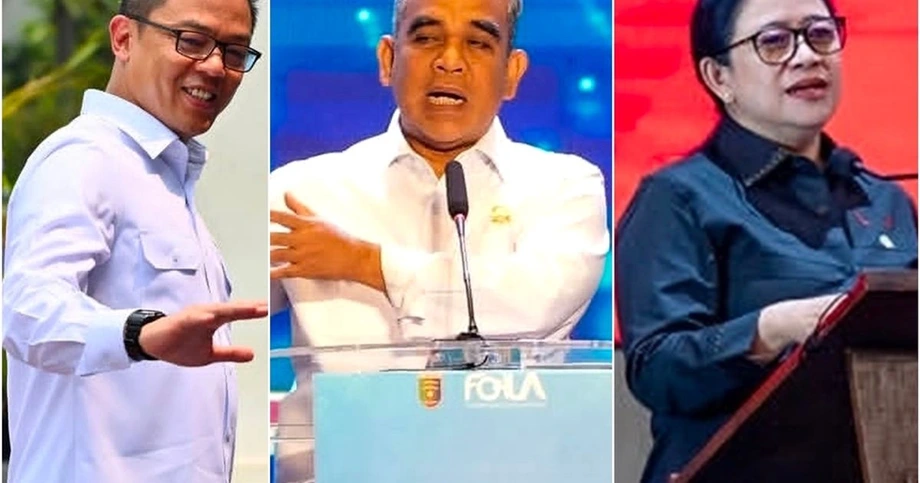
Sugiono, Ahmad Muzani and Puan Maharani have emerged as prominent potential successors. None had been announced as a presidential nominee when Muzani outlined the selection process.
Sugiono is Gerindra's secretary general and coordinating minister for human development and cultural affairs. He served as foreign minister until October 1. His close relationship with Prabowo makes him a possible choice for a president seeking a deputy drawn from his own political circle.
Muzani combines his position as MPR chairman with long experience managing Gerindra's political relationships. He served as the party's secretary general for 17 years until 2025. His potential candidacy brings attention to his connections among legislators, who will decide the contest.
Puan, the DPR speaker, belongs to the Indonesian Democratic Party of Struggle (PDI-P), the only party in the House outside the government. She is the daughter of party chairwoman and former president Megawati Soekarnoputri. Choosing her would bring a major political force from outside the governing coalition into the presidency.
Agung Baskoro, executive director of political research group Trias Politika Strategis, considered a Gerindra figure the likeliest choice, arguing that Prabowo needed political consolidation and stability. Ambang Priyonggo, a political analyst at Multimedia Nusantara University, also identified a possible alternative: a technocrat without a party background if government performance became the president's main priority.
The choice reaches into coalition talks and 2029
Prabowo can seek a second presidential term in 2029. His choice of deputy therefore involves both the immediate task of filling the vacancy and the longer political question of who might run alongside him, or compete for power later.
Firman Manan, a political analyst at the University of Padjadjaran, said a Gerindra vice president would be closely aligned with Prabowo. He argued that the president would weigh whether a potential deputy could become a rival in 2029.
Puan would bring a different calculation. Ambang said her appointment could extend government support across every party in the DPR. PDI-P also has an established network reaching into villages, giving it a political reach beyond parliamentary seats.
Firman said such a deal could require concessions to coalition parties that backed Prabowo earlier, including Golkar and the National Awakening Party (PKB), potentially through a Cabinet reshuffle. Economist Wijayanto Samirin of Paramadina University considered a PDI-P choice politically beneficial, while cautioning that the party might decline.
For the parties involved, the vice presidency is therefore part of a wider negotiation over influence, Cabinet positions and future elections. Selecting a Gerindra colleague would keep the top two offices within one party; selecting Puan would broaden the governing arrangement while requiring Prabowo to share it with another powerful political family.
A replacement will reshape the Prabowo-Jokowi alliance
Gibran's place on the 2024 ticket linked Prabowo to Jokowi's popularity and political network. The alliance joined former rivals: Jokowi defeated Prabowo in the 2014 and 2019 presidential elections before appointing him defence minister during his second term.
Burhanuddin Muhtadi, an analyst at Singapore's Yusof Ishak Institute, said Gibran's departure could mark a substantial change in that relationship. He described the loss of the vice presidential connection while allowing for continued cooperation:
Gibran's resignation does not necessarily mean that Jokowi and Prabowo have completely parted ways," said Burhanuddin Muhtadi. "However, one of the most important bonds of their alliance has been severed.
The resignation also comes amid a police investigation into suspected illegal wiretapping involving four senior police figures, including former police chief Listyo Sigit Prabowo, who is widely seen as close to Jokowi. Police said they had sufficient initial evidence to pursue treason charges over alleged surveillance of Prabowo, other politicians, activists and journalists. The allegations remain under investigation.
The December 2 selection will determine who occupies the vacant office and reveal which political relationships Prabowo wants closest to the presidency. Before that decision, the MPR's immediate task is narrower and concrete: obtain two nominations, examine their qualifications and prepare the formal appointment.
Key Points
- The MPR formed a team of 36 lawmakers to verify two vice presidential nominees from President Prabowo Subianto.
- A separate team of 36 members will draft the decree appointing the elected vice president.
- The assembly has scheduled the election for December 2, 2026.
- Parliament dated the vacancy to November 12, when Gibran submitted his resignation.
- Gibran resigned amid an education credentials dispute but said his decision was personal and unrelated to that issue.
- Sugiono, Ahmad Muzani and Puan Maharani are prominent potential successors; the two official nominees had not been announced.
- The MPR's 732 members, comprising 580 DPR members and 152 DPD members, will choose the replacement.