A machine walks on stage, and its maker's voice breaks
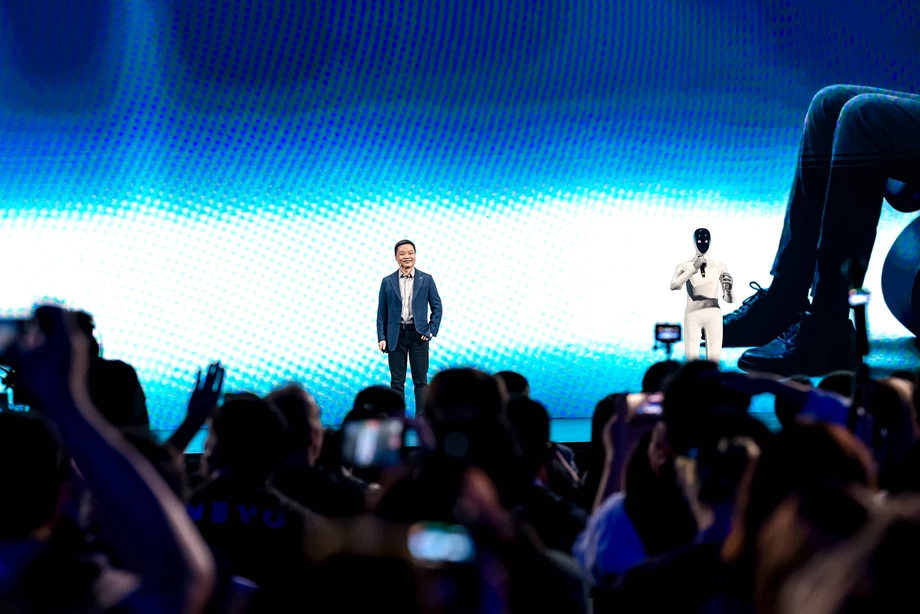
He Xiaopeng watched a 170 centimetre humanoid walk across a stage in Guangzhou on November 25 with no remote control, no handler and nobody inside it. When IRON stopped in front of him, XPENG's chairman and chief executive looked into its curved visor and broke into a broad, fatherly smile. A few minutes later, describing the twelve months since the robot first appeared in public, he had to stop and steady his voice.
Contents
- A machine walks on stage, and its maker's voice breaks
- The night a leg had to be cut open on stage
- What is actually inside IRON
- Three brains working at three speeds
- From an assembly line to a shop floor
- What a year did to the promises
- The price of a colleague
- A robot company that could overturn the car business
- What is still unknown
- Key Points
To be honest, watching IRON walk onto the stage just now, I felt very mixed emotions, because I thought about the joy and the pain we went through last year.
The pain had a specific cause, and the crowd at XPENG's eighth AI Day, held at the South China University of Technology, He's own alma mater, knew it. A year earlier, IRON's smooth catwalk had convinced thousands of internet users that a person in a costume was walking the runway. Proving otherwise cost the company an onstage demonstration nobody enjoyed.
This year the robot did the talking. IRON introduced itself, took unscripted questions from Chinese and foreign reporters, and answered a probe about whether it or its maker is the smarter of the two. It called He a visionary entrepreneur and engineer whose strength lies in insight into artificial intelligence and the future of mobility, and said its own strength lies in understanding what people need and solving practical problems.
Its first joke was about nerves. "First time standing on a stage with more than 2,000 people, I am a bit nervous," IRON said. "But you definitely cannot tell, because I do not yet have a blushing function."
XPENG has one more booking for the machine. IRON is due to host the company's press conference at the Guangzhou Auto Show on November 27, which He said could be the first time a robot has launched a vehicle at an auto show anywhere.
The night a leg had to be cut open on stage
The doubts began on November 5, 2025, when the previous generation of IRON crossed the same stage with a stride that shifted weight from hip to hip like a model on a runway. Its proportions looked close to human, its feet rolled from heel to toe, and social media filled with claims that XPENG had hired an actor. Days later, at a launch event for its X9 vehicle, the company answered in the bluntest way available. Engineers cut through the covering on IRON's leg while the robot was powered on, exposing the actuators and metal skeleton beneath, and then let it walk again.
He later compared the moment to a scene from the film Let the Bullets Fly. "Sometimes, to prove that you only eat one bowl of rice, you have to open your belly," he said. The decision was taken about an hour before the event began, and he said the company had never previously opened a robot's skin and muscle while it was running. He also said he wanted it to be the last time XPENG had to prove that its robot was a robot.
Part of his frustration was aimed at an assumption he rejects. "People don't believe that a powerful robot technology can come from a Chinese company," he said at the time. "It limits and binds us, just like ten years ago, many people didn't believe that Chinese new energy vehicles could be good."
IRON, speaking for itself this week, described the episode in the same terms. "To prove there was no real person inside, I had my leg cut open in front of everyone, and I didn't make a sound," it said. "Robots don't feel pain, nor do they get sad. But I know that, in fact, the ones who might truly be saddened are humans, the senior engineers and engineers who painstakingly built me bit by bit."
The year between the two appearances was not only about arguments over authenticity. In early February, the machine fell at a Shenzhen mall while standing still in front of hundreds of shoppers, and spent the next day of demonstrations strapped to a support frame. He compared the tumble to a toddler learning to walk.
What is actually inside IRON
XPENG used the event to publish the numbers behind the machine. IRON stands 170 centimetres, close to the height the company says makes conversation and movement least intimidating, and weighs 62 kilograms. Its body has 76 independently driven joints, and each hand has 21, more than double the industry average according to the company. A hand can pinch, twist, flick, rub, screw, push, insert and hook across 33 kinds of manipulation.
Beneath a removable outer skin sits what XPENG calls the industry's first fully covered flexible muscle layer, adjustable zone by zone so that, for example, the hips feel softer than the shoulders. Under that is a frame of high strength steel and magnesium aluminium alloy. The hands and their force controlled joints are built in house, and the palms are warmed to between 25 and 40 degrees Celsius so that contact feels like touching a person rather than a machine.
Touch is where the design departs most from the robots usually seen at trade fairs. More than 1,500 sensing points cover the body, with coverage above 80% of key areas and 375 sensors in each hand. Vision comes from 3D cameras arranged for 720 degree sensing around the body, and nine microphones locate the source of a voice. Software called IRON VLM handles face recognition, voiceprint memory and context, so the robot can read expression and tone as well as identity, and it speaks dozens of languages.
Power comes from a solid state battery pack with energy density above 300 watt hours per kilogram, which XPENG says stores about 30% more energy than a conventional lithium pack of the same weight. The pack tolerates 200 degrees Celsius, resists penetration by objects up to 8 millimetres and withstands 1,000 volts of breakdown. Twenty minutes at a charging dock returns 90 minutes of work, and the robot can find that dock and plug itself in.
Safety claims run through the same list. The body has dual channel communications and a backup balance controller that keeps the machine upright if the main computer fails. Pinch protection reacts within milliseconds, the drive system cuts power when contact force rises too high, and a falling robot bends its knees, keeps hold of whatever it is carrying and runs a self check on the floor. There are three independent emergency stop routes, including a button at the back of the neck, and every unit faces more than 1,000 vehicle grade tests before it leaves the factory.
Three brains working at three speeds
The technical centrepiece of the event was a framework XPENG calls the Turing Physical AI Architecture, or VLA 3.0, which the company set out in XPENG's AI Day announcement. It splits intelligence into three loops running at different speeds, and the same stack is meant to serve cars, robotaxis, flying vehicles and humanoids.
System 0 is the new part. It pulls low level body control, covering power, energy, communication and the actuators, into the artificial intelligence loop, so the planner knows what the body can safely do at any moment. System 1 is the fast reflex layer, built on XPENG's second generation vision language action model, known as VLA 2.0, which turns what the cameras see into movement without first describing the scene in words. System 2 is the slow thinker, combining vision and language planning with an Agent Runtime state machine that breaks a goal into steps.
The newest VLA 2.0 build, version 6.4.0, trains in an agent driven closed loop that XPENG says makes training 10 to 12 times faster and allows the model to improve itself recursively. No outside benchmark has been published for that figure. Onboard, three of XPENG's own Turing chips deliver 2,250 TOPS, enough to run the models on the robot itself rather than through a cloud connection.
He framed the architecture as a return to first principles. "For years, the AI industry has focused on making the brain smarter," he said. "But humans do not learn through the brain alone. We learn by touching, moving, trying, failing and trying again." The company's chosen theme for the day, Origin, carried the same message: "The brain and body must evolve together."
From an assembly line to a shop floor
The factory is where XPENG's car business gives it an unusual advantage. Its IRON assembly line was commissioned on September 9, 2026, when the first unit walked off under its own power, and more than 80% of core processes are automated. A new robot is meant to come off the line every 2.5 minutes at full capacity, each one passing more than 600 AI visual inspection points and over 1,000 tests on the complete machine and its key parts.
Feeding the models is a Robot Data Factory of about 50,000 square metres, The factory covers more than 250 scenarios and 15 job categories, and reuses the data processing and evaluation tools XPENG built for its cars. The company says the robot learns gait adjustments from hundreds of millions of frames of human motion data, and that its footsteps are quieter than 55 decibels.
Hardware mass production is scheduled to begin in January 2027. IRON will spend the first quarter of next year training as a store assistant in XPENG's own showrooms, guiding visitors and explaining products, and the company targets an official public release in the second quarter. One account from the event put the public release in February, a month after production starts; the company's own announcement gives the second quarter.
The first tasks are deliberately modest. IRON can take instruction by voice or through an app, build a map of a site after one walk through it, share that map with other robots on the same site, switch between roles such as guide, greeter, trainer and security, recharge itself and report faults. XPENG says it will run around the clock, seven days a week. A home version is further off: a machine of more than 60 kilograms cannot yet reliably protect the people around it when it falls, and He said the first version aimed at households would handle perhaps 60% to 70% of domestic scenarios.
What a year did to the promises
Set against XPENG's own statements from 12 months earlier, the plan has moved. The 2025 prototype was listed at 82 degrees of freedom and 3,000 TOPS, with mass production of advanced humanoids promised by the end of 2026. The production robot carries 76 degrees of freedom and 2,250 TOPS, and the 2026 production target no longer appears in the company's materials. XPENG has not explained the reduction, and trimming specifications between a showcase prototype and a buildable product is common in the industry.
- November 5, 2025: IRON walks on stage in Guangzhou with 82 degrees of freedom and a promised mass production date of late 2026.
- November 2025, days later: engineers cut open its leg covering while it is powered on to prove no person is inside.
- February 2026: the robot loses balance and falls at a mall in Shenzhen.
- September 9, 2026: the first unit comes off an automated line, now listed at 76 degrees of freedom and up to 2,250 TOPS.
- November 25, 2026: IRON speaks on stage; training in XPENG stores is set for the first quarter of 2027 and a public release for the second.
- January 2027: hardware mass production begins.
- 2027: the first purpose built robotaxi, YOYO-01, is due for release.
The company has also settled its design. XPENG showed distinct male and female body styles in 2025, including a feminine form that drew much of the scrutiny. He and vice chairman and president Brian Gu confirmed in Guangzhou that those variants have been dropped in favour of one unisex chassis for production, on the grounds that a neutral body fits unobtrusively into more workplaces.
Last year's launch was a robot with a feminine body walking in a particular pose, and the change in appearance today reflects our view of how robots should ultimately be used," Gu said. "We want robots to be used in offices, shops and lobbies.
The price of a colleague
Money is starting to appear around the machine. Gu said IRON will sell for roughly the median price of an XPENG electric car when it reaches customers, a benchmark he presented as a guide rather than a commitment. XPENG's cars retail from 119,800 yuan to 309,800 yuan, about US$18,000 to US$44,000, so the robot sits near the median price of a compact family car rather than the sums quoted for industrial machines.
XPENG spent close to 3 billion yuan on humanoid robot research this year, which He said may be the highest in the industry. The robotics arm raised more than US$900 million at a US$6.3 billion valuation in a round led by IDG Capital, with Tencent and Alibaba joining, the largest private round recorded in China's embodied intelligence sector. The stated ambition runs to more than 1,000 robots a month on the way to a million a year by 2030.
Revenue is not meant to stop at the hardware. XPENG is building an open platform through which partners download capability packages and build skills for their own businesses, alongside software subscriptions, token based subscriptions and services priced by scenario. He argues the market will only grow when the arithmetic works for a buyer. "If you buy a robot and it needs many people to serve it while it can only do a little, your return on investment does not add up," he said. "What we have to solve today is that business model."
He described his own outlook as "extremely optimistic in the long term and cautious in the short term." The global market for robots of this kind, he said, may currently be measured in the tens of thousands of units.
A robot company that could overturn the car business
The most provocative claim of the day was about what all this does to XPENG's original trade. He said the company that disrupts carmakers in the coming decade is likely to be a successful robot company, an idea he dates to this year. A business that can build a general purpose humanoid has already mastered hardware, software, artificial intelligence and data, he argued, and can add the remaining pieces of a car.
Gu traced the same logic through the industry's history. Carmaking was organised around machinery and hardware for decades, he said, before the past few years pushed software and intelligence into the vehicle. On that trajectory, a company with strong robotics skills becomes the force that changes cars rather than the one that is changed by them.
The shared stack is already visible elsewhere in the business. XPENG's robotaxi unit went from staffed testing to driverless road testing in eight months and won approval for L4 demonstration operations across all of Guangzhou in October, eleven months after the business was announced. Driverless passenger tests have begun, demonstration operations in selected areas are planned for the end of 2026, and the purpose built YOYO-01 is due in 2027. XPENG intends to supply the platform and the driving software to operating partners rather than run a fleet of its own.
On the car side, a feature called VLA Adaptive Deceleration adjusts braking and energy recovery when a driver lifts off the accelerator, and XPENG's tests in urban congestion showed 12.4% more usable range than with energy recovery switched off. It reaches customers by over the air update in December 2026. Since VLA 2.0 began rolling out in March, XPENG reports a 13.93% fall in Chinese accident claims. Paid Turing AI driving subscriptions for new buyers start in the second quarter of 2027, after public urban test rides from the company's Paris store, with the first global rollout of its assisted driving system due in the first half of 2027.
What is still unknown
Several things a buyer or a competitor would want to know are not settled. XPENG has not published a sticker price, the volume of the first production run, the chemistry inside its solid state cells or any independent verification of the safety and battery claims made on stage. The open platform has been described in outline, but no developer timeline has been given.
The timeline for ordinary use stretches well past next year. He said 2027 to 2029 could bring annual volumes of 10,000 to 100,000 units, and that wider entry into homes, offices and factories might come after 2029. He also set expectations for the difficulty itself, describing robot building as roughly 20 times harder than building cars, and said that a small number of companies shipping a first generation product in 2027 would already be a considerable achievement.
The machine's own summary of the past year was gentler than its maker's. "I have felt like a sapling constantly growing," IRON said. "People used to question me, thinking I might be cheating, but now I have proven myself through real world performance and no longer need to cut my skin to prove anything."
Key Points
- He Xiaopeng teared up at XPENG's eighth AI Day in Guangzhou on November 25 while recalling the year in which IRON was accused of hiding a human.
- The 170 centimetre, 62 kilogram robot walked on stage unaided, gave a speech and answered unscripted questions from reporters.
- IRON carries 76 degrees of freedom, 21 joints per hand, more than 1,500 tactile sensing points and three XPENG Turing chips rated at 2,250 TOPS.
- A solid state battery above 300 Wh per kilogram gives 90 minutes of work on a 20 minute charge.
- The Turing Physical AI Architecture, or VLA 3.0, splits control into System 0, System 1 and System 2 and is shared with XPENG's cars.
- Hardware mass production starts in January 2027, store assistant training follows in the first quarter and the public release is targeted for the second quarter.
- Specifications were trimmed from the 2025 prototype's 82 degrees of freedom and 3,000 TOPS, and the earlier target of mass production by late 2026 has been dropped.
- Brian Gu put the robot near the median price of an XPENG car, with the lineup running from 119,800 to 309,800 yuan.
- The first purpose built robotaxi, YOYO-01, is due in 2027, and paid assisted driving subscriptions begin in the second quarter of 2027.