The Numbers Behind India's Changing Holiday Plans
Searches for 'wellness travel India' rose 1,600% over the past year in India, while queries for 'fitness trip' climbed 950% and 'silent retreat' rose 150%, according to the 2026 travel analysis the Google India team published on 23 November 2026. The same dataset records '1 day trip near me' up 130%, 'hidden gems India' up 400%, 'travel community' up 400% and 'AI for Travel' up 600%.
Contents
- The Numbers Behind India's Changing Holiday Plans
- Wellness Is the Loudest Signal in the Data
- From Spa Weekends to Blood Tests: What a Wellness Holiday Now Means
- Kerala and the Hill Towns That Stand to Gain
- The One Day Trip Becomes a Category of Its Own
- Hidden Gems, Hiking Trails and Music Festivals
- Solo, but Not Lonely
- Stays Booked to Match a Lifestyle
- AI Joins the Planning Desk
- What Is Still Unknown
- Key Points
Google sorts the change into three movements: holidays built around an experience, getaways of a day or two, and independent travel. Each figure counts searches, not bookings. A 1,600% rise means a phrase was typed roughly 17 times as often as in the earlier period, so the numbers describe curiosity during planning rather than tickets sold or rooms filled.
Breakout queries follow a different rule. Google marks a term as a breakout when interest climbs fast enough to cross a threshold set against the earlier period. 'What is slow travel', 'hiking trails near me', 'music festival travel', 'solo travel guide' and 'best places to travel solo' all crossed it.
Maharashtra led the country for '1 day trip near me'. Weekend getaways and long weekend travel remain high-interest searches, which suggests the single day break is being added to the calendar rather than replacing the longer holiday. The findings arrive a month before the year's main booking season, when families plan summer and festival travel.
These figures extend the 2026 search data first set out on 24 November, when wellness travel and one day trips already led the change.
Wellness Is the Loudest Signal in the Data
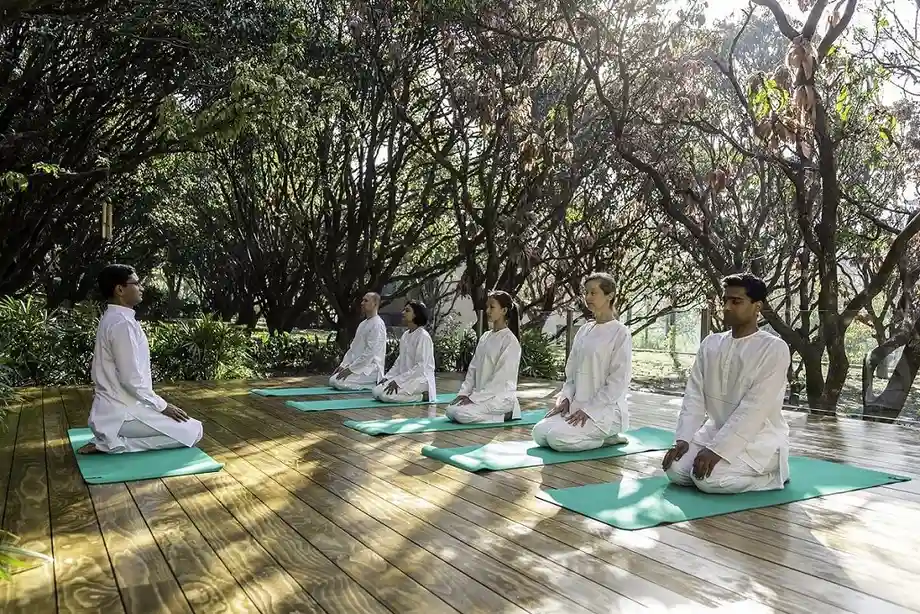
Wellness travel outgrew every other theme. Its 1,600% rise is four times the 400% increase recorded for 'hidden gems India' and about 1.7 times the 950% rise for fitness trips. The two ideas differ: a fitness trip points to training, sport or long walks, while a silent retreat usually means days away from ordinary distractions, built around meditation, limited conversation and a quieter routine.
The wish to slow down appears in a third form. Searches for 'what is slow travel' became a breakout query. Slow travel generally means spending more time in fewer places, so a visitor stays long enough to learn a town's routines instead of covering five towns in five days.
A survey by the travel search company Skyscanner found 91% of Indian travellers were drawn to stays built around wellness. A survey answer and a search trend measure different things: one records what people say they want, the other what they look up while planning a trip.
India already holds the raw material for this kind of holiday. Yoga retreats in Rishikesh and Ayurveda therapies in Kerala have drawn overseas visitors for decades. The searches show Indians themselves now looking for the same reset at home.
From Spa Weekends to Blood Tests: What a Wellness Holiday Now Means
At the top of the market, the wellness break has moved well past massage and yoga. Guests arrive at retreats to have their bodies measured: blood markers, biological age, epigenetic tests, genetic panels, fitness tests and advanced imaging, followed by a programme built around the results. Biological age tests try to estimate how well the body is ageing compared with a calendar age, while epigenetic tests look at chemical marks on DNA that shift with sleep, diet, stress and exercise.
The Wellness Co, started in 2021 by brothers Rohan and Rishabh Jain, both former professional tennis players, ran membership clinics in eight cities before opening a 270-acre retreat at Karma Lakelands in Gurugram in July, which the company describes as India's first luxury longevity retreat. Rishabh Jain explained the reasoning.
We decided to expand into the retreat space to create a programme where people could focus on wellness 24 hours a day and to offer an integrative experience with daily consultations, diet and nutrition, ayurveda, putting in a system and protocol personalised to the individuals.
The company is planning a second property in Landour, near Mussoorie, and is in discussions for retreats in Bengaluru and Goa. Dr Garima Gaur, chief wellness officer at The Wellness Co, described how a stay begins.
When a person signs up for a retreat, the first consultation with the doctor is done online to understand what concerns the patient has, what their current lifestyle is like, what is that they would like to work on, and what their barriers are. We sometimes recommend a basic blood test or profiling for nutrients. Based on this, an entire programme is customised for them and we let our team know of the customised protocol along with the nutrition requirements for the duration of the stay.
Prices show who the market is aimed at. Clinic memberships at The Wellness Co start at ₹75,000 to ₹1 lakh a month. AIWO, a Chennai operator mentored by Aircel founder C Sivasankaran, sells AIWO 360, a day of advanced diagnostics and preventive health planning, at ₹1.3 lakh per person, and runs programmes monitored by physicians under the name Healthcation at The Leela Palace Chennai and Fairmont Mumbai. Sivasankaran put the case for tailoring.
No two people are alike. So why should their health programmes be the same? At AIWO, we bring together medical science, psychology, nutrition, sleep and recovery to create a personalised experience focused on measurable health outcomes.
Independent practitioners assemble their own tests. Tanya Malik Chawla, a functional nutritionist and longevity researcher who founded Biology By Design, often begins with blood markers used to calculate phenotypic age, then looks at functional strength and mobility measures such as VO2 Max, the maximum rate at which the body uses oxygen during hard exercise, and at hormonal markers. Digestive complaints can lead to gut microbiome tests or stool cultures, and some cases to a genome panel.
Hotel groups are buying into the model. Indian Hotels Company, the parent of Taj Hotels, took a controlling stake in Atmantan Wellness Retreat at Mulshi near Pune in 2025, a property whose programmes draw on ayurveda, yoga, naturopathy, physiotherapy, nutrition, counselling, coaching and fitness. Puneet Chhatwal, managing director and chief executive of IHCL, said hotel strengths help a business that needs clinical discipline.
From a business perspective, integrated wellness requires specialist expertise, a differentiated operating model and a long-term commitment to quality. IHCL brings to its partnership its strengths in hospitality, brand building and distribution, enabling Atmantan to build on its established foundation and reach a wider audience.
Akanksha Lamba, co-founder of The Postcard Hotel, whose Ayurveda Retreat in Goa is run with Sitaram Ayurveda of Keralam, points to how differently these guests behave.
What is interesting about this segment is the decision to travel is driven by a very specific purpose.
That purpose shapes the booking calendar. Retreat hotels report stays running from a week to 21 days, far longer than a city break, with a typical guest aged 35 to 58 and a growing share of visitors over 60. The spending has produced its own market estimates: India's medical tourism market was valued at $8.7 billion in 2025 and projected to reach $16.2 billion by 2030, while the wider global market for medical value travel was put at about $115.6 billion in 2022 and expected to reach $286.1 billion by 2030. The Medical Tourism Index 2020-21 ranked India 12th among the world's top 20 wellness tourism markets and fifth among the top 10 in Asia and the Pacific.
Government policy has moved in the same direction. The 'Heal in India' programme and the AYUSH Visa, introduced in July 2023 for people travelling for ayurveda, yoga, unani, siddha and homoeopathy treatment, are designed to bring foreign patients to Indian wellness facilities.
- 2021: The Wellness Co begins as a membership clinic operating in eight cities.
- July 2023: India introduces the AYUSH Visa for treatment travel.
- 2025: IHCL takes a controlling stake in Atmantan Wellness Retreat in Mulshi, Pune.
- July 2026: The Wellness Co opens its 270-acre retreat at Karma Lakelands in Gurugram.
- 23 November 2026: Google publishes its 2026 travel trends analysis for India.
Kerala and the Hill Towns That Stand to Gain
Kerala holds an advantage the search data cannot capture directly: ayurveda, yoga and nature cure traditions that already underpin its tourism. Wayanad, Munnar, Varkala, Alappuzha and Kumarakom are the places where visitors following the slow travel idea are concentrating, with homestay culture and small properties suited to guests who stay longer in one place rather than moving on each morning.
Weekend behaviour in the state mirrors the national picture. Hikes to waterfalls and hill stations within driving distance of major towns are drawing more people, and the searches for nearby trails that Google flagged as breakouts fit the pattern Maharashtra set with day trips. Wellness retreats and slow travel packages in these districts are the parts of the state's tourism economy most likely to see the demand first.
The One Day Trip Becomes a Category of Its Own
The 130% rise in '1 day trip near me' searches describes a break with no hotel night, planned around a single free day. Maharashtra's lead fits its geography: Mumbai and Pune sit within a few hours of hill forts, beaches and lakes, so a Saturday can hold a full trip.
Survey work on younger travellers points the same way. A YouGov survey of 2,012 people aged 18 to 29 across 11 Indian cities found 87% preferred trips lasting less than a week, and seven in 10 said they would rather take three short trips than one long holiday. Airbnb data showed Indian Gen Z searches for summer travel up more than 30% year on year, with domestic stays of two to six nights up nearly 80%.
Hidden Gems, Hiking Trails and Music Festivals
Searches for 'hidden gems India' rose 400%, and 'hiking trails near me' and 'music festival travel' became breakout queries. The idea of a hidden gem has stretched beyond destinations: a lane-side breakfast joint, a bookshop that has outlasted three generations, a centuries-old sweet shop or a heritage building that never reaches a standard itinerary can all qualify.
Social media does two things at once here. A viral reel makes a quiet cafe easy to find and then makes it hard for the cafe to stay quiet, with a weekend queue arriving within weeks. The hunt for the undiscovered has itself become a mainstream pursuit, which is why the search volume keeps climbing even as the number of genuinely undiscovered places falls.
Solo, but Not Lonely
Three queries emerged as breakouts together: 'solo travel guide', 'best places to travel solo' and 'solo travel cost India'. The pattern reflects travellers who plan around their own schedules instead of waiting for friends or family to settle dates. Searches for 'travel community' rose 400% alongside them, a sign that independent travel is being paired with an interest in meeting people along the way.
Stays Booked to Match a Lifestyle
Accommodation searches became far more specific. Queries for 'best pet friendly hotels', 'affordable homestay' and 'family friendly destinations' gained traction, each answering a practical question: whether a dog can come, what a night costs, and whether children will be comfortable. For hosts, the lesson sits in the wording, since travellers now search for their constraints before they search for a place.
AI Joins the Planning Desk
Searches for 'AI for Travel' rose 600% over the past year. Google points to three tools inside the planning process. A screenshot of a cafe, a trail or a coastline can go straight into AI Mode in Google Search with the prompt 'Where is this? Help me plan a trip!' Gemini, with its Personal Intelligence setting switched on, can draw on connected apps such as Gmail, YouTube and Google Photos to build an itinerary, and Google's sample request asks for a weekend in the hills within a six-hour drive based on things the user likes to do. Ask Maps then handles conversational requests on the ground, such as finding a highly rated lunch spot along the route to a hotel.
What Is Still Unknown
Google did not disclose the baseline search volumes behind these percentages or the full period each figure covers, and no date has been given for an updated set of figures. Bookings, occupancy and spending data would be needed to show whether this curiosity turns into travel. The next signals will come from the summer booking season and from the retreat operators now expanding in Gurugram, Pune, Goa and Mussoorie.
Key Points
- Searches for 'wellness travel India' rose 1,600% over the past year, with 'fitness trip' up 950% and 'silent retreat' up 150%.
- '1 day trip near me' searches rose 130%, with Maharashtra leading national interest.
- 'Hidden gems India' and 'travel community' each rose 400%, and 'AI for Travel' climbed 600%.
- Luxury operators now sell retreats built on blood tests, biological age and epigenetic screening, priced from ₹75,000 a month for clinic membership to ₹1.3 lakh for a day of diagnostics.
- Kerala's ayurveda and homestay traditions put Wayanad, Munnar, Varkala, Alappuzha and Kumarakom in line for the wellness and slow travel demand.
- A YouGov survey of 2,012 young Indians found 87% preferred trips under a week, and seven in 10 favoured three short breaks over one long holiday.
- The figures measure search interest, not bookings, and Google has not published the underlying volumes or a date for new data.