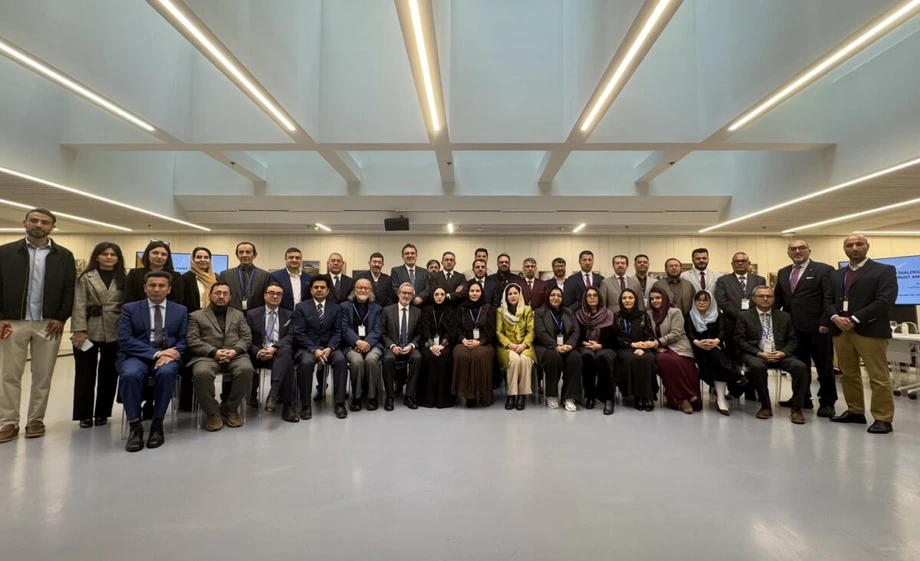
One Day, One Table, Three Rounds of Talks
Afghan political figures and activists opposed to the Taliban gathered in Madrid on Wednesday 25 November 2026 for the third round of a dialogue meant to build trust between groups that seldom share a room. The meeting lasted one day and was held at Spain's Ministry of Foreign Affairs, the same building where a summit on accountability for Afghan women had closed 48 hours earlier.
Contents
- One Day, One Table, Three Rounds of Talks
- Who Sat at the Table
- A Roadmap, Not a List of Demands
- Two Days Earlier: Women, Justice and a Million Signatures
- 264 Decrees and 20 Million Women
- Spain Draws a Line on Recognition
- Inside the Country: 95% Below the Poverty Line
- Deportations and Taliban Envoys in Europe
- Warrants, a World Court and the Fight for Evidence
- What Is Still Open
- Key Points
Women for Afghanistan, the organisation that convened the round, is led by Fawzia Koofi, a former deputy speaker of Afghanistan's House of Representatives. The group presented it as the next stage of a process it calls Towards Trust and Solidarity, while the title used for the meeting itself was Towards Trust and Unity. Two earlier rounds took place in Islamabad and in London.
Organisers said the session built on the previous two, with participants examining possible scenarios for Afghanistan's political future and weighing the opportunities and risks attached to each.
Through this women-led process, WFA seeks to encourage constructive engagement, identify common ground, and strengthen cooperation towards a peaceful, inclusive, and democratic future for Afghanistan.
No representative of the Taliban administration in Kabul attended, and organisers announced no agreements and no political decisions at the end of the day.
Who Sat at the Table
Organisers said the room held representatives of political parties, movements, networks and civic platforms, along with former ministers, former lawmakers, diplomats, academics, researchers, religious scholars and independent civil society activists.
The names released by the organisers show how wide that spread was. Abbas Basir, a former minister of higher education, and Mustafa Mastoor, a former economy minister, took part, as did Mohammad Asif Sediqi, a former deputy speaker of the Senate, and Anwar Sadat, a former minister of labour and social affairs. Masouma Khawari, a former minister of communications and information technology, and Nabila Mosleh, a former deputy minister of women's affairs, were also on the list.
Diplomatic experience came from Nasir Ahmad Andisha, who holds Afghanistan's ambassador post in Geneva, and Barna Karimi, a former ambassador to Canada. Party and movement figures included Zakir Hussain Ershad, leader of the Citizens' Party of Afghanistan, and Abdullah Qarluq, spokesperson for the High Council of National Resistance for the Salvation of Afghanistan, a body that has backed armed resistance. Rahela Dostum, a former senator and daughter of Marshal Abdul Rashid Dostum, attended, along with Mujib Rahman Rahimi, a former spokesperson for Abdullah Abdullah, and Hussain Yasa, a political activist.
Religious scholarship was represented by Fazl Hadi Wazin of the International Union of Muslim Scholars, and academia by Nazif Shahrani, a university professor. That mix of armed, party, diplomatic and religious backgrounds is central to what the organisers describe as a search for common ground rather than the launch of a single platform.
A Roadmap, Not a List of Demands
Nasir Ahmad Andisha, Afghanistan's ambassador in Geneva, said pressure on the Taliban from inside the country, from the region and from further afield had created an opening. Political, military and civic forces, he said, could now move past the stage of listing demands and work on a joint roadmap for a political transition.
He described the aim of the Madrid round as a political understanding among democratic forces, women and popular movements, leading to peace and a transition accepted by Afghans, by the wider international community and by the United Nations.
Andisha said participants were trying to agree on shared principles that could serve as the basis for any discussion of the country's future, and that movements with very different outlooks could still gather under one umbrella. He was blunt about the record of the body that has convened most international talks on Afghanistan.
The United Nations also failed to advance a process that it had itself initiated.
He set a clear bar for what listening means in this context. Any group that refuses to hear other voices and imposes a single view repeats the method of the Taliban, he said.
The Taliban hear no opinion but their own and impose it on everyone.
On women, Andisha argued that presence is not participation. Women should hold political roles with real weight in decisions, he said, rather than being seated for appearance.
He applied the same test to the idea of an inclusive government, describing it as more than the symbolic appointment of representatives from different ethnic groups. No group, current, value or voice should be removed from Afghanistan's future political structure, he said, and opponents of the Taliban have to accept each other's differences, whether they put their weight behind civil struggle or behind security options.
Two Days Earlier: Women, Justice and a Million Signatures
The Madrid dialogue followed the fourth HearUs summit, held on 22 and 23 November at the same ministry and organised by Spain's Foreign Ministry with Women for Afghanistan. Around 70 people took part, among them Afghan women's rights activists, former lawmakers, legal experts, religious scholars, diplomats and representatives of international organisations. The theme was Afghan women's leadership in achieving justice and peace through accountability.
The first day was set aside for Afghan women's groups to coordinate, agree on a shared vision and plan collective action. Four panels followed: education and economic independence as a basis for resilience, international mechanisms for justice, Islamic perspectives on the rights of women and girls, and the role of women in peace and security processes.
The summit also launched a campaign to collect one million signatures in support of Afghan women and girls, introduced by Katrín Jakobsdóttir, Iceland's former prime minister. Organisers planned to recognise the recent achievements of Afghan women athletes.
The sequence matters. The dialogue among political forces on Wednesday rested on the demands Afghan women had laid out on Monday: a place in any political process about their country, and accountability for abuses committed under Taliban rule.
- August 2021: the Taliban return to power and begin barring girls from secondary school and university and women from most jobs and public spaces.
- July 2025: the prosecutor of the International Criminal Court seeks arrest warrants for Taliban leaders over the persecution of women and girls.
- 22 and 23 November 2026: the fourth HearUs summit opens and closes in Madrid.
- 25 November 2026: the third round of the Towards Trust and Solidarity dialogue is held at Spain's Ministry of Foreign Affairs.
264 Decrees and 20 Million Women
Pramila Patten, the UN special representative of the secretary general on sexual violence in conflict, told the summit that the exclusion of women from public life had become official government policy and that the restrictions have been welded into a single legal and administrative framework.
By June 2026, the Taliban had issued 264 restrictive decrees concerning human rights, including 166 specifically targeting women and girls.
UN Women gave a lower figure in August, saying the authorities had issued more than 100 decrees affecting women and girls since 2021, while Patten's count covers decrees on human rights more widely, 166 of which she said target women and girls.
Patten said nearly 20 million Afghan women and girls live under a system designed to strip them of independence and human dignity, and that she saw no sign of a change in Taliban behaviour. She cited reports of forced marriages, gang rapes and other forms of sexual violence, and said education, work, travel and public life have been narrowed sharply for women and girls.
Afghanistan is the only country where girls and women are effectively barred from secondary and higher education, and UNICEF said in August that more than 2.6 million girls have been denied secondary schooling since 2021.
Patten asked governments to back the independent investigative mechanism for Afghanistan, to fund the collection and preservation of evidence and to keep working on victims' access to justice.
Spain Draws a Line on Recognition
Spain's foreign minister, José Manuel Albares, opened the summit with a commitment that goes further than most European capitals have been willing to go.
Spain will not recognise the Taliban authorities as a legitimate government while they violate the fundamental rights of women and girls, he said, and no government can claim legitimacy while denying women their human dignity. He called the Taliban's system gender apartheid and said women's rights must not become a bargaining chip in diplomatic deals.
Albares said Spain would push for gender apartheid to be written into the forthcoming Convention on Crimes Against Humanity, a treaty that would set out a set of offences as international crimes. He reaffirmed Spanish support for an independent investigative mechanism for Afghanistan.
He also said the Taliban have not met the international commitments they took on.
Inside the Country: 95% Below the Poverty Line
Fawzia Koofi, who heads Women for Afghanistan, used her appearance to move the argument from sympathy to money and law. She said 95% of Afghans live below the poverty line and depend heavily on humanitarian assistance, and that removing women from the labour market has damaged the economy as a whole.
She pointed to two pieces of Taliban legislation this year, a marriage law in January and a penal code in June, and said they had turned women into property under the law.
In both laws, they have basically turned women into slaves, officially.
Her verdict on the administration in Kabul was equally direct: a government of the Taliban, by the Taliban and for the Taliban. She said Taliban interference reaches into family life, and that the group has put into question the very existence of women. She also criticised Afghan content producers and online visitors who present a different picture of the country.
Koofi recalled the detention of women in Herat for not meeting the Taliban's dress rules and praised the men who stood by them. Afghan women, she said, have grown tired of being defended and supported, and the time has come for action.
Donors, she argued, should channel more aid through organisations run by women, which she described as among the few sources of income and support still open to Afghan women.
Deportations and Taliban Envoys in Europe
Koofi directed part of her criticism at European governments she said are deporting Afghan asylum seekers while dealing with the Taliban. Her example was Germany, where, she said, Taliban diplomatic representatives have been contacting young Afghans whose asylum claims were rejected or are still pending, leaving them in a limbo.
She said Afghan women who left the country and believed they would be safe in Europe now watch visas being issued to Taliban members.
They are afraid. We are afraid.
Among European Union members, she said, only Spain defends the Afghan cause seriously, citing Spanish support for visas and for Afghan women's rights inside EU institutions and at the UN Human Rights Council.
She closed with a request that ran through the whole summit: support Afghan women, sign the petition, codify gender apartheid and keep pressure on the Taliban. Pressure, she said, works, because the Taliban respond to it, and the movement is divided enough for outsiders to make use of those splits.
Warrants, a World Court and the Fight for Evidence
The legal track has already moved. In July 2025 the prosecutor of the International Criminal Court sought arrest warrants for Taliban leaders over the persecution of women and girls, a case that turns on whether the systematic exclusion of women can be prosecuted as a crime against humanity.
Koofi called for proceedings at both the ICC and the International Court of Justice and said political calculations should not stand in the way of justice for Afghan women. She urged the United Nations to extend the mandate of its special rapporteur on human rights in Afghanistan.
Navi Pillay, the 2026 Nobel Peace Prize laureate and a former UN high commissioner for human rights, addressed the summit online. She said the Taliban's policies amount to the systematic persecution of half the population and cannot be justified on cultural or religious grounds. Gender apartheid in Afghanistan, she said, will end as apartheid did in her native South Africa. She put the scale of the exclusion at eight in ten Afghan women without work or access to education.
You are not victims waiting to be rescued; you are human rights defenders and agents of change.
Pillay praised Afghan women for documenting violations, running classes from their homes and speaking out from exile, and asked the international community to use the legal tools it already has.
What Is Still Open
Three rounds of talks have produced statements, agendas and a shared vocabulary about dignity, participation and the rule of law. They have not produced a published plan, a joint leadership or a date for the next round. Organisers said nothing about where a fourth meeting would be held or which groups might join it.
What the Madrid week did establish is a division of labour. The HearUs summit put the demands of Afghan women and the legal case for accountability at the centre, with a signature campaign behind it. The dialogue two days later carried those demands into a room of former ministers, ambassadors, party leaders and resistance figures, under a Spanish roof and a chair held by a women's organisation.
For Afghans inside the country, the week's numbers describe the ground the talks are working from: 264 restrictive decrees, nearly 20 million women and girls living under them, 2.6 million girls shut out of secondary school and 95% of the population below the poverty line. No participant announced a timetable for turning the shared principles into a roadmap.
Key Points
- Women for Afghanistan, led by former MP Fawzia Koofi, held the third round of its dialogue on 25 November 2026 at Spain's Foreign Ministry in Madrid, after earlier rounds in Islamabad and London.
- Participants included former ministers Abbas Basir, Mustafa Mastoor, Anwar Sadat and Masouma Khawari, ambassadors Nasir Ahmad Andisha and Barna Karimi, and Abdullah Qarluq of the High Council of National Resistance for the Salvation of Afghanistan.
- No agreements or political decisions were announced, and no date was given for a further round.
- The talks came two days after the fourth HearUs summit in Madrid on 22 and 23 November, which drew about 70 participants and launched a campaign for one million signatures.
- UN envoy Pramila Patten said the Taliban had issued 264 restrictive decrees by June 2026, 166 of them aimed at women and girls, and that nearly 20 million Afghan women and girls live under the system.
- Spain's foreign minister, José Manuel Albares, said Spain will not recognise the Taliban and will push for gender apartheid to be included in the Convention on Crimes Against Humanity.
- Fawzia Koofi said 95% of Afghans live below the poverty line and criticised European governments for deporting Afghan asylum seekers while engaging with the Taliban.