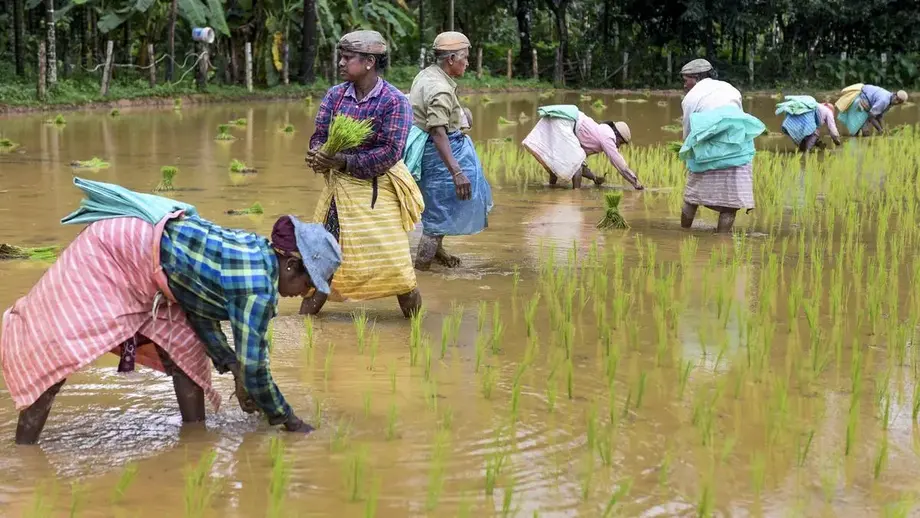
A Smaller Harvest That Still Beats Normal
India's kharif foodgrain output for the 2026-27 crop year is projected at 167.14 million tonnes, or 1,671.43 lakh tonnes, according to the first advance estimates released in New Delhi on November 26. The harvest is 5.1 per cent smaller than the 176.04 million tonnes gathered in the kharif season a year earlier, and 9.77 million tonnes above the average of the last five years.
Contents
- A Smaller Harvest That Still Beats Normal
- Rice Falls, and Granaries Stay Full
- Millets and Maize Post the Sharpest Fall
- Pulses: A Mixed Bag With Two Bright Spots
- Oilseeds Slip as Soybean Takes the Hit
- Sugarcane, Sugar and Cotton
- What El Nino Did to the Monsoon
- The Year That Just Ended Set Records
- Prices, Farmers and the Consumer
- What Comes Next, and What Is Not Known
- Key Points
Agriculture Minister Shivraj Singh Chouhan announced the numbers at a press conference, releasing two sets of figures at once: the first estimate for the season just harvested and the final estimate for 2025-26, a year he described as a record. The fall in kharif output, he said, came from the weather rather than from any shortage of effort on the farm.
Despite severe weather challenges due to El Nino and a delayed monsoon, kharif foodgrain production is projected to be 167.14 million tonnes.
The projected harvest sits about 29 million tonnes, roughly 15 per cent, below the 196.21 million tonnes kharif target the government fixed in September 2026, when it also trimmed its full year foodgrain goal for 2026-27 to 373.93 million tonnes because of El Nino. Chouhan presented the release as an early snapshot rather than a verdict on the year.
These are very preliminary estimates and are subject to change as the year goes by.
Rice Falls, and Granaries Stay Full
Kharif rice, the biggest crop of the season, is estimated at 121.91 million tonnes (1,219.05 lakh tonnes), down 2.3 per cent from 124.76 million tonnes in kharif 2025-26. Paddy is the crop that anchors both the government's procurement programme and the food security of hundreds of millions of households, so the number carried particular weight at the briefing.
Chouhan said rice and wheat stocks in government granaries are sufficient and that the marginal decline in rice will have no impact. He ruled out pressure on retail prices.
There is no reason for any price rise in foodgrains.
India is the world's largest producer of rice, and Chouhan said exports of the grain rose 5 per cent in the year to June 2026, including premium Basmati shipments to the United States, Canada and the Middle East. A smaller kharif crop will be matched against those stock and export positions when the second estimate arrives.
Millets and Maize Post the Sharpest Fall
Nutri cereals and millets, the group that includes maize, jowar, bajra, ragi and small millets, are estimated at 38.11 million tonnes (381.05 lakh tonnes), 12.8 per cent below the 43.68 million tonnes of a year earlier. The group fell faster than any other kharif category except oilseeds.
Maize, the largest crop in the group and a raw material for poultry feed, starch and ethanol, is pegged at 26.06 million tonnes (260.64 lakh tonnes), down 14.6 per cent from 30.51 million tonnes. Ragi has the steepest drop in percentage terms, at 12.48 lakh tonnes against 2 million tonnes a year earlier, a fall of 37.5 per cent. Bajra slipped 5.7 per cent to 89.43 lakh tonnes from 9.48 million tonnes. Jowar is the exception, up 13 per cent to 14.79 lakh tonnes from 1.31 million tonnes, and small millets are estimated at 3.71 lakh tonnes.
Only four crops in the whole kharif basket rose above last season's level: urad among pulses, jowar among cereals, sunflower among oilseeds and jute and mesta among fibre crops. Every other crop posted a decline, a pattern that points to a broad failure of rain rather than trouble in a single growing belt.
Pulses: A Mixed Bag With Two Bright Spots
Kharif pulses are estimated at 7.13 million tonnes (71.32 lakh tonnes), down 6.2 per cent from 7.6 million tonnes. Tur, the pigeon pea that fills most Indian kitchens through dal, is pegged 13.1 per cent lower at 3.12 million tonnes (31.22 lakh tonnes) against 3.59 million tonnes. Moong, or green gram, is down 14 per cent to 1.66 million tonnes (16.59 lakh tonnes) from 1.93 million tonnes.
Urad, or black gram, is the outlier in the group, rising 28.3 per cent to 1.45 million tonnes (14.49 lakh tonnes) from 1.13 million tonnes. Other pulses account for 9.02 lakh tonnes. The kharif numbers cover only part of India's pulse supply, because gram and other crops are grown mainly in the winter season, and the final 2025-26 figures showed chana at 12.51 million tonnes for the full year.
Pulses carry political weight in India because the country still imports them to meet demand. Chouhan said the government's attention has moved to the crops where India depends on overseas suppliers, and both the Pulses Mission and the Oilseeds Mission are being pushed to close that gap.
Oilseeds Slip as Soybean Takes the Hit
Kharif oilseeds are expected at 23.95 million tonnes (239.47 lakh tonnes), down 10.2 per cent from 26.67 million tonnes. Soybean leads the fall, estimated at 10.24 million tonnes (102.44 lakh tonnes) against 12.6 million tonnes, a drop of 18.7 per cent. Groundnut is nearly flat at 11.17 million tonnes (111.68 lakh tonnes), down 1.5 per cent from 11.34 million tonnes.
Sunflower, a small crop, rose to 1.17 lakh tonnes from 88,000 tonnes. Castor seed is estimated at 18.97 lakh tonnes, sesamum at 4.91 lakh tonnes and nigerseed at 0.30 lakh tonnes. Soybean matters beyond the kitchen: its oil goes into cooking oil blends and its meal feeds the poultry and dairy industries, so a shortfall of nearly one fifth reaches feed prices and edible oil imports.
Sugarcane, Sugar and Cotton
Sugarcane output for the kharif season is estimated at 454.34 million tonnes (4,543.39 lakh tonnes), down 9.1 per cent from 500 million tonnes (5,037.29 lakh tonnes) in 2025-26. Cotton is pegged at 24.87 million bales of 170 kg each (248.66 lakh bales), down 14.3 per cent from 29.02 million bales. Jute and mesta grew 3.3 per cent to 9.71 million bales of 180 kg each (97.06 lakh bales) from 9.4 million bales.
A day before the government release, the Indian Sugar and Bio-Energy Manufacturers Association projected that India's net sugar production would fall to a decade low of 26.52 million tonnes in the 2026-27 marketing year, which began in October. On a gross basis, the industry body put the drop at around 15 per cent from 31.21 million tonnes a year earlier. The two sets of numbers describe the same problem from different ends: less cane in the field, less sugar in the mill.
Chouhan said sugarcane has been affected but not by a large margin, and urged against alarm over the crop. Sugar mills, cane growers and state governments that set cane prices will be watching the second estimate closely, because the gap between the two sugar figures will decide how much cane is available for crushing and for ethanol blending.
What El Nino Did to the Monsoon
El Nino is a recurring warming of surface waters in the central and eastern tropical Pacific Ocean. It rearranges where heat and rain fall across the planet, and for India it usually means a weaker monsoon. Chouhan said kharif sowing of paddy, maize, tur, soybean and cotton was hit by the return of El Nino and a delayed June monsoon that delivered 35 to 40 per cent less rainfall than normal. Low soil moisture and drought conditions in major farming states including Maharashtra, Karnataka, Telangana and Andhra Pradesh added to the damage.
Lower acreage, wide gaps between spells of rain, and losses from cyclones and floods completed the picture. The World Health Organization classified the health effects of El Nino as a health emergency in early November, a signal of how far the phenomenon reaches beyond fields; an estimated 146.5 million people in India faced extreme heat during April 2026.
Chouhan credited farmers' resolve, government schemes and climate resilient crop varieties developed by scientists for keeping output above the average of the last five years. Asked whether the season should worry consumers, he pointed to that comparison.
These numbers are better than the five-year average production and should not be any cause for concern.
The Year That Just Ended Set Records
The final estimates for 2025-26, the crop year that ended in June, put foodgrain production at a record 378.54 million tonnes (3,785.38 lakh tonnes), about 5.8 per cent higher than a year earlier and 20.81 million tonnes above the 357.73 million tonnes (3,577.32 lakh tonnes) of 2024-25. Chouhan called the results historic achievements for the farm sector.
Rice reached a record 155.15 million tonnes (1,551.54 lakh tonnes), up 49.70 lakh tonnes from 1,501.84 lakh tonnes, and wheat hit a record 122.06 million tonnes (1,220.64 lakh tonnes), up 41.19 lakh tonnes from 1,179.45 lakh tonnes. Maize jumped nearly 27 per cent to 55.03 million tonnes (550.25 lakh tonnes) from 43.41 million tonnes (434.09 lakh tonnes). Nutri cereals and millets totalled 740.80 lakh tonnes, of which Shree Anna, the millets the government promotes as a nutritional crop, made up 172.09 lakh tonnes.
Pulses rose 6.1 per cent to 27.24 million tonnes (272.40 lakh tonnes), 15.57 lakh tonnes more than the 256.83 lakh tonnes of 2024-25, with record moong at 4.40 million tonnes (43.96 lakh tonnes), chana at 12.51 million tonnes (125.13 lakh tonnes) and tur at 3.60 million tonnes (35.99 lakh tonnes). Oilseeds set a record of 43.26 million tonnes (432.55 lakh tonnes), up 2.66 lakh tonnes, helped by groundnut at 13.17 million tonnes (131.71 lakh tonnes), up 12.29 lakh tonnes, and rapeseed and mustard at 13.77 million tonnes (137.66 lakh tonnes), up 10.99 lakh tonnes from 126.67 lakh tonnes. Soybean came in at 12.64 million tonnes (126.36 lakh tonnes).
Sugarcane set a record of 503.73 million tonnes (5,037.29 lakh tonnes). Cotton output was 280.06 lakh bales of 170 kg each and jute and mesta 94.28 lakh bales of 180 kg each. Chouhan said India now leads the world in the production of rice, pulses, jute, millets and spices, ranks second after Brazil in sugarcane, and second after China in wheat, cotton, groundnut, and fruits and vegetables.
Prices, Farmers and the Consumer
Questions at the briefing turned to the cost of dal and cooking oil, which have been selling above their support levels for much of the year. Minimum support prices are the rates at which the government promises to buy crops from farmers, and they set a floor under the market. Chouhan argued that growers deserve the higher prices they are getting.
Most of the crops are selling either at their minimum support prices (MSPs) or higher levels. Let farmers also get some good prices. The government is also taking care of interests of the consumers.
Winter sowing has started slowly, which matters because the kharif estimate covers only the monsoon harvest. Rabi crops, including the wheat that will be harvested in 2027, have been planted on about 17.82 million hectares, down 11.31 per cent from the same point a year earlier. A late or thin rabi season would weigh on the full year foodgrain goal of 373.93 million tonnes, which is itself below the 378.54 million tonnes actually produced in 2025-26.
For farmers in the drought hit districts of Maharashtra, Karnataka, Telangana and Andhra Pradesh, the estimate translates into real losses in cotton and soybean, the two crops that fell hardest by value. For consumers, the pressure is likely to show up first in edible oil and pulses rather than in rice and wheat, where the government holds stock and controls the market through procurement and releases.
What Comes Next, and What Is Not Known
The November 26 release is the first of several passes at the year. Yield data from crop cutting experiments at harvest, in which officials measure actual output from sample plots, will feed the second and final estimates. The figures released so far drew on reports from states and union territories, remote sensing, the weekly Crop Weather Watch Group, the Digital Crop Survey, the Digital General Crop Estimation Survey and consultations with industry, and went through a three tier process of validation and triangulation.
- September 2026: the government sets a kharif target of 196.21 million tonnes and a full year goal of 373.93 million tonnes, citing El Nino.
- October 2026: the 2026-27 sugar marketing year begins.
- November 25, 2026: the Indian Sugar and Bio-Energy Manufacturers Association projects net sugar output of 26.52 million tonnes, the lowest in a decade.
- November 26, 2026: first advance estimates for kharif 2026-27 and final estimates for 2025-26 are released in New Delhi.
- Later in the crop year: second and final estimates, after crop cutting experiments at harvest.
No date has been announced for the second advance estimates, and the rabi crop figures, which will decide the wheat total for 2027, are not yet available. The first estimate itself can move in either direction, as Chouhan acknowledged, and the revision will matter most for rice, soybean, cotton and sugarcane, the crops where the fall was largest.
Key Points
- India's kharif foodgrain output for 2026-27 is estimated at 167.14 million tonnes, 5.1 per cent below last season's 176.04 million tonnes.
- The figure is 9.77 million tonnes above the average of the last five years and about 15 per cent below the 196.21 million tonnes kharif target.
- Kharif rice is pegged at 121.91 million tonnes, down 2.3 per cent from 124.76 million tonnes.
- Maize fell 14.6 per cent to 26.06 million tonnes and ragi 37.5 per cent to 12.48 lakh tonnes.
- Pulses are down 6.2 per cent at 7.13 million tonnes, with tur down 13.1 per cent and moong down 14 per cent, while urad rose 28.3 per cent.
- Oilseeds fell 10.2 per cent to 23.95 million tonnes, led by soybean at 10.24 million tonnes, down 18.7 per cent.
- Sugarcane is estimated at 454.34 million tonnes, down 9.1 per cent, and cotton at 24.87 million bales, down 14.3 per cent.
- The industry body ISMA projects net sugar production at a decade low of 26.52 million tonnes for 2026-27.
- Chouhan attributed the decline to El Nino, a delayed June monsoon with 35 to 40 per cent less rain, drought in Maharashtra, Karnataka, Telangana and Andhra Pradesh, and cyclone and flood damage.
- The final 2025-26 figures set a record of 378.54 million tonnes of foodgrain, with record rice at 155.15 million tonnes and wheat at 122.06 million tonnes.
- Rabi sowing stands at about 17.82 million hectares, down 11.31 per cent from a year earlier, ahead of the second advance estimates.