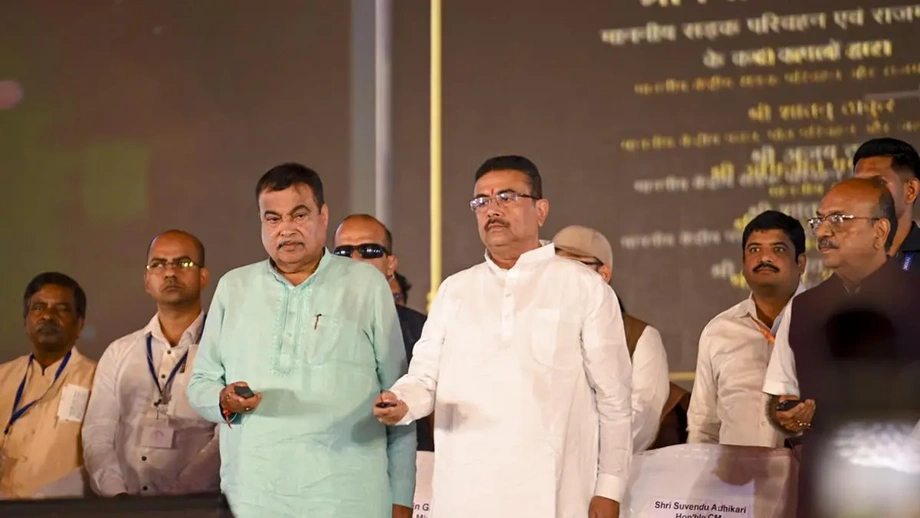
A Rs 1 lakh crore promise delivered at Kolaghat
Nitin Gadkari brought a single number to Kolaghat on Thursday, November 26, 2026: Rs 1 lakh crore. At an event organised by the National Highways Authority of India in Purba Medinipur district, the Union Minister for Road Transport and Highways announced road projects of that value for West Bengal, on top of work already running in the state, and placed a ring road of 250 km around Kolkata at the centre of the plan.
Contents
- A Rs 1 lakh crore promise delivered at Kolaghat
- What the 250 km ring road would change for Kolkata
- Four corridors that redraw the state's road map
- A programme worth Rs 3 lakh crore, part built and part on paper
- Adhikari's list: eight requests and six months of cleared files
- Land, clearances and a return visit in six months
- The politics behind the pavement
- What the roads are meant to deliver
- Key Points
The ring road carries an estimated cost of Rs 14,000 crore. It would connect Kolkata with Howrah and with North and South 24 Parganas, and link the Kona Expressway, the Belgharia Expressway and the Kalyani Expressway, giving long distance traffic a route around the city instead of through it. Gadkari said the project would ease congestion, improve links with adjoining cities and help Kolkata grow as a modern urban centre.
Gadkari shared the stage with Chief Minister Suvendu Adhikari, whose BJP government took office in the state this year, and used the occasion to promise that money would not stand in the way. He said projects worth about Rs 40,000 crore had already been completed in West Bengal and that work worth Rs 35,000 crore, covering roughly 450 km, was under implementation.
Today, I am announcing projects worth Rs 1 lakh crore for Bengal. I am not among those who make announcements and leave. Whatever I promise, I will deliver.
Turning to the chief minister, he added: "Do not worry about money. You will get tired of asking for projects, but I will not get tired of providing funds."
The same programme also produced immediate work. Gadkari inaugurated and laid the foundation stones for 22 national highway and road projects worth more than Rs 8,700 crore at Kolaghat, a mix of stretches, bridges and safety works spread across the state.
What the 250 km ring road would change for Kolkata
Gadkari described the ring road as the first step in a wider upgrade of the city's road network, and said the proposal had come from Adhikari and his ministerial colleagues, who raised Kolkata's traffic with him. He then directed officials to work out a plan.
I want to make Kolkata a better city. I had told your minister and officials to prepare a plan to free Kolkata from traffic congestion. I am announcing approval for a 250-km ring road for Kolkata at a cost of Rs 14,000 crore.
He also pushed a design idea for tight urban space: roads, flyovers and metro rail corridors stacked on a common pillar based structure, so that one strip of land carries several modes of transport. He pointed to similar work in Pune and Nagpur as models, and said he was willing to build bridges across Kolkata on the pattern of Pune if the state prepared a detailed project report.
This is just a teaser. Prepare a detailed project report (DPR) for Kolkata. I am willing to construct bridges across the city, on the lines of Pune, to improve connectivity.
His closing note on the city was ambitious. "This is just the beginning. The real picture is yet to unfold," he said, adding: "We have developed Mumbai and Delhi; now we will develop Kolkata."
Four corridors that redraw the state's road map
The Rs 1 lakh crore package is built around long distance corridors rather than small repairs, aimed at moving goods and people between Kolkata, the coast, the northern border and the northeast. The headline projects announced at Kolaghat:
- A corridor of 58 km from Dankuni to Kolaghat with eight lanes, estimated at Rs 20,000 crore, which would cut travel time by about 1.5 hours for vehicles heading from Kolkata towards Kharagpur, Balasore and Bhubaneswar, and improve access to Haldia Port.
- A corridor of 245 km from Moregram to Kishanganj with four lanes, estimated at Rs 12,000 crore, linking NH 12 and NH 27 and improving access to border areas.
- A corridor from Siliguri to Guwahati with four lanes, estimated at Rs 26,000 crore, strengthening the state's link to the northeast.
- A corridor from Siliguri to Darjeeling worth Rs 6,000 crore.
Gadkari said the Centre was also developing greenfield expressways to strengthen Bengal's network, and spoke about seven such corridors in all. He promised dedicated road infrastructure to improve access to Gangasagar, the pilgrimage site on Sagar Island in the Sundarbans.
The bigger expressway picture runs outside the state's borders but matters to it. Gadkari said the detailed project report for the Varanasi to Kolkata highway had been completed and submitted to the Cabinet, and that once running it would bring travel time between the two cities down to around five hours. He also cited the Delhi to Mumbai highway, which he said was 80 per cent complete, as proof that large corridors do get finished.
A programme worth Rs 3 lakh crore, part built and part on paper
The Rs 1 lakh crore announced at Kolaghat sits inside a larger commitment. Gadkari put the Centre's total road development programme for West Bengal at around Rs 3 lakh crore. Of that, projects worth nearly Rs 40,000 crore are complete and another Rs 35,000 crore are under execution, leaving about Rs 2 lakh crore in the pipeline.
He set a benchmark for what the state should expect: national highways in Bengal brought to the standards of roads in the United States within five years. That is a promise about quality of surface, lane width and safety features as much as about new stretches, and it depends on how fast the state hands over land and clears permissions.
Gadkari tied the spending to a wider economic argument he has repeated since 2014, when the Modi government took office. Better connectivity, in his account, is what allows factories, farms and ports to work at full capacity, and what persuades investors to put money into a state.
Water, power, transport and communication are the four pillars of infrastructure. If these are strengthened, industries and businesses will grow, agricultural productivity will improve, investment will come, and employment opportunities will increase. This will ultimately help eradicate poverty.
He traced the push back to the Prime Minister's ambition for India to rank among the world's most powerful countries, saying that goal required sustained investment in roads, ports and power, and argued that West Bengal would be a major contributor to India's aim of becoming the world's third largest economy.
Adhikari's list: eight requests and six months of cleared files
Chief Minister Suvendu Adhikari used the platform to argue that the political change in the state had already unblocked central projects. He said his administration had spent the past six months clearing pending no objection certificates, settling land arrangements and repairing administrative coordination that had broken down between Kolkata and the Centre.
Foundation stones for several more projects were also laid. The New Farakka Bridge will further strengthen industrial connectivity with Northeast India. Over the past six months, we have cleared all pending issues, including long-pending NOCs.
He recalled an assurance from Gadkari that the Centre would sanction projects worth Rs 1 lakh crore once land was arranged, and then read out his own wish list to the minister:
- Widening of the 75 km Kolkata to Bongaon national highway, and a highway expansion towards Petrapole on the Bangladesh border.
- A bridge connecting Falta and Bagnan across the Hooghly.
- Widening of the Kakdwip to Gangasagar national highway.
- Four lane roads on the Joka to Namkhana and Nandakumar to Digha routes.
- Pending bridges across the Sundarbans delta, and the Gosaba to Bongaon national highway.
- An alternative industrial corridor from Jamshedpur to Panagarh through Bankura, which he said would also open up tourist destinations.
Adhikari said the Varanasi to Kolkata expressway should connect with Durgapur, and urged the Centre to bring Bengal's infrastructure to the level of Uttar Pradesh, Maharashtra and Assam. Roads and bridges in the Sundarbans, he argued, would directly help the fishing communities there alongside the Prime Minister's welfare schemes for fishermen.
We have also restored the relationship between the state and the Central Government. You said, 'Just arrange the land, and I will sanction projects worth Rs 1 lakh crore.'
Land, clearances and a return visit in six months
The money came with conditions, and Gadkari stated them plainly. He said the state would have to move faster on land acquisition, on forest and environmental clearances and on removing encroachments from highway land, and he set himself a return visit in six months to check progress on the groundwork.
He credited the new government with part of the improvement already. Land acquisition, he said, had picked up after Adhikari became chief minister, which allowed several projects to move into construction. Adhikari responded that the state was prepared to hand over whatever land was needed, telling the gathering: "We are ready to provide the necessary land for these projects."
The chief minister linked the file clearing to the Farakka bridge, saying it would strengthen industrial links with the northeast and that bottlenecks between Kolkata and the northeast had been resolved. What is not yet public is a schedule: no dates were given for the ring road's construction start, for the four corridors announced, or for the projects Adhikari requested. The detailed project reports, land awards and tender stages will decide when shovels reach the ground.
The politics behind the pavement
Neither leader treated the event as a purely technical occasion. Gadkari described the Centre and the state as the two engines of what he called a double engine government, and said the combination would move Bengal's development forward like a bullet train under Prime Minister Narendra Modi's direction and Adhikari's leadership. He predicted the state would help India reach its economic goals, calling the partnership one that would help Bengal become prosperous and self reliant.
State minister Dilip Ghosh, speaking to reporters in Kolkata, went further in his praise, casting Gadkari as a builder in the mythological sense and blaming the previous state government for slow progress on earlier central announcements.
Respected Nitin Gadkari ji, whom we consider Vishwakarma. Wherever he lays his hands, it transforms it.
Ghosh said earlier approvals and funding for highways and greenfield roads had not advanced because the government in office at the time did not cooperate, and that the new administration intended to make up for lost time. He also flagged the second bridge at Farakka among the projects due for inauguration.
Both leaders reached for Bengal's history. Gadkari named Swami Vivekananda, Netaji Subhas Chandra Bose and Syama Prasad Mookerjee, and said the state's contribution to India's intellectual, cultural and nationalist movements could again drive national development. Adhikari invoked the Tamralipta National Government formed in Midnapore in 1942, one of three parallel governments set up during the freedom struggle, and the sacrifice of Matangini Hazra, who was shot dead during the Quit India movement.
It was your dream to see the BJP win this state. The Tamralipta National Government, established in Midnapore in 1942, was one of the three parallel national governments formed during the freedom struggle. This was the land that stood up against British rule. Matangini Hazra made the supreme sacrifice in the fight against the British.
Adhikari said it had been his ambition since his time as state BJP president to see the party win Bengal, a goal he said the state's voters delivered under Modi's leadership.
What the roads are meant to deliver
The practical test for the package lies in the state's bottlenecks. Kolkata's traffic, the approach roads to Haldia Port, the long haul from the Sundarbans to the northern districts and the border trade route through Petrapole all depend on stretches that have waited years for widening or bridging.
The Dankuni to Kolaghat corridor, by Gadkari's estimate, would save about 90 minutes for vehicles heading towards Kharagpur, Balasore and Bhubaneswar, a saving that matters for trucks carrying cargo to and from the port. The Moregram to Kishanganj corridor would tie NH 12 and NH 27 together and improve access to border districts. The Siliguri corridors address the hill route to Darjeeling and the long road towards Guwahati, where the state's connection to the northeast begins.
For the Sundarbans, the promised bridges and the Kakdwip to Gangasagar widening touch daily life more directly, linking island villages, fishing harbours and the pilgrimage route. Adhikari framed those works as welfare as much as transport, saying better roads would help fishing families reach markets and benefit from central schemes.
Gadkari's own summary of the case was economic. He argued that roads bring industry, industry brings jobs, and jobs reduce poverty, and that West Bengal, with its ports, borders and skilled workforce, has more to gain than most states from a network that finally connects its parts.
Key Points
- Union Minister Nitin Gadkari announced road projects worth Rs 1 lakh crore for West Bengal on November 26, 2026, at an NHAI event in Kolaghat, Purba Medinipur district.
- A ring road of 250 km around Kolkata, estimated at Rs 14,000 crore, will link the Kona, Belgharia and Kalyani expressways and connect the city with Howrah and North and South 24 Parganas.
- Other headline projects include a 58 km Dankuni to Kolaghat corridor with eight lanes at Rs 20,000 crore and a 245 km Moregram to Kishanganj corridor with four lanes at Rs 12,000 crore.
- Corridors from Siliguri to Guwahati (Rs 26,000 crore) and Siliguri to Darjeeling (Rs 6,000 crore) were also announced.
- Gadkari inaugurated and laid foundation stones for 22 projects worth more than Rs 8,700 crore at the same event.
- About Rs 40,000 crore of road work is complete in the state and Rs 35,000 crore is under implementation, within a programme he put at around Rs 3 lakh crore.
- The detailed project report for the Varanasi to Kolkata highway has been submitted to the Cabinet, with travel time projected at around five hours.
- Chief Minister Suvendu Adhikari said his government cleared pending NOCs over six months and requested eight more projects, including the Falta to Bagnan bridge and Sundarbans bridges.
- Gadkari tied further progress to faster land acquisition, forest and environmental clearances and removal of encroachments, and plans to review the work on a visit in six months.