A Major Milestone in Bilateral Commerce
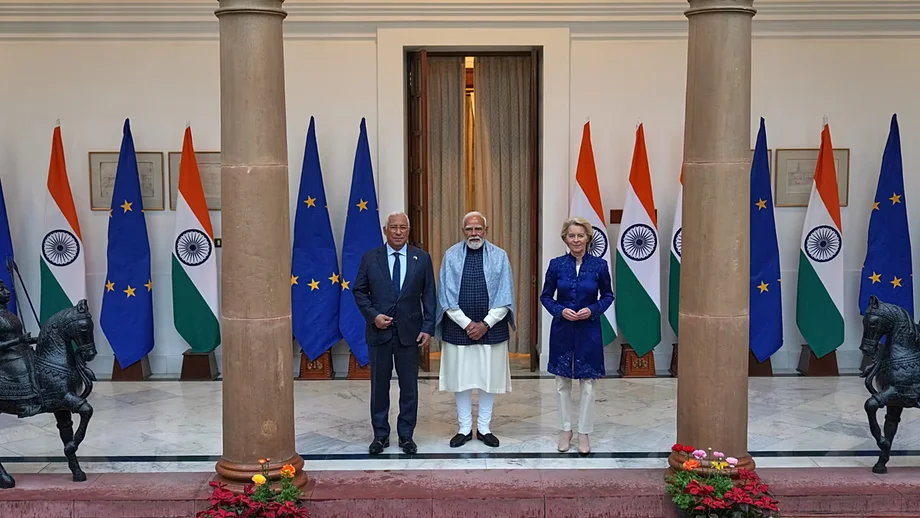
India and the 27-member European Union are preparing to sign a comprehensive free trade agreement on December 16, 2026. The signing ceremony will take place in Brussels during a high-profile diplomatic visit by Indian Prime Minister Narendra Modi. Both sides concluded formal negotiations for the pact on January 27, 2026, following discussions that spanned more than two decades. The European Commission has already submitted formal proposals to the Council of the European Union seeking authorization for the signing and conclusion of the agreement, alongside the final legal text and tariff schedules.
Contents
- A Major Milestone in Bilateral Commerce
- The Scale and Scope of the Combined Market
- Tariff Reductions and Major Savings for Exporters
- Safeguarding Sensitive Sectors and Food Safety
- Services, Professional Mobility, and Small Businesses
- Timeline for Implementation and Legal Procedures
- Regional Engagement and Broader Economic Impact
- At a Glance
Jean-Eric Paquet, European Union Ambassador to India, confirmed the mid-December timeline during a recent official visit to Assam and the Northeast region. The agreement, often described as the mother of all deals, aims to bridge two of the world's largest economic entities at a time when global trade faces increasing geopolitical pressures. This development mirrors the momentum seen earlier in trade diplomacy, such as Indonesia and European Union Sign Landmark Trade and Investment Pacts in Brussels, highlighting Europe's active expansion of commercial partnerships across Asia.
The Scale and Scope of the Combined Market
The trade pact creates a combined commercial market of approximately two billion people, uniting India as the world's fourth-largest economy with the European Union as the second-largest economic bloc. Taken together, India and the European Union account for 25 percent of global gross domestic product and roughly one-third of international trade, valued at about $11 trillion out of a total $33 trillion global trade market. In terms of bilateral exchange, goods trade between India and the European Union reached €118 billion in 2025, while services trade stood at €67 billion.
European Commission President Ursula von der Leyen highlighted the historical nature of the agreement, emphasizing that rules-based cooperation continues to yield significant economic benefits. European Commission President Ursula von der Leyen stated:
The EU and India make history today, deepening the partnership between the world's biggest democracies. We have created a free trade zone of 2 billion people, with both sides set to gain economically.
Trade Commissioner Maroš Šefčovič echoed this sentiment, noting that the agreement proves mutually beneficial trade remains achievable on a global scale. Maroš Šefčovič stated:
Win-win trade is real.
Tariff Reductions and Major Savings for Exporters
Under the terms of the agreement, 93 percent of Indian shipments will secure duty-free access to the European Union market, including zero tariffs on around $33 billion of labor-intensive exports. Key Indian export sectors benefiting from immediate or phased relief include textiles, apparel, leather, footwear, marine products, gems and jewellery, chemicals, minerals, and agricultural items like tea, coffee, and spices. Conversely, the European Union will liberalize tariff lines covering 96.6 percent of its export value to India, achieving full tariff elimination or reduction on 90 percent of tariff lines.
European exporters are projected to save up to €4 billion per year in customs duties, money that can be reinvested into production, wages, or consumer pricing. Christophe Hansen, EU Commissioner for Agriculture and Food, noted the significant opening for European agricultural goods in India's expanding middle-class market. Christophe Hansen stated:
Under this agreement European wines, spirits, beers, olive oil, confectionary, and other products will enjoy preferential access to the rapidly growing Indian market.
India's average industrial tariffs, which previously exceeded 16 percent, will see sweeping reductions that benefit capital-intensive European industries. Machinery and electrical equipment, which represented the European Union's largest export category to India at €16.3 billion in 2024, currently face tariffs of up to 44 percent that will be mostly eliminated over five to ten years. Aircraft and spacecraft exports, valued at €6.4 billion, will see existing duties of up to 11 percent reduced to zero over similar staging periods. Chemical exports worth €3.2 billion and pharmaceutical exports worth €1.1 billion will also experience substantial tariff elimination. One of the most notable changes involves motor vehicles, where Indian tariffs will drop from 110 percent to as low as 10 percent under specific quotas, while car parts will eventually become completely tariff-free.
Safeguarding Sensitive Sectors and Food Safety
While the agreement opens vast market access, both economies have deliberately protected sensitive domestic industries. The European Union will maintain its current import tariffs on sensitive agricultural products such as beef, sugar, rice, chicken meat, milk powders, honey, bananas, soft wheat, garlic, and ethanol. Limited import quotas will apply only to specific items like sheep and goat meat, sweetcorn, grapes, cucumbers, dried onions, rum made of molasses, and starches, supported by a bilateral safeguard mechanism.
European food safety standards remain fully intact under the agreement. Christophe Hansen emphasized that consumer safety is non-negotiable, and the European Commission will reinforce audits and border controls on imported food, animal, and plant products, specifically targeting pesticide compliance and animal welfare standards. On the Indian side, sensitive domestic sectors such as dairy are safeguarded through phased implementation timelines to help local agricultural industries and micro, small, and medium enterprises adjust to changing market conditions.
Services, Professional Mobility, and Small Businesses
Beyond physical goods, the free trade agreement achieves a major breakthrough in the service sector, representing India's most ambitious services commitments to date. European companies will gain predictable access to 144 service subsectors, including financial services, maritime transport, professional services, IT-enabled services, education, and business services. Total European Union services exports to India reached €26 billion in 2024 and are expected to grow significantly under new legal and market conditions.
The agreement establishes frameworks to facilitate the mobility of skilled Indian professionals, alongside provisions for traditional medicine systems such as AYUSH and safeguards for traditional knowledge through the Traditional Knowledge Digital Library. Furthermore, a dedicated small and medium-sized enterprise chapter will establish contact points and shared digital platforms to help smaller firms navigate customs procedures and market-entry requirements. The European Union and India are also negotiating a separate Investment Protection Agreement and a Geographical Indications agreement to further solidify commercial protections.
Timeline for Implementation and Legal Procedures
The formal signing ceremony in mid-December 2026 will initiate a multi-step legislative process required for the trade pact to take full effect. The European Commission has forwarded the finalized legal text and tariff schedules to the EU-India trade agreement maintained by the European Commission. To expedite the review, the Commission bypassed translation into all 24 official languages, utilizing the English version for immediate consideration by the Council of the European Union.
- January 27, 2026: Formal negotiations for the free trade agreement successfully concluded
- September 11, 2026: European Commission submitted signing proposals to the Council of the European Union
- Mid-December 2026: Scheduled visit of Prime Minister Narendra Modi to Brussels for the formal signing ceremony
- Early 2027: Anticipated entry into force following European Parliament approval, Council conclusion, and Indian domestic ratification
- By 2032: Projected timeline for European Union goods exports to India to double
Regional Engagement and Broader Economic Impact
Ahead of the official signing, European Union officials have actively engaged regional stakeholders across India to maximize the domestic benefits of the upcoming trade pact. During his recent visit to Assam, Ambassador Jean-Eric Paquet met with Chief Minister Dr. Himanta Biswa Sarma to discuss economic cooperation, highlighting the Assam Blue Valley initiative as a pilot project for aroma-based industries and fragrance development. Assam Chief Secretary Dr. Ravi Kota also hosted a round table discussion with local startups, emphasizing upcoming opportunities under the €100 billion Horizon Europe program for 2021 to 2027, which India is expected to join in January 2027. Officials also outlined a proposed €10 million Global Gateway support facility with a dedicated window for the Northeast region to assist in investment preparation.
The European Commission estimates that the trade agreement will double European Union goods exports to India by 2032, reinforcing employment across manufacturing, agriculture, and supply chains. Existing trade already supports approximately 800,000 jobs within the European bloc. While final implementation depends on successful votes in the European Parliament, adoption by the Council, and domestic ratification in India, leaders on both sides express confidence that the agreement will become operational during the first half of 2027.
At a Glance
- India and the European Union are scheduled to sign their free trade agreement on December 16, 2026, in Brussels during Prime Minister Narendra Modi's visit.
- The trade pact unites a combined market of two billion people, accounting for 25 percent of global gross domestic product and one-third of international trade.
- Ninety-three percent of Indian shipments will gain duty-free access to the European Union, while the European Union will eliminate or reduce tariffs on 90 percent of its tariff lines.
- European exporters are projected to save up to €4 billion annually in customs duties, with goods exports expected to double by 2032.
- Sensitive agricultural sectors like dairy and beef are protected on both sides, and full implementation requires approval from the European Parliament and Indian ratification.