A Plant in Odawara and a Bet on the 1950s
Fujifilm Holdings will spend about 10 billion yen, roughly $63 million, to enlarge the data storage tape plant at its Odawara site in Kanagawa Prefecture, the company said on Oct. 29, 2026. The plan lifts manufacturing capacity to around five times its fiscal 2025 level by the end of fiscal 2028, and Fujifilm measures that capacity by the total storage the cartridges can hold when shipped, not by the number of cartridges leaving the line.
Contents
Money goes to new production equipment, changes to the production system and extra staff, phased in line with demand from fiscal 2026 to fiscal 2028. Fujifilm calls it the largest investment it has made in facilities dedicated to LTO tape, and its biggest tape expansion in about 20 years, a stretch in which hard disks and flash memory took over most of the storage market and pushed tape to the edges of it.
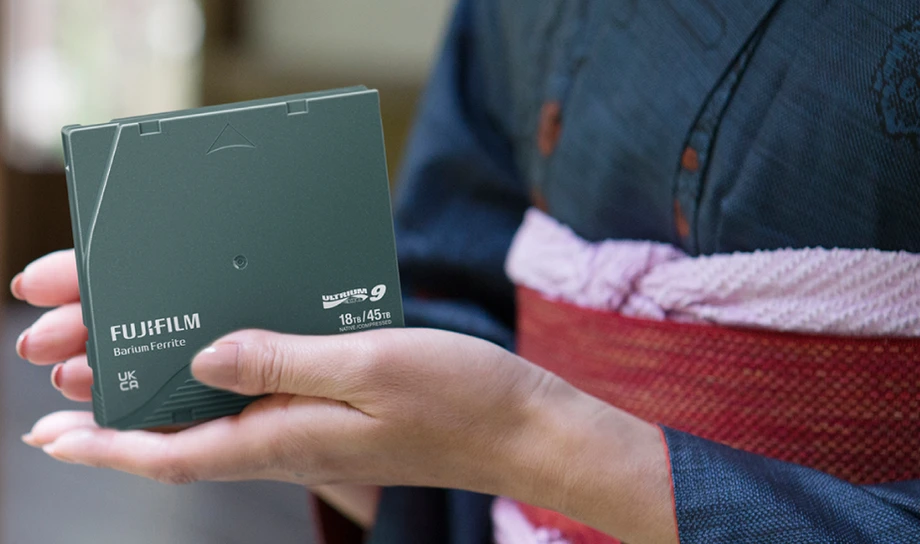
The added capacity is meant for FUJIFILM LTO Ultrium 10, which Fujifilm began selling in January 2026. A single cartridge holds 40 terabytes in its native form and up to 100 terabytes once data is compressed at a ratio of 2.5 to 1. One terabyte is 1,000 gigabytes, about the storage on a mid range laptop today. The company's own products show how far the format has travelled. LTO-5, sold in 2011 with the barium ferrite particles Fujifilm was first to commercialise, held 1.5 terabytes. The ninth generation held 18. The roadmap set by Hewlett Packard Enterprise, IBM and Quantum, the three companies behind the format, runs to 365 terabytes per cartridge, against roughly 256 terabytes at the top end of solid state drives.
Why AI Is Buying the Slowest Storage on Earth
Magnetic tape cannot do what a hard disk does. To read one file, a drive has to wind the tape to the right place, a mechanical process that takes seconds or minutes. Random access, the ability to jump straight to any file, is why disks and flash memory became the default for anything a person is waiting on.
What tape does better than anything else is wait. A cartridge that has been written and set on a shelf draws no power, keeps its data for decades and carries a very large amount of it in a small space. For the material that fills modern archives, including raw training text, model checkpoints, system logs, old invoices and scientific records, that is the whole job. Data centres, banks and research laboratories use cartridges precisely for this, and CERN keeps a large share of its scientific archive on tape.
The volumes behind that archive are growing quickly. IDC, the market research firm, estimates the world will generate 718 zettabytes of data in 2030, four times the 2024 figure. A zettabyte is a trillion gigabytes. Fujifilm says generative AI and cloud services are driving exponential growth in global data demand, and that major cloud providers and data centre operators are widening their use of tape. Training and running AI models, together with the digitisation of ordinary company business, keep producing information that must be kept for years but is read rarely.
From Falling Sales to 60 Percent Growth
A year ago the tape business was shrinking. In the July to September 2025 quarter, Fujifilm reported lower data tape sales to major IT companies, one factor that pulled its Advanced Functional Materials segment down 7.0 percent to 36.8 billion yen, according to the earnings presentation published on Nov. 6, 2025. The same segment, which houses the tape business, brought in 40.9 billion yen in the July to September 2026 quarter, up 11.4 percent, and Fujifilm credited data tape sales to large IT companies as one reason for the gain.
Within that segment, the tape line moved far faster. Fujifilm told investors the data storage tape business grew more than 60 percent year on year in the quarter, and management expects it to earn more than four times its fiscal 2025 revenue by fiscal 2028, taking it past 100 billion yen, about 574 million euros.
Shipment figures for the format mirror the swing. LTO tape shipped worldwide carried 176.5 exabytes of capacity in 2024, up 15.4 percent, then fell 9 percent to 160.3 exabytes in 2025, still the second highest volume recorded. In the first quarter of 2026, shipped capacity rose 57 percent from a year earlier.
One Cent a Gigabyte
Price is doing as much work as demand. An analysis prepared for Fujifilm with Brad Johns Consulting puts the cost of storing a gigabyte on tape at about one cent, against three to three and a half cents on a hard disk. Fujifilm's comparison of total cost of ownership for large archives found LTO-8 tape about 86 percent cheaper than storing everything on hard disks and about 66 percent cheaper than storing everything in the cloud.
Memory prices have moved hard in the other direction. A 30 terabyte enterprise solid state drive now costs about $22,600, some 18.6 times the price of hard disk storage, and its cost has risen 6.5 times in a year. Western Digital and Seagate have sold out their output through 2027. That shortage is one reason a medium written off as obsolete is back in data centre budgets.
The chain that makes cartridges also sits apart from the one AI has squeezed. Toray produces the film the tape is coated on, and Dowa Holdings supplies the magnetic coating. Fujifilm says cartridges are not scarce at the moment, while other forms of storage are tightening.
Two Companies and One Format
Almost nobody makes the media. Fujifilm and Sony Storage Media, based in Tagajo in Miyagi Prefecture, are the only large producers of LTO tape cartridges. Fujifilm says it holds the largest share of the global market on its own research, and that share rests on materials work it began in the 1950s, when magnetic tape went into television broadcasting equipment, and kept up through the years the market was shrinking.
Fujifilm entered the LTO business in 2000 with Ultrium 1, applying its coating and materials technology to raise capacity. In 2011 it became the first to commercialise barium ferrite magnetic particles for tape, a material that packs more data into the same surface. The Ultrium 10 uses a hybrid magnetic material built from barium ferrite and strontium ferrite particles designed at the nanoscale, so that performance holds as the particles shrink and capacity rises.
Rivals in other storage formats are spending too. Kioxia and SanDisk plan 5 trillion yen, about 28.4 billion euros, on solid state drive production over six years, after detailing 332-layer 3D NAND flash in August. Toshiba will put in roughly 341 million euros to double the capacity of its hard disk plant in the Philippines. Each of those bets points the same way: the data AI produces has to land somewhere.
The Ransomware Problem Tape Solves
A cartridge on a shelf is not on the network, and that has turned into a selling point. Attackers who encrypt a company's servers often hunt for the backups first. Tape that has been taken out of its drive and stored elsewhere cannot be reached remotely, a practice known as an air gap, and the LTO consortium lists resilience to cyber attacks among the reasons demand is rising.
Japanese police data shows the pressure behind that. In the first half of 2026, 123 ransomware attacks were reported in Japan, seven more than in the same period a year earlier and the highest count for any half year since the tally began in 2020. Annual totals ran from 146 in 2021 to 230 in 2022, then 197 in 2023, 222 in 2024 and 226 in 2025. Of the attacks logged in the first half of 2026, 79 hit small and medium sized companies, 31 hit large companies and 13 hit other organisations.
Backups offered limited cover. Police questioned 50 affected organisations, 44 of which held backups. Of the 40 that described how recovery went, only 11 restored their data from those copies. In 14 of the 29 failed cases, the attackers had encrypted or deleted the backups as well. Police advise companies to copy their data regularly and to keep at least one copy away from the network.
Fujifilm's Europe executive Toshinari Fujii argues that the medium is widely misread, and that the engineering behind it has kept moving while the market looked elsewhere.
Tape may remind people of cassette tapes and VHS videotapes, but it is a proven technology that continues to evolve.
A Bright Spot in a Weaker Bottom Line
Tape revenue of 40.9 billion yen sits inside a group that booked about 885 billion yen of sales in the same quarter, which puts the whole Advanced Functional Materials segment at roughly 4.6 percent of the total. Fujifilm does not report tape revenue or profit on their own, so the tape business is smaller than that share.
The rest of the group is carrying the profit. In the six months from April to September 2026, revenue rose 8.8 percent to 1.7115 trillion yen, while operating profit fell 10.9 percent to 141.2 billion yen and net profit attributable to shareholders dropped 12.5 percent to 105.2 billion yen. Sales grew and profit did not.
Health care explains part of it. Operating profit in the medical health business fell 17.3 percent to 16.0 billion yen in the quarter, hurt by the cost of bringing a new biopharmaceutical contract development and manufacturing facility in the United States into service, unplanned shutdowns after regulatory inspections and higher raw material prices.
Business Innovation was closer to the line. Revenue there slipped 1.7 percent to 293.5 billion yen and operating profit fell 14.9 billion yen to 0.9 billion yen, close to break even. Fujifilm points to government projects that were not renewed, IT equipment projects delayed by limits on semiconductor supply, and weaker exports of office equipment to the United States and Europe.
For scale, the group's own forecast in its November 2025 earnings presentation put fiscal 2025 revenue at 3,300.0 billion yen and operating profit at 331.0 billion yen. A business heading for 100 billion yen of revenue by fiscal 2028 is meaningful inside that, and still not enough to decide the group's results. Improving profit in health care, semiconductor materials, office equipment and imaging matters more for a company of that size than the tape revival does.
What Comes Next at Odawara
Fujifilm has not said when inside the three year plan the fivefold capacity will be reached, nor how much of the extra output is already committed to customers. The company has said the build out follows demand, with equipment and hiring added in steps through fiscal 2028. Investors took the news quietly: Fujifilm traded at 3,608 yen on the morning of Nov. 18, down 0.41 percent.
The history of the format runs alongside the plan and shows why the plant exists at all.
- 1954: Fujifilm begins work on magnetic tape, first used in television broadcasting equipment.
- 2000: Fujifilm enters the LTO data storage market with LTO Ultrium 1.
- 2011: Fujifilm is first to commercialise barium ferrite particles for tape; LTO-5 holds 1.5 terabytes.
- June 2025: A 30 terabyte cartridge reaches the market.
- January 2026: LTO Ultrium 10 ships at 40 terabytes native and up to 100 terabytes compressed.
- Oct. 29, 2026: Fujifilm announces the 10 billion yen Odawara expansion.
For the cloud operators and data centre businesses buying the cartridges, the calculation is narrow and practical. A copy that sits offline costs about one cent per gigabyte, needs no electricity while it waits and cannot be encrypted by someone who never touches the building. For Fujifilm, the same calculation has bought a plant expansion in a business that was losing sales to IT customers two years ago.
Key Points
- Fujifilm will invest about 10 billion yen, roughly $63 million, at its Odawara site in Kanagawa Prefecture to raise data tape capacity to about five times the fiscal 2025 level by the end of fiscal 2028.
- The expansion is the company's largest in tape in about 20 years and its biggest investment in LTO production facilities.
- Output focuses on LTO Ultrium 10 cartridges, which hold 40 terabytes native and up to 100 terabytes compressed.
- Tape revenue grew more than 60 percent in the July to September 2026 quarter, and management expects it to pass 100 billion yen by fiscal 2028.
- Worldwide LTO shipped capacity fell 9 percent to 160.3 exabytes in 2025, then rose 57 percent in the first quarter of 2026.
- Fujifilm and Sony Storage Media are the only large makers of LTO tape cartridges.
- Storing a gigabyte on tape costs about one cent, against three to three and a half cents on a hard disk.
- Japan recorded 123 ransomware attacks in the first half of 2026, and only 11 of 40 organisations that answered police questions restored data from backups.
- Group operating profit fell 10.9 percent to 141.2 billion yen in the first half of fiscal 2026, and the segment holding tape is about 4.6 percent of group revenue.