A Coral Island Where the Atlantic Has None
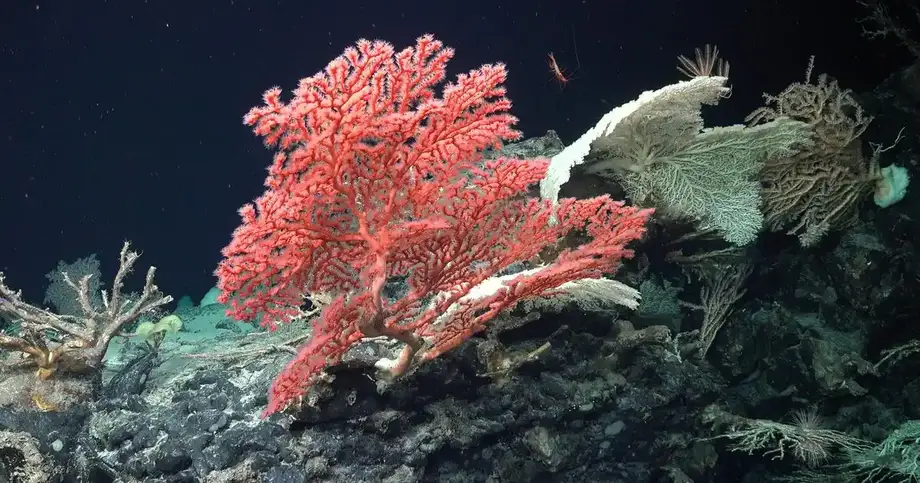
Nine hundred meters below the surface of the equatorial Atlantic, on a volcanic ridge that rises 4,100 meters from the seafloor, scientists have found the fossilized remains of a coral atoll about 5 million years old. The structure stands 300 meters tall, close to the height of the Eiffel Tower, and is built from ancient coral. A busy garden of deep-sea corals now covers its summit.
Contents
- A Coral Island Where the Atlantic Has None
- What the Cameras Found, From 600 to 4,300 Meters Down
- The Rarest Sight: A Pink Carpet the Size of a Soccer Field
- How Do You Find a Reef No One Can See?
- A Fault Line That Feeds the Deep
- How a Coral Island Ends Up 900 Meters Underwater
- A Dead Reef With New Tenants
- Decades of Work in the Sample Trays
- A Test Case for the High Seas Treaty
- Key Points
The find confirms a hypothesis floated about 30 years ago: coral atolls once rose in the middle of the Atlantic, an ocean where none exist today. The Pacific is dotted with atolls and the Indian Ocean has the Maldives, while the mid-Atlantic had none on record until this voyage.
A Brazilian-led international team made the discovery during a 35-day expedition aboard the Schmidt Ocean Institute's research vessel Falkor (too), which ran from 20 September to 29 October, according to the institute's expedition page. The institute announced the results on 23 November from Fortaleza, Brazil.
- 20 September: the expedition begins aboard Falkor (too).
- 29 October: the 35-day voyage ends.
- 23 November: the institute announces the findings from Fortaleza.
Dr Jose Angel Perez, the expedition's chief scientist and an oceanographer at the Universidade do Vale do Itajaí in Brazil, said the team had turned a suspicion three decades old into evidence.
We produced the first scientific evidence confirming the ecological and biological uniqueness of this region. Our data strengthens the importance of the Romanche Fracture Zone as an area to be considered for protection under the recently ratified High Seas Treaty.
What the Cameras Found, From 600 to 4,300 Meters Down
Across four separate areas of the fracture zone, at depths from 600 to 4,000 meters, the team recorded dozens of vulnerable marine ecosystems. The label covers communities of corals and sponges that grow slowly, and that can need generations to recover if a bottom trawl drags through them. No earlier expedition to the Romanche Fracture Zone had used a remotely operated vehicle to film the seafloor and record the animals living there.
Cameras filmed ancient sponge gardens, cold-water corals up to 1,000 years old, meadows of zoanthids (small animals related to anemones and corals), and squid and octopuses. The institute lists the four survey areas as spanning roughly 600 to 4,000 meters, while the deepest of the sponge and coral gardens sits at 4,300 meters, below that range.
The Rarest Sight: A Pink Carpet the Size of a Soccer Field
At 1,200 meters, the team came across something common in shallow water and rare in the deep sea: thousands of tiny, light pink zoanthids covering a patch of seafloor as large as a soccer field. Zoanthids are close relatives of anemones and corals, and finding them in such numbers at that depth was not expected.
Deeper still, at 4,300 meters, lay a garden of sponges and corals far below the depth where scientists expect to see large groups of these animals. Water that deep carries less food and fewer of the minerals sponges and corals need to build their skeletons and tissue.
Between those two extremes, the cameras picked out a cold-water coral and sponge community at 1,683 meters and a mushroom-shaped soft coral called Anthomastus at about 2,827 meters. Dr Paulo Sumida, a professor at the University of São Paulo, described a survey in which every stop produced something to explain.
Everywhere we looked, we saw stories emerging. While there are big stories like sponges living at depths that far exceed our expectations, there were also small ones that are just as important, like little animals hiding in the mud or dangling from coral branches. Every animal living in these ecosystems plays a vital role that we want to understand.
How Do You Find a Reef No One Can See?
The search began with mapping. Sonar systems on Falkor (too), working with an autonomous underwater vehicle named The Childlike Empress, surveyed the seafloor and picked out the shape of the atoll. An AUV is an untethered robot that follows a route set in advance and runs the survey on its own. With the atoll on the map, the team sent down the remotely operated vehicle SuBastian, a tethered machine steered live by pilots in a control room on the ship, to film the summit with cameras that record in high definition.
SuBastian weighs about 7,050 pounds out of the water, measures roughly 9 feet long and is rated to about 14,800 feet, or 4,511 meters. The deepest garden the team filmed, at 4,300 meters, sits close to that limit. The ship and its robots take their names from Michael Ende's novel The NeverEnding Story, which gives the fleet Falkor the luckdragon, Bastian the boy hero and the Childlike Empress. Schmidt Ocean Institute, founded in 2009 by Eric and Wendy Schmidt, runs the vessel.
A Fault Line That Feeds the Deep
The Romanche Fracture Zone is the longest geological fault in the Atlantic Ocean, running about 950 kilometers (590 miles) along the equator between Brazil and West Africa. It is a transform fault, a place where two slabs of seafloor slide sideways past each other, and it breaks the Mid-Atlantic Ridge into segments. The seafloor there is rough, cut by deep valleys and steep slopes that climb thousands of meters.
Water moves through the gap. North Atlantic Deep Water and Antarctic Bottom Water meet and mix inside the fracture zone, two cold currents that creep along the bottom from opposite ends of the ocean. At the surface, conditions set off regular blooms of phytoplankton, and the plankton that dies and sinks supplies food to the animals far below.
Researchers have suspected for decades that this combination made the fracture zone a place rich in deep-sea life. The expedition finally put cameras on it.
How a Coral Island Ends Up 900 Meters Underwater
Corals that build reefs need sunlight, which is why atolls form near the surface and why a fossil reef 900 meters down points to a very different past. The team's strongest clue is a fragment of shallow-water coral recovered from the site, an animal that could not have survived at that depth.
The textbook explanation, worked out by Charles Darwin after the voyage of the Beagle, starts with a volcano breaking the surface. A reef grows around its shoreline, the eruptions stop, and the cooling rock slowly settles, a process geologists call subsidence. Coral that keeps building upward stays near the light while the volcano disappears beneath it, leaving a ring of reef around a lagoon. If the seabed sinks faster than the coral can grow, the reef drowns and rides the rock downward.
The announcement does not say when or how this atoll went under, or how the 5 million year figure was calculated. Those details are not yet public.
A Dead Reef With New Tenants
The atoll's summit now holds a community of deep-water corals and sponges, animals that manage without sunlight. A reef that once depended on the sun died and sank, and a different set of corals moved in on the fossil platform above it.
Some of those corals are about 1,000 years old. That figure makes sense when set against how these animals grow: sponges and corals add only millimeters a year, so a colony the size of a dinner plate can carry a millennium of history. A coral that began growing around the year 1000 was already there when Norse sailors reached Newfoundland.
Where exactly the oldest colonies sit, the announcement does not say. The ages were recorded across the four survey areas during the expedition's dives.
Decades of Work in the Sample Trays
The expedition brought up animals from the seafloor, and the scientists expect some of them to be species new to science. Confirming that will take laboratory work on the specimens, and no date has been given for the results.
Gabriela Maurício de Alencar Filgueiras, an undergraduate at the University of São Paulo's Oceanographic Institute, handled one of those specimens in the main laboratory aboard Falkor (too) during the voyage. Perez said the volume of data gathered in 35 days could keep researchers busy for decades.
Dr Jyotika Virmani, executive director of Schmidt Ocean Institute, said the find showed how much of the ocean remains unexplored.
Finding thriving deep-sea ecosystems atop a prehistoric coral atoll is an extraordinary reminder that our ocean still holds monumental secrets. We are proud to have equipped this Brazilian-led team of scientists with the advanced marine technology they needed to uncover a hidden chapter of Earth's history and gather the data required to protect these amazing habitats.
A Test Case for the High Seas Treaty
The Romanche Fracture Zone lies in international waters, beyond the jurisdiction of any single country, and has been identified as an area targeted for marine protection. The High Seas Treaty, the United Nations agreement covering life in waters outside national boundaries, entered into force in January.
Perez argues that the footage from four survey areas gives scientists and governments a concrete case for listing the fracture zone. The communities found there, from sponge gardens to the zoanthid field, grow slowly and would need decades to recover from physical damage.
What the expedition changes for the people involved is more immediate. The work was led from Brazil, with researchers from the Universidade do Vale do Itajaí and the University of São Paulo, and it gave Brazilian students sea time on a vessel equipped with robots that can work nearly 4,500 meters down. The samples and the video now sit in Brazilian laboratories, and the analysis will occupy a generation of students.
Key Points
- A Brazilian-led team found a coral atoll about 5 million years old in the Romanche Fracture Zone, with its summit 900 meters below the sea surface.
- The atoll is 300 meters tall and sits on a volcanic ridge that rises 4,100 meters from the seafloor.
- Across four areas, at depths from 600 to 4,300 meters, the team filmed sponge gardens, corals up to 1,000 years old, zoanthid meadows, squid and octopuses.
- The deepest sponge and coral garden, at 4,300 meters, lies below the depth range where scientists expected such large groups.
- The 35-day expedition ran from 20 September to 29 October aboard R/V Falkor (too), and results were announced on 23 November from Fortaleza.
- Scientists suspect new species are among the samples, and confirmation will come from laboratory work with no date set.
- The team argues the findings support protection of the fracture zone under the High Seas Treaty, which entered into force in January.